
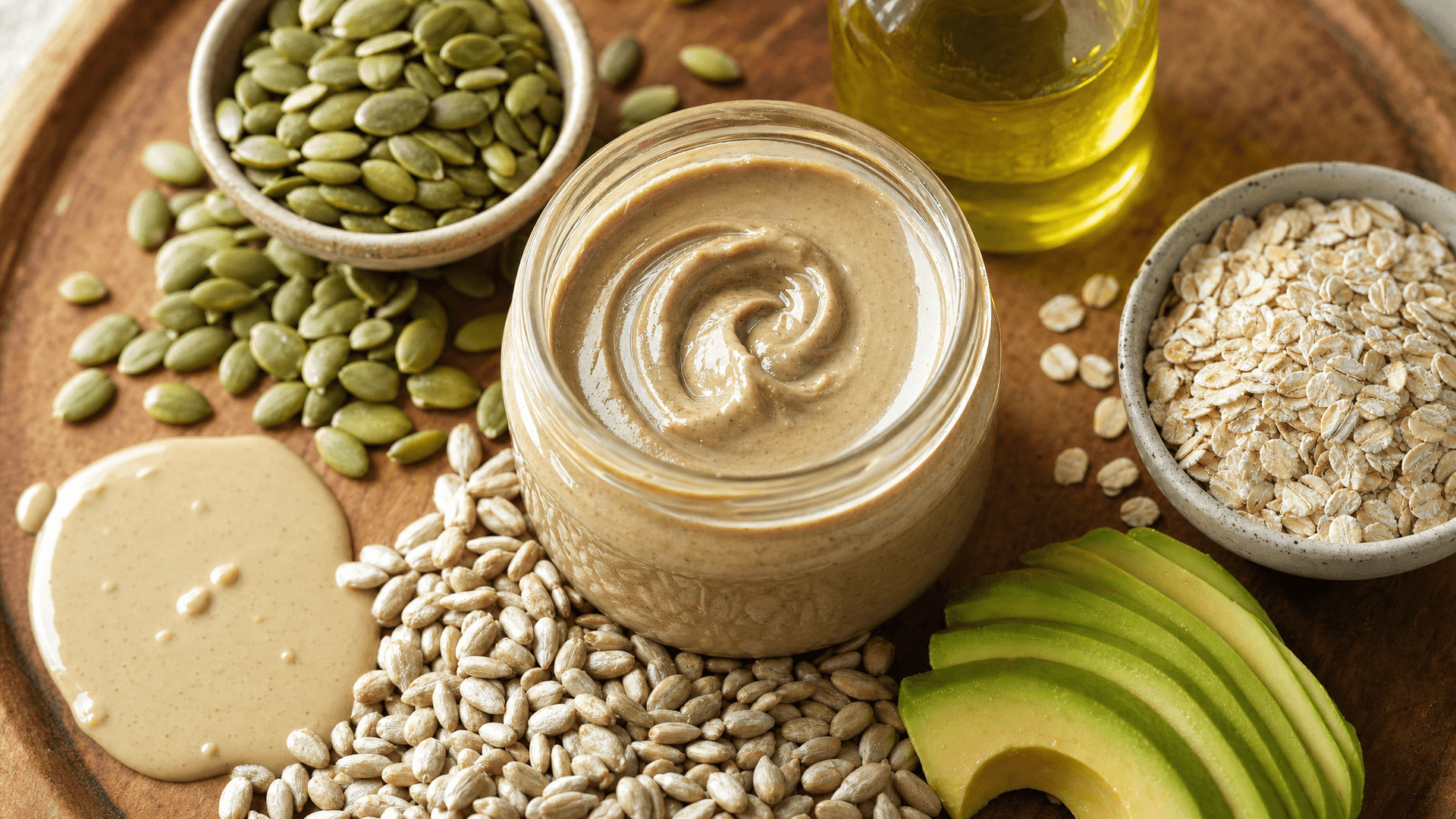
Open any bulking guide and count how long it takes before peanut butter shows up. Usually paragraph three. Sometimes the headline.
"Just add two tablespoons of PB to everything." "Snack on trail mix." "Blend almond butter into your shake." Cool. Now imagine that advice sends you to the ER.
If you've got a peanut or tree nut allergy, the entire mainstream bulking playbook is either useless to you or actively dangerous. And nobody writes the alternative version, because the internet assumes everyone can eat a handful of almonds.
So here it is. Every calorie-dense nut food has a nut-free replacement that hits the same numbers — often better. You're not stuck eating chicken and rice forever. You just need a different shopping list.
- Sunflower seed butter and pumpkin seed butter match peanut butter almost calorie for calorie
- Tahini is the most underrated bulking food on the shelf — dense, cheap, and nut-free
- Olive oil is your single highest-leverage tool at 120 calories per tablespoon
- Avocado, coconut, oats and full-fat dairy cover the rest of the gap
- "May contain nuts" on protein bars and granola is the trap that catches most people
- A nut-free 900-calorie shake is completely doable and takes 90 seconds
Why Bulking Is Genuinely Harder With a Nut Allergy
This isn't in your head. Nuts are the single most calorie-dense whole food category that's shelf-stable, requires zero prep, and doesn't fill you up much.
Peanut butter is roughly 190 calories per two tablespoons. Almonds run about 160 calories per 1 oz — a small handful. When you're trying to eat 3,000+ calories a day and your stomach taps out at 2,200, those density hacks matter enormously.
Take them away and three things happen:
You lose your emergency calories. No jar of PB to raid at 10pm when you're 500 short. No trail mix in the backpack.
You lose the easiest shake upgrade. Almost every mass-gainer shake recipe leans on nut butter for 200 calories of nothing.
You get worse restaurant and travel options. Cross-contamination risk means you cook more, and cooking more means more time and more chances to skip a meal.
None of that is fatal to your progress. But it means you have to be more deliberate than the guy who just shovels almonds. Deliberate is fine. Deliberate is actually how most people should be bulking anyway.
Nothing here replaces your allergist. Seed allergies exist, sesame is a top-9 allergen in the US, and coconut is technically classified as a tree nut by the FDA even though most people with tree nut allergies tolerate it fine. Get cleared on anything new before you make it a daily staple.
The Swap Table: What Replaces What
Here's the core of it. Every nut staple, and what you use instead.
| Nut food you can't have | Nut-free swap | Calories |
|---|---|---|
| Peanut butter (2 tbsp) | Sunflower seed butter (2 tbsp) | 200 |
| Almond butter (2 tbsp) | Tahini (2 tbsp) | 180 |
| Almonds (1 oz) | Pumpkin seeds (1 oz) | 160 |
| Walnuts (1 oz) | Hemp hearts (1 oz) | 165 |
| Trail mix (1/2 cup) | Roasted chickpeas + seeds + dried fruit | 320 |
| Nutella (2 tbsp) | Cocoa + sunflower butter + honey | 210 |
| Almond flour | Oat flour or coconut flour | varies |
| Almond milk | Oat milk (higher calorie anyway) | 120/cup |
| Peanut sauce | Tahini-soy-lime sauce | 190 |
Look at that column. You're not losing calories. In a couple of cases you're gaining them. This is a substitution problem, not a limitation problem.
Let's go through the important ones.
Seed Butters: The Direct Replacement
Sunflower seed butter — often sold as SunButter — is the closest thing to a one-for-one peanut butter clone that exists. Same texture, same spreadability, roughly 100 calories per tablespoon versus peanut butter's 95.
It tastes a little more roasted and a little less sweet than PB. Most people adjust in about three days.
Pumpkin seed butter (pepita butter) is the other option. Slightly darker flavor, higher in magnesium and zinc, usually more expensive. Around 180 calories per two tablespoons.
How to actually use them
- On toast: 1 oz of seed butter on two slices of sourdough plus honey = about 450 calories, eaten in two minutes
- In oatmeal: stir a heaping tablespoon in at the end, not the beginning, so it doesn't disappear
- In shakes: two tablespoons adds ~200 calories and makes the texture thick enough to feel like a meal
- Straight off the spoon: the classic 100-calorie top-up when you're short before bed
Buy the stir-in kind with just seeds and salt, then stir the oil back in instead of pouring it off. That oil is roughly 30-40 calories per tablespoon you'd otherwise throw in the sink.
The cost problem
Seed butters cost more than peanut butter. Usually a lot more — expect 1.5x to 2.5x the price per lb. Two ways around it:
- Buy the biggest jar available. The per-lb price drops hard above 2 lb containers.
- Don't make seed butter your only fat source. Rotate with olive oil and tahini, which are both cheaper per calorie.
Tahini Is the Sleeper Pick
Tahini is ground sesame seeds. That's it. It sits in the international aisle at maybe half the price of seed butter, and almost nobody in the fitness world talks about it.
Roughly 90 calories per tablespoon. Nearly all fat, mostly unsaturated. Runnier than peanut butter, which is a feature — it pours, drizzles and blends without seizing up.
Ways to get it in:
- Savory drizzle: thin it with lemon juice, water and salt, then pour over rice bowls, roasted vegetables, chicken. Adds 150-200 calories to a meal you were eating anyway.
- Fake peanut sauce: tahini, soy sauce, lime, honey, a little chili. Genuinely close to satay sauce. Goes on noodles, chicken, anything.
- Sweet: tahini plus honey plus cocoa powder on toast. Sounds weird, tastes like halva.
- Shakes: blends smoother than any seed butter because of the texture.
A 16 oz jar of tahini contains around 2,800 calories. That's a meaningful chunk of your weekly surplus sitting in one jar for a few bucks.
Since 2023, sesame must be declared on US food labels, which means tahini products are now clearly marked. If you're allergic to sesame specifically, skip this whole section and lean harder on sunflower seed butter and olive oil.
Olive Oil: The Highest-Leverage Tool You Own
If you take one thing from this article, take this: olive oil is 120 calories per tablespoon and it disappears into food.
No chewing. No fullness. No allergen risk. It's the closest thing to free calories that exists, and it completely replaces the density that nuts were giving you.
Three tablespoons a day across your meals is 360 calories you didn't have to eat. Over a week that's 2,500 calories — roughly enough to matter on the scale.
Where it goes:
- Finish rice and pasta with a tablespoon after cooking
- Cook eggs in a genuine pour, not a spray
- Drizzle over soup, roasted vegetables, salads
- Mix into hummus or mashed potatoes
- Blend a tablespoon into a savory-leaning shake (yes, really — you won't taste it in a chocolate shake)
We wrote a whole breakdown of this in our guide to olive oil for bulking, and it's even more relevant when nuts are off the table. If you want the wider picture on fat sources, the best fats for bulking covers how to build your fat intake without relying on any single food.
Keep a bottle on the table like it's salt. The habit of finishing every plate with a pour is worth more than any supplement you'll buy this year.
Avocado, Coconut and the Rest of the Whole-Food Layer
Avocado. One medium avocado is about 240 calories, roughly 7 oz of it. Goes on toast, in shakes (makes them absurdly creamy), on eggs, in rice bowls. The downside is cost and the two-hour window where it's actually ripe.
Coconut. Coconut milk (full fat, canned) is about 440 calories per cup. Dried unsweetened coconut flakes are roughly 185 calories per 1 oz. Coconut oil is 120 per tablespoon. Curries and rice cooked in coconut milk instead of water are one of the easiest 300-calorie upgrades in cooking.
Note the FDA classifies coconut as a tree nut for labeling purposes. Most people with tree nut allergies tolerate coconut without issue, but this is exactly the kind of thing you confirm with your allergist rather than the internet.
Oats. Cheap, dense, endlessly modifiable. 3.5 oz of dry oats is around 380 calories and cooks into a base you can load with seed butter, dried fruit, honey and full-fat milk.
Full-fat dairy. If you tolerate it, whole milk at 150 calories per cup, full-fat Greek yogurt, and hard cheese are the fastest calories in the fridge. Four cups of whole milk a day is 600 calories with zero cooking.
If dairy is also off the table for you — some people get the unlucky double — our dairy-free bulking guide covers that side of the problem in detail. The overlap between the two articles is basically olive oil, oats and seed butters, which tells you something about how valuable those three are.
Dried fruit. Dates are around 65 calories each. Dried mango, raisins, dried apricots — all dense, all portable, all nut-free provided you check the packaging.
Seeds themselves. Pumpkin seeds, sunflower seeds, hemp hearts. 1 oz is 160-170 calories, and hemp hearts bring about 10g of protein per 1 oz serving, which most nuts don't.
Reading Labels: The "May Contain" Trap
This is where people get hurt, and it's specifically a bulking problem, because the foods bulkers reach for are the exact foods most likely to be made on shared nut lines.
The high-risk categories:
Protein bars. Enormous overlap with nut manufacturing. Even bars with no nuts in the ingredient list are frequently made on shared equipment. Assume every bar is contaminated until the label says otherwise.
Granola and cereal. Same story. Granola in particular is almost always produced alongside nut varieties.
Mass gainer powders. Big tubs of blended stuff produced in facilities that handle everything. Check the allergen statement on every new tub, and re-check when the brand reformulates.
Chocolate. Notoriously bad for cross-contact. Dark chocolate especially.
Bakery items. Anything from an open bakery case is a coin flip.
Ice cream. Shared scoops in shops, shared lines in factories.
How to read the label properly
- Ingredient list first. Nuts must be declared by name in the US, EU, UK, Canada and Australia. This part is legally reliable.
- Allergen statement second. The "Contains:" line summarizes the declared allergens.
- Advisory statement third. "May contain," "produced in a facility that also processes," "made on shared equipment." Here's the thing most people don't know: this labeling is voluntary in most countries. No advisory statement doesn't mean no risk. It means the company chose not to print one.
- When it matters, call the manufacturer. For a food you'll eat daily for months, a five-minute email to customer service is worth it. Ask specifically about shared lines and cleaning protocols between runs.
Reformulations happen silently. A product you've eaten safely for two years can change its manufacturing site without any front-of-package announcement. Re-read the label when the packaging design changes — that's usually your signal something else changed too.
Build yourself a list of 15-20 confirmed-safe products and just rotate them. The mental overhead of checking every single item at every shop is what makes people give up and undereat. Lock in your staples and stop re-litigating them.
The 900-Calorie Nut-Free Shake
Every bulking shake recipe online uses peanut butter. Here's the version that doesn't, and it hits harder than most of them.
| Ingredient | Amount | Calories | Protein |
|---|---|---|---|
| Whole milk (or oat milk) | 2 cups | 300 | 16g |
| Rolled oats | 1/2 cup | 150 | 5g |
| Sunflower seed butter | 2 tbsp | 200 | 7g |
| Banana | 1 large | 120 | 1g |
| Whey or plant protein | 1 scoop | 120 | 25g |
| Olive oil or coconut oil | 1 tbsp | 120 | 0g |
| Total | 1,010 | 54g |
Blend for 45 seconds. If it's too thick, add water — never add more milk to thin it, you'll just make it heavier without adding volume.
Variations:
- Chocolate: swap banana for two dates, add a tablespoon of cocoa powder
- Tahini version: 2 tbsp tahini instead of seed butter, add honey
- Avocado version: half an avocado instead of the oil, absurdly creamy
- No-blender version: shake milk, protein and seed butter in a bottle — you lose the oats but keep about 620 calories
Freeze the banana. It makes the shake thick and cold without ice, and ice is just calorie-free volume that fills you up before you finish drinking.
One of these a day is roughly 1,000 calories that took 90 seconds. That's your entire surplus handled before you've eaten a single meal.
A Full Nut-Free 3,000-Calorie Day
This is what it looks like in practice. Adjust portions up or down based on your own numbers — a 155 lb guy at 5'10" who lifts four days a week is usually somewhere around 2,900-3,100 calories for a lean bulk.
Breakfast — about 750 calories
- 2.8 oz rolled oats cooked in whole milk
- 1 tbsp sunflower seed butter stirred in
- 1 tbsp honey
- 1 banana
- Coffee with whole milk
Mid-morning — about 350 calories
- 2 slices sourdough with tahini and honey
- Glass of whole milk
Lunch — about 800 calories
- 6 oz chicken thigh
- 7 oz cooked rice
- Roasted vegetables
- 2 tbsp olive oil poured over the whole plate after cooking
- Half an avocado
Pre-workout — about 250 calories
- 3 dates
- 1 oz pumpkin seeds
Dinner — about 700 calories
- 7 oz salmon or beef
- Potatoes roasted in olive oil
- Green vegetables
- Tahini-lemon sauce over everything
Before bed — about 300 calories
- Full-fat Greek yogurt with dried fruit and hemp hearts
Total: roughly 3,150 calories, about 170g protein. No nuts anywhere. No hunting for specialty products. Nothing on that list is hard to find.
If you need more, the levers in order of ease: another tablespoon of olive oil (120), an extra cup of whole milk (150), swap the yogurt for the full shake (add 700).
If you need less, cut the mid-morning snack first.
Aim for 0.7-1.0g per lb of bodyweight. Nuts were never a great protein source anyway — peanut butter is about 7g per two tablespoons — so losing them costs you almost nothing on the protein side. It's purely a calorie-density problem.
Eating Out and Travelling Without Losing the Bulk
Restaurants are where nut-allergy bulking gets genuinely annoying, because the safe options tend to be the lean, low-calorie ones.
Cuisines that are usually easier: Italian, Greek, Mexican, most steakhouse and pub food. Olive oil, cheese, bread and meat — all dense, all typically nut-free kitchens.
Cuisines that need more care: Thai, Vietnamese, Chinese, Indian, and most bakeries and dessert menus. Not off-limits, just require a real conversation with staff rather than a quick scan of the menu.
The travel kit. Pack it, because airport and service-station food is a minefield:
- A jar or squeeze packs of sunflower seed butter
- Rice cakes or crackers you've verified
- Dried fruit in sealed original packaging
- Protein powder in a shaker, pre-portioned
- Two or three of your confirmed-safe bars
That kit is easily 1,200-1,500 calories of insurance. The days you lose on a bulk are almost never training days — they're travel days where you ate 1,400 calories because nothing was safe.
Verbal assurance from a server isn't a substitute for talking to the kitchen. If they can't confirm, order something obviously safe and top up the calories at home with olive oil and a shake. One boring meal beats one bad reaction.
Common Mistakes
1. Undereating quietly. You lose 400 calories of nut snacks and never consciously replace them. Six weeks later the scale hasn't moved. Track for at least the first month so you can see the gap.
2. Treating seed butter as a luxury. It's expensive, so people ration it. Then it's not doing anything. Budget for it properly as a food line item, or lean harder on tahini and olive oil, which cost less per calorie.
3. Assuming "nut-free" on the front of the package. Front-of-pack claims are marketing. The allergen statement on the back is the legal part.
4. Going all-in on one new food. If you switch to sunflower seed butter and eat 5 oz a day, you'll get sick of it inside two weeks and stop. Rotate four or five dense foods instead.
5. Ignoring liquid calories. Nut allergy or not, drinking calories is the single easiest fix for a small stomach. Milk, oat milk, juice, shakes.
6. Not weighing yourself consistently. Daily weigh-ins, same time, weekly average. If the average isn't moving up 0.5-1 lb per week, add 200 calories and reassess in two weeks.
How to Know It's Working
Weigh daily, average weekly. That's the whole system.
Gaining 0.5-1 lb per week is a solid lean-bulk pace for most people. Faster than that and you're adding more fat than you need to.
Strength should climb in parallel. If the scale's moving and your lifts aren't, you're gaining the wrong kind of weight — check your protein and your sleep before you touch the calories.
Take photos every two weeks in the same light. The mirror lies day to day; a photo from six weeks ago doesn't.
And check in on the allergy side too. If you're getting mouth tingling or stomach symptoms from a new staple, stop eating it and talk to your allergist — new sensitivities can develop, and seeds are not immune to that.
Where FuelTheGains Fits
The hardest part of nut-free bulking isn't the food. It's the mental load — recalculating every meal plan you find online, mentally subtracting the peanut butter, then figuring out where those calories went.
That's what we built for. You tell it what you can't eat and it builds the plan around that, with the calories already redistributed into foods that are actually safe for you. No manual substitution math, no generic template that assumes you can eat almonds.
It handles the boring part — hitting your numbers with foods you'll actually eat — so you can spend your attention on training instead of on a spreadsheet.
The Bottom Line
A nut allergy makes bulking more annoying. It doesn't make it harder in any way that matters once you've got the right shopping list.
Sunflower seed butter, tahini, olive oil, avocado, coconut, oats, full-fat dairy, seeds, dried fruit. Nine foods. Every one of them dense, cheap enough, and completely nut-free.
Lock in your safe products, keep the olive oil on the table, drink one big shake a day, and weigh yourself every morning. That's it. The guy eating almonds isn't getting a better result than you — he's just got one more jar in his cupboard.