
You've been doing it the hard way.
If you're a skinny guy trying to bulk, you probably spend your whole day fighting food. Choking down a fifth chicken breast. Staring at another mountain of rice you don't want. Setting alarms just to eat. And by 8pm you're still short on calories, stuffed, and wondering why the scale won't budge.
Here's the thing nobody told you: the single most calorie-dense, appetite-friendly weapon for gaining weight is already sitting in your kitchen. It costs a few bucks. It has zero fullness. And you're probably using a fraction of what you should.
It's olive oil.
At 120 calories per tablespoon, olive oil is the closest thing to free calories a hardgainer has. It doesn't fill you up. It doesn't require chewing. And you can hide it in almost anything you already eat. Learning to use it on purpose is the same trick that turns peanut butter and whole milk into bulking legends — you're just applying it to a fat almost nobody uses intentionally.
Let's fix that.
- Olive oil packs 120 calories per tablespoon with almost zero effect on fullness
- Adding 3-4 tablespoons a day banks an easy 360-480 extra calories
- Drizzle it after cooking so the flavor stays mild and the calories stay intact
- Hide it in rice, pasta, eggs, soups, and shakes where you won't taste much
- Extra virgin is worth it for taste, but any olive oil delivers the same calories
- Track it like any other macro — liquid calories are the ones skinny guys forget
Why olive oil is a hardgainer's cheat code
The problem with bulking isn't that you can't find calories. It's that solid food fills you up long before you hit your target. A 140-190 lbs guy who trains hard might need 3,000 to 3,500 calories a day to grow. Try eating that in chicken, rice, and broccoli and you'll feel like you're force-feeding yourself around the clock.
That's why the smartest bulking foods aren't the "clean" ones. They're the calorie-dense ones — foods that pack a huge number of calories into a small, easy-to-eat volume. Fat is king here because it has 9 calories per gram, more than double the 4 calories per gram in carbs and protein.
Olive oil is basically pure fat. That means it's one of the most efficient calorie sources you can buy. A single tablespoon delivers 120 calories in a splash you barely notice. Compare that to eating an extra 7 oz of chicken breast for roughly the same calories — one is a whole meal's worth of chewing, the other disappears into your rice in two seconds.
If you've read our guide on the best fats for bulking, you already know fat is the skinny guy's secret weapon. Olive oil is the most flexible member of that family. It goes on savory food, sweet food, hot food, cold food. It doesn't clump like peanut butter or spoil fast like avocado. And unlike butter, it stays liquid, so it coats and hides instead of sitting in a lump.
Carbs are great for training energy, but they're bulky and filling. Fat gives you the same job — surplus calories — in a fraction of the volume. When you're already stuffed and still short, fat is how you close the gap.
The appetite angle matters more than people think. Research on satiety shows that liquid fats have a weak effect on fullness compared to solid, high-fiber foods. For a normal person trying to lose weight, that's a warning. For you, trying to gain, it's a superpower. You can add hundreds of calories that your stomach barely registers, leaving room for the actual food you still need to eat.
The math: how many calories are we talking?
Let's make this concrete, because the numbers are what sell it.
| Amount | Calories | Fat |
|---|---|---|
| 1 tablespoon | 120 | 14g |
| 2 tablespoons | 240 | 28g |
| 3 tablespoons | 360 | 42g |
| 4 tablespoons | 480 | 56g |
Three to four tablespoons spread across your day is 360 to 480 extra calories — enough to turn a maintenance day into a genuine surplus. That's the difference between spinning your wheels and gaining 0.5-1 lb a week.
Think about how little effort that is. One tablespoon on your morning eggs. One stirred into lunch. Two drizzled over dinner. You never sat down to a "big meal." You never felt stuffed. You just quietly banked half a pound of weekly weight gain from a bottle that costs less than a protein bar.
For context, that's the same principle behind our post on how to add 500 calories to any meal — small, dense additions beat trying to eat a second dinner. Olive oil is the fastest of those additions because it needs zero prep.
Measure with an actual tablespoon for the first week. "A drizzle" from the bottle can be anywhere from 1 to 3 tablespoons, and if you're eyeballing it you'll almost always pour less than you think. Once you know what 2 tablespoons looks like, you can freehand it.
How much should you actually add?
Start where you are, then build. If you've never intentionally added fat to your meals, dumping four tablespoons of oil on everything overnight is a recipe for a queasy stomach and a bottle you never want to see again.
Here's a simple ramp:
- Week 1: 1 tablespoon per day. Just get in the habit. That's 120 easy calories.
- Week 2: 2 tablespoons per day, split across two meals. Now you're at 240.
- Week 3 and beyond: 3-4 tablespoons per day, spread across three or four meals.
Splitting it matters. Your body handles fat better in smaller doses, and spreading it out means no single meal tastes greasy. A tablespoon here and a tablespoon there is invisible. Four tablespoons on one plate of pasta is a slick, heavy mess.
A good target for a hardgainer is roughly 1g of fat per kg of bodyweight from all sources, or 0.45g per lb if you want the exact ratio. For a 150 lb guy that's around 68g of fat a day total — and olive oil can comfortably supply a third of that without you noticing. Someone bigger, say 180 lb at 6'0", can push the oil higher because their overall calorie needs are higher too.
Don't get so aggressive that you crowd out protein, though. Fat is for topping up your surplus, not replacing your 0.7-1.0g per lb of daily protein. Think of olive oil as the calorie multiplier on top of a solid base of chicken, eggs, dairy, and rice — not a substitute for any of it.
If you have a sensitive stomach, don't drink olive oil straight or slam it all in one sitting. Big single doses of fat can send you running to the bathroom. Spread it over meals and mix it into food, and your gut will handle it fine.
Where to hide 4 tablespoons a day
This is the whole game. The reason people don't use olive oil for bulking is they think it only belongs on salads. Wrong. Here's where to sneak it in so you get the calories without the "I'm drinking oil" feeling.
On starchy carbs
This is the easiest win. Rice, pasta, potatoes, couscous — they all soak up olive oil and taste better for it.
- Stir 1-2 tablespoons into a bowl of cooked rice. It coats every grain and the flavor is mild.
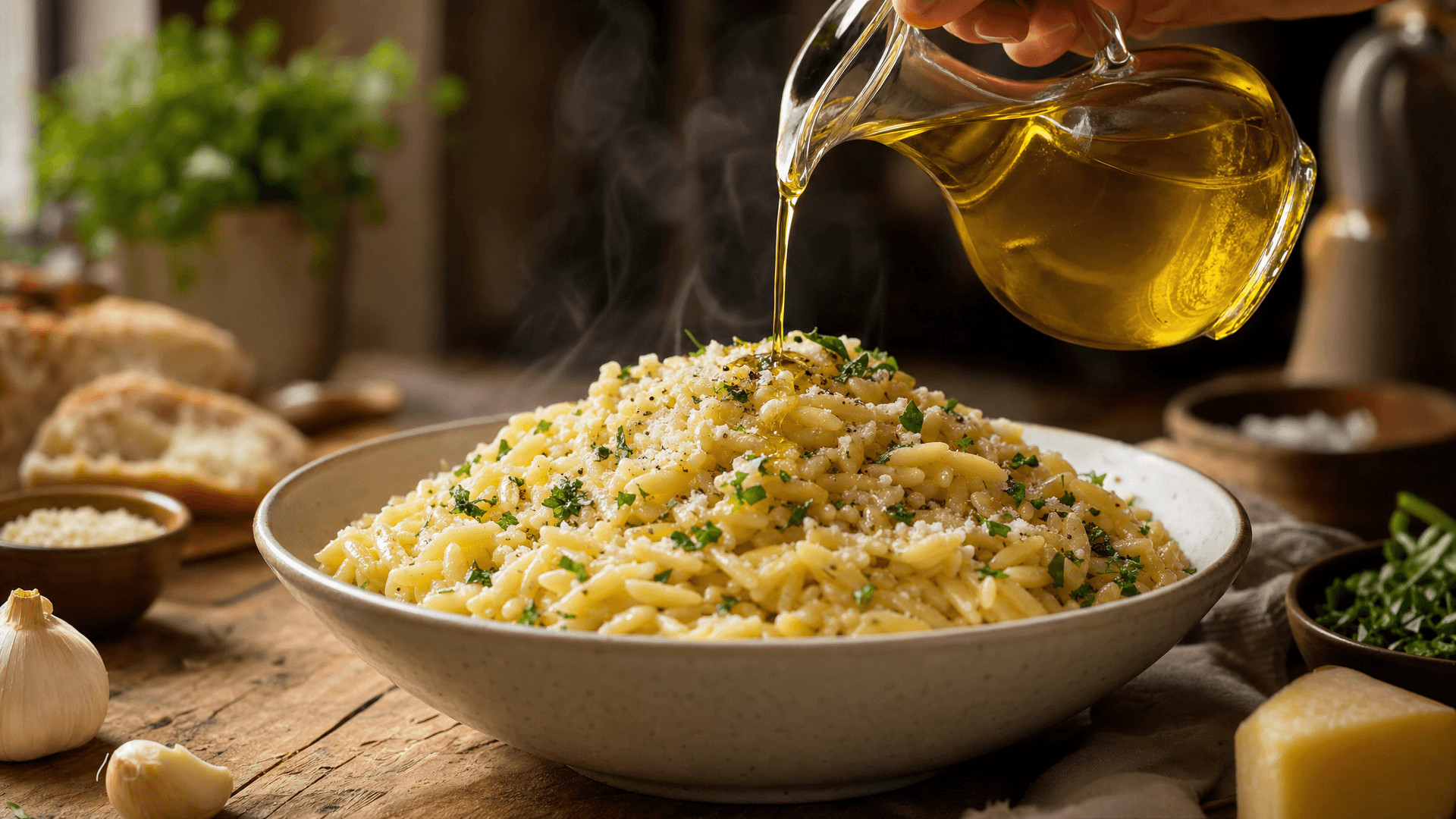
- Toss cooked pasta with olive oil, garlic, and a little parmesan. Instant 240-calorie upgrade to a 5 oz portion of pasta.
- Drizzle it over roasted potatoes after they come out of the oven.
A plate of 9 oz cooked rice is already a lot to chew. Adding two tablespoons of oil bumps it by 240 calories without adding a single bite.
Into eggs and breakfast
Cook your scrambled eggs in a generous glug of olive oil instead of a light spray. Or drizzle it over the finished plate. Either way you've added 120-240 calories to a meal you were already eating.
In soups, sauces, and stews
A swirl of olive oil on top of soup, chili, or pasta sauce vanishes completely. It's a classic move in Mediterranean cooking for a reason — it adds richness and calories you'd never guess were there. One tablespoon per bowl, done.
In shakes and smoothies
Yeah, really. A tablespoon of a mild-tasting olive oil blends into a chocolate or peanut butter shake without changing the flavor much. If a shake is already your go-to weapon — and it should be, check our peanut butter for bulking guide for the ultimate liquid-calorie combo — adding oil is a free 120 calories on top.
On finished dishes
Roasted veggies, grilled chicken, steak, avocado toast, hummus, a bowl of beans — a drizzle right before eating adds flavor and calories at once. This is where extra virgin shines, because you actually taste it.
Keep a small bottle or a labeled squeeze bottle of olive oil right on the table where you eat. Out of sight, out of mind — but if it's sitting next to your plate, you'll remember to add a tablespoon every single meal.
Cook with it or add it raw?
Both work, but the details matter.
For hiding calories, adding oil raw after cooking is best. The flavor stays mild, none of it gets left behind in the pan, and you control the exact amount. When you stir a tablespoon into finished rice, all 120 calories go into your body.
For cooking, olive oil is fine at normal stovetop temperatures despite the myth that it "can't handle heat." Its smoke point is high enough for scrambling eggs, sautéing veggies, or pan-frying chicken. You'll lose a little in the pan, but you're also making the food taste better, which means you'll eat more of it. Just don't crank the burner to max and let it smoke.
The one place to be a little careful is deep-frying or ripping-hot high-heat searing, where a more neutral oil is cheaper and handles the temperature better. For 95% of what a bulking guy cooks, olive oil is perfect.
Extra virgin olive oil smokes around 375-405°F. Regular scrambling and sautéing happens well below that. You are not "destroying" the oil by cooking normal food in it — that's an internet myth. Cook with it and enjoy it.
What kind should you buy?
Here's the honest truth: for calories, it doesn't matter. Extra virgin, virgin, "pure," light — every olive oil is roughly 120 calories per tablespoon. If your only goal is banking a surplus, buy the cheapest big bottle you can find and go to town.
That said, taste matters because taste is what keeps you consistent. And extra virgin olive oil (EVOO) tastes dramatically better raw. So here's the practical split:
- Cheap regular olive oil for cooking and for stirring into rice, pasta, and shakes where you won't taste it much. Buy the big 34 oz bottle.
- A better extra virgin for drizzling on finished food where the flavor actually lands — salads, roasted veggies, steak, bread.
You don't need a fancy artisan bottle. A mid-range supermarket EVOO is plenty. What you want to avoid is letting "I need the perfect oil" become an excuse to buy nothing. The best olive oil for bulking is the one that's in your kitchen right now.
Storage-wise, keep it in a cool, dark cupboard, not next to the stove where heat and light degrade it. A 34 oz bottle at 3-4 tablespoons a day lasts about three weeks, so buy in a size you'll actually finish before it goes stale.
Common mistakes to avoid
Even something this simple has ways to screw it up. Here are the big ones.
1. Pouring instead of measuring. As mentioned, a freehand "drizzle" is usually way less than you think. If you're not gaining weight and swear you're adding oil, you're probably adding half a tablespoon. Measure until you can eyeball it accurately.
2. Dumping it all in one meal. Four tablespoons on one plate feels greasy and can upset your stomach. Spread it across the day.
3. Using it as an excuse to skip protein. Olive oil has zero protein. It's a calorie tool, not a food group. Keep hitting your protein target from real sources first, then add oil on top.
4. Buying a tiny expensive bottle. A small designer bottle runs out in a week and makes you stingy with it. Buy the big one so you never feel bad about a generous pour.
5. Forgetting to track it. This is the sneaky one. Because olive oil disappears into food, it's easy to forget you added 360 calories. That's fine if you're gaining — but if you're trying to dial in your numbers, log every tablespoon. Liquid calories are exactly the ones skinny guys forget to count.
6. Being scared of the fat. Some guys panic at "56g of fat a day from oil." Relax. On a bulk, dietary fat is your friend, and monounsaturated fat like olive oil is about as heart-healthy as fat gets. You're building muscle, not clogging arteries with a couple of tablespoons on your rice.
How to know it's working
Give it two to three weeks and watch two things.
The scale. Weigh yourself every morning, same conditions, and track the weekly average — not day-to-day noise. If you were stuck and you're now up 0.5-1 lb a week, the extra oil is doing its job. If nothing's moving after two weeks, add another tablespoon a day.
Your energy and gym numbers. A real surplus shows up as better training. More reps, heavier lifts, faster recovery between sessions. If you're eating more but your lifts are flat, you might not be in a surplus yet — add more calories.
Keep it simple. You're not trying to win a nutrition PhD. You're trying to eat slightly more than you burn, consistently, without hating your life. Olive oil is one of the lowest-effort ways to tip that balance.
Where FuelTheGains fits in
Adding olive oil is the easy part. The hard part is knowing your actual numbers — your TDEE, your surplus, your protein target — and then building meals that hit them without turning eating into a full-time job.
That's what we built FuelTheGains for. It calculates exactly how many calories you need to grow based on your stats and activity, then builds meal plans around calorie-dense foods like olive oil, peanut butter, and whole milk so you're not choking down endless chicken and rice. It tells you where your surplus should come from and shows you how small additions — a couple of tablespoons here, a shake there — add up to real weight gain.
If you're tired of guessing whether you're actually in a surplus, . It does the math so you can just eat and grow.
The bottom line
You don't need to eat more meals to gain more weight. You need denser calories, and there's almost nothing denser or easier than a tablespoon of olive oil.
Three or four tablespoons a day is 360-480 nearly effortless calories — hidden in food you already eat, requiring zero extra chewing, from a bottle that costs pocket change. It's the same logic that made peanut butter and whole milk bulking staples, applied to a fat that's been sitting in your cupboard the whole time.
Start with one tablespoon tomorrow morning. Build from there. Then watch the scale finally start to move.