
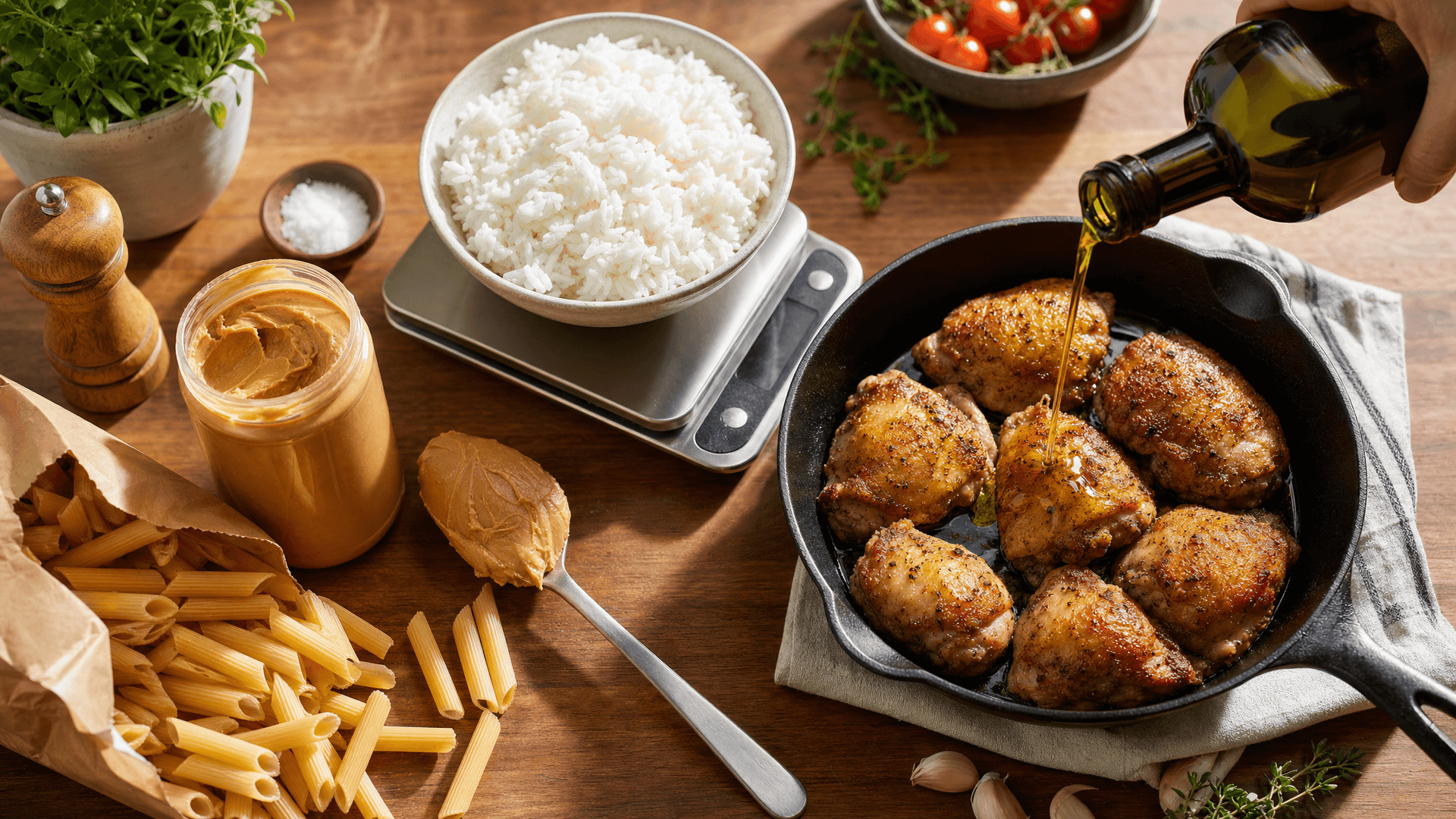
You've been tracking for six weeks. The app says 3,500 calories almost every day. Your protein's dialed. You're training four times a week and adding weight to the bar. And the scale hasn't moved a single damn pound.
So you do what every skinny guy does at this point: you decide you're a genetic anomaly. A furnace. Someone whose metabolism laughs at food.
You're probably not. What's far more likely is that your 3,500 calories is actually about 3,000 — and 3,000 happens to be almost exactly your maintenance. You're not fighting your genetics. You're eating at maintenance while genuinely believing you're in a surplus, because every single tool you're using to measure your intake has error baked into it.
This isn't a discipline problem. You've been disciplined for six weeks. It's a measurement problem. And measurement problems have specific, fixable causes.
Here are the six places calories leak out of your log, how big each leak actually is, and how to calibrate your number against the only sensor that never lies: the scale.
- Nutrition labels are legally allowed to be off by up to 20% — that's 400 calories on a 2,000-calorie day
- Crowd-sourced app database entries are frequently wrong, sometimes by 100% or more
- Cooking oil is the single biggest untracked item in most people's logs, often 200-400 calories a day
- Eyeballing portions of calorie-dense food underestimates by 20-40%, and it gets worse the bigger the portion
- Two untracked weekend days can wipe out a full week's surplus by themselves
- The real fix isn't perfect tracking — it's calibrating your logged number against your weekly weight trend
Why "3,500 calories" is a guess wearing a lab coat
Here's the thing nobody tells you when you download a tracking app: that number at the top of your screen is not a measurement. It's an estimate built on a stack of other estimates.
The label estimate. The database estimate. The portion estimate. The cooking-loss estimate. Each one has an error bar. Some of them are small. Some of them are huge. And here's the part that ruins bulks — the errors aren't random. They stack in one direction.
Nobody forgets to log the salad. Everybody forgets the oil it was tossed in. Nobody picks the smallest database entry for peanut butter. Everybody eyeballs low on the stuff they feel slightly guilty about. When errors are biased instead of random, they don't cancel out over a week. They compound.
Research on self-reported food intake has found underreporting in the range of 20% or more, and it's consistent across people who are genuinely trying to be accurate. That's not liars. That's the measurement system.
If you've already got the basics down and just want a refresher on setting your targets in the first place, our guide on how to track macros for bulking covers the setup. This article is about what happens after the setup, when the numbers look right and the scale disagrees.
If you've eaten your "surplus" for six straight weeks with zero weight gain, you were not in a surplus. Energy balance isn't a theory that sometimes takes the week off. The number in your app was wrong. That's the only possible explanation, and it's good news, because wrong numbers are fixable.
Leak 1: Label rounding is legal, and it's not in your favor
In the United States, the FDA's compliance approach means a food is considered accurately labeled as long as the actual calorie content isn't more than 20% above the declared value. Similar tolerance bands exist in the EU and UK. Manufacturers aren't cheating when a product lands over the stated number. They're operating inside the rules.
There's a second layer. The Atwater factors used to calculate calories on labels — 4 per gram of protein and carbs, 9 for fat — are averages from over a century ago. They're close enough for most whole foods, but they systematically misestimate high-fiber foods, nuts, and heavily processed products. Whole almonds, for example, deliver noticeably fewer usable calories than their label says, because a chunk of the fat never gets absorbed.
So which way does this cut for you?
Both ways, and that's the problem. On any given item you might be getting 15% more or 10% less than the label. On a mixed diet the errors partially wash out — but "partially" is the operative word, and if a large share of your calories comes from a small number of packaged products, one bad label can skew your whole day.
What to do: Don't chase this one. You can't audit a factory. Just internalize that your label-based total carries roughly a ±10% real-world margin, which on a 3,500-calorie day is 350 calories in either direction. That margin is exactly why you calibrate against the scale instead of trusting the app. More on that at the end.
Leak 2: Your app's database is full of garbage
Most popular tracking apps let users create food entries. Millions of them exist. Many are wrong.
Common failure modes you'll actually run into:
- Per-serving vs. per-100g confusion. Someone enters the per-100g values but tags the entry as "1 serving." Now your 7 oz of pasta logs as half of what you ate.
- Cooked vs. raw mismatch. An entry called "chicken breast" that's built on cooked values, used by someone weighing raw. Or the reverse. This one alone can swing a meal by 30%.
- Missing fat. Restaurant and recipe entries constantly omit the oil, butter, or dressing the dish was actually made with.
- Straight-up typos. Someone types 15g of fat as 1.5g. Nothing stops them.
Studies auditing crowd-sourced nutrition databases have found meaningful error in a large fraction of user-generated entries, with some off by more than 100%.
How to clean your database in 20 minutes
Open your app and look at your top 20 most-logged foods. That list is probably 80% of your calories. For each one:
- Prefer verified or brand-official entries. Most apps flag them with a checkmark or a "verified" tag. Use those.
- Sanity-check against the physical package. Pull the actual product out of your cupboard and compare the label to the entry, field by field.
- Sanity-check whole foods against known values. Raw chicken breast is roughly 165 calories per 3.5 oz. Uncooked white rice is around 360 per 3.5 oz. Olive oil is about 120 per tablespoon. If an entry is wildly off these, it's wrong.
- Save the good ones as favorites and never search again. Searching every time is how bad entries sneak back in.
Never log a home-cooked meal by searching its name. "Chicken stir fry" in a database is somebody else's recipe with somebody else's oil. Build your own recipe entry from raw ingredients once, save it, and reuse it forever.
Leak 3: The oil you're not logging
This is the big one. If you fix nothing else in this article, fix this.
Cooking fats are calorie-dense, invisible in the finished dish, and almost never logged. A tablespoon of olive oil is about 120 calories. Butter is roughly 100 per tablespoon. And nobody actually uses one tablespoon — a real "drizzle" into a hot pan is closer to two, and a generous pour is three.
Cook two meals a day with a real (not measured) amount of oil and you're looking at 240 to 480 untracked calories daily. That's a full surplus, gone, before you've counted a single sauce.
And the sauces are their own category. Mayo runs about 90 calories per tablespoon. Ranch and caesar are in the same neighborhood. Peanut butter is roughly 95 per tablespoon, and nobody's "one spoonful" is one level tablespoon.
Here's what a typical untracked day looks like:
| Item | Realistic amount | Calories |
|---|---|---|
| Oil for eggs in the morning | 1 tbsp | 120 |
| Oil for lunch stir-fry | 2 tbsp | 240 |
| Mayo on a sandwich | 1.5 tbsp | 135 |
| Splash of milk in coffee (×3) | 3 tbsp total | 30 |
| Dressing on a side salad | 2 tbsp | 150 |
| Total invisible calories | 675 |
Now flip that around. If you're a hardgainer struggling to reach your target, oil is your best friend. Deliberately adding two tablespoons of olive oil across your day is 240 easy calories that don't fill you up at all.
What to do: Put the bottle on the scale. Zero it, pour, note the grams. Oil is about 9 calories per gram, so 0.7 oz of oil is roughly 180 calories. Do this for two weeks and you'll be able to eyeball it within 10% forever after.
Leak 4: Eyeballing works fine, right up until it doesn't
People are decent at estimating volume for low-density food and terrible at estimating mass for dense food. Eyeball a bowl of broccoli and you'll be off by 30 calories. Eyeball a chunk of cheese and you'll be off by 200.
Research on portion estimation consistently finds underestimation in the 20-40% range for energy-dense foods — and, critically, the error scales with the portion. The bigger the serving, the bigger the percentage miss. Which means the exact meals that matter most on a bulk are the ones you're worst at guessing.
The foods where eyeballing wrecks you, ranked by damage:
- Nut butters and nuts — the single worst offender, because density is high and "a spoonful" is elastic
- Cheese — a "sprinkle" over pasta is often 1.4 oz and 160 calories
- Oils and dressings — see above
- Rice and pasta — dry weight matters enormously; a "cup" of dry pasta varies hugely by shape
- Granola and cereal — one of the most volume-deceptive foods there is
- Meat — a "chicken breast" ranges from 4 oz to 10.5 oz depending on where you shop
What to do: Weigh anything above roughly 4 calories per gram. Everything else, eyeball freely — vegetables, broth, fruit, plain yogurt. You are not going to derail a bulk with an imprecise cucumber.
And weigh food raw whenever you can, because water loss during cooking changes weight without changing calories. Chicken can lose 25% of its weight on the grill. Rice roughly triples. If you're confused about which state to log, our breakdown of weighing food cooked vs raw settles it properly.
Weigh in "tare mode": put the plate on the scale, zero it, add ingredient one, log it, zero again, add ingredient two. The whole meal gets logged accurately in about 40 seconds with one dish to wash.
Leak 5: Package versus serving — the double-your-day mistake
You grab a bag of trail mix. The label says 160 calories. You log 160 calories. You eat the bag.
The bag was three servings. You just logged 480 calories as 160.
This one is embarrassingly common and it hits hardest on exactly the foods bulkers love, because calorie-dense snack products are almost always packaged in multiple servings:
- A "single" bag of chips: often 2-3 servings
- A bottle of juice or a sports drink: usually 2-2.5 servings
- A tub of ice cream: sometimes 4-6
- A large yogurt pot: often 2
- A "personal" frozen pizza: frequently 2 servings
The reverse error exists too and it's just as bad in the other direction. You log "1 serving" of a protein bar the app has stored as a whole 2-bar package, and suddenly you're logging 400 calories for the 200 you ate. On a bulk, that phantom 200 is a surplus you never got.
What to do: Before logging anything from a package, read two lines on the label — serving size and servings per container. Then decide, deliberately, how many servings you're eating. It takes three seconds. Better still, weigh the portion in grams and log by weight; grams don't care how the marketing team defined a serving.
Leak 6: The weekend hole in your data
Look at your log. How many of the last 28 days are complete?
Most people track Monday through Friday with real precision and then go quiet from Friday night to Sunday evening. It's not laziness — weekends are restaurant meals, other people's cooking, drinks, and situations where pulling out a food scale would be genuinely weird.
But here's what that does to a bulk. If your weekday surplus is 400 calories and you go five for five, that's 2,000 surplus calories banked. If your two untracked weekend days land 1,000 calories below what you assume they were — extremely easy when you skip breakfast after a late night and grab whatever's around — your actual weekly surplus is zero. Six weeks of that and you're exactly where you started, holding a log that says you did everything right.
The blind spot is directional, and for a hardgainer it almost always points down. Skinny guys eat less when they're not paying attention. That's how they got skinny.
What to do: You don't need to weigh food at a restaurant. You need to stop letting weekends be a data void.
- Log a rough estimate, then add 20%. Restaurant meals have been shown to average well above their stated calories, and home estimates run low. A deliberate 20% padding gets you closer to truth than a blank.
- Anchor the day with two tracked meals. Have your normal weighed breakfast and a normal shake regardless of plans. Now only one meal is a guess.
- Front-load. If you know dinner is unpredictable, bank calories early instead of hoping to make them up at 11pm.
The 3-day audit that finds your actual number
Enough theory. Here's the protocol. Three days, and you'll know exactly which leaks are yours.
Day 1 — Log everything twice. Track normally. Then, at the end of the day, go back through and add every single thing you didn't log: the oil, the sauces, the milk in your coffee, the two bites of your girlfriend's dessert, the handful of nuts from the kitchen counter. Note the difference between the two totals. That gap is your invisible-calorie number.
Day 2 — Weigh everything above 4 calories per gram. No estimates on dense food. Weigh the oil. Weigh the peanut butter. Weigh the cheese. Compare each weighed amount to what you would have logged by eye, and note the difference per item. That's your eyeball error, food by food.
Day 3 — Audit your database entries. Take every entry you used on days 1 and 2 and verify each against the physical package or a known reference value. Fix the wrong ones and save them as favorites.
Add up the three corrections. Most people find between 300 and 700 calories a day hiding in there. That's the difference between a stalled bulk and gaining 0.5-1 lb a week.
You don't need forensic accuracy. You need consistent accuracy — the same method every day, so that when the scale doesn't move, you can trust the adjustment you make. A number that's consistently 8% low is far more useful than a number that's randomly right.
The real fix: calibrate against the scale
Here's what most tracking articles won't say. You will never make your logged number exactly true. Labels have tolerance, absorption varies between individuals, and your TDEE moves around by a few hundred calories depending on your training, sleep, and how much you fidget.
That's fine. The logged number doesn't need to be true. It needs to be stable, so you can use it as a dial.
Do this:
- Weigh yourself daily, same conditions — first thing in the morning, after the bathroom, before food.
- Use the weekly average, never a single day. Daily weight swings by 2-4 lb on water, sodium and gut contents alone. Day-to-day readings are noise.
- Compare week to week. Your target on a lean bulk is roughly 0.25-0.5% of bodyweight per week. For a 155 lb guy, that's about 0.4-0.75 lb per week.
- Hold the line for two full weeks before judging. One flat week means nothing.
- If the average is flat after two weeks, add 250 calories to your daily target and keep the tracking method identical. Then reassess.
That last point is everything. When you change your intake, don't simultaneously change how you track. Change one variable. If you tighten your tracking and add calories at the same time, you'll have no idea which one worked.
Do this for a month and something great happens: your logged number becomes a genuine, personally calibrated control. It might be 8% off in absolute terms and it won't matter, because you'll know that your 3,400 produces your gain rate. That's the whole game.
If you've run this process and the scale still refuses to move, the problem is probably somewhere else in your setup — nine common reasons bulks stall walks through the ones that aren't tracking-related.
And keep the protein target simple while you sort the calories out: 0.7-1.0g per lb of bodyweight is the range that matters. For a 165 lb lifter at 5'11", that's roughly 120-165g of protein a day. Nail that and total calories, and everything else is optimization.
When the tracking isn't the problem
Two honest caveats.
One: if you're gaining 2 lb a week, your tracking is also wrong — just in the other direction. Fast gain on a bulk is mostly fat and water, and it means your logged number is under-reading badly. The same audit applies.
Two: some people genuinely shouldn't track forever. If the log is making you anxious, or you've been at it for a year with no break, calibrate for four to six weeks, learn what your portions look like, then switch to tracking two days a week as a spot check. The point of tracking was never to track. It was to learn what a surplus feels like on your plate.
Where FuelTheGains fits
Most of the leaks in this article come from the same root cause: you're improvising your food. Improvised meals mean unmeasured oil, guessed portions, database entries built on somebody else's recipe, and no idea what your day actually adds up to.
That's the problem was built to solve. You put in your stats, your training, your budget and the foods you'll actually eat, and it builds a bulking meal plan where the calories are calculated from the ingredients — cooking fat included — with a matching grocery list. The numbers come pre-attached to the food, so there's no oil to forget and no ambiguous entry to search for.
You still weigh your dense stuff. You still watch the scale. But you're not reverse-engineering your own intake every night at 10pm, and the gap between what you think you ate and what you actually ate gets very small.
The bottom line
If you've been eating "3,500 calories" for six weeks and the scale hasn't budged, you weren't eating 3,500 calories. That's not a judgment — it's the predictable output of labels with legal tolerance, a database anyone can edit, unlogged cooking fat, guessed portions, and two blank days every week.
Run the three-day audit. Find your gap. Then stop trying to make the number perfect and start using it as a dial: same method every day, weekly averages, plus 250 calories whenever two weeks go flat.
Get that loop running and the guessing ends. You'll know your real number, and your bulk starts moving again.