
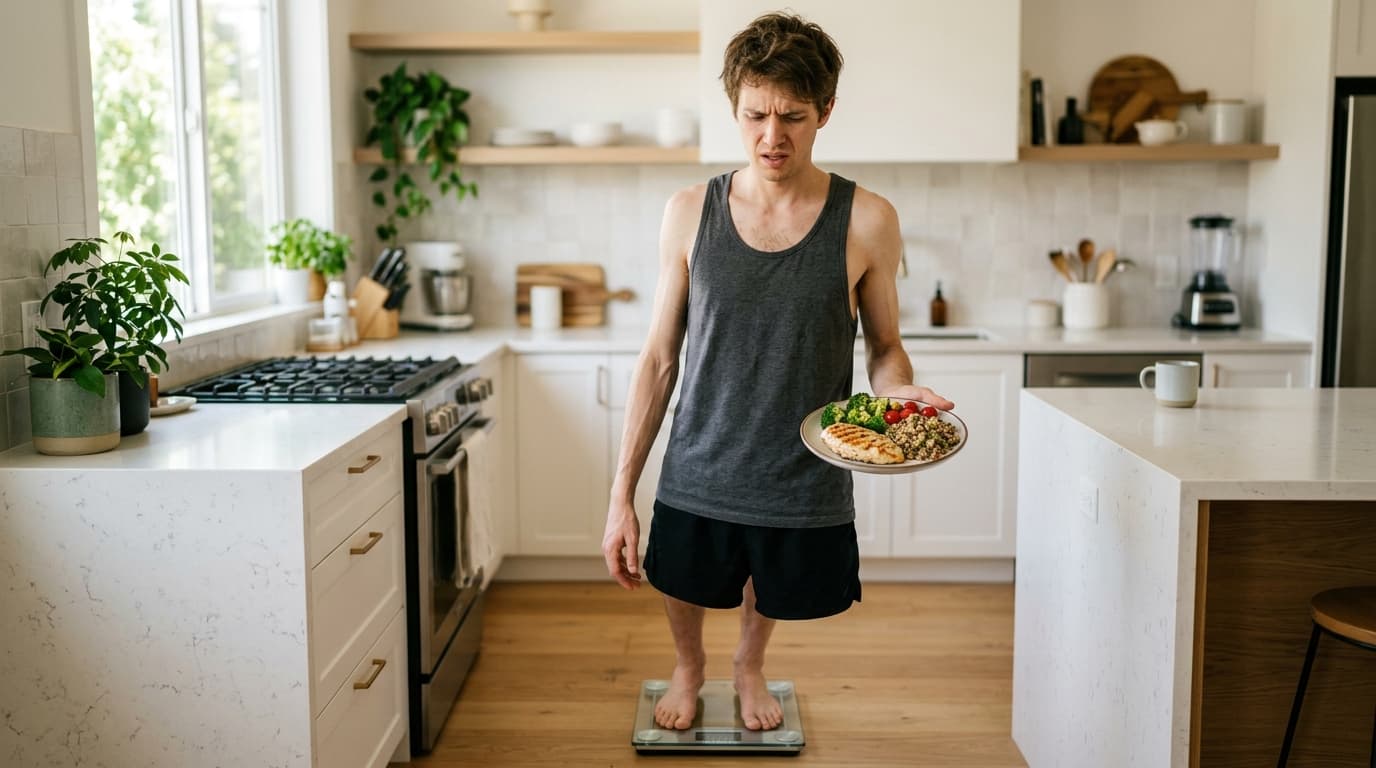
You're eating "a lot." You're training hard. You swear you're doing everything right. But the scale hasn't moved in weeks — maybe months.
Sound familiar? You're not alone. This is the single most common frustration skinny guys face when trying to bulk. And the answer is almost always simpler than you think.
Here's the truth that stings: you're not eating as much as you think you are. That's the reason 90% of the time. But let's dig into all 9 reasons your bulk might be stalled — and the exact fix for each one.
- Most "hardgainers" drastically overestimate their calorie intake
- Track everything for 7 days to find the real number — no guessing
- You need a consistent surplus every single day, not just on good days
- Liquid calories are the easiest fix for guys who can't eat enough volume
- Sleep, stress, and inconsistency kill gains just as much as under-eating
1. You're Not Eating as Much as You Think
This is the big one. The #1 reason skinny guys don't gain weight.
You feel like you're eating a ton. Maybe you had a massive dinner last night. Maybe you crushed a huge breakfast this morning. But here's what typically happens:
- Monday: You eat 3,200 calories (great day)
- Tuesday: You're still full from Monday, eat 2,100 calories
- Wednesday: Busy at work, skip lunch, end at 1,800 calories
- Thursday: Big dinner out, 2,900 calories
- Friday: 2,400 calories
Weekly average: 2,480 calories. That's maintenance for a 154 lb guy — not a surplus.
Your body doesn't care about your best day. It cares about your average over time.
The Fix
Track every single thing you eat for 7 consecutive days. Use MyFitnessPal, Cronometer, or even a notebook. Don't change your habits — just observe.
Most guys discover they're eating 500-800 calories less than they thought. That's the entire surplus they needed.
Weigh your food with a kitchen scale for the first week. Eyeballing portions is notoriously inaccurate — most people underestimate by 20-40%.
2. Your "Surplus" Isn't Actually a Surplus
Even if you calculated your TDEE and added 500 calories, the number might be wrong. Online TDEE calculators are estimates — they can be off by 300+ calories in either direction.
Here's what makes it worse for skinny guys specifically:
- NEAT (Non-Exercise Activity Thermogenesis) — fidgeting, pacing, gesturing. Some guys burn 400-700 extra calories per day just being restless
- Thermic effect of food — high-protein diets burn more calories during digestion
- Training intensity — if you're doing intense compound lifts 4-5x per week, you're burning more than the calculator assumed
A guy who calculates his TDEE at 2,500 might actually need 2,900 just to maintain. His "500 calorie surplus" of 3,000 is barely above maintenance.
The Fix
Forget the calculator after the first week. Use the scale as your feedback loop:
- Pick a calorie target (TDEE + 500)
- Eat that amount consistently for 2 weeks
- Weigh yourself daily, track the weekly average
- Gaining 0.5-1 lb per week? Perfect, stay there
- Not gaining? Add 200 calories and repeat
The scale doesn't lie. If it's not moving up, you need more food. Period.
If you need help figuring out your starting number, check out our guide on how to calculate your bulking calories.
3. You're Inconsistent (The Weekend Problem)
Consistency is the silent killer of bulks. Many guys eat well Monday through Thursday, then fall apart on weekends:
- Sleeping in and skipping breakfast
- Going out drinking (alcohol suppresses appetite for hours)
- "Winging it" without a plan
- Eating one big meal instead of 4-5
You need to be in a surplus every single day — not just on weekdays when your routine is locked in.
The Fix
- Meal prep Sunday for the week ahead — check our meal prep guide for a complete system
- Set phone alarms for meal times (every 3-3.5 hours)
- Have a backup plan — keep a mass gainer shake or calorie-dense snacks ready for days when cooking isn't happening
- Front-load calories — eat a big breakfast within an hour of waking, even on weekends
If you hit your calorie target 90% of days (that's missing only 2-3 days per month), you'll still make excellent progress. Perfection isn't required — but showing up most days is non-negotiable.
4. You're Eating Too "Clean"
This might sound counterintuitive. Isn't clean eating good?
Sure — for health. But for a skinny guy trying to gain weight, an ultra-clean diet can actually work against you. Here's why:
- Chicken breast, broccoli, and rice is high-volume, low-calorie
- Whole foods are more satiating — you get full faster
- Fiber-heavy meals fill your stomach before you hit your calorie target
- You end up eating massive plates just to get 500 calories
A 7 oz chicken breast with 7 oz of broccoli and 5.3 oz of brown rice is only about 480 calories. That's a lot of chewing for not a lot of fuel.
The Fix
You don't need to go full dirty bulk, but you should strategically add calorie-dense foods that don't fill you up:
- Cook with olive oil (120 cal per tablespoon)
- Add cheese to everything (100+ cal per slice)
- Use whole milk instead of water in shakes
- Swap chicken breast for fattier cuts like thighs
- Add nut butters, avocado, and granola to meals
Check out our list of calorie-dense foods that won't fill you up for more ideas.
Two tablespoons of olive oil drizzled on rice adds 240 calories with zero extra volume. You won't even taste it.
5. You're Not Drinking Your Calories
If chewing is the bottleneck — and for most skinny guys, it is — liquid calories are the single best hack.
A well-made shake can pack 700-1,000 calories into something you drink in 2 minutes. Try eating that much solid food in 2 minutes. Impossible.
The Fix
Add at least one high-calorie shake per day. Here's a simple recipe that hits 800+ calories:
- 2 cups whole milk (300 cal)
- 1 scoop whey protein (120 cal)
- 2 tbsp peanut butter (190 cal)
- 1 banana (100 cal)
- ½ cup oats (150 cal)
Total: ~860 calories, 50g protein.
Drink this between meals — not as a meal replacement. It's additional calories on top of your regular food.
Drink your shake 30-60 minutes after a meal when your stomach has settled but you're not yet hungry for the next meal. This is the sweet spot for adding calories without feeling sick.
6. Your Training Isn't Stimulating Growth
This is a nutrition blog, but training matters here too. If your workouts aren't creating enough stimulus for muscle growth, your body has no reason to use those extra calories for building tissue.
Signs your training is the problem:
- You're doing the same weight every week (no progressive overload)
- Your program is all isolation exercises (curls, lateral raises) with minimal compounds
- You're training 6-7 days per week with no recovery
- Sets are too easy — you're never close to failure
- You change programs every 2-3 weeks (program hopping)
The Fix
- Focus on compound lifts: squats, deadlifts, bench press, overhead press, rows, pull-ups
- Progressive overload: add weight or reps every week — even 2.5 lbs counts
- Train 3-5 days per week with at least 2 rest days
- Take sets close to failure (1-3 reps in reserve)
- Stick with one program for at least 8-12 weeks before switching
Without proper training stimulus, extra calories just become fat — and for skinny guys, often not even that.
7. You're Not Sleeping Enough
Sleep is when your body actually builds muscle. Growth hormone peaks during deep sleep. Testosterone production happens overnight. Protein synthesis ramps up while you rest.
If you're sleeping 5-6 hours per night, you're sabotaging your gains no matter how perfectly you eat.
Research shows that sleep-deprived lifters gain 60% less muscle and 55% more fat compared to well-rested lifters eating the same calories and following the same program.
The Fix
- Aim for 7-9 hours every night (8 is the sweet spot for most guys)
- Keep a consistent schedule — same bedtime and wake time, even weekends
- No screens 30 minutes before bed (blue light suppresses melatonin)
- Keep your room cool — 64-67°F is optimal
- Consider a bedtime snack — casein protein or Greek yogurt provides slow-digesting protein overnight
For more on the sleep-muscle connection, read our guide on sleep and recovery for muscle growth.
8. Stress Is Eating Your Gains
Chronic stress elevates cortisol — and cortisol is directly catabolic (it breaks down muscle tissue). It also:
- Suppresses appetite (making it harder to eat enough)
- Impairs digestion and nutrient absorption
- Reduces testosterone
- Disrupts sleep quality
- Increases fat storage, especially around the midsection
If you're stressed about work, relationships, finances, or school, your body is in survival mode — not building mode.
The Fix
You can't eliminate stress entirely, but you can manage it:
- Train consistently — exercise itself is one of the best stress reducers
- Get outside daily — even 15 minutes of sunlight helps regulate cortisol
- Limit caffeine after 2 PM — it elevates cortisol and disrupts sleep
- Practice deep breathing — 5 minutes of box breathing (4-4-4-4) before bed
- Have a wind-down routine — your body needs signals that the day is over
Don't underestimate this one. A guy eating 3,500 calories in a chronically stressed state will build less muscle than a guy eating 3,000 in a relaxed, well-rested state.
9. You're Skipping Meals (or Eating Too Infrequently)
Trying to eat 3,000+ calories in 2-3 meals is brutal for a skinny guy with a small stomach. Each meal would need to be 1,000-1,500 calories — that's physically uncomfortable.
Many guys attempt this, get full after 700 calories, and give up. Then they're left with a massive deficit they can't make up later.
The Fix
Eat 4-6 smaller meals spread across the day instead of 2-3 giant ones:
| Meal | Time | Calories |
|---|---|---|
| Breakfast | 7:00 AM | 600 |
| Mid-morning snack | 10:00 AM | 400 |
| Lunch | 12:30 PM | 700 |
| Afternoon snack | 3:30 PM | 400 |
| Dinner | 6:30 PM | 700 |
| Evening shake | 9:00 PM | 500 |
| Total | 3,300 |
No single meal exceeds 700 calories. That's manageable for anyone — even guys with small appetites.
For meal timing strategies that work, check our bulking meal timing guide.
Set phone alarms every 3 hours. Eat by the clock, not by hunger. Skinny guys often don't feel hungry enough — waiting for hunger signals means you'll always under-eat.
Quick Diagnostic: Which Problem Is Yours?
Still not sure which fix applies to you? Answer these questions:
Are you tracking calories?
- No → Start tracking. Problem #1 is almost certainly your issue.
- Yes → Move to next question.
Is the scale moving AT ALL?
- No movement for 2+ weeks → You're not in a surplus. Add 200-300 calories.
- Gaining but too slowly → Slight calorie increase needed.
- Gaining but inconsistently → Consistency issue (#3). Check weekends.
Are you sleeping 7+ hours?
- No → Fix sleep first. It affects everything else.
Are you training with progressive overload?
- No → Fix training. Extra food without stimulus = fat, not muscle.
Are you stressed/anxious?
- High stress → Address this alongside nutrition. It's a multiplier.
How to Know It's Working
Once you fix the issue, here's what proper bulking progress looks like:
- Week 1-2: Scale jumps 2-4 lbs (water, glycogen, food volume — not all muscle)
- Week 3-4: Scale gains stabilize to 0.5-1 lb per week
- Month 2-3: Clothes start fitting differently (tighter in shoulders, chest, arms)
- Month 4-6: Visible changes in the mirror
- Year 1: Realistic gain of 15-25 lbs (mix of muscle and some fat)
If you're gaining faster than 1 lb per week consistently, you're probably gaining too much fat. Dial back 100-200 calories.
If you want a full timeline of what to expect, read our bulking results timeline for skinny guys.
Where FuelTheGains Comes In
Tracking all of this manually — calculating TDEE, hitting calorie targets, planning meals across the day, making sure every day is consistent — is a lot of mental overhead. And mental overhead is what causes most guys to quit.
That's exactly what solves. You tell it your stats, your goals, and your food preferences — and it builds your daily meal plan automatically. Every meal timed out, every macro calculated, every calorie accounted for.
No guessing. No tracking fatigue. No wondering if you're in a surplus. Just follow the plan and eat.
The Bottom Line
If you're not gaining weight, you're not in a calorie surplus. Full stop. Everything else — sleep, stress, training, consistency — either affects how much you need to eat or how efficiently those calories build muscle.
Fix the fundamentals first: track your food, confirm you're in a real surplus, eat consistently every day, and sleep enough. That alone will solve the problem for 90% of you.
The other 10%? Address training, stress, and meal frequency — and the scale will finally start moving.
You're not a "hardgainer." You're an under-eater who hasn't found the right system yet. Now you have one. Use it.