
Six weeks in, the scale finally moves. You've gone from 130 lb to something that actually fills a t-shirt, your lifts are climbing, and for the first time in your life the mirror is on your side.
And then your jawline erupts. Then your back. Then your shoulders, right where the barbell sits.
So you do the obvious thing: you assume the food did it, drop the surplus, ditch the shakes, and go back to eating like a bird. The acne fades a bit. So does everything you built.
That trade is a bad deal, and you don't have to take it. Bulking acne isn't caused by "too many calories." It's caused by a handful of very specific things that tend to ride along with a surplus — huge dairy volume, sugar spikes, a fat profile that's tilted the wrong way, a few missing micronutrients, and skin that sits in sweat for an hour a day. Every one of those has a fix that costs you zero calories.
Here's what's actually happening, what's noise, and how to rebuild a 3,500-calorie day so your skin calms down while the scale keeps moving.
- Acne on a bulk is rarely about total calories — it's about what those calories are made of
- Dairy volume is the single biggest lever, and whey concentrate hits harder than casein or isolate
- Big glycemic spikes raise insulin and IGF-1, which push oil production and skin cell turnover
- A bad omega-6 to omega-3 ratio and low zinc make everything inflame more easily
- Sweat, friction and unwashed gym gear turn existing congestion into visible breakouts
- Every fix in this article is calorie-neutral — you swap the source, not the surplus
- Give any change 8 to 12 weeks before you judge it, because skin lags by a full cycle
Why your skin freaked out the moment you started gaining
Your skin doesn't know what a bulk is. What it responds to are hormones, and eating in a surplus turns a few of them up.
Acne needs four things to happen at once: your oil glands produce more sebum, skin cells lining the pore multiply faster than they shed, the pore blocks, and bacteria that live there quietly start a fire. Anything that accelerates step one or two makes step three and four far more likely.
Insulin and IGF-1 are the whole story
Two hormones sit at the middle of this. Insulin, which you already know about, and IGF-1 (insulin-like growth factor 1), which is the one nobody mentions.
IGF-1 is genuinely great for you as a lifter. It's part of why a surplus builds muscle in the first place — it drives tissue growth and repair. The problem is that your sebaceous glands are also tissue, and they're loaded with receptors for it. Push IGF-1 up and your oil glands get the same "grow, produce more" signal your quads do.
Insulin does two things here. It raises IGF-1 directly, and it lowers the binding proteins that keep IGF-1 parked and inactive in your blood. So a big insulin spike doesn't just raise the hormone, it raises the free, active fraction of it.
This is why the guy eating 3,500 calories of white bread, cereal and chocolate milk breaks out and the guy eating 3,500 calories of rice, salmon, potatoes and olive oil often doesn't. Same surplus. Completely different hormonal texture.
The IGF-1 that grows a sebaceous gland is the same IGF-1 that grows a muscle fibre. You don't want to suppress it — you want to stop spiking it in giant, unnecessary bursts eight times a day. Smooth it out and you keep the anabolic benefit without the oil slick.
The four things actually driving it
1. Dairy volume (the big one)
Dairy is the most consistently implicated food in acne research, and it's not close. It's also, unfortunately, the single easiest bulking food on earth. A litre of whole milk is 600-ish calories you can drink standing at the fridge.
Two mechanisms are at play. Milk carries bioactive hormones and growth factors from the cow, and milk proteins — especially the whey fraction — trigger an insulin response far larger than their carb content should produce. Whey is roughly twice as insulinemic as white bread gram for gram. That's exactly why it's great post-workout. It's also why chugging it all day isn't free.
The hierarchy matters:
- Skim milk is the worst offender in most data, not whole milk. Removing the fat concentrates the protein and speeds absorption.
- Whey concentrate hits harder than whey isolate, which hits harder than casein.
- Fermented dairy — Greek yogurt, kefir, aged cheese — is consistently the gentlest, likely because fermentation chews through some of the bioactive load.
If you're going through 34 oz of milk a day plus three scoops of whey plus 9 oz of cottage cheese, dairy isn't a component of your diet. It is your diet. That's the first place to look.
2. Glycemic load, not "sugar"
The distinction matters. A banana isn't your problem. Sixty grams of sugar dissolved in a shaker with nothing to slow it down is.
Low-glycemic-load diets have been shown to reduce lesion counts in controlled trials, and the mechanism is the insulin pathway above. What you're targeting isn't sugar as a category, it's the speed and size of the spike.
The bulking diet is uniquely bad at this because we're told to prioritise "fast carbs" for convenience. Bagels, white rice, dextrose, juice, cereal, mass gainers built on maltodextrin. All easy to eat, all designed to hit your bloodstream in ten minutes flat.
3. Your fat profile is tilted
Most bulking calories come from cheap fats: seed oils, peanut butter, fried food, restaurant meals. All heavy in omega-6. Meanwhile omega-3 intake for most guys is basically zero.
Omega-6 fats are precursors to inflammatory signalling molecules; omega-3s are precursors to the ones that resolve inflammation. You don't need to eliminate omega-6 — you need to stop running a ratio of 20:1 when your grandparents ran 4:1. Getting 5 oz of oily fish in twice a week does more for that ratio than any elimination diet.
4. Micronutrients you quietly dropped
Zinc is the one to know. It's directly involved in wound healing, sebum regulation and immune response in the skin, and supplemental zinc has repeatable (if modest) effects on inflammatory acne. Vitamin A regulates how fast skin cells turn over — it's the entire basis of every prescription retinoid. Vitamin D and selenium play supporting roles.
Here's the bulking trap: when you eat 3,500 calories of the same six foods every day, you can be in a massive energy surplus and still be short on half the micronutrient panel. More calories does not mean more nutrients if they all come from rice, chicken, oil and whey. We went deep on this in the micronutrients skinny guys miss while bulking, and skin is one of the first places the shortfall shows up.
The bonus driver: your skin is filthy for an hour a day
This one isn't dietary and it's responsible for more back and shoulder acne than anything you eat.
Sweat plus friction plus occlusion is a purpose-built acne machine. A sweaty cotton shirt pressed under a barbell, a backpack strap, a bench you didn't wipe, hands going from a public pull-up bar to your face. Then you drive home and sit in it for forty minutes.
If your acne is mostly on your back, shoulders and chest — the exact map of where a shirt sits and a bar rests — start with hygiene and friction before you rip up your entire diet. You may not have a food problem at all.
The myths that'll waste your time
"Greasy food gives you greasy skin." The fat you eat does not travel to your face and come out of your pores. Fried food may matter through the omega-6 and glycemic angle, but not because it's greasy.
"Chocolate causes acne." Cocoa is not the issue. The 40 grams of sugar and the milk powder in a standard bar are. 0.7 oz of 85% dark chocolate is not doing anything to your face.
"Just cut calories until it clears." This works about as well as cutting your leg off to fix a limp. You'll lose the surplus, lose the gains, and often still have acne — because the driver was the composition of the food, not the amount.
"It's just testosterone from lifting." Natural training moves your testosterone by a rounding error compared to what puberty already did. If your acne genuinely started with a compound you took, that's a different conversation and a real one. Training itself isn't it.
"Protein powder causes acne." Whey concentrate in large daily volumes plausibly contributes. "Protein powder" as a category does not — plant blends and isolates are a completely different animal. We broke down the differences in our guide to picking a protein powder, and the type you choose matters more here than the fact that you use one.
Swap-for-swap: same calories, calmer skin
This is the part that matters. Every swap below is designed to be calorie-matched or close enough that your surplus doesn't move. You are changing the source, not the size.
| Instead of | Use this | Why |
|---|---|---|
| Skim or semi-skim milk | Whole milk, or unsweetened soy | Lower insulin response per calorie; soy removes the dairy load entirely |
| Whey concentrate, 3 scoops/day | Isolate or a plant blend, 1-2 scoops | Isolate strips most of the lactose and bioactive fraction |
| Mass gainer with maltodextrin | Oats, whole milk, nut butter, banana | Same calories, a fraction of the glycemic spike |
| Cereal breakfast | Overnight oats with Greek yogurt | Fermented dairy, slower carbs, same macros |
| Fruit juice | Whole fruit | The fibre alone flattens the curve |
| Sunflower or corn oil | Olive oil | Better fat ratio at identical calorie density |
| Chicken every meal | Salmon, mackerel or sardines twice a week | Omega-3s, plus zinc and selenium |
| Rice cakes as a snack | Nuts and seeds | Zinc, healthy fats, no spike |
| Second daily shake | Real food meal | Fewer liquid calories hitting at once |
The dairy audit
Before you cut anything, count. Write down every dairy source in a normal day: milk in shakes, milk on cereal, yogurt, cheese, cottage cheese, whey. Add it up.
If dairy is supplying more than about a third of your daily calories, that's your first lever — and you don't have to go to zero. Halve it and replace with equal calories from elsewhere. Swap 17 oz of your milk for unsweetened soy plus a spoon of olive oil in the shake, and you've matched calories and protein while removing the biggest single trigger.
If halving it fixes things, you now know. If cutting dairy entirely for eight weeks does nothing, put it back and stop worrying about it — plenty of guys tolerate it fine. For anyone who does need to go all the way, our dairy-free bulking guide covers how to keep the calories up without it.
Flatten the spikes
You're not going low-carb. You're just changing the shape of the curve.
- Never eat a carb naked. Add fat, protein or fibre to everything. 2.8 oz of oats with milk and nut butter behaves nothing like the same oats with water.
- Keep the fast carbs where they earn their keep — around training. That's the one window where a spike is doing a job.
- Trade a couple of liquid meals for solid ones. Liquid calories arrive all at once. A meal of 4 oz dry rice, 7 oz beef and olive oil delivers the same 900 calories over hours.
- Whole fruit over juice, always. Two bananas and an apple beat a glass of orange juice on every axis except speed.
If you use a mass gainer, read the first ingredient. If it's maltodextrin, you're drinking something with a higher glycemic index than table sugar. Blending your own — oats, whole milk, peanut butter, banana, a scoop of isolate — costs less and spikes far less.
Fix the fats and the zinc
Target oily fish twice a week: 5 oz of salmon or 3.5 oz of sardines. Sardines are absurdly cheap and carry zinc, selenium and vitamin D alongside the omega-3s. If you genuinely won't eat fish, a fish oil supplement is a reasonable substitute.
For zinc, the food sources are beef, shellfish, pumpkin seeds and cashews. 7 oz of beef a few times a week plus 1 oz of pumpkin seeds gets most guys there without a pill. If you do supplement, keep it modest and take it with food — high-dose zinc on an empty stomach is a fast track to nausea, and chronic megadoses interfere with copper absorption.
Then just eat some colour. Two servings of vegetables and a handful of berries a day covers most of the vitamin A, C and antioxidant gap, and costs you nothing in calories.
A 3,500-calorie day, rebuilt
Here's what this looks like in practice for a 155 lb guy at 5'11" trying to gain around 1 lb a week. Protein sits at roughly 0.8g per lb, which is plenty.
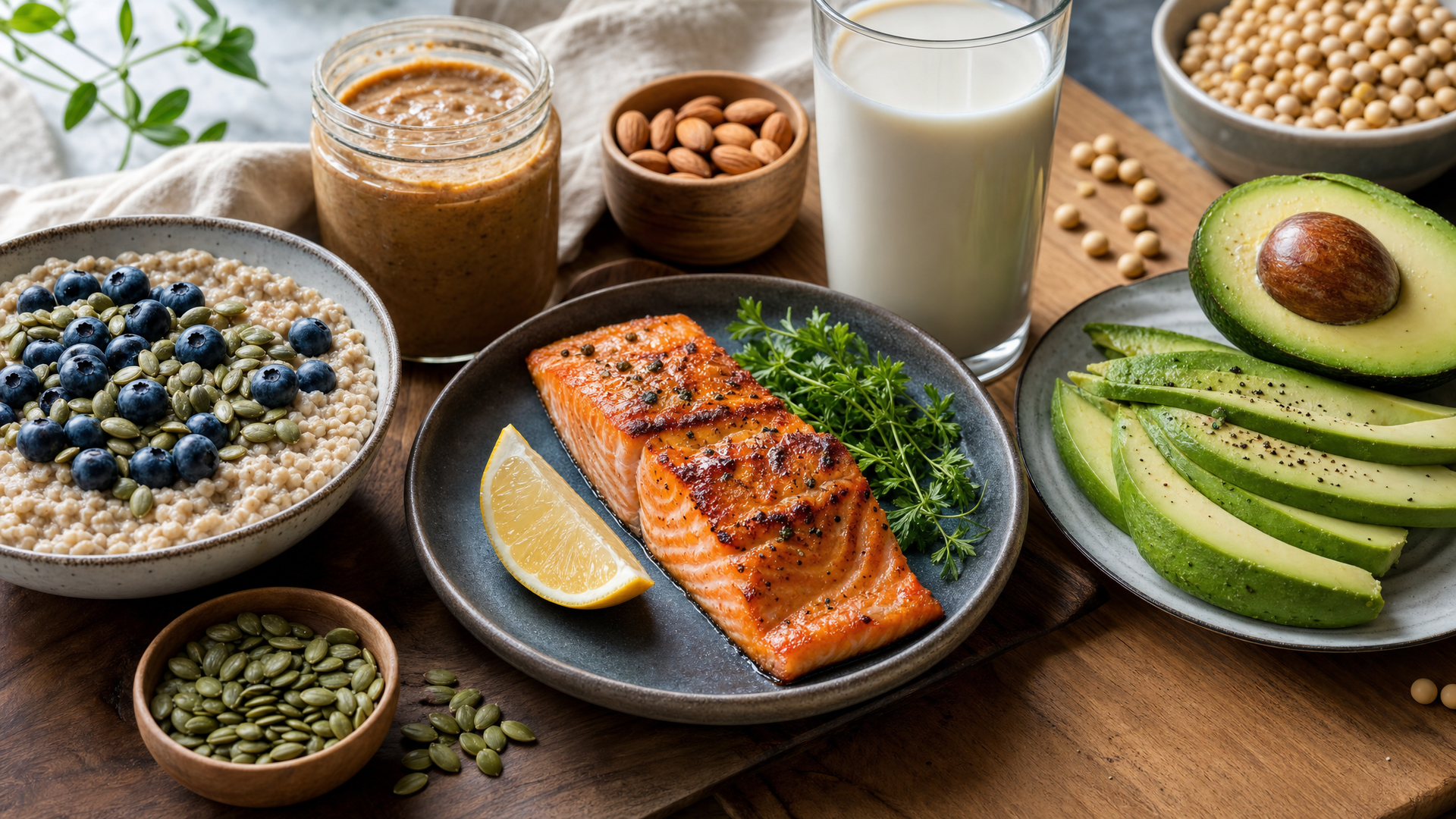
Breakfast (~750 cal). 2.8 oz oats soaked overnight in 7 oz Greek yogurt, a banana, 2 tbsp peanut butter, a handful of berries. Fermented dairy, slow carbs, no spike.
Lunch (~900 cal). 4 oz dry rice, 7 oz beef or chicken thigh, a pile of vegetables, olive oil, avocado.
Pre/post training (~600 cal). This is where fast carbs belong. A shake with one scoop of isolate, a banana, honey, and 8 oz of milk or soy.
Dinner (~900 cal). 5 oz salmon, 14 oz potatoes roasted in olive oil, greens, a handful of pumpkin seeds thrown on top.
Evening (~350 cal). 2 oz almonds or cashews, or a bowl of cottage cheese with berries if dairy is fine for you.
Same calories as the milk-and-mass-gainer version. Roughly a third of the dairy, half the glycemic load, several times the omega-3s and zinc.
The gym-skin protocol
Diet won't fix a mechanical problem. This takes about four minutes a day.
- Shower within 30 minutes of finishing. Not after dinner. Not after you've sat in the car and answered emails.
- Wear technical fabric, not cotton. Cotton holds sweat directly against skin for the entire session.
- Fresh shirt every session. Yes, every one. Bacteria and oil don't air out.
- Wipe every bench and back pad before you lie on it.
- Stop touching your face. Chalk hands, bar hands, phone between sets — that's your jawline right there.
- Wash your phone screen. It spends more time against your cheek than anything else you own.
- A benzoyl peroxide body wash on your back and shoulders, left on for a minute before rinsing, does more for bacne than any dietary change.
Keep a small towel between your back and the bench or backpack strap. Friction plus occlusion plus sweat is what turns a blocked pore into an angry one — remove any one of the three and the whole thing calms down.
What to expect, and when
Skin moves slowly, and this is where most guys quit.
A pore that's blocking today became visible three to eight weeks from now. So when you change your diet on Monday and your face is still a mess on Friday, that means nothing at all. Judge nothing before 8 weeks, and give it 12 before you call a change a failure.
Change one thing at a time. If you cut dairy, drop the mass gainer, start fish oil and buy a new face wash in the same week, you'll never know which one worked — and you'll have restricted your diet four times over for no reason.
Take a photo in the same light, same angle, once a week. Same principle as tracking your lifts. Your memory of "how bad it was" is unreliable; the photos aren't.
And keep gaining while you do it. If you're still adding 0.9-1.1 lb a week and your training is progressing, the bulk is working. Don't sabotage it to chase a variable that's going to take two months to respond anyway.
Mistakes that make it worse
Cutting calories the moment you break out. The most common one, and the most expensive. You lose 5-9 lb of hard-earned weight to fix something that was never about the amount of food.
Eliminating everything at once. Dairy, gluten, sugar, nuts, all gone on the same day. Now you're under-eating, miserable, and no closer to knowing the cause.
Over-washing and scrubbing. Stripping your skin barrier makes your face produce more oil and inflames what's already there. Twice a day, gentle, done.
Megadosing zinc. More is not better. Large chronic doses cause nausea and block copper absorption, and the benefit plateaus fast.
Treating whey like the villain and eating three ice creams. People will drop protein powder — genuinely useful, easy to swap for isolate — while leaving in a pile of sugar and skim milk that's doing far more damage.
Not seeing a dermatologist. If you've got deep, painful cystic nodules, food will not fix it and waiting scars you permanently. Prescription treatment works and it's not a failure to use it. Fix the diet and get the prescription.
Where FuelTheGains fits
The reason most guys never untangle this is that they're eyeballing everything. You can't audit your dairy intake, flatten your glycemic load or check whether you're actually hitting your zinc if you don't know what you ate on Tuesday.
That's what we built FuelTheGains for. You get a calorie and macro target based on your actual body and training, and a meal plan built from foods you'll genuinely eat — so when you decide to halve the dairy or push omega-3s up, you can rebuild the day around it and see immediately whether the calories still land where they need to. No guessing, no accidentally dropping 400 calories while trying to fix your skin.
If you're tired of choosing between the gains and the mirror, take a look at what we put together. The whole point is keeping the surplus intact while you change what it's made of.
The bottom line
Bulking didn't break your skin. The specific way you were bulking did — and that's a much easier problem.
Audit the dairy, flatten the spikes, get some fish and zinc in, shower right after you train. Keep every single calorie exactly where it is. Then give it eight weeks and take the photos.
You worked too hard for those 11 lb to hand them back over a breakout. Fix the composition, keep the surplus, and let both things go your way at once.