
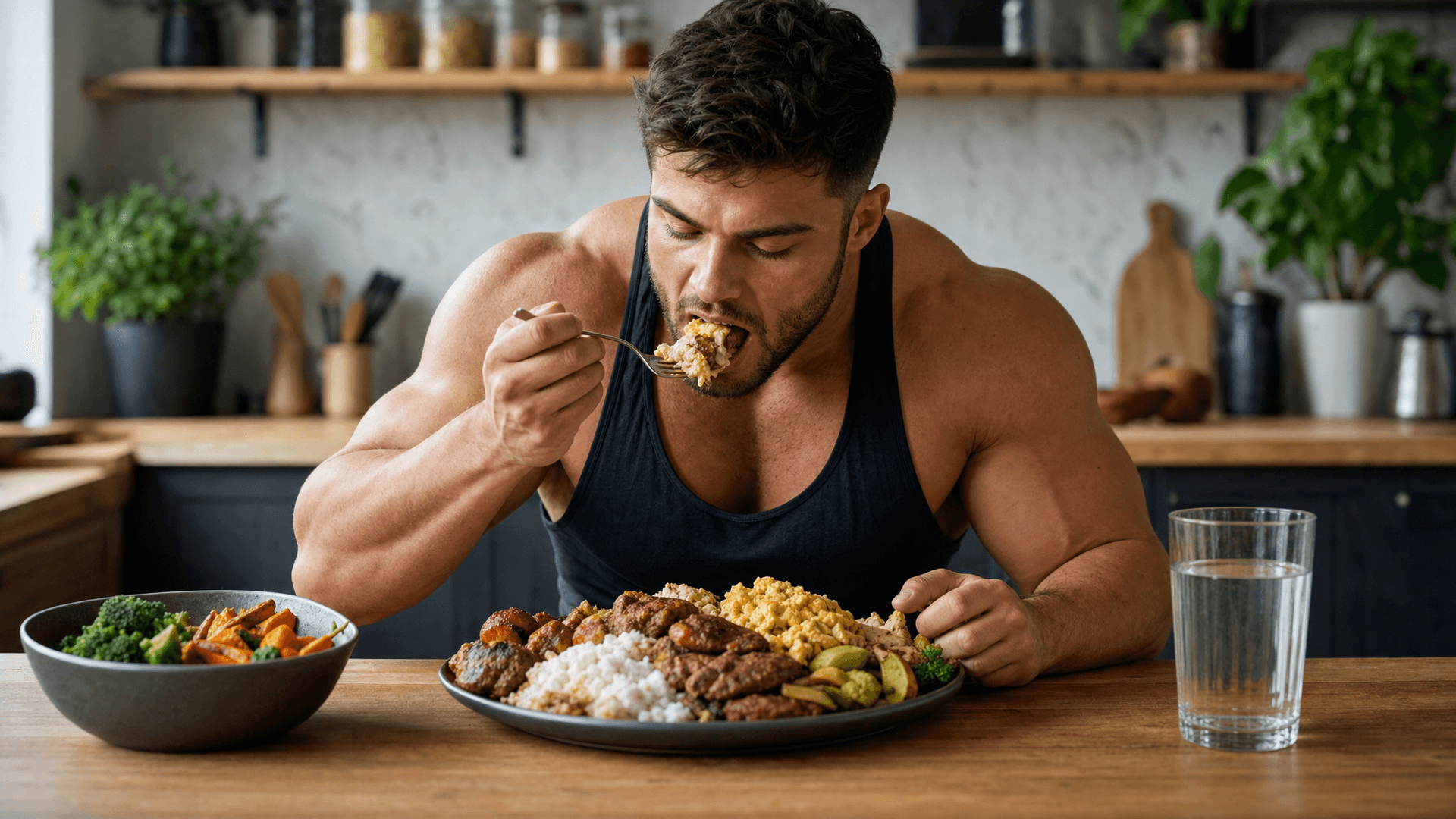
Let's be honest — most skinny guys who try to bulk quit within two weeks. And it's almost never because the food is too much. It's because weighing every chicken breast and logging every tablespoon of peanut butter feels like a second job.
Tracking macros works. Nobody's denying that. But if it makes you miserable enough to quit, then it doesn't work for you. And a system you abandon is worse than a system that's "only" 85% optimal.
Here's the good news: you can absolutely build muscle without counting a single calorie. You just need a different set of tools. Think portion frameworks, meal templates, and habit stacking instead of spreadsheets and food scales.
This guide is for the skinny guy who wants to gain 20-30 lbs of muscle but would rather eat glass than open MyFitnessPal every day.
- You don't need to count calories to bulk — but you do need a system
- The hand-portion method gives you accurate-enough estimates without a food scale
- Building 4-5 meal templates you rotate weekly removes daily decision fatigue
- Weigh yourself 2-3 times per week to confirm you're actually in a surplus
- Add calories by upgrading existing meals, not adding extra ones
- Track effort once — build the template, then run on autopilot
Why Calorie Counting Burns Out Skinny Guys
There's a reason bodybuilders count calories and most regular people don't: it's tedious as hell.
For a skinny guy trying to eat 3,000+ calories a day, that means logging 15-25 individual food items daily. Every meal. Every snack. Every splash of olive oil. Miss a few entries and your data becomes useless.
Here's what usually happens:
- Week 1: You're motivated. Everything gets logged. You buy a food scale.
- Week 2: You start estimating portions because you're "getting good at eyeballing."
- Week 3: You forget to log lunch. Then dinner. Then you stop opening the app.
- Week 4: The food scale collects dust. You're back to eating whatever.
The tracking didn't fail because you're lazy. It failed because the friction was too high for a habit that needs to happen 4-5 times per day, every single day, for months.
The alternative isn't "just eat more and hope for the best." The alternative is building systems that guarantee a surplus without requiring daily math.
The Hand-Portion Method
This is the simplest, most practical way to estimate portions without a scale or app. Your hand is always with you, it scales with your body size, and it's accurate enough for bulking.
Here's how it maps out:
| Body Part | Measures | Portion Size |
|---|---|---|
| Palm | Protein | ~4-5 oz cooked meat/fish |
| Fist | Carbs | ~1 cup cooked rice/pasta/potatoes |
| Cupped hand | Fruits/veggies | ~3-4 oz |
| Thumb | Fats | ~1 tbsp oil, butter, or nut butter |
Your Bulking Targets Per Meal
For a skinny guy between 130-175 lbs aiming to gain weight, each of your 4 main meals should include:
- 2 palms of protein
- 2 fists of carbs
- 1-2 thumbs of added fats
- 1 cupped hand of fruits or veggies
That puts each meal at roughly 600-800 calories without counting a thing. Four meals a day gets you to 2,400-3,200 calories. Add a shake or snack and you're solidly in surplus territory.
If you're not gaining weight after 2 weeks using these portions, add one extra thumb of fat and one extra fist of carbs to two of your meals. That's roughly 400 extra calories with zero math.
Build Your Meal Template Library
Here's where the magic happens. Instead of deciding what to eat every day (which leads to decision fatigue and defaulting to easy, low-calorie options), you build a library of 4-5 go-to meals and rotate them.
How to Build Your Templates
Step 1: Write down 4-5 meals you already enjoy eating.
Step 2: Make sure each one hits the hand-portion targets above (2 palms protein, 2 fists carbs, 1-2 thumbs fat).
Step 3: If a meal is too small, upgrade it (we'll cover how below).
Step 4: Assign meals to time slots and rotate weekly.
Example Template Rotation
Template A (Week 1):
| Meal | What |
|---|---|
| Breakfast | 4 eggs scrambled + 2 slices toast + avocado + banana |
| Lunch | Double chicken wrap with rice, beans, cheese, salsa |
| Snack | Protein shake with whole milk + peanut butter |
| Dinner | 8 oz ground beef + pasta + tomato sauce + olive oil |
Template B (Week 2):
| Meal | What |
|---|---|
| Breakfast | Overnight oats with protein powder + whole milk + berries + almonds |
| Lunch | 2 turkey + cheese sandwiches on thick bread + side of trail mix |
| Snack | Greek yogurt bowl with granola + honey + banana |
| Dinner | Stir-fry with 7 oz chicken, rice, veggies, sesame oil |
You only need to "count" once — when you build the template. After that, you just follow it. No app. No scale. No daily decisions.
Research on dietary adherence consistently shows that reducing daily food decisions improves consistency. Bodybuilders have known this for decades — they eat the same meals on repeat. You don't need to be that extreme, but 4-5 templates gives you enough variety without the overhead.
The Meal Upgrade Strategy
Most skinny guys don't need to add meals — they need to make their existing meals bigger. Adding a fifth or sixth meal feels forced and usually doesn't stick. Upgrading what you already eat is nearly invisible.
Here are the highest-impact upgrades:
Upgrade #1: Cook With More Fat
This is the single easiest way to add calories. Fat has 9 calories per gram versus 4 for carbs and protein. A little goes a long way.
- Cook eggs in butter instead of spray → +100 cal
- Add 2 tbsp olive oil to pasta after cooking → +240 cal
- Use whole milk instead of water in oatmeal → +100 cal
- Spread avocado on sandwiches → +120 cal
That's +560 calories across a day with literally zero extra food volume.
Upgrade #2: Double Your Carb Portions
Skinny guys chronically under-eat carbs. If you're having one fist of rice, have two. If you're eating one slice of toast, eat two.
Carbs are easy to eat, they don't fill you up as much as protein, and they fuel your workouts. Most hardgainers should be eating 2-3g per lb of bodyweight in carbs daily.
Upgrade #3: Drink Your Calories
If you're reading this site, you've probably seen this advice before — because it's the most effective hack for skinny guys. A shake with whole milk, protein powder, oats, peanut butter, and a banana can easily hit 700-900 calories and takes 60 seconds to make.
Check out our complete guide to high-calorie shakes for recipes that hit 1,000+ calories per glass.
Upgrade #4: Add Toppings and Extras
Every meal is an opportunity to sneak in extra calories through toppings:
- Cheese on everything savory → +100-200 cal per serving
- Granola on yogurt → +200 cal per quarter cup
- Nuts or seeds on salads and bowls → +170 cal per handful
- Honey or maple syrup on oatmeal → +60-90 cal per tbsp
- Sour cream or guac on Mexican food → +100-150 cal per dollop
These small additions compound. If you add +150 calories to each of four meals, that's +600 calories per day — enough to turn maintenance into a solid bulk.
The Anchor Meal System
Here's a framework that works incredibly well for guys who hate structure but need results.
Pick one meal per day as your "anchor." This is the one meal you put thought into — the one that hits all your targets and anchors your entire day's nutrition.
For most guys, this should be dinner (biggest meal, most time to prepare) or a post-workout shake (easiest to make calorie-dense).
Why This Works
When you nail one big meal, the pressure on your other meals drops dramatically. Your anchor might deliver 800-1,000 calories and 50g protein on its own. That means your remaining 3 meals only need to average ~600-700 calories each to hit a 3,000-calorie day.
600 calories per meal is easy. That's a sandwich with a glass of milk. That's a bowl of cereal with a banana. That's leftovers from last night.
The anchor system turns "I need to eat 3,000 calories today" into "I need to nail dinner and eat normally the rest of the day."
Your anchor meal is also the best place to batch prep. Cook a big dinner on Sunday and Monday, portion it into containers, and you've got your anchor covered for 4-5 days. Check out our meal prep guide for a step-by-step system.
How to Know It's Working (Without Counting)
If you're not tracking calories, you need another feedback loop. Otherwise you're flying blind. Here are three no-counting checkpoints:
Checkpoint #1: The Scale
Weigh yourself 2-3 times per week, first thing in the morning, after using the bathroom. Use the weekly average, not individual readings.
Target rate of gain:
| Experience Level | Weekly Gain |
|---|---|
| Beginner (first year) | 0.5-1.0 lb per week |
| Intermediate (1-3 years) | 0.3-0.5 lb per week |
| Advanced (3+ years) | 0.1-0.3 lb per week |
If your weekly average isn't moving up → eat more (add one upgrade from the list above).
If it's moving up too fast (more than 1 lb per week for beginners) → you're gaining too much fat. Pull back one upgrade.
Checkpoint #2: Gym Performance
Your lifts should be going up. If you're eating enough and training hard, you should see strength increases every 1-2 weeks as a beginner. Stalling lifts with a stalling scale means you need more food.
Checkpoint #3: The Mirror and Photos
Take progress photos every 2-4 weeks, same lighting, same angle. The mirror lies to you daily because changes are gradual. Side-by-side photos don't lie.
If you want to understand the full timeline of what to expect, our bulking results timeline breaks it down month by month.
A Day of Eating Without Counting (Example)
Here's what a full day looks like using the hand-portion method and meal upgrades. No calorie counting involved — just following the template.
Morning (within 1 hour of waking)
- 4 whole eggs scrambled in butter (2 palms protein, 1 thumb fat)
- 2 slices thick sourdough toast with peanut butter (2 fists carbs, 1 thumb fat)
- 1 large banana (1 cupped hand fruit)
- Glass of whole milk
Estimated total: ~850 calories, 45g protein
Midday
- Double chicken breast sandwich on a sub roll (2 palms protein, 2 fists carbs)
- Cheese, mayo, lettuce, tomato (1 thumb fat from mayo + cheese)
- Handful of trail mix on the side
Estimated total: ~800 calories, 50g protein
Afternoon (post-workout or snack)
- Protein shake: 2 cups whole milk, 1 scoop whey, 1 banana, 2 tbsp peanut butter
- Blend for 60 seconds
Estimated total: ~700 calories, 48g protein
Evening
- 7 oz ground beef (2 palms) cooked in olive oil
- 2 fists of rice
- Steamed broccoli with butter
- Side of bread to soak up the juices
Estimated total: ~850 calories, 45g protein
Daily Total (approximate)
| Macro | Amount |
|---|---|
| Calories | ~3,200 |
| Protein | ~188g |
| Carbs | ~350g |
| Fat | ~115g |
That's a solid bulking day for a 150-170 lb guy — and you didn't open an app once.
Notice that this day has 4 eating occasions, not 6. You don't need to eat every 2 hours. Three meals and one shake is plenty for most skinny guys. Quality and size per meal matters more than frequency.
The Weekly Habit Checklist
Since you're not tracking daily numbers, use a simple weekly checklist instead. This takes 30 seconds on Sunday night.
Did you this week:
- ☐ Eat 4 meals on most days (at least 5 out of 7)?
- ☐ Hit 2 palms of protein at each meal?
- ☐ Drink at least one high-calorie shake?
- ☐ Cook with added fats (oil, butter, cheese)?
- ☐ Weigh yourself 2-3 times and log the average?
- ☐ See the scale trend upward vs. last week?
If you checked 5-6 boxes, you're on track. If you missed 3+, identify which habits broke down and fix those — not the calories.
This is the mindset shift: track habits, not numbers. The numbers follow when the habits are right.
Common Mistakes When Bulking Without Tracking
Mistake #1: Assuming You're Eating Enough
The #1 reason skinny guys don't gain weight is they think they're eating a lot but they're not. Without tracking, this trap is even easier to fall into.
Fix: The scale doesn't lie. If it's not going up over 2-3 weeks, you're not in a surplus, period. Add one meal upgrade per week until it starts moving. Read more about why you're not gaining weight.
Mistake #2: Skipping Meals When Life Gets Busy
Without a rigid plan, busy days become skip-meal days. One skipped meal can erase your entire surplus for the day.
Fix: Have a non-negotiable "emergency meal" — something you can eat with zero prep. A bag of trail mix + a protein shake takes 2 minutes and delivers 800+ calories. Check out our guide to bulking snacks for more grab-and-go options.
Mistake #3: Eating the Same Thing Every Single Day
Rotating meal templates means variety. But some guys lock onto one meal they like and eat it every day for months. This leads to nutrient gaps and burnout.
Fix: Have at least 3 different templates and rotate weekly. Same effort, way more sustainable.
Mistake #4: Ignoring Protein
When you're not tracking, protein is the most likely macro to fall short. Carbs and fats are easy to eat — protein takes intention.
Fix: The 2-palm rule at every meal is your safety net. If every meal has 2 palms of protein, you'll hit 0.7-0.9g per lb of bodyweight without trying. Learn more in our protein guide.
Mistake #5: Going Full "Dirty Bulk" Mode
Without tracking, some guys swing the other way — eating everything in sight because "more is better." This works for gaining weight, but a lot of it will be fat.
Fix: Stick to the hand-portion framework. The built-in structure keeps portions reasonable. You'll gain weight, but more of it will be muscle.
When Should You Actually Count Calories?
Look — intuitive bulking works great for most skinny guys who just need to get bigger. But there are situations where counting makes sense:
- You've been stuck at the same weight for 4+ weeks despite trying upgrades → count for 1 week to find the gap
- You're getting too fat too fast → count for 1 week to see where the excess is coming from
- You're competing or have a deadline → precision matters when the timeline is tight
- You genuinely enjoy it → some people find tracking satisfying. If that's you, go for it
The key insight: counting is a diagnostic tool, not a lifestyle. Use it for 1-2 weeks when something's off, then go back to your habit-based system once you've recalibrated.
How FuelTheGains Helps
Building meal templates from scratch takes time. Figuring out the right portions for your body takes trial and error. And adjusting when the scale stalls takes experience.
That's where comes in. You tell us your stats and goals, and we build a personalized bulking plan with meals sized to your body — no calorie counting required. The meals are designed around the same portion framework we covered here, but calibrated to your specific calorie needs.
Think of it as someone doing the "count once, eat on repeat" step for you. You get the templates, follow them, and focus on eating and training instead of math.
The Bottom Line
You don't need to count calories to build muscle. You need to eat enough, consistently, with enough protein. The hand-portion method, meal templates, and weekly habit checks give you the structure to do that without turning every meal into a data entry exercise.
Build your templates. Upgrade your meals. Check the scale weekly. Adjust when needed.
The best nutrition system isn't the most precise one — it's the one you actually follow for 6 months straight.
Start today. Pick one meal template, nail it this week, and add from there. Six months from now, you'll be glad you kept it simple.