
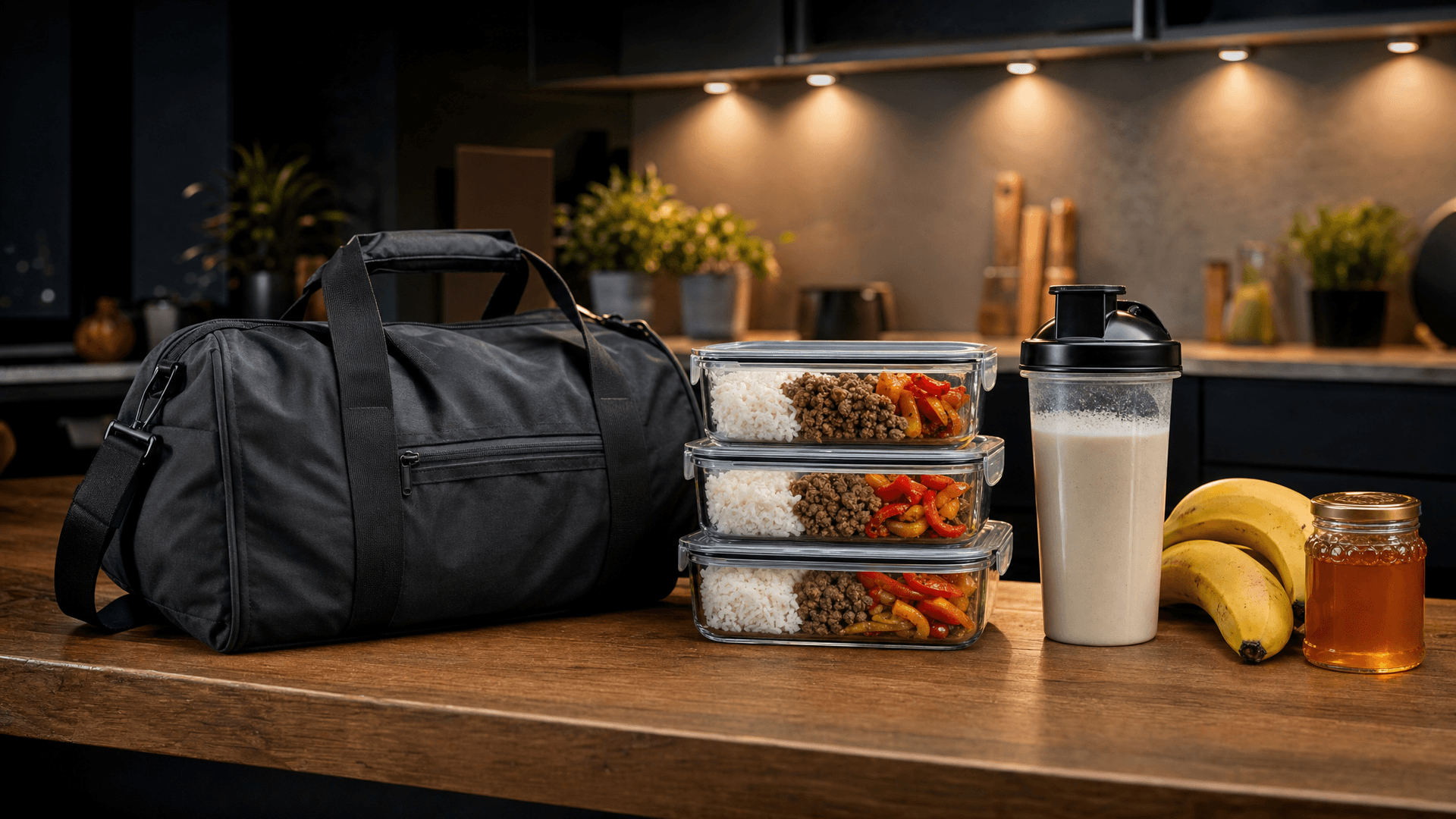
Every bulking guide on the internet quietly assumes one thing: that lifting is the only thing you do.
Eat your TDEE plus 400. Lift four times a week. Be patient. Great advice — if your entire weekly activity is 45 minutes of squats and a slow walk to the car.
But you play. You've got five-a-side Tuesday, pickup ball Thursday, and a league game Saturday morning. Or you're rolling three nights a week at the gym and getting absolutely wrecked by a purple belt who weighs 18 lb less than you. That's 600 to 1,000 calories a session you're burning and never accounting for.
So you do the math from the calculator, you eat what it says, and the scale doesn't move for two months. Then someone tells you to "just do less cardio," which is a useless answer when you've got a match Saturday and you're not skipping it.
Here's the thing: you don't have to choose. You just have to do the math honestly and eat like an athlete instead of like a bodybuilder who occasionally jogs.
- Your sport can add 600-1,000 calories to a single day — that's your entire surplus, gone
- Build your intake off practice days, not a weekly average, so you're never accidentally in a deficit
- Use two calorie targets: a high one for sport days, a lower one for lift-only and rest days
- Eating around a match is nothing like eating around a bench day — go lower fat, higher carb, and eat closer to the session
- Protein goes up, not down: aim for the top of the range because you're recovering from two stressors
- Expect slower gain. Half the rate for twice the time still gets you there.
Your sport is a second job your calorie math never hired
Most guys anchor their bulk to an online TDEE calculator. You pick "moderately active — exercise 3-5 days per week," it spits out a number, you add 400, and you call it a bulk.
The problem is that "moderately active" was built for someone who lifts. It was not built for someone who lifts and sprints for 90 minutes on grass. The activity multiplier doesn't stretch far enough, and the gap is not small.
Rough burn for an hour of hard effort, for a guy around 165 lb:
| Activity (60 minutes, hard effort) | Approximate calories burned |
|---|---|
| Weight training (typical hypertrophy session) | 250-350 |
| Basketball (full-court pickup) | 550-750 |
| Soccer (competitive match pace) | 600-900 |
| BJJ (live rolling, not drilling) | 600-850 |
| Boxing / Muay Thai sparring rounds | 700-950 |
Two things jump out. First, your sport burns roughly two to three times what a lifting session does. Second, a Saturday match plus the warm-up, plus the nerves, plus walking to the pitch, can easily clear 1,000 calories on its own.
Now stack that. If you play three times a week and your calculator undercounted by 500 calories a session, you're 1,500 calories short every week. That's your entire surplus wiped out and then some. You're not failing to bulk. You're maintaining, with extra steps.
This is the same trap guys with physically demanding jobs fall into — the burn is real, it's daily, and it hides inside a number you never audited.
Hard training days also mess with your water weight. Glycogen holds roughly 3g of water per gram stored, so a depleting session can drop the scale 2-4 lb overnight that comes right back once you refill. Never judge a bulk off a Sunday morning weigh-in after a Saturday match.
Step 1: build your number off training days, not averages
Here's where most people go wrong. They calculate a weekly average and eat that every day.
On paper it works out. In practice it means on your two hardest days of the week you're eating 800 calories below what you burned, and your body doesn't care that Wednesday was generous. Recovery happens on the day, not on the ledger.
Do it this way instead.
1. Find your true baseline. Forget the calculator. Eat a fixed amount for 10-14 days, weigh yourself every morning, and see what the weekly average does. If your weight is flat, that intake is your maintenance — for that week's activity level. This takes two weeks and it's the only number in this entire article you can actually trust.
2. Add the sport on top. For each session, add a real estimate: 500-700 for a training session, 700-1,000 for a competitive match or a hard sparring night. Don't use your watch. Wrist heart-rate monitors routinely overestimate burn in stop-start sports by 20-30%.
3. Add your surplus last. On top of everything, add 300-400 calories. That's the actual bulk.
So a 160 lb guy at 5'11" who lifts four times a week and finds his maintenance at 2,900 might land here:
- Rest day: 3,300
- Lift-only day: 3,300
- Practice day (soccer or BJJ): 3,900
- Match day: 4,200
Yes, that's a lot of food. That's the honest cost of doing both. If those numbers make you wince, read our breakdown of why fast-metabolism hardgainers struggle to gain — the tactics for getting calories in without feeling like a stuffed sock apply double when you're also burning them on a pitch.
Don't try to eat the extra 600 in one heroic meal. Two 17 oz shakes — one before practice, one right after — will cover almost the entire gap and cost you four minutes total.
Step 2: run two calorie targets, not one
Simplify the above into two numbers you can actually remember.
Low day — no sport, maybe a lift. Baseline plus your surplus. High day — any day you practice, play or roll. Low day plus 500-800.
That's it. Two numbers on a note in your phone. You don't need a spreadsheet with seven daily targets.
The high day is where you deliberately front-load easy calories: rice, pasta, potatoes, juice, honey, whole milk, dried fruit. Carbs are the right tool here, not fat. You're refilling glycogen you actually burned, and carbs digest faster and sit lighter than a plate loaded with grease.
A practical high-day shape:
| Meal slot | What it looks like |
|---|---|
| Breakfast | Oats, whole milk, whey, banana, peanut butter |
| Lunch | Big rice bowl, chicken thigh, olive oil, veg |
| Pre-practice (90 min out) | Bagel with honey, coffee, small yogurt |
| Post-practice (within 45 min) | Recovery shake with milk, whey, banana, oats |
| Dinner | Pasta, ground beef, sauce, parmesan |
| Before bed | Greek yogurt, granola, drizzle of honey |
Weigh a portion of rice once so you know what 5.3 oz dry actually looks like in your bowl. After that you can eyeball it forever.
On low days you can pull back the starch a little and let appetite catch up. That's the whole point of splitting them — you get one gear for output and one gear for recovery.
Step 3: eating around a match is nothing like eating around a bench day
This is the part nobody explains, and it's where most sport-playing lifters actually suffer.
Before a lifting session you can eat almost anything. A big meal 7 oz of chicken with rice 60 minutes before squats is fine. You're standing still between sets. Nothing is going to slosh.
Before a match or a rolling session, that same meal is a disaster. You're sprinting, changing direction, getting compressed, inverted, and knelt on. Fat and fibre sit in your stomach for hours. Get sat on in side control with a full stomach and you'll find out exactly how much fibre you ate.
Before
- 3 hours out: your last full meal. Normal size, moderate fat, plenty of carbs.
- 60-90 minutes out: the top-up. Low fat, low fibre, mostly carbs. A bagel with honey, a banana with white bread, a rice cake stack, a sports drink. Aim for 60-100g of carbs here.
- 20 minutes out: optional. A piece of fruit or a few sips of a carb drink if you feel empty.
Skip the "clean" whole-grain, high-fibre stuff pre-session. Save it for the rest of the day. White bread and white rice exist for exactly this window.
During
For anything over an hour of hard work, drink your calories. A bottle with 30-60g of carbs — a scoop of dextrose, diluted juice, or a standard sports drink — keeps your output up and, more importantly, keeps you from burning through your session in a hole you have to dig out of later.
This is not sugar you have to feel guilty about. You're bulking. It's the cheapest, easiest surplus you'll ever get, and it's landing exactly where it's useful.
After
The post-session window matters more for you than for the guy who only lifts, because you've got a second training stressor to recover from before the week's out.
Within 45 minutes: 40g of protein and 80-120g of carbs. A shake with whey, whole milk, a banana and a scoop of oats does it in one glass. Then eat a real meal within two hours.
The single biggest mistake here is the "I'm not hungry after training" surrender. Hard sport blunts appetite for 60-90 minutes. If you wait until you feel like eating, you've lost the window and 700 calories with it. Drink something instead — liquids bypass the appetite problem entirely.
Late-night training
Rolling that finishes at 9:30pm is its own problem. You come home wired, it's late, and you don't want a full meal.
Eat anyway. A late meal is not going to make you fat — that's a myth that refuses to die. Have your shake in the car, then something real at home: eggs and toast, leftover pasta, a rice bowl. The bed you're going to is where the actual growing happens, and it works better with fuel in the tank.
Sport-specific adjustments
Soccer
Soccer is the highest-burn sport on this list because of sheer volume — a match is 90 minutes of repeated sprinting with almost no real rest. Midfielders cover the most ground and pay the most.
Two things to watch. First, the eccentric load of sprinting and decelerating is brutal on hamstrings and quads, which means your leg day and your match day need to be as far apart as you can get them. Second, soccer players tend to be chronically underfed on carbs, which is exactly the fuel their sport runs on.
If you play once a week and train twice, treat match day as the highest calorie day of your week — no exceptions, no "I'll make it up Sunday."
Basketball
Pickup basketball is deceptive. It doesn't feel as hard as a match because there's constant stoppage, but you'll play for two hours without noticing and jump a few hundred times. The jumping is the part that steals from your lifting.
Basketball players also tend to underestimate session length. A "quick run" that started at 7 is finishing at 9:15. Track the actual clock, not the intention, and eat accordingly. If you're playing twice a week for two hours, that's not a side activity — that's a training block.
BJJ
Grappling is the strangest one for a bulk, for two reasons.
Isometric burn. Rolling is grip, frame and posture — enormous sustained tension with very little movement. You burn a huge amount for how little distance you cover, and it fries your forearms and grip for days. If your deadlift or row numbers are falling, your grip is the bottleneck, not your back.
Weight class psychology. This is the real killer. Half the guys reading this are secretly scared to gain because they'll move up a division. Be honest with yourself: are you competing this season, or are you telling yourself you might? If a competition isn't on the calendar, gaining 9 lb of muscle over six months will make you better in every single division, including the one above.
Add a dedicated grip-recovery habit — hanging from a bar for 30 seconds, wrist circles, and forearm stretching after class. Fresher forearms mean you can actually load your pulls, and pulls are where a lot of upper-body mass comes from.
Protein and recovery go up, not down
You're recovering from two different kinds of damage: mechanical from lifting and metabolic plus impact from your sport. So protein sits at the top of the range, not the middle.
Target 0.9-1.0g per lb of bodyweight. For a 165 lb guy that's about 160g a day, split across four or five feedings so you're never going eight hours without amino acids in the system.
Practically, that's something like 7 oz of chicken at lunch, 7 oz of beef at dinner, two shakes, and a Greek yogurt. Nothing exotic.
Then there's the part that isn't food:
- Sleep is non-negotiable. Seven hours minimum, and if you can push to eight-plus on your heaviest weeks, take it. You're asking your body to do two recovery jobs at once.
- Hydrate more than you think. Add roughly 17-25 oz of water per hour of sport on top of your normal intake. Dehydration reads as fatigue, and fatigue reads as "I need to cut back on lifting."
- Take real deload weeks. Every 6-8 weeks, cut your lifting volume by roughly a third while keeping calories high. You'll come back stronger and you won't lose an inch.
Where lifting fits in the week
You can't lift five days a week and play three days a week. Something will break, and it'll usually be your knees or your motivation.
Three full-body or upper/lower sessions is the sweet spot. Here's a workable week for someone with soccer training Tuesday and Thursday and a match Saturday:
| Day | Session |
|---|---|
| Monday | Lower body — heavy, moderate volume |
| Tuesday | Soccer training |
| Wednesday | Upper body — push emphasis |
| Thursday | Soccer training |
| Friday | Upper body — pull emphasis, light legs |
| Saturday | Match |
| Sunday | Full rest |
Note what's missing: there's no heavy leg day within 48 hours of the match. Legs go Monday, the match is Saturday, and Friday's leg work is light and single-leg at most.
Cut anything from your program that competes directly with your sport for recovery — long conditioning finishers, high-rep leg circuits, plyometric work. Your sport already delivers all of that. Our guide on how much cardio is too much while bulking covers the trade-off in more detail, and the logic is the same: the goal is the minimum extra work that doesn't cost you gains.
Six mistakes that kill sport bulks
1. Eating the same amount every day. Rest-day calories on a match day is a self-inflicted deficit. Split your targets.
2. Trusting your watch. Fitness trackers overestimate burn in stop-start sports significantly. Use them for trends, never for your food math.
3. Going heavy on legs the day before a game. You'll play badly and recover from neither. Push it to the far end of the week.
4. Skipping the post-session shake because dinner is in two hours. Two hours is 500 calories you can't get back, and appetite doesn't work in your favour after hard training.
5. Eating "clean" before a match. Brown rice, beans and broccoli 90 minutes before rolling is a punishment, not a strategy. Low fibre, low fat, high carb — that's the pre-session rule.
6. Panicking after one flat week. Sport-heavy bulks are noisier than regular ones. Water shifts from glycogen depletion, sodium swings and inflammation will mask two weeks of real progress.
How to know it's actually working
Weigh yourself every morning, same conditions, and only ever look at the weekly average. Daily numbers are noise, and your noise is louder than most people's.
Target 0.5-0.7 lb per week. That's slower than the standard bulking advice, and it should be. You're building while spending, so the margin is thinner. If you're gaining 1.5 lb a week while playing three times a week, you're gaining a lot of fat.
Beyond the scale, track these every four weeks:
- Waist measured at the navel, first thing in the morning
- One upper-body and one lower-body lift's top set
- How you feel in the last 15 minutes of a session
That third one is the real athlete's metric. If you're bulking correctly, you should be finishing games and rolls stronger, not more gassed. If your late-session performance is falling off while the scale climbs, you're gaining the wrong kind of weight or you're under-fuelling on the day.
Give it 12 weeks before you judge anything. Four weeks tells you nothing.
Getting the calories in when your week is already full
The math in this article is straightforward. Actually eating 4,000 calories on a Saturday when you've got a 10am kickoff, an afternoon of errands, and a body that stopped feeling hungry at 2pm — that's the hard part.
That's the gap FuelTheGains was built for. It's designed for guys who need a high-calorie intake that doesn't take over their day: meals and shakes built around real surplus targets, with the protein already handled, so getting an extra 700 calories in after training is a two-minute decision instead of a cooking project.
If your problem isn't knowing what to eat but finding the time and appetite to eat it around a training schedule, take a look at . It's a lot easier to hit a high day when the food is already sorted.
The bottom line
You don't have to quit your sport to build muscle, and you don't have to accept a fake bulk where the scale never moves.
Count the sport honestly. Run two calorie targets. Eat light and carb-heavy before you play, and drink your recovery immediately after. Keep protein high, lifting to three quality sessions, and legs away from game day.
Then be patient with a slower rate of gain, because half the speed for twice the time still gets you the same body — and unlike the guy who only lifts, you'll actually be able to use it.