
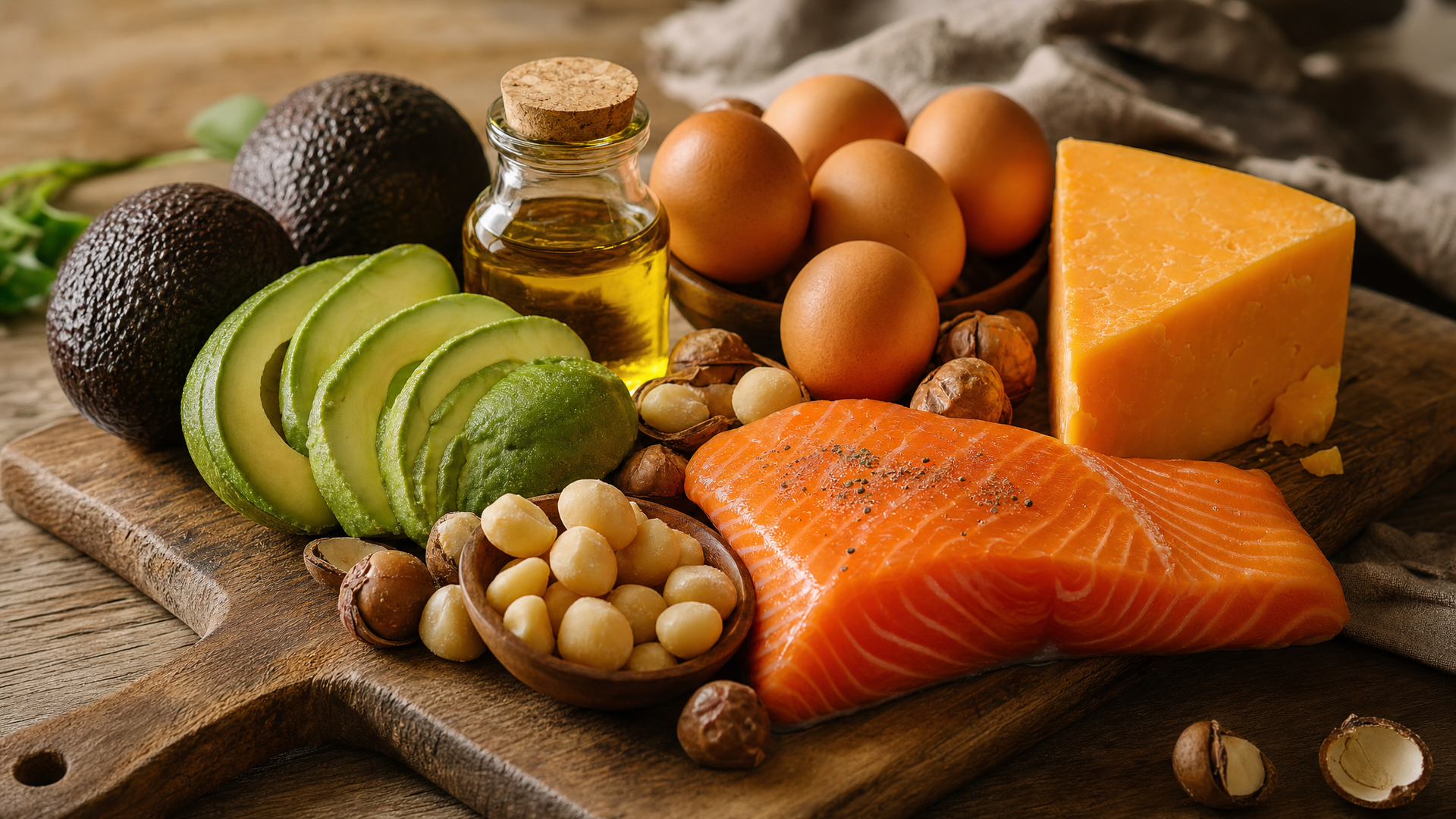
Most bulking advice assumes you're shoveling rice, oats, and pasta down your throat all day. Carbs are the cheat code — they're calorie-dense, easy to eat fast, and they barely fill you up.
So what happens when you take carbs off the table?
If you're keto for the mental clarity, the steady energy, or just because your body runs better without the blood-sugar rollercoaster, you've probably hit a wall the second you tried to gain weight. Everyone tells you to "just eat more," but keto food is filling as hell. A ribeye and three eggs and you're stuffed for hours — nowhere near the surplus you need.
Here's the truth nobody says out loud: bulking on keto is harder than bulking on carbs. Not impossible. Harder. And it fails for a completely different reason than normal bulking fails.
Normal skinny guys fail because they don't eat enough on purpose. Keto skinny guys fail because they physically can't — the diet is so satiating they hit a wall of fullness before they hit their calorie target. This guide fixes exactly that.
- Keto bulking works, but you gain muscle from the calorie surplus and protein — not from ketones
- Fat is your surplus lever: it's 9 calories per gram and doesn't fill you up like protein does
- Set protein at roughly 1.6-2.2g per kg of bodyweight, then let fat carry the rest of your calories
- Keep net carbs under 30-50g so you stay in ketosis while still eating volume
- Drink your surplus: fat-loaded coffee, cream-based shakes, and nut butter beat trying to chew it all
- Salt aggressively and hydrate — the keto flu will wreck your training if you ignore electrolytes
Does Keto Bulking Even Work?
Let's kill the biggest myth first: you do not build muscle from being in ketosis. You build muscle from three things — a calorie surplus, enough protein, and progressive overload in the gym. Ketosis is just a metabolic state, not a muscle-building magic trick.
That cuts both ways. The good news: keto doesn't stop you from gaining muscle. Plenty of research shows that when protein and total calories are matched, low-carb and high-carb lifters build similar amounts of muscle over time. The bad news: keto also gives you zero muscle-building advantage. Anyone selling you "anabolic ketosis" is selling you nothing.
So why do it? Two honest reasons. First, if you already feel better on keto — steadier energy, no afternoon crashes, less bloat — that quality of life makes you more consistent, and consistency is what actually builds a physique. Second, some guys just digest fat and protein better than a mountain of carbs. If that's you, forcing down oatmeal you hate is a worse plan than a keto bulk you'll actually stick to.
The one real trade-off: your gym performance on very high-intensity sets may dip slightly, especially in the first few weeks. Once you're fat-adapted, most lifters recover most of that. It's a minor tax, not a dealbreaker.
Keto is a delivery method, not a shortcut. If you eat enough calories and enough protein, you'll grow. If you don't, no amount of ketones will save you.
Why Keto Bulking Is So Damn Hard
The core problem is a word you don't hear enough in bulking guides: satiety.
Protein and fat are the two most filling macros on earth. Fiber-rich low-carb veggies pile on even more fullness. Carbs, by contrast, are the least filling per calorie — which is exactly why a normal bulker can inhale a giant bowl of pasta and be hungry again in two hours.
Strip the carbs out and every meal becomes a fullness bomb. You sit down to a steak, some eggs, half an avocado, and a handful of nuts, and 700 calories in, your stomach taps out. On a carb bulk, 700 calories is a snack. On keto, it can be a whole meal you're struggling to finish.
There's a second trap: protein is too filling to be your calorie source. New keto bulkers make the mistake of just eating more and more meat. But protein is the most satiating macro of all. Load your surplus onto protein and you'll be miserable, full, and still short on calories. Worse, chronically overeating protein can nudge you out of ketosis through a process called gluconeogenesis, where your body converts excess protein into glucose.
So the keto bulker is squeezed from both sides. You can't lean on carbs (they're capped), and you can't lean on protein (it fills you up and can break ketosis). That leaves exactly one lever big enough to create a real surplus: fat.
Fat is the keto bulker's best friend. It's the most calorie-dense macro at 9 calories per gram — more than double the 4 in protein and carbs — and gram for gram it's far less filling than protein. If you want to understand how to use different fats strategically, our guide to the best fats for bulking breaks down which ones to lean on. On keto, that knowledge isn't optional. It's the whole game.
Set Your Keto Bulking Calories
Before you touch a single macro, you need a target. Guessing is why most bulks stall. If you want the full walkthrough with formulas, read our step-by-step guide to calculating bulking calories — but here's the keto-specific short version.
Step 1: Estimate your maintenance calories (TDEE). A rough starting point is your bodyweight times a multiplier based on activity. For a lifter training 3-5 times a week, multiply your weight in pounds by 15-16, or use an online TDEE calculator. A 154 lb guy who trains hard lands somewhere around 2,500-2,700 maintenance calories.
Step 2: Add your surplus. For a lean bulk that minimizes fat gain, add 300-500 calories on top of maintenance. Don't go crazy — a bigger surplus just means more fat, not more muscle. So our 154 lb lifter targets roughly 2,900-3,100 calories per day.
Step 3: Set protein. Aim for 0.7-1.0g per lb of bodyweight. For our example lifter that's roughly 130-155g of protein daily. Lock this number in — it's the priority.
Step 4: Cap carbs. Keep net carbs under 30-50g per day to stay in ketosis. Net carbs means total carbs minus fiber. This is your ceiling, not a target — you'll mostly get these from low-carb veggies and nuts.
Step 5: Fill the rest with fat. Whatever calories are left after protein and carbs, you eat as fat. This is almost always a big number — often 200g+ of fat per day. That's normal on keto. Fat is doing the heavy lifting.
Do not skip the protein calculation and just "eat a lot of meat." Overshooting protein while undershooting fat is the single most common keto bulking mistake — you'll feel stuffed, undereat total calories, and risk dropping out of ketosis.
Here's how the macros shake out for a 154 lb lifter bulking at 3,000 calories:
| Macro | Target | Calories | % of total |
|---|---|---|---|
| Protein | 140g | 560 | ~19% |
| Net carbs | 30g | 120 | ~4% |
| Fat | 235g | 2,115 | ~70% |
| Total | — | ~2,795 | 100% |
Notice how fat dwarfs everything else. That's not a mistake — that's keto working as designed.
The Fat-Loading Playbook
This is where keto bulking is won or lost. You need to add fat to nearly everything, deliberately and constantly. Here's the tactical toolkit.
Cook and finish with fat
Every meal is an opportunity to add 100-300 calories of pure fat with almost no extra volume:
- Cook eggs and meat in butter, ghee, or tallow instead of a dry pan
- Finish steak and veggies with a heavy drizzle of olive oil — 0.5 oz of olive oil is 120 calories you'll barely notice
- Melt cheese over everything: eggs, burgers, broccoli
- Add a scoop of sour cream or full-fat crème fraîche to sauces and sides
Snack on calorie bombs
Keto snacks can be absurdly dense. A small handful goes a long way:
- Macadamia nuts — the fattiest nut, around 200 calories per 1 oz
- Nut butters — a couple of tablespoons of almond or macadamia butter straight off the spoon
- Cheese and hard salami — pair 1 oz of each for a fast 250 calories
- Dark chocolate (85%+) — a few squares for a low-carb treat
- Pork rinds dipped in guacamole — crunchy, zero carbs, tons of fat
Build fat-loaded meals around anchors
Pick a protein anchor, then pile fat on top. A 7 oz ribeye is already fatty — add butter, avocado, and a side cooked in oil and you've got an easy 900-1,000 calorie meal. Salmon, chicken thighs (not breast — thighs are fattier), and ground beef at 80/20 are all better keto bulking choices than lean cuts.
Fatty cuts of meat are your friend on a keto bulk. Ground beef at 80/20 instead of 93/7, chicken thighs instead of breast, ribeye instead of sirloin. The fattier cut adds hundreds of calories for the same amount of chewing.
Drink Your Surplus
Here's the single biggest unlock for keto bulking: liquid calories don't fill you up the way solid food does. When chewing a fourth meal feels impossible, drinking it is your escape hatch.
The fat-loaded coffee
The classic keto move. Blend your morning coffee with butter and MCT oil or heavy cream. A tablespoon of butter plus a tablespoon of MCT oil turns a zero-calorie coffee into a 200+ calorie fat delivery system that keeps you smooth all morning. Blend it — don't stir — for a latte-like foam.
The keto mass-gainer shake
This is your secret weapon. Blend:
- 1 cup heavy cream or full-fat coconut milk
- 1 scoop of a low-carb or keto protein powder
- 2 tablespoons of macadamia or almond butter
- 1 tablespoon MCT oil
- A handful of ice, a pinch of salt, cinnamon or unsweetened cocoa to taste
That's roughly 700-900 calories and 30g of protein in a glass you can drink in five minutes. Have one between meals or before bed and you've closed most of your surplus gap without touching your fullness.
Drink your shake between meals, not with them. Sipping it 60-90 minutes after lunch means you're adding calories during a window when your stomach has room, instead of trying to cram more in when you're already full.
Other liquid tricks
- Stir MCT oil or heavy cream into soups and bone broth
- Add heavy cream to your coffee throughout the day — each splash is 50-100 calories
- Full-fat Greek yogurt blended with nut butter and berries as a spoonable "shake"
Liquid fat is how you go from "I physically cannot eat more" to hitting your surplus every single day.
Handle the Keto Flu (Or It'll Wreck Your Bulk)
When you first cut carbs, your body dumps water and electrolytes fast. The result is the infamous "keto flu": headaches, fatigue, brain fog, cramps, and — critically for a bulker — garbage workouts. You can't build muscle if you're too drained to lift.
The fix is almost entirely about electrolytes:
- Sodium: Salt your food aggressively and sip salted water or broth. Most people need far more than they think on keto — aim for around 4-5g of sodium per day.
- Potassium: Get it from avocados, leafy greens, and salmon.
- Magnesium: Nuts, seeds, and dark leafy greens help; many keto lifters supplement it to fix cramps and sleep.
- Water: You'll pee more on keto, so drink more to compensate. Aim for pale-yellow urine.
If your strength craters in week one or two, don't panic and quit — it's almost always dehydration and low sodium, not "keto killing your gains." Fix your electrolytes first before you blame the diet.
Give yourself 2-4 weeks to become fat-adapted. After that, energy stabilizes, training feels normal again, and the whole thing gets a lot easier.
A Sample Keto Bulking Day
Here's what roughly 3,000 calories and 140g of protein looks like in practice for our 154 lb lifter. Adjust portions to hit your own numbers.
Breakfast: 3 eggs scrambled in butter, 1 oz cheddar, half an avocado, and a fat-loaded coffee with heavy cream and MCT oil. (~750 cal)
Lunch: 7 oz ground beef (80/20) with sautéed spinach in olive oil, topped with sour cream and more cheese. (~800 cal)
Afternoon shake: The keto mass-gainer — heavy cream, protein powder, macadamia butter, MCT oil. (~800 cal)
Dinner: 6 oz salmon roasted with butter, a big side of broccoli finished in olive oil, and a handful of macadamia nuts. (~700 cal)
That's roughly 3,050 calories with fat doing the heavy lifting and protein landing right on target. Notice there are only four eating occasions — you're not grazing all day. Dense, fat-loaded meals plus one shake gets you there.
If you're still short at the end of the day, the easiest fix is a spoon of nut butter or a square of high-fat cheese before bed. It's the lowest-effort way to add 150-200 calories without a whole meal.
Common Keto Bulking Mistakes
Even guys who understand the theory trip over these. Avoid all five:
- Eating too much protein, not enough fat. The classic. Protein fills you up and can nudge you out of ketosis. Set it, don't chase it.
- Fearing fat. You've been told your whole life that fat is bad. On a keto bulk, fat is your surplus. Pour the olive oil. Eat the fatty cut.
- Ignoring electrolytes. Blaming keto for weak workouts when the real problem is you're not eating enough salt. Fix this first.
- Not tracking. Keto macros are unforgiving — a few "harmless" carbs here and there add up and kick you out of ketosis. Track for at least the first month.
- Undereating because you're full. Being full is not the same as hitting your calories. If solid food maxes you out, that's what the shakes and fat-loaded coffee are for.
Some guys genuinely struggle to hit a surplus on keto no matter what. If you've given it an honest 6-8 weeks and can't gain, there's no shame in a more flexible low-carb approach — or checking out our gluten-free bulking plan, which keeps carbs in play while still avoiding the foods that bother a lot of lifters.
Track Progress the Right Way
You can't manage what you don't measure. On any bulk, the scale is your primary feedback tool — but it's noisy, especially on keto where water weight swings hard in the first weeks.
Weigh yourself every morning, same conditions, and track the weekly average. A good lean-bulk pace is gaining around 0.5-1 lb per week. Faster than that and you're probably adding more fat than muscle.
If the weekly average is flat for two weeks, add 200-300 calories — the easiest way is one more tablespoon of MCT oil or a bigger shake. If you're gaining too fast or getting soft, trim a little fat back. This is a dial you adjust, not a set-and-forget number.
Also watch your lifts. If your working weights are creeping up month over month, you're building muscle, not just gaining weight. Strength going up plus scale going up slowly is the exact combination you want.
Where FuelTheGains Fits In
Let's be honest about the hardest part of all this: hitting your numbers, every single day, when the food fights you the whole way. Keto bulking lives or dies on precision — protein locked in, carbs capped, fat filling the gap — and doing that math by hand for every meal gets old fast.
That's the exact problem is built to solve. It figures out your keto bulking calories and macros for you, then helps you actually hit them with meals and shakes that fit inside your carb ceiling. Instead of guessing whether that ribeye-and-avocado dinner leaves you room for a shake, you just follow the plan.
If you're the type who feels better on keto but keeps stalling out on the surplus, having the numbers handled for you removes the one thing that trips up most hardgainers: the daily grind of tracking. Consistency is what builds muscle, and the easier the plan is to follow, the more consistent you'll be.
The Bottom Line
Bulking on keto isn't magic and it isn't impossible — it's a math problem with a fullness tax. You lock in your protein, cap your carbs, and lean on fat to build the surplus that carbs would normally handle. When solid food maxes you out, you drink the difference.
Do that consistently, keep your electrolytes topped up, and progressively overload in the gym, and you'll build muscle on high-fat just like anyone else. The ketones aren't doing the work — the surplus and the protein are.
Pick your fat sources, blend your first shake, and give it an honest 8 weeks. Your fork does the rest.