
You logged 3,500 calories. You ate 3,500 calories. Your body kept maybe 3,000 of them.
That's not a rounding error. That's the difference between gaining 1 lb a month and standing on the scale in November at the exact same weight you were in August, wondering what the hell you're doing wrong.
Here's the thing nobody tells skinny guys: a calorie on a label is not a calorie in your bloodstream. Between your fork and your fat cells there's a whole gauntlet — chewing, stomach acid, enzymes, gut bacteria, transit time — and every one of those steps takes a cut. Some foods hand over almost everything. Some foods walk through your digestive system, wave, and leave.
If you've been hitting your numbers on paper for two months and the scale hasn't budged, absorption is one of the first places to look. Let's break down exactly where the calories go, which foods leak the most, and the specific swaps that recover 200-500 calories a day without adding a single logged one.
- The number on a food label is gross energy, not what your body actually absorbs
- Protein burns 20-30% of its own calories during digestion — fat burns almost none
- Whole almonds deliver roughly 20-30% fewer calories than the label says; almond butter delivers nearly all of them
- High-fiber "clean" bulk foods can block 100-150 calories a day from ever being absorbed
- Grinding, blending, cooking and softening food raises how much energy you actually keep
- Cooked egg protein is about 91% absorbed versus roughly 51% raw
- Absorption losses stack: a typical clean-bulk day can leak 300-500 calories versus an identical logged day built from softer, denser foods
The Calorie on the Label Isn't the Calorie in Your Blood
Food labels are built on a system from the 1890s. Wilbur Atwater burned food in a calorimeter, measured the heat, subtracted a rough estimate for what comes out the other end, and landed on the numbers we still use: 4 calories per gram of protein, 4 for carbs, 9 for fat.
It was brilliant for 1896. It's blunt in 2026.
Atwater's system assumes all protein digests the same, all fat digests the same, and that food form doesn't matter. None of that is true. Almonds don't digest like almond butter. Raw oats don't digest like cooked oats. Steak doesn't digest like whey.
There are three separate leaks between the label and your bloodstream:
- The thermic effect of food (TEF) — the energy your body spends breaking food down
- Incomplete absorption — calories that physically exit in your stool
- Fiber interference — fiber speeding transit and trapping fat and protein on the way out
Individually, each one is small. Stacked on a high-volume, high-fiber, whole-food bulking diet, they're the reason your surplus is fictional.
Absorption losses hurt hardgainers disproportionately. A guy eating 2,000 calories to cut loses maybe 200 to these leaks and doesn't care. You're eating 3,500 and trying to bank a 400-calorie surplus. Lose 400 to digestion and your surplus is exactly zero.
The Thermic Effect of Food: Your Macros Charge Different Taxes
Digestion isn't free. Your body spends energy chewing, secreting acid, running enzymes, and shuttling nutrients across your gut wall. That cost is the thermic effect of food, and it varies wildly by macronutrient.
| Macronutrient | TEF (% of calories burned digesting) | Calories kept per 100 eaten |
|---|---|---|
| Protein | 20-30% | 70-80 |
| Carbohydrate | 5-10% | 90-95 |
| Fat | 0-3% | 97-100 |
| Alcohol | ~20% | ~80 |
| Mixed meal (typical) | ~10% | ~90 |
Read that protein row again. A 40g protein serving of chicken breast costs you roughly a quarter of its own calories just to process. That 165-calorie chicken breast is functionally closer to 120 usable calories.
This is fantastic news when you're cutting. It's a tax when you're bulking.
What this means for a high-protein bulk
A lot of skinny guys read "protein builds muscle" and go absolutely nuclear on it — 1.1-1.4g per lb of bodyweight, chicken and whey and egg whites at every meal. For a 165 lb guy that's 190-225g of protein a day, or 760-900 calories from protein alone.
At 25% TEF, you just burned 190-225 calories digesting it.
You don't need that much. Muscle protein synthesis maxes out around 0.7-1.0g per lb. Everything above that is expensive, filling, and partly incinerated on arrival. Take the extra 60g of protein you didn't need, replace it with olive oil and white rice, and you've quietly recovered 150+ calories a day at the same logged intake.
Don't read this as "eat less protein." Read it as "stop eating protein you don't need instead of calories you do." Hit 0.7-1.0g per lb and spend the rest of your budget on carbs and fat.
Nuts Are the Biggest Lie in Your Food Log
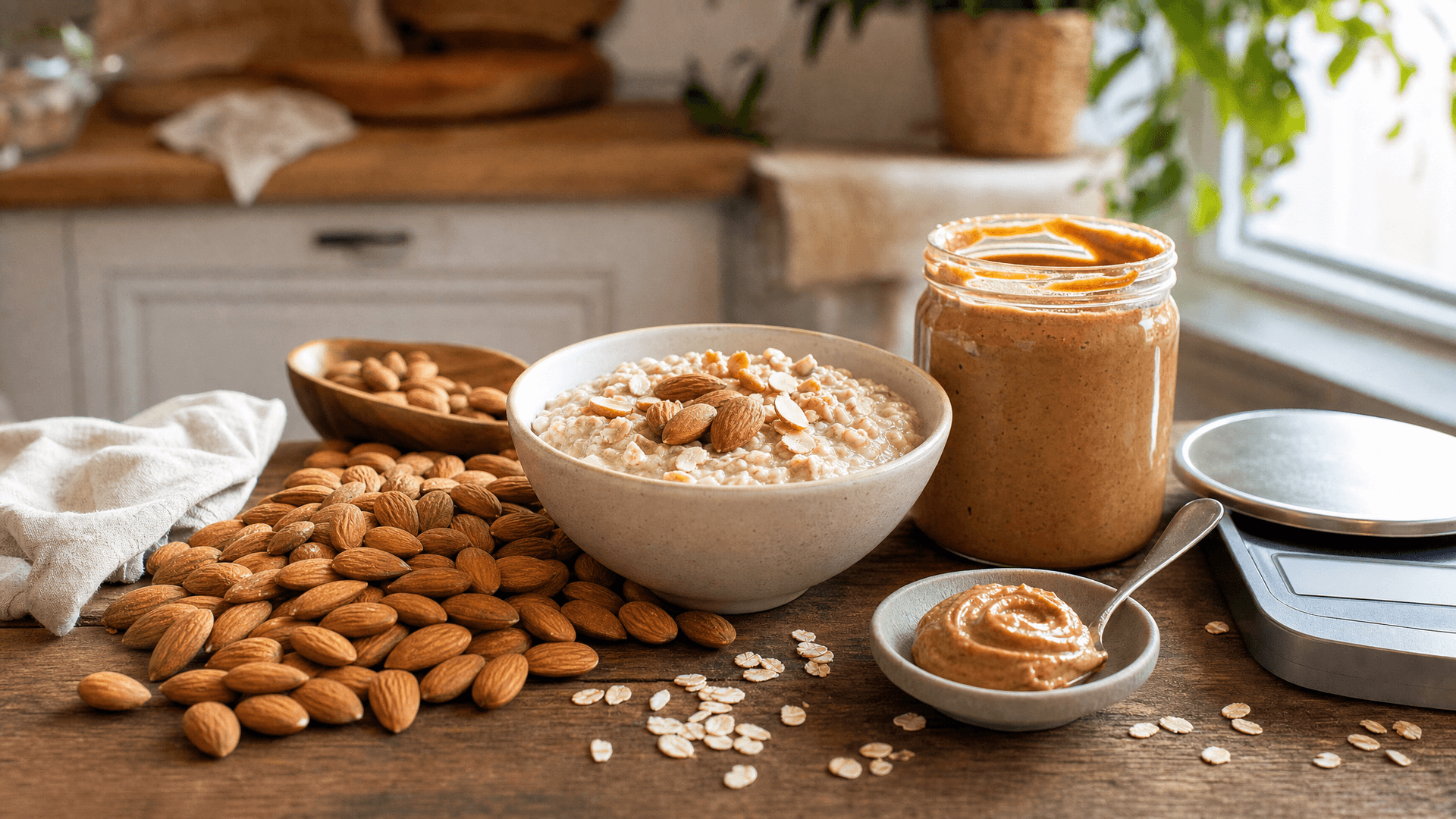
Nuts are the number-one recommendation given to hardgainers. Calorie dense, portable, whole food, easy to add. And they're also where the biggest single absorption gap lives.
USDA researchers ran controlled feeding studies where they measured what actually came out the other end. The results were not subtle:
| Food | Label calories per serving | Actually absorbed | Gap |
|---|---|---|---|
| Whole almonds | 170 | ~129 | ~24% |
| Roasted almonds | 170 | ~140 | ~18% |
| Almond butter | 170 | ~160-165 | ~4% |
| Walnuts | 185 | ~146 | ~21% |
| Pistachios | 160 | ~152 | ~5% |
| Peanut butter | 190 | ~185 | ~3% |
Here's the mechanism, and once you get it you can apply it to everything else you eat.
Almond fat is locked inside plant cell walls. Cell walls are made of cellulose, which humans cannot digest. If you eat a whole almond and chew it maybe fifteen times, you fracture the outer cells and free that fat — but the cells in the middle of each fragment stay intact. That fat rides straight through you, still sealed in its little cellulose box.
Grind the same almond into butter and you've mechanically ruptured essentially every cell. The fat is exposed. Your lipase gets to all of it.
Same nut, same log entry, 30-40 calories of difference per serving. Eat 2 oz of almonds a day and you're leaving 60-80 calories on the table daily — about 25,000 a year, or roughly 7 lb of theoretical tissue.
If your snack is "a handful of almonds," swap it for two heaping tablespoons of almond butter on toast. Nearly identical log entry, 30-40 more calories actually absorbed, and it goes down in twenty seconds instead of five minutes of jaw work.
Pistachios and peanuts are softer and break down more completely, which is why their gaps are small. The harder and more intact the nut, the more you leak.
Fiber: The Clean Bulk Tax
Fiber is genuinely good for you. It's also, for a hardgainer, an actively hostile macronutrient.
It works against you three ways:
It blocks absorption directly. Soluble fiber forms a gel in your small intestine that physically traps fat and protein and escorts them out. Research on high-fiber diets consistently shows increased fecal energy loss — roughly 1-2 calories lost for every extra gram of fiber, on top of the fiber's own calories not counting.
It speeds transit. Insoluble fiber pushes everything through faster. Less contact time with your gut wall means less absorption of everything, not just the fiber.
It kills your appetite. This is the big one. Fiber is the most filling thing you can eat per calorie. A guy eating 60g of fiber a day physically cannot get to 3,500 calories without misery.
Now look at the standard "healthy bulk" grocery list: oats, brown rice, sweet potatoes, broccoli, beans, whole wheat bread, apples, almonds. That's easily 50-70g of fiber a day.
| Daily fiber | Rough calories lost to malabsorption | Fullness impact |
|---|---|---|
| 20-25g | 20-40 | Minimal |
| 30-40g | 40-80 | Noticeable |
| 50-60g | 80-140 | Significant |
| 70g+ | 140-200 | Severe |
You want fiber. You want 25-35g, not 65g. That's enough for gut health and regularity with a fraction of the cost.
The fix is boring and it works: swap half your "brown" for "white." White rice instead of brown. Sourdough or white bread instead of dense whole wheat. Peeled potatoes instead of skin-on sweet potatoes. Fruit juice alongside whole fruit rather than instead of it.
White rice isn't a moral failure, it's a tool. It's calorie dense, nearly fiber free, almost completely absorbed, and it doesn't fill you up. It is arguably the single best bulking carb on earth. If you're struggling to eat enough, the brown rice is not the health-conscious choice — it's the choice that keeps you skinny.
If your fiber is high and your surplus is thin, you may also be under-eating in ways that have nothing to do with absorption. Our breakdown of why you're not gaining weight while bulking covers the other nine culprits worth ruling out.
Food Form: Why Blending, Cooking and Grinding Matter
The almond thing isn't an almond thing. It's a structure thing, and it applies across your whole diet. The more intact the food's physical structure when it hits your stomach, the more energy escapes.
Cooking
Cooking is the oldest calorie hack there is. Heat gelatinizes starch, denatures protein, and breaks down cell walls — all of which make nutrients dramatically easier to reach.
The numbers are big:
- Raw egg protein: ~51% absorbed. Cooked egg protein: ~91% absorbed. Nearly double.
- Cooked starch is absorbed far more completely than raw starch, which largely resists digestion entirely
- Cooked meat requires less chewing and less enzymatic work than raw
Practical translation: cook your oats. Don't eat them raw in a shaker. Overnight oats are fine because prolonged soaking does similar work to heat, but dry oats blitzed into a shake are the worst of both worlds.
Grinding and blending
Every mechanical step you take before food reaches your mouth is a step your gut doesn't have to take — and can't fail at.
- Whole nuts → nut butter: +15-25% absorbed
- Whole grains → flour: significantly more starch reached
- Whole fruit → smoothie: cell walls ruptured, faster gastric emptying
- Steak → ground beef: more surface area, softer matrix
This is why liquid calories are the hardgainer's best friend and it has nothing to do with "drinking calories is easier." A blended shake with milk, oats, banana and peanut butter is more completely absorbed and leaves your stomach faster than the same ingredients eaten separately. You get more of the calories and you get hungry again sooner.
Chewing
Yes, really. How thoroughly you chew changes how much you absorb, especially with nuts and seeds. Studies comparing 10, 25 and 40 chews per mouthful of almonds found meaningfully more fat released with more chewing.
But let's be honest about what you'll actually do: you're not going to count chews for the rest of your life. Just grind the nuts once and stop thinking about it.
There's a limit. Blending everything into a slurry means less chewing satisfaction, and some guys end up hungrier and snackier as a result. Use shakes to supplement meals, not to replace all of them.
Resistant Starch: The Rice and Potato Problem
One more leak, and it's a sneaky one because it happens after you cook.
When you cook starch and then cool it, some of it recrystallizes into resistant starch — a form your small intestine can't digest. It travels to your colon where bacteria ferment it. You recover some energy from that fermentation, but roughly half the calories of that portion are simply gone.
This matters because meal prep is the standard hardgainer advice. Cook 3.3 lb of rice on Sunday, portion it into containers, refrigerate all week. That cooling step converts a chunk of your carbs into something you don't fully absorb.
Rough numbers: cooling cooked rice or potatoes overnight can raise resistant starch content by several grams per 7 oz serving. On a day with three prepped rice portions, you might be quietly losing 50-90 calories.
The fix takes thirty seconds: reheat it properly. Reheating reverses a good portion of retrogradation and pushes the starch back into digestible form. Microwave your rice until it's genuinely hot, not lukewarm. Same for potatoes and pasta.
Cold pasta salad and cold rice bowls are great for a cut. They're working against you on a bulk.
The Absorption Math on a Real 3,500-Calorie Day
Let's make this concrete. Two days. Both log 3,500 calories. Both hit 180g protein. Same guy, 165 lb, same training.
Day A — the "clean bulk" build: oatmeal with whole almonds and berries, chicken breast with brown rice and broccoli, apple with a handful of raw almonds, salmon with sweet potato and green beans, cold prepped rice, Greek yogurt with chia seeds. Fiber: 64g.
Day B — the absorption-aware build: blended oats with almond butter and banana, chicken thigh with hot white rice and olive oil, almond butter on sourdough, salmon with peeled potatoes and butter, whole milk, full-fat yogurt with honey. Fiber: 28g.
| Leak | Day A loss | Day B loss |
|---|---|---|
| Thermic effect (protein-heavy vs balanced) | 340 | 285 |
| Whole nuts vs nut butter | 75 | 10 |
| Fiber malabsorption | 110 | 35 |
| Resistant starch (cold vs hot carbs) | 70 | 10 |
| Total lost | 595 | 340 |
| Net absorbed | ~2,905 | ~3,160 |
A 255-calorie daily difference at identical logged intake. Over a 16-week bulk that's roughly 28,000 calories — call it 7-8 lb of bodyweight you either gained or didn't.
And notice: Day A isn't a bad diet. It's the diet most people recommend. It's just optimized for satiety and micronutrients, which is exactly backwards for a guy trying to force weight on.
If your logged number itself is shaky, absorption is the second problem, not the first. Fix your measurements before you fix your food form — our guide to the most common calorie tracking mistakes covers the errors that make a 3,500 log actually mean 2,900.
8 Swaps That Add Calories Without Adding Calories
Every one of these keeps your log identical or nearly identical while raising what you actually absorb.
- Whole nuts → nut butter. The single highest-leverage swap. Recovers 20-25% of the nut's calories.
- Brown rice → white rice. Less fiber, faster transit, more complete absorption, easier to eat a lot of.
- Cold prepped carbs → properly reheated carbs. Free calories from a microwave.
- Whole fruit snacks → smoothies with the same fruit. Ruptured cells, faster gastric emptying, room for more food later.
- Excess protein → carbs and fat. Cap at 1.0g per lb and redirect the rest.
- Chicken breast → chicken thigh. Higher fat percentage means lower average TEF and a lot more calories per 3.5 oz.
- Raw oats → cooked or soaked oats. Gelatinized starch, dramatically more available.
- Skin-on potatoes → peeled potatoes with butter. Drop the fiber, add the fat.
Change nothing about your calorie target. Make swaps 1, 2 and 3 only. Weigh yourself daily for two weeks and compare weekly averages. If the trend moves and your intake didn't, absorption was your bottleneck.
What This Doesn't Excuse
Quick reality check, because absorption is a very convenient thing to blame.
If you're not gaining, the overwhelmingly likely cause is that you're eating less than you think. Untracked oil, eyeballed portions, weekend meals nobody logged, "one scoop" that's actually three quarters of a scoop. That's the first suspect, every single time.
Absorption is the second suspect. It's real, it's worth several hundred calories a day at the extremes, but it will never explain a guy who's genuinely eating 3,500 and gaining nothing over eight weeks. That guy is not eating 3,500.
Also worth checking: whether your surplus was ever big enough to begin with. A properly sized calorie surplus for a hardgainer is bigger than most people assume, and absorption losses are exactly why the standard "eat 200 over maintenance" advice fails so many skinny guys.
And if you have persistent digestive symptoms — chronic bloating, loose stools, visible undigested food, unexplained weight loss — that's not a food-form problem. Go see a doctor. Celiac disease, IBD, pancreatic insufficiency and SIBO all cause genuine malabsorption that no amount of blending will fix.
How to Know If Absorption Is Your Problem
Signs it's worth attacking:
- Your diet is genuinely high fiber — 50g+ a day
- Nuts and seeds are a major calorie source and you eat them whole
- You meal prep and eat most carbs cold or barely reheated
- Your protein is well above 1.0g per lb
- You feel stuffed constantly despite a scale that won't move
- Your food volume is enormous — huge plates of vegetables, salads, whole grains
Signs it isn't:
- You only track on weekdays
- You don't own a food scale
- You've been "bulking" for six weeks and the trend is flat, but you also had four nights out
- Your fiber is already under 30g and you already eat white rice
Where FuelTheGains Comes In
The frustrating part of all this is that it's invisible. Your tracking app doesn't have an "actually absorbed" column. It shows 3,500, you shrug, and you go another month wondering why nothing's happening.
That's the gap we built to close. Instead of handing you a calorie number and leaving you to figure out the rest, it builds meal plans around foods that are actually dense, actually absorbable, and actually eatable at volume — softer carbs, nut butters instead of whole nuts, fiber kept in a sane range, protein capped where it stops being useful. Hot meals designed to be reheated, not eaten cold out of a container.
Same target on paper. Meaningfully more of it ending up in your body. Which, when you're a hardgainer, is the entire game.
The Bottom Line
You are not a bomb calorimeter. The label tells you how much energy a food contains, not how much of it you'll keep, and the gap between those two numbers can run 10-20% on a diet built the way most people build one.
Protein burns a quarter of itself on the way in. Whole nuts hand back a quarter of what they promise. Heavy fiber blocks another chunk and fills you up while it's at it. Cold, raw, intact food gives up less than hot, ground, blended food.
None of that is a reason to eat garbage. It's a reason to stop optimizing your bulk for a cut. Grind the nuts, cook the oats, heat the rice, peel the potato, cap the protein, and dial fiber down to 25-35g.
Same log entry. Few hundred more calories where it counts. Go eat.