
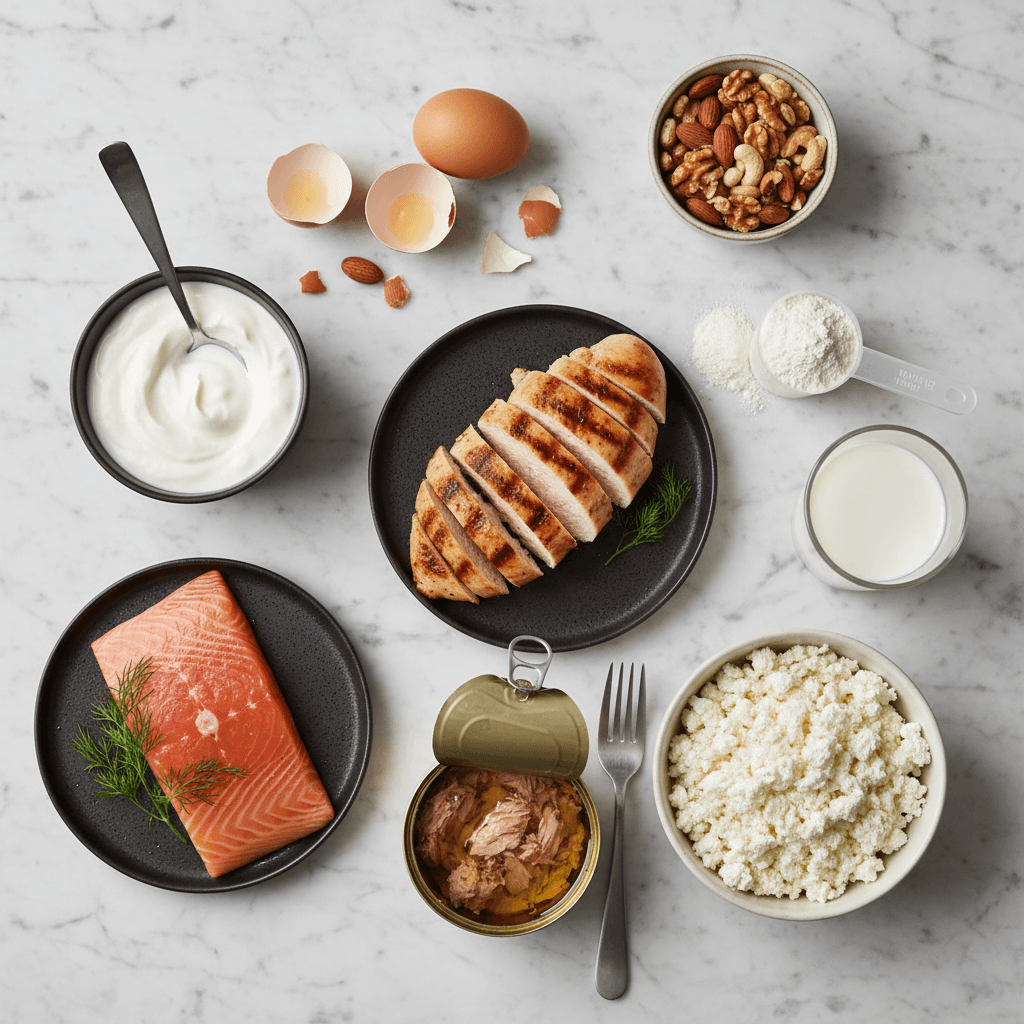
- Vise 1,6 à 2,2 g par kg de protéines pour prendre du muscle
- Au-delà de 2,2 g/kg, la recherche ne montre aucun bénéfice supplémentaire
- Répartis tes protéines sur 4 à 5 repas (30 à 50 g par repas) pour optimiser la synthèse
- Le timing des protéines compte moins que l'apport total journalier
- Les aliments entiers valent mieux que les compléments — utilise la whey uniquement pour combler les écarts
"De combien de protéines ai-je besoin pour prendre du muscle ?" C'est la question la plus cherchée en nutrition sportive. Et pourtant, après des décennies de recherche, internet ne parvient toujours pas à s'accorder sur une réponse.
Certains disent 1,1 g par kg. Les bodybuilders jurent par 4,4 g par kg. Les fabricants de compléments aimeraient te faire croire qu'il t'en faut 300 g par jour (en vente dans des pots à 60 €, bien entendu).
Voilà la réalité : la science sur ce sujet est en fait assez claire. Le problème n'est pas un manque de recherche — c'est que la réponse n'est ni aussi extrême que l'un ni que l'autre camp ne le voudrait.
Réglons ça une bonne fois pour toutes.
La réponse courte
Mange entre 1,6 et 2,2 g de protéines par kg de poids corporel par jour.
C'est tout. C'est la fourchette fondée sur les preuves qui maximise la synthèse protéique musculaire pour la majorité des gens.
Pour un gars de 80 kg, ça représente 128 à 176 g de protéines par jour. (Tu veux un plan alimentaire complet qui atteint cet objectif ? Consulte notre plan à 3 000 calories pour la prise de masse.)
| Poids corporel | Minimum (1,6 g/kg) | Optimal (2,2 g/kg) |
|---|---|---|
| 60 kg | 96 g | 132 g |
| 70 kg | 112 g | 154 g |
| 80 kg | 128 g | 176 g |
| 90 kg | 144 g | 198 g |
| 100 kg | 160 g | 220 g |
Si tu te situes régulièrement dans cette fourchette, tu es couvert. Pas besoin de stresser pour atteindre des chiffres exacts. Un gars de 80 kg qui mange 140 g et un autre qui en mange 175 g obtiendront des résultats quasi identiques — du moment que l'entraînement et les calories totales sont bien réglés.
Ce que la recherche dit vraiment
La méta-analyse qui a tranché le débat
En 2018, Brad Schoenfeld et Alan Aragon ont publié une vaste méta-analyse dans le British Journal of Sports Medicine, combinant les données de 49 études portant sur 1 863 participants. Leur conclusion :
Un apport en protéines allant jusqu'à 1,6 g par kg de poids corporel par jour maximise les gains en masse musculaire et en force.
Au-delà de ce seuil, les gains supplémentaires sont statistiquement non significatifs.
Parce que 2,2 g/kg est facile à retenir. Et ça offre une petite marge de sécurité au-dessus du minimum validé par la recherche (1,6 g/kg). Ce n'est pas faux — c'est simplement un peu plus que strictement nécessaire. Considère ça comme une assurance.
Et 4,4 g par kg ?
Il n'existe aucune preuve qu'avaler 4,4 g de protéines par kg construit plus de muscle que 2,2 g/kg. Zéro.
Un gars de 90 kg qui mange 400 g de protéines par jour :
- Dépense nettement plus en nourriture
- Remplace probablement des glucides et des lipides qui alimentent son entraînement
- Fait travailler ses reins inutilement
- Est quasi certainement malheureux à force de manger autant de poulet
Si tu manges plus de 2,2 g/kg, tu ne construis pas plus de muscle — tu produis une urine plus chère. Économise l'argent et mange plus de glucides. Tes séances t'en remercieront.
L'exception : pendant une sèche
Quand tu es en déficit calorique (sèche), les besoins en protéines augmentent, pas l'inverse. Le muscle est plus difficile à préserver quand tu manges moins, donc un apport protéique plus élevé aide à limiter la perte musculaire.
En période de sèche, vise 2,2 à 2,6 g par kg. C'est l'un des rares cas où dépasser 2,2 g/kg a un véritable intérêt.
Le timing des protéines : est-ce vraiment important ?
Le mythe de la fenêtre anabolique
Tu te souviens de l'époque où tout le monde avalait un shake de protéines dans les 30 minutes suivant leur dernière répétition, sinon leurs gains étaient perdus ? C'est largement démenti depuis.
La "fenêtre anabolique" post-entraînement est réelle, mais c'est plutôt une grande porte anabolique — elle dure 4 à 6 heures, pas 30 minutes.
Si tu as mangé 2 à 3 heures avant ton entraînement, tu es déjà couvert. Ton corps ne cesse pas soudainement de construire du muscle parce que tu t'es douché avant de préparer ton shake.
Ce qui compte vraiment : la répartition
Ce que la recherche soutient réellement, c'est de répartir les protéines sur plusieurs repas plutôt que de les concentrer en un ou deux.
Ton corps ne peut utiliser qu'une certaine quantité de protéines pour la construction musculaire à la fois. Les recherches actuelles suggèrent que 30 à 50 g par repas est la zone optimale pour maximiser la synthèse protéique musculaire à chaque prise.
| Approche | Protéines/jour | Répartition | SPM |
|---|---|---|---|
| 3 repas | 180 g | 60 g / 60 g / 60 g | Sous-optimal |
| 4 repas | 180 g | 45 g / 45 g / 45 g / 45 g | Meilleur |
| 5 repas | 180 g | 36 g × 5 | Optimal |
| 1 seul repas | 180 g | 180 g en une fois | Le pire |
La règle pratique : mange 4 à 5 repas par jour avec 30 à 50 g de protéines à chaque repas. C'est bien plus important que de s'inquiéter de manger dans les 30 minutes après ton entraînement.
Les protéines avant de dormir
Une stratégie de timing qui est bien validée : manger des protéines avant de dormir. Ton corps répare et construit du muscle pendant le sommeil. Une source de protéines à digestion lente avant de te coucher (caséine, fromage blanc ou yaourt grec) fournit un flux régulier d'acides aminés toute la nuit.
Une étude de 2012 (Res et al.) a montré que 40 g de caséine avant le coucher augmentait significativement la synthèse protéique musculaire nocturne par rapport à un placebo.
La collation du soir la plus simple : 200 g de fromage blanc — environ 25 g de protéines, surtout de la caséine, en moins d'une minute de préparation. Pour d'autres idées de collations riches en protéines, consulte notre guide des meilleures collations pour la prise de masse.
Meilleures sources de protéines (classées par qualité)
Toutes les protéines ne se valent pas. Voici les meilleures sources classées par valeur biologique, teneur en leucine et praticité.
Niveau 1 : l'élite
Ce sont les sources de protéines les plus efficaces pour construire du muscle.
| Aliment | Protéines par portion | Leucine | Pourquoi c'est top |
|---|---|---|---|
| Œufs (entiers) | 12 g (2 œufs) | 1,1 g | Profil complet en acides aminés, économique, polyvalent |
| Blanc de poulet | 30 g (120 g) | 2,3 g | Peu gras, haute densité en protéines |
| Whey protein | 25 g (1 mesure) | 2,5 g | Teneur en leucine la plus élevée, absorption rapide |
| Yaourt grec | 20 g (200 g) | 1,5 g | Mélange caséine + whey, parfait avant le coucher |
| Saumon | 25 g (120 g) | 1,8 g | Protéines + oméga-3, anti-inflammatoire |
Niveau 2 : les incontournables du quotidien
| Aliment | Protéines par portion | Notes |
|---|---|---|
| Bœuf haché (5 % MG) | 30 g (180 g) | Calorique, idéal pour la prise de masse |
| Fromage blanc | 25 g (200 g) | Caséine à digestion lente, parfait le soir |
| Thon (en boîte) | 27 g (1 boîte) | Économique, longue conservation, zéro cuisson |
| Dinde hachée | 27 g (120 g) | Alternative maigre au bœuf haché |
| Lait entier | 8 g (250 ml) | Calories liquides faciles + protéines |
Niveau 3 : les bons compléments
| Aliment | Protéines par portion | Notes |
|---|---|---|
| Haricots noirs | 15 g (200 g cuits) | Végétal, riche en fibres |
| Lentilles | 18 g (200 g cuites) | Économique, élevé pour une légumineuse |
| Tofu ferme | 20 g (½ bloc) | Protéine végétale complète |
| Beurre de cacahuète | 8 g (2 c. à soupe) | Surtout une source de lipides, mais ça s'accumule |
| Fromage | 7 g (30 g) | Dense en calories, bien pour la prise de masse |
Le déclencheur leucine
Si un seul acide aminé compte vraiment pour la construction musculaire, c'est la leucine. C'est le principal déclencheur de la synthèse protéique musculaire — l'interrupteur moléculaire de la croissance.
La recherche montre qu'il faut environ 2,5 à 3 g de leucine par repas pour stimuler la SPM au maximum.
Voici la quantité d'aliments nécessaire pour y parvenir :
| Pour atteindre 2,5 g de leucine | Quantité nécessaire |
|---|---|
| Whey protein | 1 mesure |
| Blanc de poulet | 120 g |
| Œufs | 4 œufs entiers |
| Yaourt grec | 300 g |
| Bœuf | 150 g |
| Tofu | 1 bloc entier |
| Haricots noirs | 600 g+ |
C'est pourquoi les protéines animales sont généralement plus efficaces gramme pour gramme pour la construction musculaire — elles sont naturellement plus riches en leucine. Ça ne signifie pas qu'une alimentation végétale ne peut pas construire du muscle, mais les portions doivent être plus importantes pour atteindre le même seuil de leucine.
Les mythes sur les protéines qui ont la vie dure
Mythe 1 : "Le corps ne peut absorber que 30 g de protéines à la fois"
Faux. Ton corps peut absorber bien plus de 30 g en un seul repas. La confusion vient d'études sur la synthèse protéique musculaire montrant que la SPM plafonne autour de 30 à 50 g par prise. Mais absorption et utilisation sont deux choses différentes.
L'excès de protéines n'est pas "gaspillé" — il est utilisé pour d'autres fonctions corporelles, contribue à l'équilibre azoté global et est métabolisé pour l'énergie. Tu n'obtiens simplement pas de stimulation SPM supplémentaire au-delà de ~50 g.
En pratique : Manger 60 g de protéines en un repas n'est pas du gaspillage. Mais les répartir en deux repas de 30 g stimulerait la SPM deux fois au lieu d'une.
Mythe 2 : "Trop de protéines abîme les reins"
Faux pour les personnes en bonne santé. De multiples études à long terme n'ont montré aucun dommage rénal lié à une alimentation hyperprotéinée chez des personnes sans maladie rénale préexistante.
Une étude de 2016 (Antonio et al.) a fait consommer à des sportifs pratiquant la musculation jusqu'à 5,5 g/kg de protéines pendant plus d'un an. Aucun effet indésirable sur la fonction rénale, les lipides sanguins ou la fonction hépatique.
Si tu as une maladie rénale existante, consulte ton médecin. Pour tout le monde : mange tes protéines.
Mythe 3 : "Il faut des protéines immédiatement après l'entraînement"
Majoritairement faux. Comme évoqué plus haut, la "fenêtre anabolique" est bien plus large que 30 minutes. Si tu as mangé dans les quelques heures précédant ton entraînement, tu es tranquille. Pas besoin de te précipiter sur un shake dans les vestiaires.
Mythe 4 : "Les protéines végétales sont moins efficaces pour construire du muscle"
Partiellement vrai, mais gérable. Les protéines végétales sont généralement moins riches en leucine et peuvent être moins digestibles. Mais si tu consommes suffisamment de protéines au total (légèrement plus — vise 2,2 à 2,4 g/kg avec une alimentation végétale) et que tu combines différentes sources, tu peux tout à fait construire autant de muscle.
Mythe 5 : "Les protéines font grossir"
Seulement si tu t'entraînes aussi intensément et manges en surplus. Les protéines seules ne te font pas prendre de la masse. Sinon, chaque gars qui boit des shakes de protéines ressemblerait à un bodybuilder. La prise de masse nécessite une surcharge progressive régulière à l'entraînement + un surplus calorique + un apport adéquat en protéines + une bonne récupération. Les protéines ne sont qu'une pièce du puzzle.
Comment atteindre tes objectifs en protéines (guide pratique)
Si tu vises 170 g/jour
Voici à quel point il est simple d'atteindre 170 g sans le moindre complément :
| Repas | Aliment | Protéines |
|---|---|---|
| Petit-déjeuner | 3 œufs + 200 g de yaourt grec | 32 g |
| Déjeuner | 180 g de cuisse de poulet + riz | 30 g |
| Collation | 200 g de fromage blanc + amandes | 28 g |
| Dîner | 180 g de bœuf haché + pâtes | 35 g |
| Avant de dormir | 2 verres de lait entier + banane | 16 g |
| Total | 141 g |
C'est 141 g sans trop d'effort. Ajoute une boîte de thon au déjeuner ou un œuf supplémentaire au petit-déjeuner et tu atteins 170 g.
Si tu es régulièrement 20 à 30 g en dessous de ton objectif, C'EST le moment où un shake de protéines a du sens. Pas en remplacement des vrais aliments — comme complément pour combler l'écart.
La stratégie sans prise de tête
Si compter chaque gramme te semble trop contraignant, applique cette règle simple :
Inclus une portion de protéines de la taille d'une paume à chaque repas, mange 4 à 5 fois par jour, et bois un verre de lait avec au moins 2 de ces repas.
Ça suffit à amener la plupart des gens à 140-170 g sans compter le moindre macro.
Situations particulières
Les débutants (les "gains du débutant")
Si tu t'entraînes depuis moins de 6 mois, tu peux construire du muscle plus vite que les sportifs expérimentés. Ton corps est hyper-réactif au stimulus d'entraînement. Assure-toi d'atteindre au moins 1,8 g/kg pour profiter pleinement de cette fenêtre.
Les sportifs de plus de 40 ans
La recherche montre que les adultes plus âgés ont une "résistance anabolique" plus élevée — autrement dit, il te faut plus de protéines par repas pour déclencher la même réponse SPM qu'un gars de 25 ans. Vise la fourchette haute : 2,2 g par kg, avec au moins 40 g par repas.
Les personnes en fort surpoids
Si tu es significativement en surpoids, utiliser ton poids corporel total surestime tes besoins en protéines. Utilise plutôt ta masse maigre ou ton poids de forme cible.
Exemple : un homme de 118 kg avec 35 % de masse grasse a environ 77 kg de masse maigre. Vise 170 g de protéines, pas 260 g.
Comment FuelTheGains simplifie tout ça
Calculer tes besoins en protéines, c'est la première étape. Trouver ce qu'il faut manger concrètement chaque jour pour atteindre cet objectif — de façon régulière, sans monotonie — c'est la partie difficile.
C'est exactement ce que fait FuelTheGains.
Indique ton poids, ton objectif et tes préférences alimentaires. FuelTheGains génère un plan alimentaire hebdomadaire complet avec chaque repas détaillé, chaque gramme de protéine comptabilisé, et une liste de courses pour savoir exactement quoi acheter.
Fini les calculs mentaux au supermarché — télécharge notre liste de courses petit budget et c'est réglé. Fini l'angoisse du "est-ce que je mange assez ?". Tu n'as plus qu'à suivre le plan.
En résumé
Les protéines ne sont pas aussi compliquées que l'industrie du fitness veut te le faire croire.
Mange 1,6 à 2,2 g par kg de poids corporel. Répartis-les sur 4 à 5 repas. Privilégie les aliments entiers. Utilise les compléments uniquement pour combler les écarts, pas comme base de ton alimentation.
Respecte ça de façon constante, entraîne-toi sérieusement, dors suffisamment et mange en surplus. C'est la formule. Il n'y a pas de secret protéiné, pas de protocole de timing magique, et aucune raison de manger 400 g par jour.
Tes gains ne sont pas cachés dans ton quatrième shake de protéines. Ils sont cachés dans la régularité.
Maintenant, va manger.