
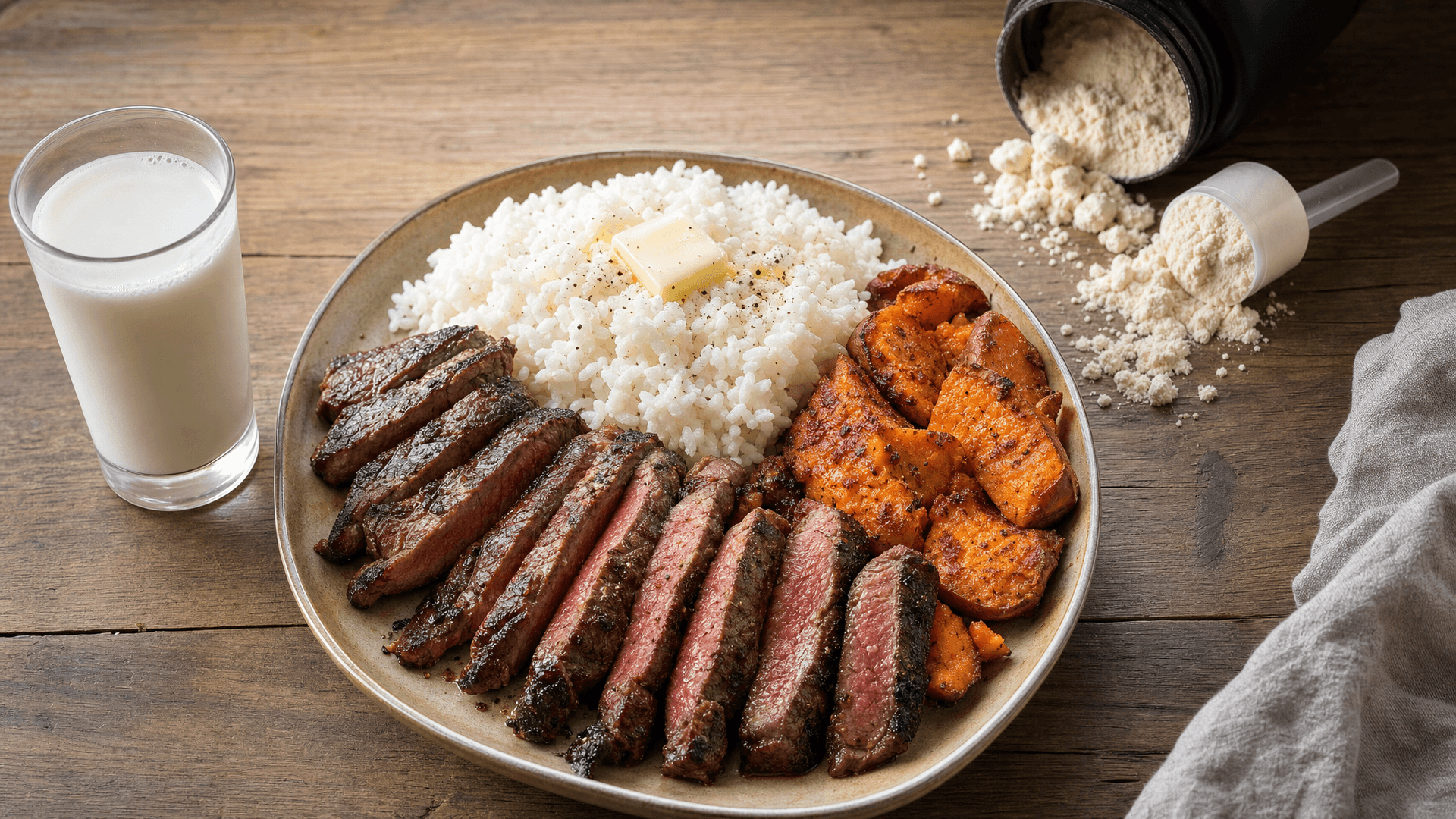
You walked back into the gym this week and the weights felt heavier than they had any right to feel.
Maybe it was summer. Maybe it was exams, a job change, a busted shoulder, or just four months where life happened and lifting didn't. Either way, you looked in the mirror in August and thought: well, damn. Flatter arms. Softer midsection. A bench press that used to be a warm-up now feels like a working set.
Here's the good news, and it's genuinely great news: the muscle you already built comes back way faster than it went on the first time. Not a little faster. Dramatically faster. Guys who took 18 months to build 15 lb of muscle routinely get it back in 8 to 12 weeks.
But there's a catch, and it's the reason most returning lifters waste their comeback window. They come back and eat like a beginner — cautious, "let me ease into it," maintenance calories for the first month because they're scared of the fat they just noticed in the mirror.
That's backwards. The comeback window is the single most efficient period of muscle growth you will ever get, and you only get it a handful of times in your lifting life. Underfeeding it is like getting handed a discount code and refusing to shop.
- Muscle memory is real — myonuclei from your previous training stick around for years
- Regain is 2-4x faster than building the same muscle from scratch
- Run a bigger surplus early (400-500 cal) when regain rates are highest, then taper
- Spike protein to the top of the range in weeks 1-4, not the middle
- Use the mirror and the tape, not just the scale — early regain weight is mostly muscle and glycogen
- Phase 3 is where you decide: keep bulking past your old peak, or hold and lean out
Why Muscle Memory Is Actually Real (And Not Just Gym Bro Talk)
For years "muscle memory" got lumped in with broscience. Then the research caught up, and it turns out the mechanism is beautifully simple.
When you train and grow a muscle fiber, you don't just add protein to it. You add myonuclei — the command centers that direct protein synthesis inside the fiber. More myonuclei means more capacity to build and maintain tissue.
Here's the key finding: when you stop training and the muscle shrinks, the myonuclei don't go away. The fiber gets smaller. The nuclei stay. Research on this suggests they persist for years, possibly permanently in humans.
So when you come back, you're not rebuilding a factory from an empty lot. The factory is still standing. You just need to turn the lights back on and restock the shelves — and the "restocking" is what you eat.
That's why detrained lifters regain size at rates that look absurd on paper. A returning lifter can put on 2-3 lb of actual muscle in a month, when a natural lifter starting fresh might manage 1-2 lb in that same month on a great program.
How much did you actually lose?
Before you panic, know that you probably lost less than you think.
| Time off | Typical muscle loss | Typical strength loss |
|---|---|---|
| 1-2 weeks | Essentially zero | 0-3% |
| 3-4 weeks | Minimal, mostly glycogen | 5-10% |
| 2-3 months | 2-6% of muscle mass | 10-20% |
| 6 months | 8-15% of muscle mass | 20-35% |
| 12+ months | 15-25% of muscle mass | 30-50% |
A lot of what you're seeing in the mirror after 3 months off isn't lost muscle at all. It's glycogen and intramuscular water. A trained muscle holds a meaningful amount of stored carbohydrate, and each gram of glycogen drags roughly 3 grams of water with it. Stop training, stop eating as much, and your muscles deflate like a tire — same structure, less air.
That deflation reverses in about two weeks of training and eating properly. Which is why guys report looking dramatically better after 14 days back and think they've built muscle. They haven't, not much. They've refilled. But it feels incredible, and it's the first sign the comeback is working.
If some of your "loss" is just deflation, some of your early "gain" is just refill. Don't extrapolate week 2 progress out to month 6 and expect a bodybuilder. Real tissue growth follows a slower curve — we broke that down in our month-by-month bulking results timeline.
The Mistake That Kills Most Comebacks
Here's the pattern I see constantly.
Guy takes four months off. Comes back. Notices he's softer than he was. Decides he'll "get lean first, then bulk." Runs maintenance or a small deficit for six to eight weeks while training hard.
And he burns the entire window.
The regain rate isn't constant. It's highest in the first 4-6 weeks back and declines from there. Your body is at its most anabolically responsive right when you decide to be conservative with food. By the time you finish your little cut and start eating properly, the steepest part of the curve is behind you.
The other version of this mistake is the opposite extreme: coming back and slamming a 800-calorie surplus on day one because "muscle memory means I can eat anything." You can't. Muscle memory accelerates muscle regain, not your ability to partition unlimited calories. Overshoot and you'll regain the muscle and add 9-11 lb of fat you'll spend the winter cutting off.
The move is in the middle, and it's phased.
The one exception: if you're coming back after an injury layoff and you gained real fat during it, you may need a different starting point. We covered that scenario in detail in our guide to eating while injured — start there, then come back to this plan once you're at a reasonable body fat.
Your Starting Numbers
Before phases, you need a baseline. Two numbers.
1. Your current maintenance
Not your maintenance from before the layoff — your maintenance now. You're lighter, you're carrying less muscle, and if you were sedentary for months, your daily activity dropped too.
Quick estimate: bodyweight in lb × 15 for a moderately active lifter training 4 days a week. A 165 lb guy lands around 2,475 calories.
That's a starting point, not gospel. Run it for 10 days, weigh yourself daily, take the weekly average. If the average didn't move, that's your maintenance. If it climbed or dropped, adjust by 150-200 calories and repeat.
If you want the full method with activity multipliers and adjustment protocols, our step-by-step guide to calculating bulking calories walks through it properly.
2. Your previous peak
What did you weigh at your best, and roughly what body fat? This matters because it's your ceiling for the "easy" regain. Muscle memory gets you back to your previous peak fast. Going past it means building new tissue at normal, slow, natural rates.
Write both numbers down. They shape the whole 8 weeks.
Don't have your old numbers? Dig up progress photos with dates on them, or old gym logs. Your working weights from 6 months ago are a decent proxy — if you were benching 200 lb for reps and you're at 145 lb now, you know exactly how much runway you have.
Phase 1: Weeks 1-3 — Refill and Prime
Surplus: +400 to +500 calories over maintenance Protein: 1.0g per lb of bodyweight — top of the range Carbs: high, deliberately
This is the aggressive phase, and it feels wrong to most people. You just came off a layoff, you're softer than you'd like, and I'm telling you to eat 500 calories over maintenance immediately.
Do it anyway. Here's why it works right now specifically:
Your muscles are glycogen-depleted. A big chunk of those early surplus calories go straight into refilling muscle glycogen rather than into fat cells — that's why the scale can jump 3-5 lb in the first two weeks and you look better, not softer. That's not fat. Fat gain doesn't work that fast.
Your myonuclei are sitting there, primed and underused. Protein synthesis rates in returning lifters spike hard in response to training. Feed that.
Protein: go to the top, not the middle
Standard bulking advice is 0.7-1.0g per lb. During a comeback, park yourself at the top of that range for the first month.
The reason: your rate of muscle protein synthesis is elevated, but your body also isn't fully re-adapted to the training load yet. Soreness is high, recovery demand is high, and you're likely doing more total volume than your body's used to. More protein buffers all of that.
For a 165 lb lifter that's 165g of protein per day. Spread across 4-5 feedings of 35-45g each.
Practical version:
| Meal | Example | Protein |
|---|---|---|
| Breakfast | 4 eggs + 2 slices toast + Greek yogurt | 42g |
| Lunch | Chicken breast, rice, olive oil | 45g |
| Post-training shake | Whey + milk + banana + peanut butter | 40g |
| Dinner | Ground beef, pasta, cheese | 45g |
| Total | 172g |
Carbs are the lever here
In phase 1, carbs do more for you than fat does. They refill glycogen, they improve training performance when your work capacity is trashed, and they're the cheapest way to hit a surplus without feeling stuffed.
Set fat at around 25% of total calories, protein at your target, and fill the rest with carbs. For most returning lifters that lands somewhere around 350-450g of carbs a day. Rice, oats, pasta, potatoes, fruit, bread. Nothing exotic.
Time the bulk of your carbs around training. Not because nutrient timing is magic, but because in weeks 1-3 your training feels brutal and a carb-heavy meal 90 minutes before the gym genuinely makes the session better. Better sessions, better stimulus, faster regain.
Training note (because it changes your food needs)
Do not come back at your old working weights. Start at roughly 60-70% of what you used to lift and build back over 3-4 weeks. Your muscles will recover faster than your tendons and connective tissue, which is the exact injury trap that ends comebacks in week 4.
Your appetite in week 1 will also be smaller than it was when you were training hard. Eating 3,000 calories after months of eating 2,200 is a genuine adjustment.
Phase 2: Weeks 4-6 — The Steep Part
Surplus: +300 to +400 calories Protein: 0.9g per lb Carbs: still high, fat creeping up slightly
Glycogen is full. The easy visual wins are done. Now you're building actual tissue, and this is where the majority of your regain happens.
Pull the surplus back slightly. Not because growth is slowing — it isn't — but because the glycogen sink is closed. Those extra 100-150 calories that were going into muscle storage now have nowhere useful to go, and they'll show up as fat.
What you should see in this phase:
- Scale climbing 0.7-1.1 lb per week
- Working weights jumping session to session, sometimes shockingly fast
- Arms and shoulders filling out visibly
- Waist roughly stable
That last one is the whole game. If your waist measurement is holding steady while your bodyweight climbs and your lifts go up, you are regaining muscle and almost nothing else. That is the single best signal you have.
The tape measure protocol
Once a week, same morning, fasted, before training:
- Bodyweight (but use the 7-day average, never a single day)
- Waist at the navel
- One "vanity" site — upper arm flexed, or chest
Three numbers, thirty seconds, and they tell you everything the scale alone can't.
| Waist | Bodyweight | Verdict |
|---|---|---|
| Stable | Rising | Perfect. Don't change anything. |
| +1 cm/month | Rising | Fine for a bulk. Acceptable. |
| +2 cm/month | Rising fast | Surplus too big. Cut 200 calories. |
| Stable | Flat 2+ weeks | Surplus too small. Add 200 calories. |
Do not measure your waist right after a big carb meal or on a day you're bloated. Same conditions every week or the number is noise. And do not suck your gut in — you're measuring data, not taking a photo.
Recovery demand peaks here
Weeks 4-6 are when total training volume tends to be highest and your body is still catching up. If you're under-sleeping, this is where progress stalls regardless of what you eat.
Seven to nine hours. It's not a lifestyle tip, it's part of the protocol. Protein synthesis and the hormonal environment that drives regain both take a real hit on five hours of sleep.
Phase 3: Weeks 7-8 and Beyond — The Decision Point
Surplus: +200 to +300 calories Protein: 0.8-0.9g per lb
By week 7 you're usually within striking distance of your old physique, sometimes already past it if the layoff was short. The regain curve flattens as you approach your previous peak — because at that point, there's nothing left to regain. You're building new tissue now, at normal natural rates.
So the surplus has to come down to match. A +500 surplus at week 8 gains you the same muscle as a +250 surplus, plus a bunch of fat.
This is the decision point, and you've got two honest options.
Option A: Keep going past your old peak
You're at your previous best and you want more. Fine — but understand the rules change completely. You're no longer a returning lifter, you're just a lifter bulking. Expect 0.5 lb per week at best, and only if you're patient.
Hold the +250 surplus, keep protein at 0.8g per lb, and settle in for months, not weeks.
Option B: Hold and sharpen
You got your physique back, you're carrying a bit more fat than you'd like from the process, and you'd rather look good now than be bigger in April.
Drop to maintenance for 3-4 weeks first — don't jump straight into a deficit. Let things settle, confirm your weight is genuinely stable, then run a modest cut of 300-400 calories below maintenance with protein kept high at 1.0g per lb.
Rough guide: if you're under about 15% body fat at the end of phase 3, keep bulking. If you're above it, take the maintenance period and then cut. Bulking from too high a starting body fat means a worse ratio of muscle to fat and a longer cut later.
The 8-Week Numbers at a Glance
For a 165 lb lifter with maintenance around 2,475 calories:
| Phase | Weeks | Calories | Protein | Expected gain |
|---|---|---|---|---|
| 1 — Refill | 1-3 | 2,950 | 165g | 2-3 kg (mostly glycogen/water) |
| 2 — Steep | 4-6 | 2,825 | 150g | 1.2-1.8 kg (mostly muscle) |
| 3 — Taper | 7-8 | 2,725 | 140g | 0.5-0.8 kg |
Total over 8 weeks: roughly 9-13 lb on the scale, of which maybe 6.5-9 lb is muscle and glycogen and the rest is fat. That ratio is dramatically better than what a non-detrained lifter gets from the same surplus, and it's the entire reason this window matters.
Practical Eating When Your Appetite Isn't Back Yet
The single most common failure in phase 1 isn't discipline. It's that eating 2,950 calories genuinely feels hard when you've spent four months eating 2,100 and not thinking about it.
Your stomach capacity, your hunger signaling, and your habits all shrank. Here's how to bridge that.
Drink some of it. A shake with 12 oz whole milk, a scoop of whey, a banana and 2 tbsp of peanut butter is roughly 650 calories and 40g protein, and it goes down in a minute. One of these a day solves most of the gap.
Add fat to what you already eat. A tablespoon of olive oil on rice is 120 calories you won't notice. Cook with butter. Full-fat dairy over skim. This is the highest-leverage change you can make in week 1 because it requires no additional eating.
Eat on a clock, not on hunger. Every 3 to 3.5 hours, whether you feel like it or not. Hunger cues are unreliable when you're re-adapting.
Don't fill up on volume. Big salads, soup, and huge amounts of vegetables will wreck you in phase 1. Keep vegetables present but modest until your appetite catches up — usually around week 3.
If you're still short 400 calories at the end of the day, don't force down another chicken breast. Have 2 oz of nuts or a bowl of cereal with whole milk. Calorie-dense, easy to eat, done in five minutes.
Foods that do the heavy lifting
- Whole milk — 17 oz is 300 calories and 16g protein, effortless
- Rice and pasta — cheap, cook in bulk, calorie-dense per bite
- Ground beef (80/20) — protein plus fat in one ingredient
- Oats — 3.5 oz dry is 380 calories before you add anything
- Peanut butter — 190 calories per 2 tbsp, add it to everything
- Olive oil — pure calories, no volume, no effort
Common Comeback Mistakes
1. Cutting first. Already covered, but it's the big one. You're trading the best muscle-building window you'll get for six weeks of being slightly leaner.
2. Comparing your week 1 lifts to your old PRs. Strength comes back on its own timeline — usually faster than size, sometimes slower depending on the lift. Chasing old numbers in week 2 is how you tear something.
3. Not adjusting after the first two weeks. The glycogen refill inflates your early weight gain. If you don't recalibrate at week 3, you'll think you're gaining faster than you are and cut calories exactly when you shouldn't.
4. Under-eating protein because "muscle memory does the work." Myonuclei give you the capacity. Amino acids are the raw material. No material, no building.
5. Weighing yourself once a week on a random day. Daily weigh-ins, weekly average. A single reading can swing 3 lb on sodium and carbs alone.
6. Adding cardio "to stay lean" in week 1. Your recovery capacity is already stretched. Save it for phase 3 if you want it at all.
7. Program hopping. You need consistent, progressively loaded training to give the food somewhere to go. Pick a program and run it for the full 8 weeks.
How to Know It's Actually Working
Four signals, in order of reliability:
Strength trajectory. If your working weights are climbing week over week — sometimes by 10 lb on the big lifts in a single week during phase 1 — the comeback is on rails.
Waist stability against rising bodyweight. The gold standard. Covered above.
Pump quality. Subjective, but real. Once glycogen refills, your pumps come back hard. When a session pump feels like it used to, you're back in business.
Photos. Same lighting, same time of day, same pose, every two weeks. The mirror lies daily. Photos taken two weeks apart don't.
What is NOT a good signal: how you feel on a given day, whether one meal made you feel bloated, or the scale on any single morning. Comebacks are noisy in the short term and extremely clear over four weeks. Zoom out.
When the Hard Part Is Just Hitting the Numbers
None of this is complicated. Eat 400 over maintenance for three weeks, then 350, then 250. Keep protein high. Track your waist.
The hard part is that "2,950 calories with 165g of protein" turns into a daily logistics problem the moment you actually try to live it. What do I eat tonight? Does this hit my macros? I'm 600 calories short at 9pm and I have no idea what to cook.
That's what we built for. You give it your numbers and your situation — coming back from a layoff, aiming for a specific surplus, whatever you've got in the fridge — and it builds meal plans that hit those targets with food you'll actually eat. No 47-tab spreadsheet, no weighing broccoli.
It's especially useful in phase 1, when your appetite hasn't caught up and you need calorie-dense meals rather than "more chicken and rice." Getting the plan handed to you removes the exact friction that makes most comebacks stall in week two.
The Bottom Line
You didn't lose it. It's sitting there, waiting, in the form of nuclei your old training left behind.
The comeback window is real, it's steep, and it closes. Feed it properly for eight weeks — bigger surplus early, protein at the top of the range, waist measured weekly — and you'll be back where you were faster than you'd believe, with a fraction of the fat you're worried about.
Go eat. The hardest part was walking back through the door, and you already did that.