
You're standing in the supplement aisle staring at a 5 lb tub of mass gainer that costs sixty bucks and tastes like sweetened drywall. You do the math. That's maybe two and a half weeks of daily servings, and you'd need to buy it again every month for the rest of your bulk.
Meanwhile, three aisles over, in the baking section, next to the flour and the shortening, there's a bag nobody under 60 ever picks up.
Nonfat dry milk. Powdered milk. Skim milk powder. Whatever your store calls it, it's roughly 100 calories and 10g of complete, leucine-rich protein per quarter-cup — and it costs a fraction of what you're paying per gram of protein for whey.
It dissolves into oatmeal. It thickens pasta sauce. It disappears into mashed potatoes. It turns a sad glass of skim into something with actual body. And it sits in your pantry for months without refrigeration, which means you can buy it in bulk when it's on sale and forget about it.
If you're a skinny guy who can't eat enough and can't afford another tub of gainer, this is the single most overlooked tool in the entire grocery store.
- Nonfat dry milk delivers about 100 calories and 10g of complete protein per quarter-cup for a fraction of the cost of whey
- It's shelf-stable for 12-18 months unopened, so you can buy in bulk and stop worrying about spoilage
- Stir it into oatmeal, shakes, sauces, mashed potatoes, and coffee to add 300-600 calories a day you never have to chew
- Whisk it into cold liquid first, or bloom it in a small amount of water, to avoid clumping
- The lactose load is real — start with a quarter-cup a day and build up over two weeks
- Above about 3/4 cup per drink the chalky taste shows up, so spread the dose across several foods instead of loading one
What Powdered Milk Actually Is
Powdered milk is just milk with the water taken out. Manufacturers spray liquid milk into a heated chamber, the water evaporates, and what falls out the bottom is a fine cream-colored powder that's shelf-stable.
That's it. No proprietary blend, no "anabolic matrix," no marketing. It's a food, not a supplement, which is exactly why it's cheap.
You'll find two main versions:
Nonfat dry milk (NFDM) is the common one. The fat's been removed, so per quarter-cup you get about 100 calories, 10g protein, 12g carbs (lactose), and near-zero fat. It lasts 12-18 months unopened in a cool pantry.
Whole milk powder keeps the fat, which pushes it closer to 160 calories per quarter-cup. It tastes better and it's more calorie-dense, but the fat oxidizes, so shelf life drops to about 6-9 months and it costs more. Great if you can find it. Nonfat is what's actually on the shelf at most stores.
There's also buttermilk powder, which is tangy and mostly useful for baking, and instant vs. non-instant nonfat. Instant dissolves better and is worth the small premium if you're mixing it into drinks. Non-instant is denser per scoop and cheaper, and it's fine when you're stirring it into hot food.
The macro profile, per quarter-cup (about 30g)
| Type | Calories | Protein | Carbs | Fat |
|---|---|---|---|---|
| Nonfat dry milk | 100 | 10g | 12g | 0.2g |
| Whole milk powder | 160 | 8g | 11g | 8g |
| Whey concentrate (for reference) | 120 | 24g | 3g | 2g |
Whey wins on protein density. Nobody's arguing that. But you're not trying to win a protein-per-scoop contest — you're trying to close a calorie gap on a budget, and that's a completely different problem.
The Protein Is Actually Good
This is the part people get wrong. They see "baking aisle" and assume it's a garbage protein source.
It isn't. Milk protein is roughly 80% casein and 20% whey, and it scores a 1.0 on the PDCAAS scale — the maximum. That's the same score as whole eggs, whey isolate, and beef. It has every essential amino acid in quantities your body can actually use.
Crucially for muscle growth, it's leucine-rich. Leucine is the amino acid that flips the switch on muscle protein synthesis, and you need roughly 2.5-3g of it in a sitting to max out that signal. A quarter-cup of nonfat dry milk gets you about 1g of leucine. Two-thirds of a cup gets you into the range where the switch flips hard.
The casein fraction is a bonus, not a drawback. Casein digests slowly, releasing amino acids over 4-6 hours instead of dumping them in 90 minutes like whey does. That's genuinely useful before bed, and it's useful when you're eating every three hours and want a steady drip rather than spikes.
Powdered milk isn't priced as a supplement — it's priced as a commodity baking ingredient. You're not paying for a label, a flavor system, a proprietary blend, or an athlete endorsement. You're paying for dehydrated milk. That's the whole reason the math works.
The heat used in spray-drying does denature some of the protein, but denaturing isn't destruction — your stomach acid denatures protein anyway. Digestibility stays high. This is the same reason cooking an egg doesn't ruin the protein.
The Cost Math That Makes This Worth It
Here's why this matters more than any taste argument.
A typical 2.4 lb bag of nonfat dry milk runs somewhere in the low-to-mid teens depending on your store and whether you buy the store brand. That bag holds roughly 36 quarter-cup servings.
That's about 3,600 calories and 360g of protein out of one bag.
Compare it to a 5 lb tub of whey at sixty dollars. That's around 70 servings, 1,680g of protein, 8,400 calories. Better protein-per-dollar on paper if you're only counting grams of protein — but you're not. You're counting the total daily calorie gap you need to close, and powdered milk closes it for a lot less money per calorie.
The real comparison isn't powdered milk vs. whey. It's powdered milk vs. mass gainer, and there it's not close. Most gainers are maltodextrin and a little whey, sold at a markup that assumes you won't read the label. Powdered milk gives you the same calorie job with better protein quality and none of the markup.
If you want the broader picture of how this stacks up against every other cheap bulking staple, we broke it all down in our guide to the cheapest calories per dollar for bulking — powdered milk lands solidly in the top tier there for a reason.
Where to buy it
- Baking aisle of any big grocery store — usually a box or bag near the flour
- Warehouse clubs — best price per lb, usually in a large bag
- Restaurant supply stores — sometimes sell 25 lb bags at commodity pricing
- Online bulk retailers — good for whole milk powder, which most grocery stores don't stock
Buy the biggest bag you can store, then transfer it into an airtight container with a tight-sealing lid. Powdered milk absorbs moisture from the air and turns into a rock if you leave it in the paper bag it came in.
How to Actually Get 300-600 Calories a Day Into You
The whole point is calories you don't have to chew. Chewing is the bottleneck for skinny guys — your jaw and your stomach fill up long before your calorie target does.
Powdered milk fixes that because it's a calorie multiplier for food you're already eating. You're not adding a meal. You're making existing meals denser.
Here's the full playbook.
1. Oatmeal (easiest win: +200 calories)
This is where it works best, hands down. Oatmeal is already wet, already hot, and already bland enough that a dairy note improves it.
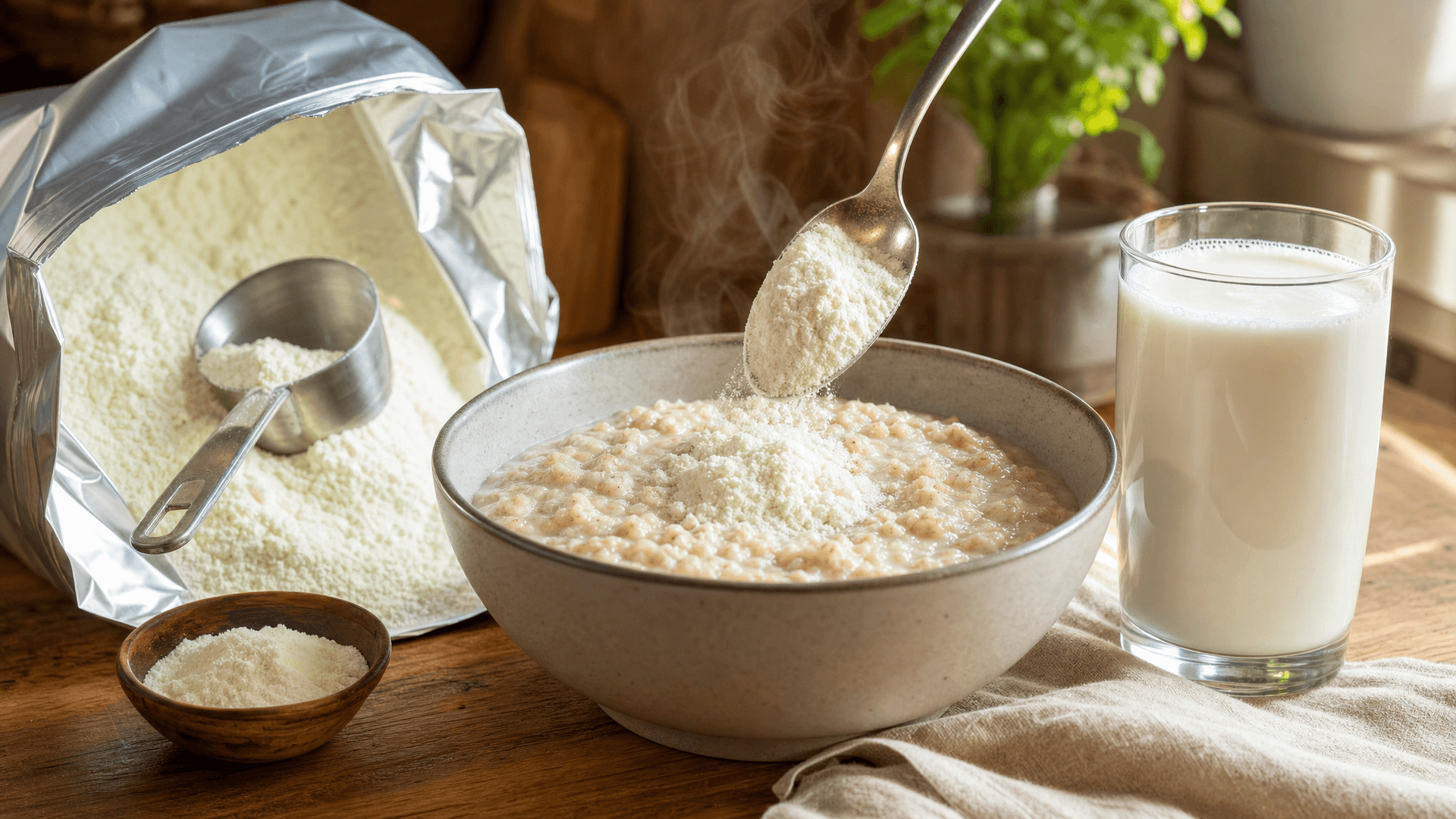
Cook your oats as usual. When they're done and off the heat, stir in half a cup of nonfat dry milk. It'll dissolve almost instantly into the residual moisture and turn the whole thing creamy — like it was cooked in milk instead of water, because functionally it was.
That's +200 calories and +20g protein on a bowl you were already eating.
Add a tablespoon of peanut butter and a banana and you're at a 700-calorie breakfast that took eight minutes.
2. Shakes (the big one: +200-400 calories)
This is where you'll do the heavy lifting. Standard formula:
- 2 cups whole milk (300 cal, 16g protein)
- 1/2 cup nonfat dry milk (200 cal, 20g protein)
- 1 banana (100 cal)
- 2 tbsp peanut butter (190 cal, 7g protein)
- 1/2 cup rolled oats (150 cal)
Total: about 940 calories, 46g protein. That's a mass gainer serving for a fraction of the cost, made from four ingredients that were already in your kitchen.
The powdered milk does two jobs here. It adds calories and protein, obviously, but it also thickens the shake, which makes it feel like a meal instead of flavored water. That texture matters more than people expect when you're trying to make a liquid feel satisfying.
If you're already drinking a lot of liquid milk, powdered milk is the cheat code — it lets you double the milk calories without doubling the volume you have to get down. Half a cup of powder in a glass of milk gives you the nutrition of nearly two glasses in the space of one.
That volume problem is exactly why straight-up milk protocols get hard to sustain. If you've ever tried or considered the classic gallon-a-day approach, our honest breakdown of whether GOMAD is actually worth it covers where it works and where it falls apart — and powdered milk solves a lot of the "I physically cannot drink this much" problem.
3. Coffee (+100 calories, zero effort)
Two heaping tablespoons in your morning coffee instead of creamer. It froths a little, tastes like a latte, and adds about 100 calories and 10g of protein to something you were drinking anyway.
Whisk it into a splash of cold liquid first, or it'll clump on the surface of hot coffee. More on that in a second.
4. Mashed potatoes (+150 calories)
Powdered milk was practically invented for this. Add a third of a cup to the pot along with your butter and liquid. It makes them richer, adds protein to an otherwise pure-carb food, and nobody at the table will be able to tell you did it.
5. Pasta sauce and soups (+100-200 calories)
Whisk a quarter-cup into tomato sauce and you get a rosé sauce — creamier, less acidic, and 100 calories heavier. Same move works in tomato soup, chili, and any cream-based soup you're already making.
Don't boil it hard after adding, or the proteins can curdle and go grainy. Stir it in near the end over low heat.
6. Scrambled eggs and pancakes (+100 calories)
Two tablespoons whisked into your eggs before they hit the pan makes them fluffier and adds protein. Same amount into pancake batter works too, and it browns nicely.
7. Yogurt and smoothie bowls (+100 calories)
Stir a quarter-cup into Greek yogurt. It thickens it dramatically and pushes the protein of a single cup up toward 30g.
Don't try to hit all seven of these in one day. That's over 1,000 calories of powdered milk, which is roughly 120g of lactose, and your gut will make you regret it. Pick two or three placements and build the habit there.
If you want more ways to bump the density of a meal beyond dairy powder alone, we've got a whole list of tactics in how to add 500 calories to any meal — powdered milk is one lever among many, and stacking a couple of them works better than maxing out any single one.
A Sample Day: +500 Calories, No Extra Meals
Here's what it actually looks like when you distribute the dose instead of hammering it in one sitting.
| When | Food | Powder added | Calories added |
|---|---|---|---|
| 7:00 am | Coffee | 2 tbsp | 100 |
| 7:30 am | Oatmeal | 1/2 cup | 200 |
| 1:00 pm | Tomato soup | 1/4 cup | 100 |
| 8:00 pm | Bedtime shake | 1/4 cup | 100 |
| Total | 500 |
That's 500 calories and roughly 50g of extra protein with no new meals, no new dishes, and maybe ninety seconds of total added prep time across the whole day.
Over a week that's 3,500 extra calories. That's the difference between a scale that doesn't move and one that climbs steadily.
If you're a guy sitting at 140 lb trying to get to 160 lb, that gap is the entire game. You're probably already eating close to enough — you're just a few hundred calories short every day, and that shortfall is invisible until you measure it.
The Clumping Problem (and How to Fix It)
Everybody who tries this hits the same wall. You dump powder into hot liquid, it hits the surface, and instantly forms little white bombs that refuse to dissolve. You stir harder. They get smaller but they never fully go away. You drink it and get a chalky mouthful.
Here's why it happens: the outside of each clump hydrates instantly and forms a waterproof gel shell around dry powder inside. Once that shell forms, stirring won't break it.
Three fixes, in order of how much I use them:
1. Cold liquid first. Always. Whisk the powder into cold or room-temp liquid before it goes anywhere hot. Cold water hydrates the powder more slowly, so it disperses before it can gel.
2. Bloom it. Put your powder in a mug, add a few tablespoons of cold water, and stir into a smooth paste. Then pour that paste into your hot coffee, soup, or oatmeal. Zero clumps, every time. Takes ten seconds.
3. Shake it in a sealed bottle. For shakes, put the liquid in first, powder in second, seal it, and shake for a solid 20 seconds. The blender ball helps but isn't required. Never scoop powder into an already-half-shaken bottle.
Buy the instant version if you can find it. Instant nonfat dry milk is agglomerated — the particles are clustered so liquid can penetrate — and it dissolves dramatically better in drinks. Non-instant is cheaper and totally fine when you're stirring it into hot food that's getting mixed anyway.
One more thing: don't add powder to something already at a rolling boil. High heat plus acid (tomato sauce, coffee) can curdle the casein into a grainy texture. Low heat, stir in at the end.
The Honest Downsides
I'm not going to pretend this is free.
Lactose
This is the real one. A quarter-cup of nonfat dry milk carries about 12g of lactose. If you're stacking three or four servings a day on top of the liquid milk you're already drinking, you could be pushing 60-80g of lactose daily.
Even people who tolerate dairy fine can hit a wall there. Bloating, gas, and a stomach that feels like a balloon aren't great when you're also trying to force down a big dinner.
The fix is boring but it works: start at a quarter-cup a day for four or five days, then add another quarter-cup. Build over two weeks. Your gut's lactase production adapts somewhat, and more importantly your gut bacteria adapt a lot.
If you're genuinely lactose intolerant, this whole strategy isn't for you. Lactase pills help some people, but at these doses you'd be taking a lot of them. Look at cheap oil, oats, and nut butters instead.
Taste at high doses
Below about half a cup per serving, powdered milk is nearly invisible in most foods. Between half and three-quarters of a cup it starts to taste slightly sweet and dairy-forward, which is fine in a shake and noticeable in soup.
Above three-quarters of a cup in a single drink, it gets chalky and faintly cooked-tasting. That's the ceiling. This is exactly why spreading the dose across four foods beats loading it into one shake — you stay under the taste threshold everywhere.
Sodium and sugar optics
Nonfat dry milk is about 12g of carbs per quarter-cup, and those carbs are lactose, which is a sugar. If you're reading nutrition labels obsessively, "sugar 12g" is going to jump out at you.
Ignore it. It's milk sugar in milk, the same as it is in a glass of skim. It's not added sugar, and in a bulk you want the carbs anyway.
It's not a whey replacement
Post-workout, whey still digests faster and hits a higher leucine dose per calorie. If you've got whey, keep using it around training. Powdered milk isn't competing for that slot — it's competing for the "I need 500 more calories today and I'm out of money" slot, and it wins that one outright.
If you're using powdered milk to hit a big protein target, watch your total dairy intake across the day. Milk protein plus whey plus Greek yogurt plus cheese adds up fast, and a diet that's 70% dairy protein is a diet that's going to get boring and probably a little uncomfortable. Keep meat, eggs, and legumes in the rotation.
Storage: Don't Screw This Up
Powdered milk's superpower is shelf life, but only if you store it right.
Keep it dry. Moisture is the enemy. The powder is hygroscopic — it pulls water out of the air, and once it does, it cakes into a solid brick and eventually grows mold. Transfer it out of the original bag into an airtight container the day you open it.
Keep it cool and dark. A pantry is fine. Above a stove is not. Heat accelerates the Maillard browning that makes old powder taste stale and slightly caramelized.
Nonfat lasts 12-18 months unopened, and about 3-6 months once opened if it's stored properly. Whole milk powder lasts 6-9 months unopened because the fat goes rancid. If it smells like crayons or old paint, throw it out.
Reconstituted milk is real milk. Once you mix it with water, it's perishable dairy. Refrigerate it and drink it within 3 days.
If you make reconstituted milk to drink straight, mix it the night before and chill it hard. Powdered milk mixed and drunk immediately at room temperature tastes noticeably worse than the same milk after 12 hours cold — the flavor compounds mellow and the proteins fully hydrate.
Who This Is Actually For
Be honest with yourself about whether this fits.
This is great if you:
- Are under 155 lb and struggling to gain
- Tolerate dairy without issues
- Are on a tight budget — student, first job, whatever
- Already eat oatmeal, drink shakes, or make sauces regularly
- Keep falling 300-500 calories short of your target every day
Skip it if you:
- Are lactose intolerant or dairy-sensitive
- Are cutting (there are better protein-per-calorie options)
- Already hit your calories easily and just need more protein — buy whey instead
- Hate the taste of milk generally, because this is concentrated milk flavor
The honest summary: powdered milk is a calorie delivery vehicle with unusually good protein attached. Judge it on that job, not on whether it beats a supplement designed for a different one.
Where FuelTheGains Fits
Knowing that powdered milk adds 100 calories a quarter-cup is the easy part. The hard part is knowing how many quarter-cups you actually need — and where in your day they should go.
That's what FuelTheGains does. You tell it your weight, your training, and your budget, and it builds a full meal plan around foods you'll actually eat, with the calorie math already done. If you're the kind of guy who needs a plan that says "put half a cup in your oatmeal at 7:30 and a quarter-cup in your shake at 8pm" instead of "eat more," that's the whole idea.
It also handles the part most people get wrong: adjusting as you gain. The 500-calorie surplus that worked at 140 lb isn't a surplus anymore at 160 lb, and most guys stall out because they never recalculate. Check it out at .
Common Mistakes
1. Dumping it in dry. Always whisk into cold liquid or bloom it into a paste first. This single mistake is why most people try powdered milk once and quit.
2. Going from zero to a full cup on day one. Your gut needs a ramp. Quarter-cup, then build.
3. Loading it all into one shake. Past three-quarters of a cup in a single drink, taste and digestion both fall apart. Spread it.
4. Storing it in the original bag. It'll cake within a month in a humid kitchen. Airtight container, day one.
5. Boiling it. Curdles into grainy bits, especially in acidic sauces. Low heat, stir in at the end.
6. Treating it as a whey replacement. Different tools. Whey for the post-training window if you can afford it, powdered milk for closing the daily gap.
7. Not tracking whether it's working. Weigh yourself every morning, same conditions, and take the weekly average. If the average hasn't moved in two weeks, add another quarter-cup somewhere.
Tracking Progress
You want the scale climbing roughly 0.25-0.5% of your bodyweight per week while bulking. For a 150 lb guy that's somewhere between 6 oz and 12 oz a week. Slower than that and you're not eating enough. Faster and you're adding more fat than you need to.
Weigh in every morning, after the bathroom, before food, same clothes. Ignore any single day — daily weight swings by 2-4 lbs from water and food volume alone. Only the weekly average means anything.
If two consecutive weekly averages are flat, add 200 calories. Which, conveniently, is half a cup of powdered milk into your oatmeal. That's the entire adjustment, and it costs you about twenty cents.
The Bottom Line
Powdered milk isn't sexy. It's in the baking aisle next to stuff your grandmother bought. There's no athlete on the bag and nobody's posting about it.
But it's 100 calories and 10g of complete, leucine-rich protein per quarter-cup, it lasts most of a year in your pantry, and it costs a fraction of what you're paying for the same job in a supplement tub.
Start with one placement. Half a cup in your oatmeal tomorrow morning. That's 200 calories you didn't have to chew and didn't have to plan for.
Do that for a week, add a second placement, and in a month you'll be eating 500 calories a day more than you are right now without ever feeling like you're forcing food down.
That's how skinny guys actually get bigger — not with one heroic meal, but with a hundred boring calories added in five places you never noticed.