
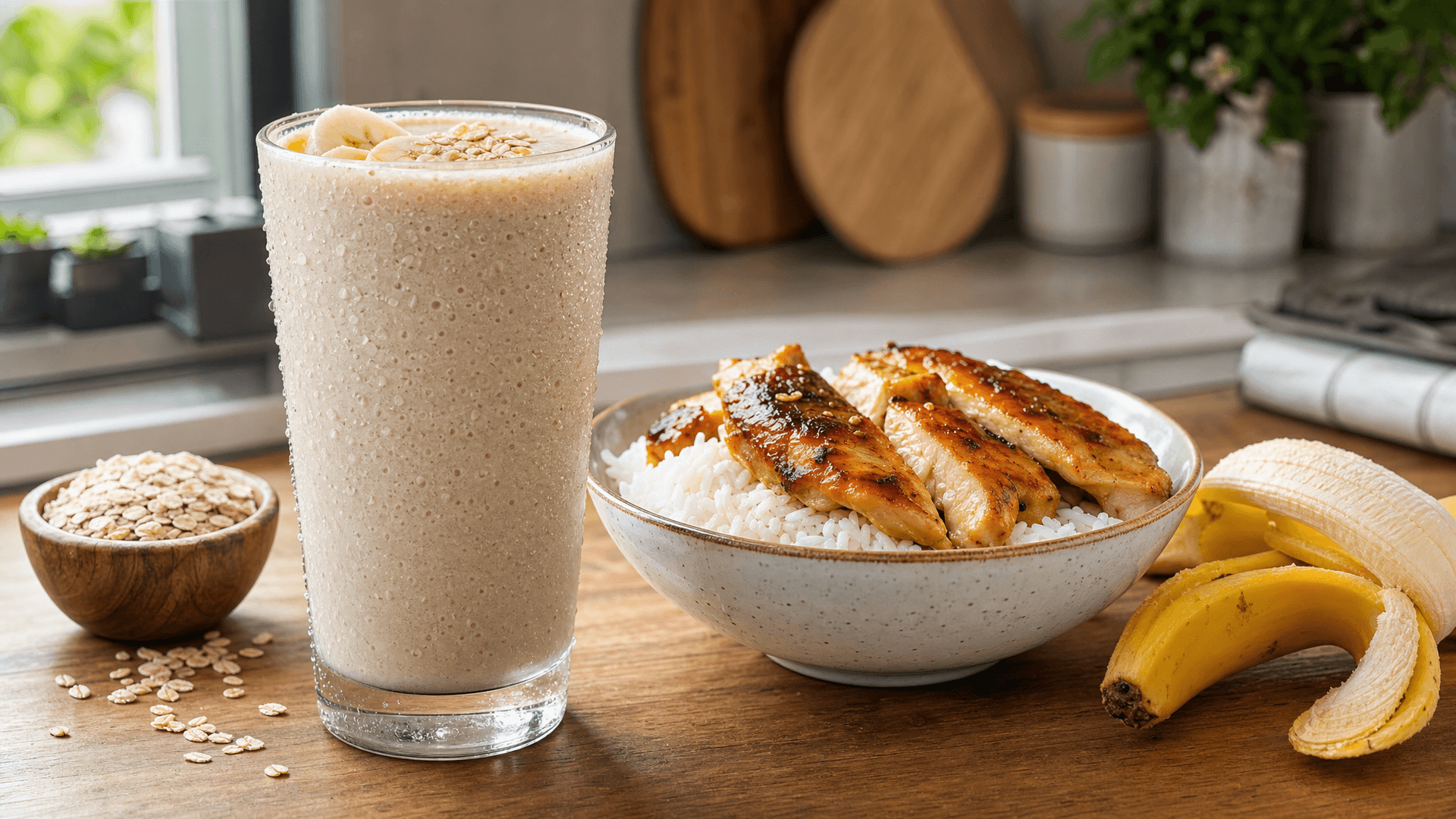
You just finished the best session you've had in weeks. Every set moved. You're still buzzing.
And the idea of eating food makes you want to lie down on the gym floor.
This is the cruelest joke in bulking. The single hour when your body is most primed to use calories is the exact hour your appetite completely disappears. You stand in your kitchen at 8 PM holding a plate of chicken and rice, chewing slowly, feeling like you're doing homework.
So you eat half. You tell yourself you'll make it up later. You don't.
That one skipped meal is why your 3,500-calorie target lands at 2,800 four days a week. Not your metabolism. Not your genetics. One missing meal, repeated.
Here's what's actually happening in your gut after hard training, how long it lasts, and the exact stack that gets calories in anyway.
- Intense training suppresses ghrelin (hunger) and spikes PYY and GLP-1 (fullness) for roughly 30 to 120 minutes
- Heat, dehydration and pre-workout stimulants each independently crush appetite on top of that
- Liquid calories bypass the problem entirely — cold, thin, and sipped within the first 30 minutes
- Your first real meal should be carb-forward, low-fat and low-fiber so it clears your stomach fast
- A delayed second feeding 90 minutes later is where most of your post-workout calories should actually land
- Evening lifters need a front-loaded day — you cannot bank on eating big at 9 PM
- One missed post-workout meal a day is a 500 to 800 calorie hole that erases your surplus
Why Hard Training Shuts Your Stomach Down
This isn't willpower. It isn't "you're just not hungry today." There's a measurable hormonal cascade that happens the moment you start training hard, and it's working directly against you.
Ghrelin Drops
Ghrelin is your hunger hormone. It's made mostly in the stomach lining, it rises before meals, and it's the thing that makes you open the fridge without deciding to.
Intense exercise suppresses acylated ghrelin — the active form — for a window that typically runs 30 to 90 minutes after you stop. The harder and more intense the session, the bigger the drop. A heavy squat day with short rest periods does more damage to your appetite than an easy 30-minute walk.
So the signal that normally says "eat" just... doesn't fire. You're not full. You're not nauseous, necessarily. There's simply no message coming through.
PYY and GLP-1 Spike
At the same time, your gut releases peptide YY (PYY) and GLP-1. These are satiety hormones — the ones that tell your brain you've had enough. GLP-1 is the same pathway that the well-known weight-loss drugs target, which should tell you how powerful it is at killing appetite.
Hard training pushes both up. So you're getting hit from both directions at once: the "eat" signal goes quiet and the "you're full" signal goes loud. For a guy trying to lose weight this is a free gift. For a hardgainer trying to force down 800 calories it's a wall.
Naturally lean guys tend to have a more responsive appetite-regulation system overall. The same hormonal response that makes a heavier guy feel "a bit less hungry" can make you feel genuinely unable to eat. You're not imagining that it hits you harder — it probably does.
Blood Flow Leaves Your Gut
During hard sets, your body reroutes blood to working muscles and skin. Splanchnic blood flow — circulation to your stomach and intestines — can drop substantially during intense exercise.
Less blood to your gut means slower digestion and slower gastric emptying. Which means whatever is already sitting in your stomach stays there longer, and anything new you add on top sits there too. That's the heavy, sloshing, "I can't put anything else in" feeling.
Core Temperature
Heat suppresses appetite on its own. If your core temperature is elevated and you're still sweating, your body has zero interest in the thermic load of digesting a big meal.
This is why training in a hot garage gym in August is appetite murder, and why a hard session in a cold room barely touches you by comparison.
Dehydration
Lose fluid, and appetite tanks. Even mild dehydration — the kind you'd get from a hard hour of lifting without drinking much — blunts hunger noticeably. Thirst and hunger signals get tangled, and thirst wins.
The fix here is embarrassingly simple and most guys skip it anyway.
Your Pre-Workout Is Working Against You
Caffeine is an appetite suppressant. That's not a side effect, it's a well-documented primary effect. If you're taking 200-400mg of caffeine 30 minutes before you train at 6 PM, that caffeine is still meaningfully active five to seven hours later.
Add the other common pre-workout ingredients — tyrosine, higenamine, yohimbine in some formulas — and you've built a product that is, functionally, an appetite killer you drink on purpose.
If you use a high-stim pre-workout and then can't eat for three hours afterward, the pre-workout is a prime suspect. Try two weeks without it — just a small amount of caffeine or none at all — and see if your post-training hunger comes back. Most guys are shocked.
How Long Does It Actually Last?
This matters, because the fix depends entirely on the timeline.
| Phase | Time after training | What's happening | What to do |
|---|---|---|---|
| Dead zone | 0-30 min | Ghrelin suppressed, PYY high, gut blood flow low | Liquid only, cold, sipped |
| Thaw | 30-90 min | Hormones normalizing, core temp dropping | First solid meal — carb-forward |
| Rebound | 90-180 min | Appetite often overshoots baseline | Second feeding, your biggest calories |
| Normal | 180+ min | Back to your usual hunger | Regular meal schedule |
The key insight: the suppression is temporary and it often overcorrects. Many guys get a genuine rebound in hunger roughly two to three hours after training. That rebound window is enormously valuable and almost nobody plans for it, because by then they've mentally filed the evening under "already ate."
If you train at 6 PM and finish at 7:15, your real appetite comes back around 9:15. If you're in bed at 10:30, that's a solid hour of usable eating time you're currently wasting on a protein bar and regret.
The Fix Stack: Three Layers
Don't try to solve this with one giant meal. Solve it with three layers spread across three hours. Each one is easy on its own. Together they're 900 to 1,200 calories.
Layer 1: Cold Liquid Calories (0-30 Minutes)
This is the non-negotiable one. In the dead zone, your body will not accept a plate of food, but it will almost always accept a cold drink.
Liquids work because they bypass three of the four problems at once:
- No chewing. Chewing is genuinely effortful when you feel wrecked. Removing it removes most of the psychological resistance.
- Fast gastric emptying. Thin liquids leave the stomach far faster than solid food. Less fullness, less sloshing.
- Cold helps with heat. A cold shake actively drops your core temperature and rehydrates you at the same time.
The rules for the post-workout shake specifically:
Make it cold. Ice, frozen fruit, refrigerated milk. Room-temperature shakes are much harder to get down when you're overheated.
Make it thin. Thick, creamy shakes feel like food and trigger the same resistance. More liquid, less nut butter, no thickeners like oats or avocado in this particular one. Save the thick calorie bombs for a time when you're actually hungry.
Sip, don't chug. Chugging 17 oz of shake in ninety seconds into a stomach with reduced blood flow is how you end up nauseous. Spread it over fifteen to twenty minutes on the drive home.
A solid template that doesn't feel heavy:
| Ingredient | Calories | Protein |
|---|---|---|
| Whole milk (2 cups) | 300 | 16g |
| Whey isolate (1 scoop) | 120 | 25g |
| Frozen banana | 105 | 1g |
| Honey (2 tbsp) | 120 | 0g |
| Ice | 0 | 0g |
| Total | 645 | 42g |
That's 645 calories you didn't have to chew, in a window where a plate would have been impossible. If you want more variety in what you're drinking, we've broken down seven full recipes in our guide to high-calorie shakes for weight gain — just pick the thinner ones for this slot.
Blend it in the morning and leave it in the fridge, or blend it before you leave and keep it in a cold shaker in your gym bag. If your shake requires you to get home, find the blender, and clean it afterward, you will skip it on exactly the nights you need it most.
Layer 2: The Carb-Forward First Meal (30-90 Minutes)
Once you're home, showered and cooled down, you eat. But what you eat matters enormously here, and most guys pick the worst possible option.
The classic post-workout meal — a big fatty piece of salmon, a mountain of broccoli, brown rice, some olive oil — is a gastric emptying disaster. Fat and fiber both slow stomach emptying dramatically. You're taking a stomach that's already sluggish from reduced blood flow and loading it with the two macronutrient properties most likely to make it sit there like concrete.
What you want instead: carb-forward, moderate protein, low fat, low fiber.
| Eat this | Not this |
|---|---|
| White rice | Brown rice, quinoa |
| White potato, sweet potato | Large raw salads |
| Chicken breast, white fish, lean beef | Fatty salmon, ribeye, fried anything |
| Cooked and peeled vegetables | Raw broccoli, cabbage, beans |
| White bread, bagel, cream of rice | Whole-grain heavy breads |
| Fruit juice, honey, jam | Large volumes of whole fruit |
This isn't a forever rule. Fiber is good. Fat is good. You just want them at other meals, not the one you're forcing down at 8 PM with no appetite.
A practical version:
- 9 oz cooked white rice
- 6 oz chicken breast
- 2 tbsp teriyaki or barbecue sauce
- Cooked carrots or green beans
That's roughly 650 calories and 50g of protein, and critically, it's easy to swallow. Sauce matters more than you think — dry chicken and plain rice is a chore when you have no appetite. Sauce turns it into something you can actually finish.
For more options that fit this slot, our full list of post-workout meals for bulking has twelve builds you can rotate through so you're not eating the same thing five nights a week.
Don't be afraid of salting this meal properly. You just sweated out sodium, salt improves palatability significantly, and palatable food is food you'll actually finish. Keep total daily sodium reasonable, but the post-workout meal is not the place to eat bland.
Layer 3: The Delayed Second Feeding (90-180 Minutes)
This is the layer nearly everyone misses, and it's the one that closes the gap.
Two to three hours after training, ghrelin has rebounded. Often it overshoots. If you've only eaten a shake and a modest meal, you're now genuinely hungry for the first time all evening — and you're about to go to bed instead of eating.
Plan for this. Have something pre-made and ready, because at 9:45 PM nobody cooks.
Good delayed-feeding options:
- A bowl of cereal with whole milk — 500-700 calories, and cereal is famously easy to eat when nothing else appeals
- Greek yogurt with granola and honey — 550 calories, no cooking
- Two slices of toast with peanut butter and jam — 600 calories, sixty seconds of effort
- Leftover rice with an egg and soy sauce — 450 calories
- A second, thicker shake with oats and nut butter — 700 calories
The psychology matters here. If this feeding requires a decision, you'll skip it. Decide in the morning what the 9:45 PM food is, and have it visible.
Use a rule instead of a judgment call: "After training, I always have cereal before bed." No evaluating whether you're hungry enough, no negotiating. Rules survive fatigue. Decisions don't.
Fixes Specific to Training Time
The right approach changes completely based on when you train, because the constraint isn't the same.
If You Train at 6 AM
Your problem is usually the opposite — you're not hungry because you just woke up and went straight to the gym fasted, not because of training itself.
The fix is easy. Post-workout is genuinely your best appetite window of the day, because it's morning, your core temp normalizes quickly, and you have twelve hours of eating ahead. Eat a real breakfast within an hour: eggs, toast, fruit juice, a shake alongside it. Target 700-900 calories at that meal.
If you truly can't eat at 7 AM, have the shake immediately and a full second breakfast at 9:30. Two breakfasts is a legitimate hardgainer strategy, not a joke.
If You Train at Lunch
You've got the easiest schedule for calories and the hardest one for timing. The shake in the first 30 minutes is essential because your lunch break is short. Make it the biggest one of your day — 700-800 calories — then eat a normal lunch at your desk an hour later once appetite returns.
The win here is that the 90-180 minute rebound lands in the middle of your workday, which means a proper afternoon snack instead of a bedtime scramble. A bag of trail mix and a bottle of chocolate milk at 3 PM is 600 easy calories in a window where you're actually hungry.
If You Train at 6-8 PM
This is the hard one, and it's the most common schedule.
You finish at 7:30, you're suppressed until 9:00, your appetite rebounds at 9:30, and you're in bed at 10:30. The eating window is brutally compressed, and the physiologically best hour for you to eat is the hour you're supposed to be winding down.
The fix isn't in the evening. It's in the rest of your day.
If you train at night, you have to front-load. Build your day so that by the time you walk into the gym, you've already eaten 60-70% of your daily calories. Then the post-workout shake and one modest meal is enough to close it out, instead of needing to cram 1,800 calories into two suppressed hours.
A front-loaded day for a 3,600-calorie target:
| Time | Meal | Calories |
|---|---|---|
| 7:00 | Big breakfast — eggs, oats, juice | 800 |
| 10:00 | Shake + banana | 600 |
| 13:00 | Full lunch | 900 |
| 16:00 | Snack + shake | 500 |
| 18:30 | Train | — |
| 20:00 | Post-workout shake | 450 |
| 20:45 | Carb-forward meal | 600 |
That's 3,850 calories with only 1,050 landing after training. Compare that to the typical version — light breakfast, sandwich for lunch, and a desperate attempt to eat 2,000 calories between 8 and 10 PM. One of these works. The other is why you've been the same weight for eight months.
The most common evening-lifter mistake is skipping or shrinking breakfast because "I'm not hungry in the morning." You're not hungry in the morning partly because you ate enormously late the night before. Break the cycle from the morning side, not the evening side.
If You Train Late (9 PM+)
Shift workers and night owls, this one's for you. Your post-workout window overlaps entirely with sleep.
Two adjustments. First, the pre-workout meal becomes the big one — eat 800-900 calories about 90 minutes before you train, so the calories are already in you. Second, keep the post-workout feeding liquid and moderate. A 17 oz shake around 500 calories before bed is plenty. You don't need a full meal at 11 PM, and it will wreck your sleep quality if you try.
Seven Practical Tactics That Move the Needle
1. Hydrate During, Not Just After
Drink 17-25 oz of water across your session. Add electrolytes if you sweat heavily. Showing up to your post-workout meal properly hydrated removes one of the five suppression mechanisms entirely, and it's free.
2. Cool Down Properly
Don't walk straight from your last set to your car to your kitchen. Five minutes of easy walking, then a cool or lukewarm shower. Getting your core temperature down is the single fastest way to bring appetite back, and most guys accidentally do the opposite by taking a hot shower.
3. Cut the Pre-Workout Stimulants
If you train in the evening, cap caffeine at 100-150mg and take it early. Better yet, train without it for a block and see how much your evening appetite improves. You'll probably lose a small amount of session intensity and gain several hundred calories a day. That's a trade worth making when you're trying to grow.
4. Don't Waste Stomach Space on Volume
Sparkling water, giant salads, and huge portions of vegetables are all appetite killers in this window. Cooked, not raw. Dense, not voluminous. Save the vegetable volume for lunch when you can handle it.
5. Sauce and Salt Everything
Palatability is a tool, not a cheat. Teriyaki, barbecue, honey mustard, sriracha mayo — a couple of tablespoons adds 100-150 calories and, more importantly, turns a chore into a meal you'll finish. The same 6 oz of chicken is either hard work or genuinely good depending entirely on what's on it.
6. Make the Food Before You Train
Your post-training self is not going to cook. Whatever has to happen at 8 PM should require only a microwave. Cook on Sunday, portion into containers, and remove every decision from the moment when you have the least willpower.
7. Eat on the Clock, Not on Hunger
This is the master principle and it applies well beyond post-workout. If you wait to feel hungry, you will eat at a maintenance surplus at best. Set times — every three hours — and eat then regardless of how you feel. Your appetite adapts to the schedule within two to three weeks. If you want the full breakdown of how to build that adaptation, we cover it in how to increase your appetite for bulking.
Mistakes That Make This Worse
Waiting until you feel hungry. You already know this one. Post-workout hunger is chemically suppressed — waiting for it is waiting for a signal that won't come for two hours. By then you've lost the window.
Drinking a huge volume of water right after training instead of calories. Rehydrate during the session and with your shake. Chugging 34 oz of plain water post-workout fills your stomach with zero calories and makes eating harder for the next hour.
Choosing the "healthiest" post-workout meal. High-fiber, high-fat, high-volume whole foods are excellent generally and terrible specifically here. Right food, wrong time.
Eating a small meal and calling it done. If your post-workout meal is 5 oz of chicken and a small salad, you ate about 300 calories at the single most important feeding of your day. That's a rounding error, not a meal.
Going straight to bed after the shake. You're skipping the rebound window — the only part of the evening where eating is actually easy.
Blaming your metabolism. Almost nobody's metabolism is the problem. Track honestly for a week and count what you actually eat on training days versus rest days. The training-day deficit is usually 400 to 700 calories, and it's almost always the post-workout meal.
How to Know It's Working
Two weeks of the fix stack should produce measurable changes. Look for these:
Your training-day calories match your rest-day calories. This is the core metric. If you're still eating 500 fewer calories on days you train, the problem isn't solved. Track for a week and compare the two averages directly.
Scale weight moves. Weigh yourself daily, first thing, and use the weekly average. A lean bulk should show roughly 0.25-0.5% of body weight gained per week. For a 155 lb guy, that's around 0.4-0.8 lb per week.
Post-workout eating stops feeling hard. After two or three weeks of eating on schedule, the meal that used to feel impossible starts feeling normal. Your gut genuinely adapts — gastric accommodation improves with consistent practice.
You're hungry at your scheduled times. Ghrelin release entrains to habitual meal timing. Eat at 8 PM every night for three weeks and you'll start getting hungry at 8 PM.
If two weeks of consistent effort produces nothing on the scale, you're not in a surplus. Add 300 calories to the pre-workout half of your day — not the post-workout half — and reassess in another two weeks.
Where FuelTheGains Fits
The reason post-workout eating fails isn't that guys don't know they should eat. It's that at 8 PM, tired and appetite-suppressed, "figure out what to eat" is a decision you'll lose every single time.
That's what is built to remove. You get a meal plan built around your actual calorie target and your actual training schedule, with the post-workout slot specifically designed to be easy to eat — carb-forward, low-fiber, high-calorie, and simple enough to reheat. Front-loading is built in for evening lifters, so you're not staring down 2,000 calories at 9 PM.
No decisions at the moment you have the least willpower. Just a plan that already accounts for the fact that you won't feel like eating.
The Bottom Line
Your appetite disappearing after hard training is real physiology, not weakness. Ghrelin drops, PYY and GLP-1 rise, blood leaves your gut, and your stimulants pile on top. For roughly ninety minutes, your body genuinely doesn't want food.
But it's a ninety-minute problem, not an all-evening one — and you can work around it completely. Cold liquid calories in the first 30 minutes. A carb-forward, low-fat, low-fiber meal once you've cooled down. A second feeding when the rebound hits. And if you train at night, a front-loaded day so the evening only has to carry a third of your calories.
Do that for a month and the meal that used to be the hardest part of your day becomes the easiest. Your training-day total finally matches the number on your plan.
That's the whole game.