
It's 2pm. You had class until 1, you've got a lab session at 3, and lunch was a bag of chips from the vending machine. Again.
You're not lazy. You're just not going to cook a chicken breast between two buildings on the other side of campus. And that's how skinny guys stay skinny — not from one catastrophic failure, but from four or five missed meals a week that quietly erase the surplus you built on the days you did eat well.
Meal replacement powders look like the obvious fix. Huel, Soylent, Ka'Chava — pour, shake, drink, done. But every single one of them is marketed at a 34-year-old product manager who wants to skip lunch and lose 10 lbs. Nobody on those websites is talking to a 140 lb guy trying to gain.
So let's actually run the numbers. What's in these things, what do they cost per 1,000 calories, is the protein any good, and — most importantly — how do you turn a 400-calorie "meal" into a legitimate 900-calorie bulking meal.
- Stock meal replacement shakes are 400 calories — that's a snack, not a meal, for anyone bulking
- Huel Black has the best protein-per-calorie ratio of the mainstream brands
- Ka'Chava is roughly three times the cost per 1,000 calories of Huel Powder
- Most brands use pea and rice protein, which works fine if you get enough total protein
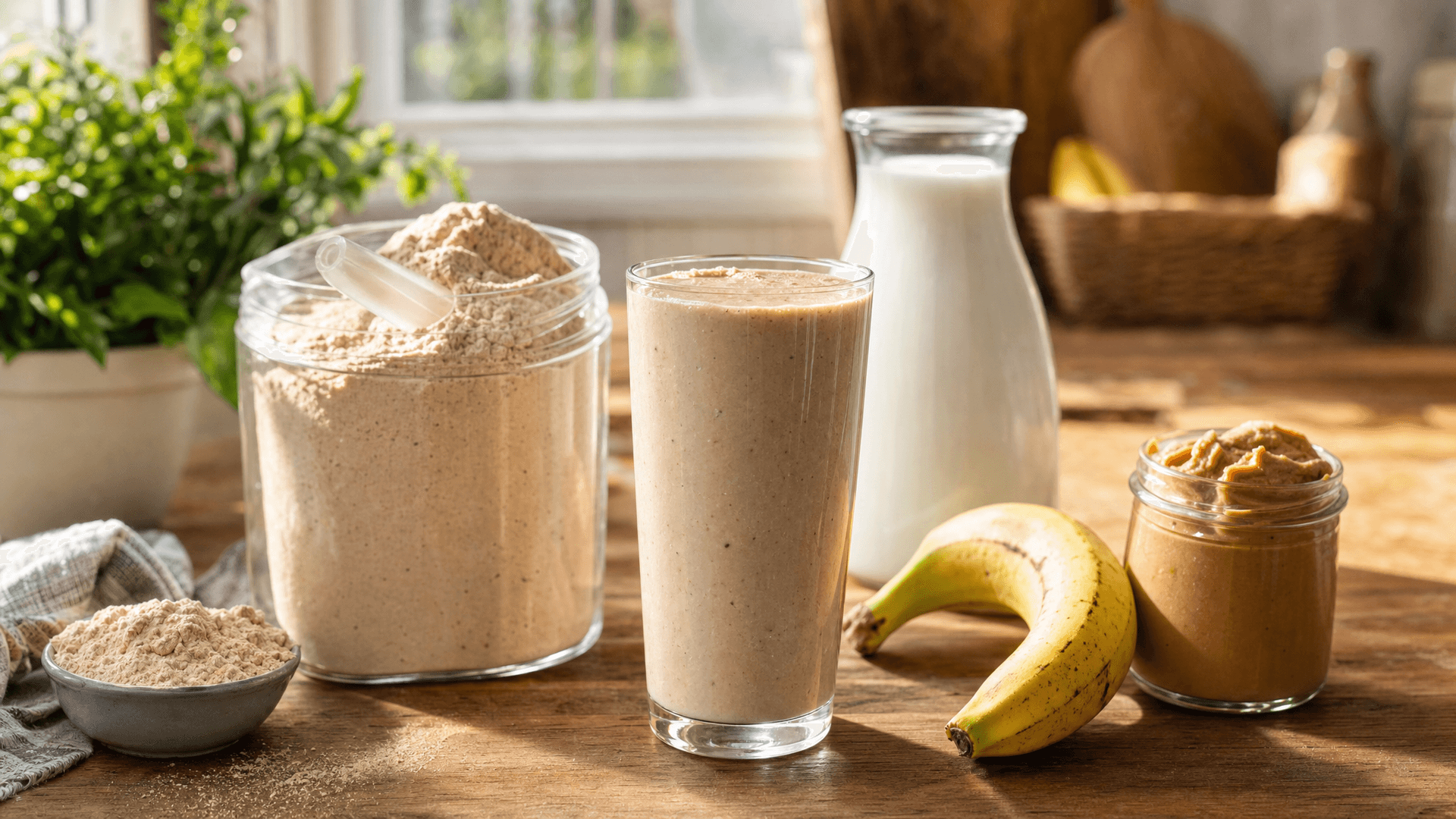
- Adding whole milk, oats and oil turns a 400-calorie serving into a 900-calorie meal for pennies
- Use these as missed-meal insurance, not as your primary food source
What a "Complete Meal" Actually Means
The pitch behind every meal replacement powder is nutritional completeness: all your vitamins, all your minerals, decent macro split, in one scoop. That part is generally true. These products are formulated by people who know what they're doing, and the micronutrient profiles are genuinely solid — often better than what you'd get from the sad sandwich you'd have eaten instead.
The problem isn't the nutrition. The problem is the portion size, and it comes from who these products were designed for.
The default serving on almost every complete-meal brand is 400 calories. That number isn't arbitrary. It's engineered around a 2,000-calorie daily target — the standard reference intake for a sedentary adult. Four hundred calories, three times a day, plus a snack, and you land at maintenance for someone who sits down for a living.
You are not that person. If you're bulking, your target is probably somewhere between 2,900 and 3,600 calories. A 400-calorie meal is 11-14% of your day. That's not a meal. That's a large coffee with a pastry.
Take your daily calorie target and divide by four (three meals plus a shake or snack). If you're eating 3,200 calories, your average meal needs to be around 800. That's your benchmark for every section below.
This is the single most common mistake I see guys make with these products. They swap a real lunch for a stock Huel shake, feel great about "hitting their nutrition," and quietly run a 400-calorie deficit against the day they'd planned. Then they wonder why the scale hasn't moved in six weeks.
The Macro Breakdown: What You're Actually Buying
Let's put the major players side by side. All numbers below are per standard 400-calorie serving, prepared with water, based on the current standard formulations.
| Product | Calories | Protein | Carbs | Fat | Fiber | Protein source |
|---|---|---|---|---|---|---|
| Huel Powder v3.1 | 400 | 29g | 37g | 13g | 7g | Pea + brown rice |
| Huel Black Edition | 400 | 40g | 17g | 17g | 8g | Pea + faba bean |
| Soylent Powder | 400 | 20g | 37g | 21g | 3g | Soy protein isolate |
| Soylent RTD | 400 | 20g | 36g | 21g | 3g | Soy protein isolate |
| Ka'Chava | 240 | 25g | 24g | 7g | 6g | Pea + brown rice + sacha inchi |
| Athletic Greens + protein | ~300 | 26g | 9g | 9g | 4g | Pea + rice blend |
A few things jump out immediately.
Huel Black Edition is the standout for lifters. Forty grams of protein per 400 calories is a protein ratio of 0.1g per calorie — that's better than most protein bars and about as good as it gets outside of straight whey. If you're only going to buy one of these, and you care about protein, this is the one.
Soylent is a carb-and-fat delivery system with some protein attached. Twenty grams per 400 calories is fine for a snack but weak for a meal. For a guy targeting 0.8g per lb of bodyweight in protein, Soylent is going to eat calories without moving your protein needle much.
Ka'Chava isn't even a 400-calorie product. Its standard serving is 240 calories. It's marketed as a meal replacement, but by calorie count it's a smoothie. This matters enormously when we get to cost.
Fiber is the sleeper issue. Huel's 7-8g of fiber per serving is great for general health and awful for someone trying to eat 3,400 calories a day. Fiber fills you up. If you drink three Huel servings, you've just eaten 21-24g of fiber and you'll be too full to eat dinner. This is a real problem for hardgainers and nobody warns you about it.
Cost Per 1,000 Calories: The Only Metric That Matters
When you're bulking, you're not buying meals. You're buying calories. So the honest way to compare these products is cost per 1,000 calories — the same way we broke it down in our guide to the cheapest calories per dollar for bulking.
Prices below are approximate US subscription pricing at the largest bag size. Your local pricing will vary, but the ratios hold.
| Product | Price per serving | Calories | Cost per 1,000 cal |
|---|---|---|---|
| Huel Powder v3.1 | $2.50 | 400 | $6.25 |
| Huel Black Edition | $3.20 | 400 | $8.00 |
| Soylent Powder | $2.30 | 400 | $5.75 |
| Soylent RTD (bottle) | $3.25 | 400 | $8.13 |
| Ka'Chava | $4.67 | 240 | $19.46 |
| Whole milk + oats + PB (homemade) | $1.10 | 600 | $1.83 |
| Plain white rice | $0.30 | 700 | $0.43 |
Now you see the real picture.
Ka'Chava costs $19.46 per 1,000 calories. That's more than ten times the cost of a homemade shake with the same or better macros, and roughly 45 times the cost of rice. You're paying for adaptogens, a superfood blend, and marketing. As a bulking calorie source it's indefensible.
Soylent and Huel Powder land around $6 per 1,000 calories, which is expensive but not insane. For context, most people bulking on whole foods land somewhere between $1.50 and $4 per 1,000 calories. So you're paying roughly a 2x convenience premium.
If you replaced three meals a day with stock Huel and hit 3,200 calories, you'd spend about $20 a day, or $600 a month, on powder. That's not a bulking strategy. That's a subscription you'll cancel in week three.
The honest conclusion: these products are too expensive to be your base. They're perfect as an insurance policy for the two or three meals a week that would otherwise become nothing.
Is the Protein Actually Any Good?
Short answer: yes, with one caveat.
Most complete-meal brands use plant protein — pea, brown rice, faba bean, soy. Plant proteins get a bad reputation among lifters, and the reputation is about 20% deserved.
Here's the actual issue. Protein quality comes down to two things: the amino acid profile (does it contain all nine essential amino acids in useful ratios) and leucine content (leucine is the specific amino acid that triggers muscle protein synthesis).
- Pea protein is high in leucine but low in methionine
- Rice protein is low in leucine but high in methionine
- Blend them and you get a complete profile that's genuinely comparable to dairy protein
That's why every serious brand uses a pea-rice blend rather than one alone. It's not a marketing gimmick — it's solving a real amino acid gap.
Soy protein isolate (what Soylent uses) is already a complete protein on its own and has a PDCAAS score of 1.0, the same as whey. The soy-and-testosterone panic has been repeatedly tested and doesn't hold up at normal intakes. Not a concern.
The caveat: plant proteins need roughly 20-30% more total grams to produce the same muscle protein synthesis response as whey, mostly because of the leucine difference. Practically, that means if you're getting a big chunk of your daily protein from plant sources, aim for the higher end of the range — 0.9-1.0g per lb rather than 0.7g per lb.
For a 155 lb lifter, that's the difference between 112g and 154g of protein a day. Real, but manageable.
Add a scoop of whey to your meal replacement shake. It costs about 60 cents, adds 25g of high-leucine protein, and fixes the amino acid question permanently. If you're not sure which whey to buy, we covered it in detail in our protein powder guide for skinny guys.
Turning a 400-Calorie Shake Into a 900-Calorie Meal
This is the part nobody on the Huel website will tell you, because it undermines their serving-size math. But it's the whole reason these products are useful to you.
A stock shake is a base. Your job is to load it.
The Four Levers
There are exactly four things you can add, ranked by calories added per unit of effort and stomach space:
1. Swap water for whole milk. This is the single highest-leverage change you can make. Two cups of whole milk instead of water adds 300 calories and 16g of protein for about 70 cents. It also makes the shake taste dramatically better, which matters more than you think when you're drinking this three times a week.
2. Add oats. Half a cup of rolled oats blended in adds 150 calories and thickens the shake. Cheap, neutral-tasting, and it's the same trick that powers most of the homemade mass gainer recipes we've published.
3. Add fat. Fat is 9 calories a gram — it's the densest lever you have. Two tablespoons of peanut butter adds 190 calories. One tablespoon of olive oil or MCT oil adds 120 calories with zero taste and zero volume. Oil is the cheat code for hardgainers who fill up fast.
4. Add a half scoop of the powder itself. Going from one scoop to 1.5 adds 200 calories and keeps the micronutrient profile proportional. It's the most expensive lever per calorie, but the least effort.
The Loaded Build
Here's what a real bulking version of a Huel shake looks like:
| Component | Calories | Protein |
|---|---|---|
| Huel Black, 1 serving | 400 | 40g |
| Whole milk, 2 cups | 300 | 16g |
| Rolled oats, ½ cup | 150 | 5g |
| Peanut butter, 1 tbsp | 95 | 4g |
| Total | 945 | 65g |
945 calories and 65 grams of protein in a shaker bottle you filled in ninety seconds. That's not a snack. That's a bigger, better-balanced meal than most people eat sitting down.
The added cost over the stock shake is roughly $1.10, which drops the overall cost per 1,000 calories from $8.00 down to about $4.55. Loading the shake doesn't just fix the calories — it makes the product significantly cheaper per calorie, because you're diluting expensive powder with cheap milk and oats.
Pre-portion your oats and powder into a shaker at night. In the morning you add milk, shake, and walk out the door. The friction of measuring things at 7am is what kills this habit.
A Soylent Version
Soylent's lower protein means you need to load it differently — with protein, not just calories.
| Component | Calories | Protein |
|---|---|---|
| Soylent Powder, 1 serving | 400 | 20g |
| Whole milk, 2 cups | 300 | 16g |
| Whey isolate, 1 scoop | 120 | 25g |
| Olive oil, 1 tbsp | 120 | 0g |
| Total | 940 | 61g |
Same calorie target, similar protein, built from a weaker base.
When These Actually Make Sense
Let's be specific about where meal replacement powders earn their cost, because the answer isn't "always."
They're great for:
- The lunch you'd otherwise skip. Class, shift work, a commute that eats your midday — this is the core use case and it's a genuinely good one.
- The post-workout window when you're not hungry. Training hard kills appetite for a lot of guys. Drinking 900 calories is dramatically easier than chewing them.
- Travel and dorm life. No kitchen, no fridge, no problem. A bag of powder and a shaker works anywhere.
- Breakfast, if you don't do breakfast. Most hardgainers are skipping breakfast entirely. Replacing zero calories with 900 is the biggest single win available.
- The last meal of a day you're behind on. Down 700 calories at 9pm and not hungry? This is exactly what it's for.
They're bad for:
- Being your main food source. Too expensive, too much fiber, and you'll be miserable by week two.
- Anyone with an easily-filled stomach who also wants to eat real meals. The fiber and volume will crowd out actual food.
- Cost-sensitive bulking. If your food budget is tight, a bag of oats, some milk and peanut butter beats any of these on every metric except convenience.
Watch your total fiber. Two loaded Huel shakes plus a normal day of vegetables can push you past 40g of fiber, and you'll feel it — bloating, gas, and a stomach too full to take dinner. If you're going to drink more than one a day, Soylent's lower fiber content is actually the better choice.
The Brands, Ranked for Bulking
Here's my honest ordering if your goal is gaining weight.
1. Huel Black Edition
Best protein density on the market at 40g per 400 calories. Lower carb, which means you need to add your own — but that's easy with oats or milk. Loads well, tastes decent with milk, and the amino profile is solid. The high fiber is the only real knock.
2. Huel Powder v3.1
Cheaper than Black, more carbs, less protein. Perfectly fine as a base if you're adding whey anyway. Best value of the Huel line at $6.25 per 1,000 calories.
3. Soylent Powder
Cheapest of the group and the lowest fiber, which is genuinely useful for hardgainers. Protein is weak, so plan to add a scoop of whey. The RTD bottles are convenient but cost 40% more per calorie — buy powder.
4. Everything else
Ka'Chava, Athletic Greens and the boutique superfood blends are priced for a wellness audience with disposable income. At $19.46 per 1,000 calories, Ka'Chava is a luxury product, not a bulking tool. If you love the taste and you're rich, enjoy it. Otherwise it's an easy skip.
Common Mistakes
1. Treating the stock serving as a meal. Four hundred calories replaced your 800-calorie lunch. You just lost 400 calories. Load it or don't bother.
2. Making it with water. Water adds zero calories and makes it taste worse. Milk adds 300 and makes it taste better. There's no argument here.
3. Drinking three a day. Fiber overload, cost explosion, and you'll hate it. Cap it at one or two.
4. Not tracking them. These are dense and easy to under-log. A loaded shake is nearly 1,000 calories — if you log it as "Huel, 1 serving," your tracker is off by 545.
5. Buying RTD bottles. The ready-to-drink versions cost 40% more per calorie, can't be loaded easily, and ship water around the country. Powder every time.
6. Expecting them to fix a broken diet. If you're eating 2,200 calories and adding one shake, you're at 3,100 — great. If you're eating 2,200 and replacing a meal with one shake, you're still at 2,200.
How to Know It's Working
Meal replacement shakes are a tool for consistency, so measure consistency.
Weigh yourself every morning, same conditions, and track the weekly average rather than any single day. For a lean bulk you're looking for 0.25-0.5% of bodyweight per week. For a 155 lb guy that's roughly 0.4-0.75 lbs a week.
Also track how many meals you actually hit. Count them for two weeks. If you were missing four meals a week before and you're missing zero now, the shakes are doing their job even if the scale takes a month to catch up.
If after three weeks the weekly average hasn't moved, you're not in a surplus. Add another 7 oz of whole milk to each shake, or one more tablespoon of oil, and reassess in another two weeks.
Where FuelTheGains Fits
Here's the thing about meal replacement shakes: they solve the execution problem, not the planning problem. You still have to know how many calories you need, how much protein, and what your other meals should look like so the shake actually fills a gap instead of replacing something better.
That's where comes in. You put in your weight, height, training schedule and — critically — your real constraints, like a tiny budget, no kitchen, or four days a week where lunch isn't happening. It builds a weekly plan around those constraints, with exact quantities, and tells you where a shake makes sense and where you should just eat food.
It's built specifically for hardgainers, not for a general fitness audience. So the plans assume you struggle to eat enough rather than struggle to stop.
The Bottom Line
Complete meal powders are a legitimate tool for skinny guys, but only if you ignore how they're sold. The 400-calorie serving is designed for someone who wants to eat less. You want to eat more.
Load the shake. Whole milk, oats, a spoon of oil. Turn a 400-calorie snack into a 900-calorie meal for about a dollar. Use it for the two or three meals a week that would otherwise become a bag of chips, and build the rest of your day around real food that costs a quarter as much.
Buy Huel Black if you care about protein. Buy Soylent Powder if you fill up fast. Skip Ka'Chava entirely.
Do that, and the missed meals stop being the reason you're not growing.