
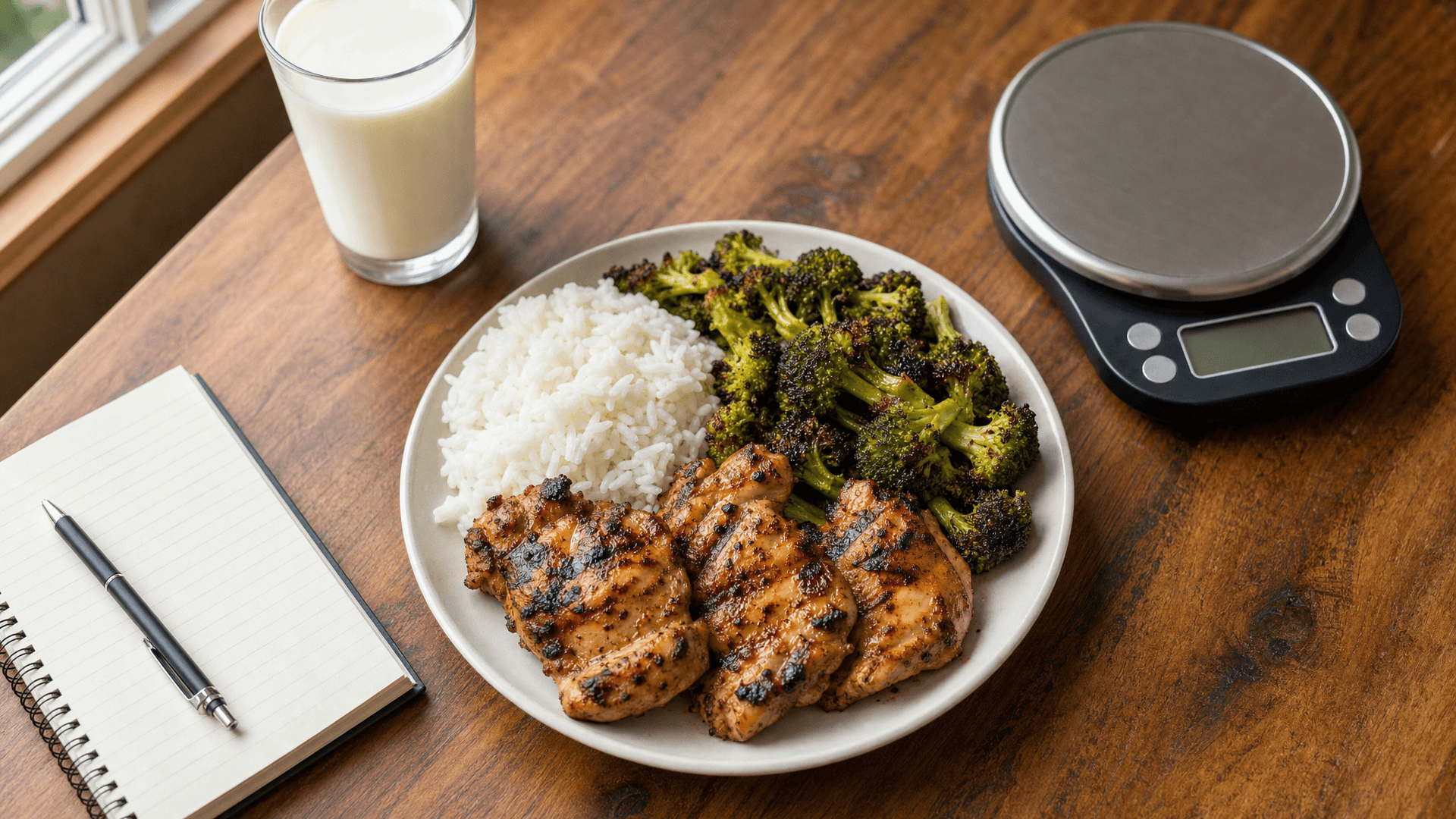
Every bulking guide on the internet ends the same way: hit your calories, be patient, congrats on the 20 lbs. Roll credits.
Then nobody says a word about the four weeks that follow.
Which is a problem, because those four weeks are where most hardgainers quietly hand back a quarter of what they just built. You stop counting. Your appetite finally normalizes after months of force-feeding. The scale slides 6-8 lbs in a month and you tell yourself it was "just water weight" — except the shirts fit differently and the bar feels heavier and by January you're starting the next bulk from almost exactly where you started the last one.
That's the hardgainer treadmill. Gain, drift, gain, drift. Two years of work, net result: a few pounds and a lot of grocery receipts.
The fix isn't complicated, but it is deliberate. You have to treat maintenance as a phase with its own number, its own rules, and its own end date — not as the absence of a phase.
- Your maintenance calories are 400-600 higher after a bulk than they were before it
- Never drop straight to maintenance — taper 150-250 calories per week over 3-4 weeks
- Spend a full 8-12 weeks at maintenance before you cut or bulk again
- The scale should hold within a 1 kg band across weekly averages, not day to day
- Appetite normalizing is the real threat, not metabolism — keep eating on a schedule
- Keep protein and training volume identical to the bulk; only carbs and fats move
- Your next bulk should start from a higher floor, not from square one
Your Maintenance Number Moved — And You Didn't Notice
Here's the thing almost nobody tells you: the maintenance calories you calculated at the start of your bulk are now fiction.
You are a physically bigger organism. More tissue costs more energy to carry around, to heat, to repair, and to move through space. A guy who went from 150 lbs to 170 lbs is not the same machine anymore.
The rough math breaks down like this:
| Component | What changed | Extra daily calories |
|---|---|---|
| Resting metabolic rate | More lean and fat mass to maintain | 100-180 |
| Activity cost | Every step, rep and stair costs more | 100-200 |
| Digestion (TEF) | You're processing more food overall | 60-120 |
| NEAT rebound | Fidgeting and spontaneous movement return | 50-150 |
Add it up and you land somewhere between 400 and 600 extra calories per day compared to your pre-bulk maintenance. For most guys who ran a proper bulk, that's not a rounding error — that's a whole meal.
This is exactly why "just go back to eating normally" is such terrible advice. Normal was the intake that kept a smaller version of you in place. Eat like that guy and you'll shrink until you are that guy again.
Losing 8 lbs over five weeks is a deficit of about 400 calories a day. That's one shake. One. You will not feel hungry, you will not feel like you're dieting, and you will not notice until the scale has already made the decision for you.
If you're fuzzy on how those numbers were built in the first place, it's worth re-reading how to calculate your bulking calories — the same framework applies here, you're just solving for zero gain instead of steady gain.
Step 1: Find Your New Maintenance With Data, Not a Calculator
You can estimate your new maintenance with an equation. You'll be off by 200-300 calories, because every online calculator is fitted to population averages and hardgainers are, by definition, not average.
So do it the empirical way. It takes two weeks and it's basically free.
The two-week baseline
Hold your bulk calories exactly where they are for 14 more days. Don't cut anything yet. Weigh yourself every morning, same conditions: after the bathroom, before food or water, minimal clothing.
At the end of each week, average the seven daily weights. You now have two weekly averages, and the difference between them tells you everything.
| Weekly average change | What it means | Your move |
|---|---|---|
| Up more than 0.4 kg | Still in real surplus | Subtract ~400 calories to find maintenance |
| Up 0.2-0.4 kg | Normal late-bulk gain | Subtract ~250-300 |
| Up under 0.2 kg | You're already close | Subtract ~100-150 |
| Flat or down | Bulk calories became maintenance | You're already there — hold |
That last row surprises people, but it's common. Bulks stall precisely because your maintenance climbed to meet your intake. If the scale hasn't moved in three weeks on the same food, congratulations — you already found your new maintenance number, the hard way.
The arithmetic behind it: roughly 7,700 calories per 2.2 lbs of tissue gained, spread over seven days, means gaining 0.5 lb per week is about a 275-calorie daily surplus. Subtract that surplus from your current intake and you have maintenance.
Do not run this baseline during a deload, a vacation, a week of bad sleep, or the week you started a new job. Any of those swings your daily energy expenditure by hundreds of calories and you'll anchor to a garbage number.
A worked example
Say you're 170 lbs at 5'10", finishing a bulk on 3,400 calories. Over two weeks your averages go 169 lbs to 169.5 lbs — about 0.6 lb total, or 0.3 lb a week.
That's roughly a 165-calorie daily surplus. So your true maintenance is about 3,235 calories — call it 3,250. Compare that to the 2,700 you were maintaining at before the bulk started, and there's your 550-calorie shift, sitting right in the predicted range.
That number, 3,250, is the one you're defending for the next three months.
Step 2: Taper Down, Don't Fall Off a Cliff
The single most common post-bulk mistake is going from 3,400 to 3,250 to 2,800 in the space of a weekend, because you're sick of eating and the freedom feels good.
Two things go wrong when you drop that fast.
First, your body compensates. A sudden intake drop of 500-plus calories triggers a measurable reduction in spontaneous movement — you sit more, you take the elevator, you stop bouncing your leg. Research on this effect puts the swing at 100-300 calories a day. So you cut 500, your body claws back 200, and now your "maintenance" isn't maintenance anymore — it's a slow deficit you can't see.
Second, and bigger for hardgainers: your stomach adapts down faster than it adapted up. It took you eight weeks to comfortably eat 3,400 calories. Cut hard for four days and that capacity starts evaporating. Getting it back is another month of misery.
The taper protocol
Come down in steps of 150-250 calories per week, and hold each step for a full seven days before the next one.
| Week | Calories | What you're doing |
|---|---|---|
| 1 | 3,400 | Baseline week — no change |
| 2 | 3,400 | Baseline week — confirm the trend |
| 3 | 3,250 | First step down |
| 4 | 3,250 | Hold and observe |
| 5 | 3,250 | Confirm the scale is flat |
Notice that in this example there's only one step, because the calculated maintenance was only 150 below the bulk. If your bulk was more aggressive — say you were running a 500-calorie surplus — you'd take three weeks to walk it down instead of one.
Every calorie you remove should come from carbs and fats only. Protein stays exactly where it was: 0.8-1.0g per lb of bodyweight, every single day. That's the tissue you just paid for, and protein is what keeps the body from deciding it's optional.
Cut the calories from the meal you enjoy least, not from the one you enjoy most. If forcing down that second scoop of rice at lunch is the low point of your day, that's the 200 calories to remove first. Post-bulk adherence is an appetite management problem, and you win it by removing friction, not flavor.
Step 3: Defend the Number for 8-12 Weeks
Here's the part that separates guys who build year over year from guys who oscillate: you have to actually stay here for a while.
Eight weeks minimum. Twelve is better.
Why 8-12 weeks and not two
Your new weight needs to become boring. A lot of what you gained on a bulk is glycogen, intramuscular water and gut content — real, useful, but not durable. The connective tissue, the capillary density, the actual contractile protein: that stuff consolidates over months, not days.
Your appetite has to recalibrate. Weeks 1-3 post-taper, you'll still be hungry on schedule because you trained yourself to be. Weeks 4-8, hunger drops off a cliff and this is the danger zone — you'll start "forgetting" meals. Weeks 9-12, hunger stabilizes at your new bodyweight's genuine baseline, which is meaningfully higher than it used to be.
Your next bulk needs a higher floor. If you spend three months holding 170 lbs, your body stops treating it as an anomaly. The next bulk starts there instead of restarting at 161 lbs after the drift. That's the entire game.
This is also the natural decision point for what comes next. If you're wondering whether you should be cutting instead of maintaining, how long you should bulk before cutting walks through the body-fat thresholds and timing that make that call for you.
What "holding" actually looks like on the scale
Your weight will not sit still, and that's fine. Sodium, carb load, hydration, training soreness and how recently you used the bathroom can swing you 2-3 lbs within a single day.
The rule: judge only weekly averages, and give yourself a band.
| Weekly average vs. target | Verdict | Action |
|---|---|---|
| Within 0.5 kg | Perfect | Nothing |
| Down 0.5-1 kg for 2 weeks | Real drift | Add 150 calories/day |
| Down over 1 kg for 2 weeks | You're dieting by accident | Add 250-300 calories/day |
| Up over 1 kg for 3 weeks | Creeping surplus | Subtract 150 calories/day |
Two consecutive weeks is the trigger. One bad week is noise. Reacting to noise is how people end up chasing the scale in circles.
The weight-loss direction is the one that sneaks up on you, because it feels like nothing is wrong. Nobody notices being 200 calories short. Set a recurring reminder to check your two-week average — this is the single highest-leverage habit of the entire maintenance phase.
The Appetite Trap (And How to Beat It)
Let's name the actual enemy. It's not your metabolism. It's not "hardgainer genetics." It's that after months of eating past comfort, your body finally gets permission to stop — and it takes it enthusiastically.
The symptoms are predictable. Around week 3 or 4 post-taper you'll notice you're not finishing plates. You'll skip the mid-afternoon meal because you're "not hungry yet." A shake gets replaced by coffee. None of these feel like decisions. Collectively they're a 400-calorie daily deficit.
Four defenses that actually work
1. Keep eating on the clock, not on hunger. Same rule that got you through the bulk. Every 3-3.5 hours, food happens, hungry or not. Hunger is a terrible signal at maintenance because it's calibrated to a bodyweight you no longer have.
2. Protect one liquid meal. If you drop to zero shakes the day the bulk ends, you've just removed 500-700 of the easiest calories in your day and you will not replace them with solid food. Keep at least one — even a smaller one. 10 oz of whole milk, a scoop of whey and a banana is 400 calories in 60 seconds.
3. Front-load your day. Post-bulk appetite tends to collapse in the evening. Push a bigger share of your calories into breakfast and lunch, when eating is still easy, so a light dinner doesn't blow the day.
4. Don't drop calorie density. The instinct after a bulk is to "eat cleaner" — more vegetables, more volume, less oil. That's fine in principle and disastrous in practice, because you'll fill up on 14 oz of broccoli and come in 500 calories short. Keep the olive oil, keep the nut butter, keep the whole milk. Density is your friend at every phase.
A simple audit: if your daily food total weighs noticeably less than it did during the bulk but your calorie target only dropped by 150, something's off. Weigh your food for one week during the taper. It's boring, it takes four days, and it catches the drift before the scale does.
What About Training and Body Composition?
Maintenance is not a break. Do not deload for eight weeks.
Keep your volume and intensity where they were. The signal that tells your body to keep the new muscle is the same signal that told it to build the muscle. Cut training volume in half at maintenance and you'll lose tissue even while holding your weight perfectly — you'll just replace it with fat.
Keep progressing, slowly. You have plenty of food to recover from hard sessions, so add reps and load where you can. Maintenance is actually one of the better times to push strength, because you're fully fueled and not fighting a deficit.
Expect some recomposition. Over 8-12 weeks at a stable weight with hard training and high protein, most guys get slightly leaner at the same bodyweight. Nothing dramatic — maybe a point or two of body fat — but the mirror often improves while the scale sits still. If that happens, don't panic and don't start adding calories. The scale is doing its job.
If you finished the bulk noticeably softer than you'd like and the idea of holding that for three months makes you twitchy, a short controlled deficit is a reasonable option — the 3-week mini cut exists for exactly this situation. Run it, then come back and do your maintenance block properly. Don't skip the maintenance block. That's the whole point of the article.
The Five Mistakes That Undo a Bulk
-
Stopping tracking on day one. You don't have to log forever. But log through the taper and the first four weeks of maintenance, because that's when your intake changes fastest and your intuition is least reliable.
-
Using the old maintenance number. Your pre-bulk calculation is dead. It described a smaller person. Using it guarantees a 400-600 calorie deficit.
-
Treating a bad weigh-in as data. One morning 2 lbs down after a poor night's sleep and a salty dinner means nothing. Weekly averages, two consecutive weeks, then act.
-
Cutting protein because "I'm not bulking anymore." Protein requirements don't drop when the surplus does. If anything, they matter more, because now protein is doing defensive work instead of offensive work.
-
Ending maintenance the moment you're bored. Six weeks isn't enough. The consolidation and the appetite recalibration both need the back half of that window. Set an actual end date on a calendar when you start.
Where FuelTheGains Fits
The reason maintenance goes badly for most people isn't ignorance — it's that the work of hitting a specific calorie target every day, with real food you'll actually eat, doesn't get easier just because the number got smaller.
That's the problem was built for. You give it your new maintenance number, your training days, the foods you already like and the ones you refuse to touch, and it builds the week's meals around them — with the calorie density kept high so you're not trying to hit 3,250 on salad. When your two-week average tells you to add 150 calories, you change one number and the plan adjusts instead of you rebuilding it from scratch in a spreadsheet.
It won't eat the food for you. But it removes the part where you're standing in the kitchen at 9pm doing mental math about whether you're 300 calories short, which is precisely the moment most maintenance phases fall apart.
The Bottom Line
The bulk isn't over when you stop eating in a surplus. It's over when the weight has been yours for three months.
Find your new number with two weeks of honest data. Walk down to it in 150-calorie steps instead of jumping. Hold it for 8-12 weeks with the same protein, the same training, and the same eat-on-a-schedule discipline that got you here.
Do that once and the next bulk doesn't start at square one — it starts 20 lbs up the ladder. Do it every time, and three years from now you're not the guy who's been "bulking on and off" forever. You're just bigger.