
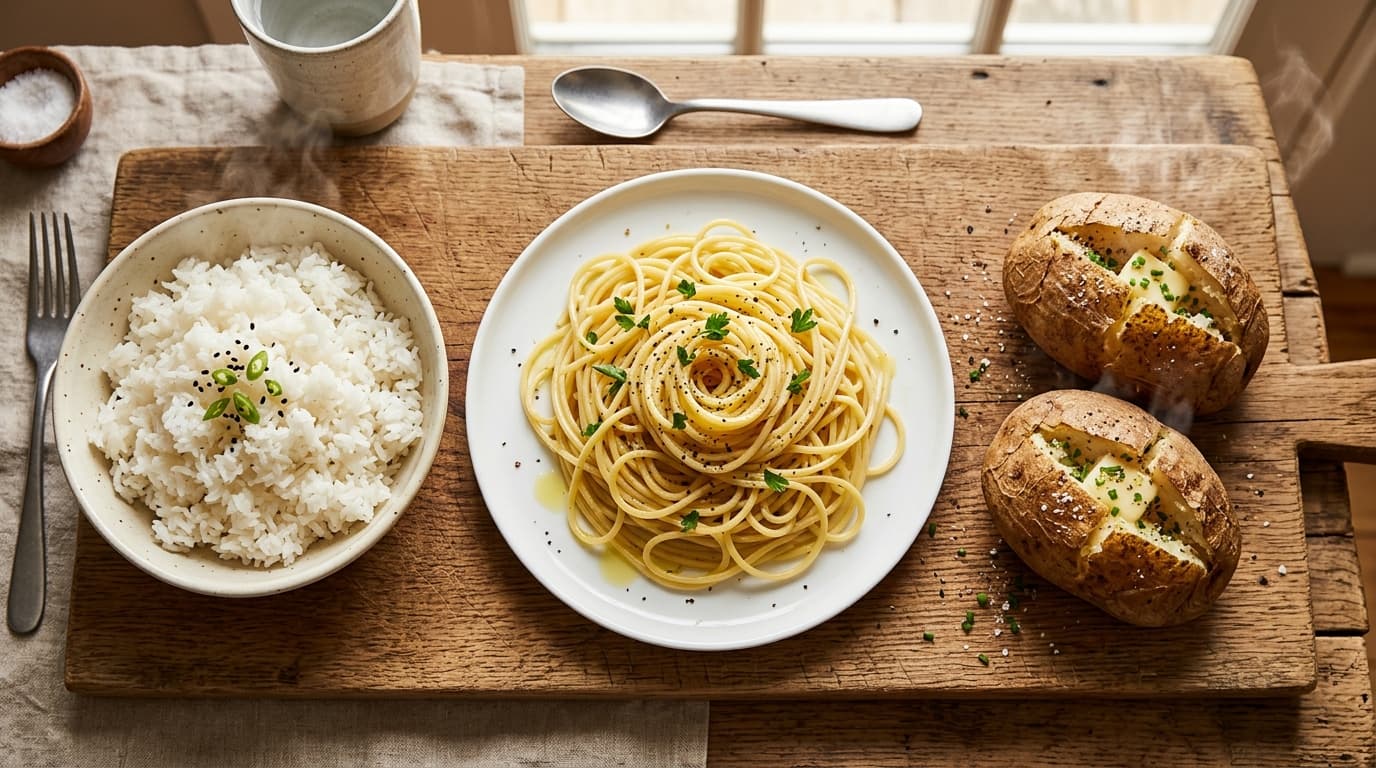
If you're a skinny guy trying to bulk, you've probably already learned the lesson: protein alone doesn't build muscle — you need a mountain of carbs underneath it.
And when it comes to cheap, high-volume, training-friendly carbs, three foods dominate every hardgainer's kitchen:
- Rice
- Pasta
- Potatoes
They're cheap. They cook in under 20 minutes. They pair with literally any protein. And they've fueled pretty much every lifter who's ever gone from 132 lb to 200 lb.
But which one is actually best for bulking? Which one packs the most calories for the least effort? Which one digests fastest post-workout? And does it even matter which you pick?
This is the no-nonsense head-to-head comparison. By the end, you'll know exactly which carb to default to — and when to swap it for another.
- All three carbs work for bulking — there is no "bad" choice
- Rice is the winner for calorie density per volume and post-workout recovery
- Pasta is the winner for sheer calories per plate and ease of eating large portions
- Potatoes are the winner for fullness, nutrients, and appetite when you're not hungry
- Most successful bulks rotate all three across the week to prevent boredom
- The carb itself matters less than hitting your total daily calories consistently
Why Carbs Matter So Much When You're Bulking
Before the head-to-head, let's settle the "why" in one paragraph.
Carbs do three things that are non-negotiable when you're trying to gain muscle:
- They spare protein. When carbs are low, your body burns protein for fuel instead of using it to repair muscle.
- They refill glycogen. Heavy training drains the glycogen in your muscles. Carbs put it back, which is why you feel strong session after session.
- They're calorically cheap. Carbs are the easiest way to hit a 3,000-4,000 calorie target without forcing yourself to eat gallons of olive oil.
If you're still confused about how many carbs you actually need, start with our bulking calorie calculator guide. For most skinny guys, the answer is "way more than you think" — usually 400-600g of carbs per day during a real bulk.
Now let's compare the three kings.
The Head-to-Head: Rice vs Pasta vs Potatoes
First, the raw numbers. These are per 3.5 oz of cooked weight — which is what actually matters when you're putting food on your plate.
| Food | Calories | Carbs | Protein | Fat |
|---|---|---|---|---|
| White rice (cooked) | 130 | 28g | 2.7g | 0.3g |
| Pasta (cooked) | 158 | 31g | 5.8g | 0.9g |
| Potato (boiled, skin on) | 87 | 20g | 1.9g | 0.1g |
At first glance, pasta looks like the runaway winner. More calories, more carbs, more protein — all in the same volume.
But that's only half the story. Cooked weight is deceiving because each of these foods absorbs water differently. Let's look at dry weight → cooked weight next, because that's what determines how much food ends up on your plate.
| Food | Dry weight | Cooked weight | Calories (cooked) |
|---|---|---|---|
| White rice | 3.5 oz | ~10.5 oz | ~370 |
| Pasta | 3.5 oz | ~7.8 oz | ~370 |
| Potato | 3.5 oz (raw, peeled) | ~3 oz | ~80 |
Now it gets interesting. Per 3.5 oz of dry starting ingredient, rice and pasta deliver almost identical calories — around 370. Potatoes deliver less than a quarter of that.
This is the single most important fact about bulking with potatoes: you have to eat a lot more of them by volume to match rice or pasta.
That's a bug for some guys and a feature for others. We'll get to that.
Round 1: Calorie Density per Plate
Winner: Pasta
When you're a skinny guy with a small appetite, the name of the game is packing calories into the smallest possible plate. You want calories per fork, not volume.
A normal bulking portion of pasta — let's say 5.3 oz dry — cooks up into a plate that most people can finish without feeling stuffed. That's ~555 calories before you add anything to it.
The same calories from rice require 16 oz of cooked rice on your plate. That's a full mixing bowl. Doable, but you feel it.
The same calories from boiled potatoes? About 25 oz. That's like a kilogram of food. Most skinny guys can't eat that in one sitting without calling it a day.
If you dread looking at a giant bowl of food, make pasta your default dinner. It's the most calorie-dense plate of the three, and it slides down easy. Rotate rice and potatoes into lunches when you've got more time to eat.
Round 2: Post-Workout Recovery
Winner: White rice
Right after training, your muscles are screaming for glycogen. You want a carb source that:
- Digests fast
- Spikes insulin (yes, this is good post-workout)
- Doesn't sit heavy in your stomach for two hours
White rice wins this round for a simple reason: it has the highest glycemic index of the three. It converts to glucose fast, floods your bloodstream, and delivers it to your drained muscle cells quickly.
Potatoes are a close second — plain boiled potatoes actually have a very high GI, even higher than white rice in some studies. But they take longer to chew and sit heavier in the stomach, which can be uncomfortable 30 minutes after a heavy squat session.
Pasta is the slowest of the three to digest. It has the lowest glycemic index because of its dense protein structure. That's great for sustained energy, but not what you want post-workout.
Default stack for after training: rice + lean protein + a piece of fruit. That's what most physique athletes have been doing for decades, and there's a reason — it just works. We break down more options in our guide to the best post-workout meals for bulking.
Round 3: Fullness and Satiety
Winner: Potatoes (and it's not close)
Potatoes are the most filling food on earth, pound for pound. There's a famous study called the Satiety Index where researchers ranked 38 foods by how full they made people feel. Boiled potatoes scored 323 — the highest of any food tested. White bread, the baseline, was 100.
In other words, potatoes make you feel about 3x as full as the same calories from bread.
For a skinny hardgainer trying to stuff down 3,500 calories, this is… actually a huge disadvantage for most meals. You don't want to feel full. You want to feel like you could keep eating.
But here's the flip: there's one situation where potatoes are the best choice — when you're not hungry but still need to eat.
On rest days, or on days when life is chaotic and your appetite has disappeared, you don't need something calorie-dense. You need something that feels like real food, digests without discomfort, and doesn't leave your stomach churning. Potatoes are perfect here. A baked potato with butter, salt, and a grilled chicken breast is one of the easiest meals to force down when your hunger is broken.
For more strategies on eating when you're not hungry, check out how to eat more when you're never hungry.
Round 4: Cost per Calorie
Winner: Rice (with pasta a very close second)
If you're on a tight budget — and most skinny guys trying to bulk in college or early twenties are — cost matters as much as macros.
Rough prices per 1,000 calories from the grocery store:
| Food | Cost per 1,000 calories |
|---|---|
| Rice (bulk bag) | ~$0.50 |
| Pasta (store brand) | ~$0.60 |
| Potatoes | ~$1.00 |
A 11 lb bag of white rice is legitimately one of the cheapest food purchases on the planet. It lasts weeks. It never goes bad. It cooks in one pot.
Potatoes are cheap too, but they spoil faster, weigh more to transport, and you're paying for water weight. If money is the only thing standing between you and a real bulk, rice should be your default.
For a full list of the cheapest bulking foods, see our bulking grocery list on a budget.
Round 5: Muscle-Building Micronutrients
Winner: Potatoes
This is the round that surprises most people. Potatoes — especially with the skin on — are significantly more nutrient-dense than white rice or plain pasta.
Per 200 calories:
| Nutrient | Rice | Pasta | Potato |
|---|---|---|---|
| Potassium | 80 mg | 70 mg | 900 mg |
| Vitamin C | 0 mg | 0 mg | 35 mg |
| Vitamin B6 | 0.15 mg | 0.07 mg | 0.70 mg |
| Magnesium | 25 mg | 40 mg | 55 mg |
| Fiber | 1 g | 3 g | 5 g |
That potassium number isn't a typo. A single large baked potato has more potassium than three bananas. And potassium plays a massive role in muscle contraction, hydration, and preventing cramps during heavy sets.
Pasta (especially whole wheat) takes second place thanks to more fiber and slightly more micronutrients from the wheat germ. White rice is the least nutrient-dense of the three — but it's also the easiest on digestion, which matters when you're already packing away 4,000 calories a day.
The "best" carb is usually the one you can eat the most of without wrecking your digestion. For some guys that's rice. For others, potatoes. Test each one for a week during a heavy training block and see how you feel — then default to the winner.
What About Brown Rice, Whole Wheat Pasta, and Sweet Potatoes?
The "healthier" versions of each carb have slightly more fiber and micronutrients. But for bulking specifically, they come with two downsides:
- They're more filling — which, again, is bad when you're trying to eat 3,500+ calories.
- More fiber can wreck your digestion at high carb intakes. Once you're eating 500g of carbs a day, whole-grain everything turns into a fiber bomb that slows everything down and leaves you bloated.
The rule most lifters follow is simple: 75% white, 25% whole-grain. Get most of your bulking carbs from fast, clean sources like white rice and regular pasta. Save the whole-grain versions for when you want a flavor change or when you're trying to stay a bit fuller on a rest day.
This is the same logic we explained in depth in our best carbs for bulking guide — fast-digesting carbs are actually better for muscle gain than slow ones, contrary to most "clean eating" advice.
Round 6: Ease of Meal Prep
Winner: Rice
If you're meal prepping for the week on a Sunday, rice is the most forgiving carb of the three.
- Rice: Cooks once, stays edible for 4-5 days in the fridge, reheats in 90 seconds in the microwave with no loss in texture.
- Pasta: Turns gummy and dries out after day 2. Needs a splash of oil or sauce to come back to life.
- Potatoes: Keep for 4-5 days, but they oxidize and turn gray quickly once cut, and the texture is never quite as good reheated.
A rice cooker is one of the best $25 purchases a bulking hardgainer can make. Set it and forget it, and you'll always have 10 servings of perfectly cooked carbs sitting in your fridge ready to go.
Make one giant batch of rice every 3 days. Portion into 5 containers with your protein source pre-cooked. Add different sauces or veggies on serving day to keep things interesting. This alone will take you from "failing to bulk" to "effortlessly hitting calories."
Round 7: Versatility Across Meals
Winner: Tie between rice and pasta
Rice and pasta can both play any role in any meal. Rice with eggs for breakfast, rice with chicken for lunch, rice with beef for dinner. Same for pasta — breakfast pasta is less common in the US but perfectly legitimate.
Potatoes are more meal-specific. They're usually a lunch or dinner side. A breakfast potato is delicious (hash browns, home fries) but it takes more prep, and potatoes don't really fit into a shake or a cold meal-prep container the same way.
If you want flexibility across every meal of the day, default to rice and pasta.
The Verdict: Which Should You Actually Use?
Here's the real answer — and it's going to be unsatisfying if you were hoping for a single winner.
All three work. Rotating between them is optimal.
Here's the rotation most successful bulking hardgainers settle into:
| Meal | Best carb | Why |
|---|---|---|
| Breakfast | Rice (with eggs) or oats | Fast, cold-friendly, easy on the stomach |
| Lunch | Pasta or rice | Calorie-dense, easy to pack for work/school |
| Pre-workout | Rice | Digests fast, no bloat during training |
| Post-workout | Rice | Fastest glycogen replenishment |
| Dinner | Pasta or potatoes | Big plate, comfort food, family-friendly |
| Rest days | Potatoes | More filling, more micronutrients, less calorie-dense |
That's the rotation. Notice how rice shows up the most? That's not an accident. For sheer bulking efficiency, white rice is the single best carb source — highest calories per effort, fastest recovery, cheapest per calorie, best meal-prep behavior.
But pasta wins on the "easy to eat a lot in one sitting" front, and potatoes win on rest days and nutrient density. Use all three, just weight them toward rice as your default.
Common Mistakes Guys Make With These Carbs
Mistake 1: Measuring cooked weight instead of dry weight
One 3.5 oz of dry pasta is not the same as 3.5 oz of cooked pasta. The difference is 250 calories.
Always log the dry weight in your tracking app if you can. It's far more accurate. If you only have cooked weight, make sure your tracker is set to the cooked entry.
Mistake 2: Skipping starch toppings
Plain rice is 130 cal per 3.5 oz. Rice with 1 tbsp of butter stirred in is 200 cal. Rice with butter and a drizzle of olive oil is 280 cal. On a bulking diet, these toppings are free calories that cost you zero appetite.
Same for pasta — a generous drizzle of olive oil on your pasta adds 200+ calories and zero bloat. See our guide on the best fats for bulking for the full list of calorie-dense toppings.
Mistake 3: Being a "clean eating" purist
Some guys refuse to touch white rice or white pasta because they've been told to eat "whole grains" their whole life. As we covered above, this is actively hurting your bulk. Clean carbs are filling carbs, and filling carbs kill appetite.
If you're underweight, skinny, and struggling to gain weight, fast-digesting white carbs are better for your goals — full stop.
Mistake 4: Eating the same carb every single meal
This is the fastest way to burn out on a bulk. By week 3, you'll literally gag at the sight of rice. Rotate between all three, vary the sauces and seasonings, and treat meals like a menu, not a chore.
Mistake 5: Forgetting carbs on rest days
Rest days still require carbs. Your body is still repairing tissue. Your muscles are still refilling glycogen from yesterday's session. If you drop carbs on rest days, recovery stalls — and that's how plateaus start. For a full breakdown, see our rest day nutrition guide.
Sample Day of Bulking Carbs (All Three)
Here's what a real 3,500-calorie bulking day looks like when you rotate all three:
Breakfast (750 cal): 3 whole eggs + 2 egg whites + 7 oz cooked white rice + splash of soy sauce + 1 tbsp olive oil. Quick, high-calorie, protein-packed.
Snack (400 cal): Greek yogurt + 1.75 oz granola + honey + a banana.
Lunch (900 cal): 5.3 oz dry pasta + 5.3 oz ground beef + jarred marinara + grated parmesan + a small salad with olive oil.
Pre-workout (300 cal): A rice cake with peanut butter and a banana. Fast carbs for training.
Post-workout (550 cal): 7 oz cooked rice + 6.3 oz grilled chicken breast + steamed broccoli + hot sauce.
Dinner (600 cal): 1 large baked potato with butter + pan-seared salmon + roasted veggies.
That's rice at breakfast, pasta at lunch, rice again post-workout, and a potato at dinner. Variety across the day, total calories hit cleanly, and you never got bored.
For more meal plan structure, grab our complete bulking meal plan for skinny guys.
The Bottom Line
Rice, pasta, and potatoes are the three bulking carbs that have built more muscle on skinny guys than every "fancy" carb source combined.
- Default to rice — highest efficiency, cheapest, cleanest recovery
- Use pasta when you need the most calories per plate
- Use potatoes on rest days and when appetite is low
The real winner of this comparison isn't any single food. It's the guy who stops overthinking it, picks all three, and eats consistently for 12 weeks in a row.
Because the truth about bulking is the same as it's always been: consistency beats optimization every single time. The best carb is the one that ends up on your plate, meal after meal, day after day — not the one that looked best in a blog post.
Pick one to start with this week. Hit your calorie target. Log your training. And next week, rotate in the other two. That's the whole game.