
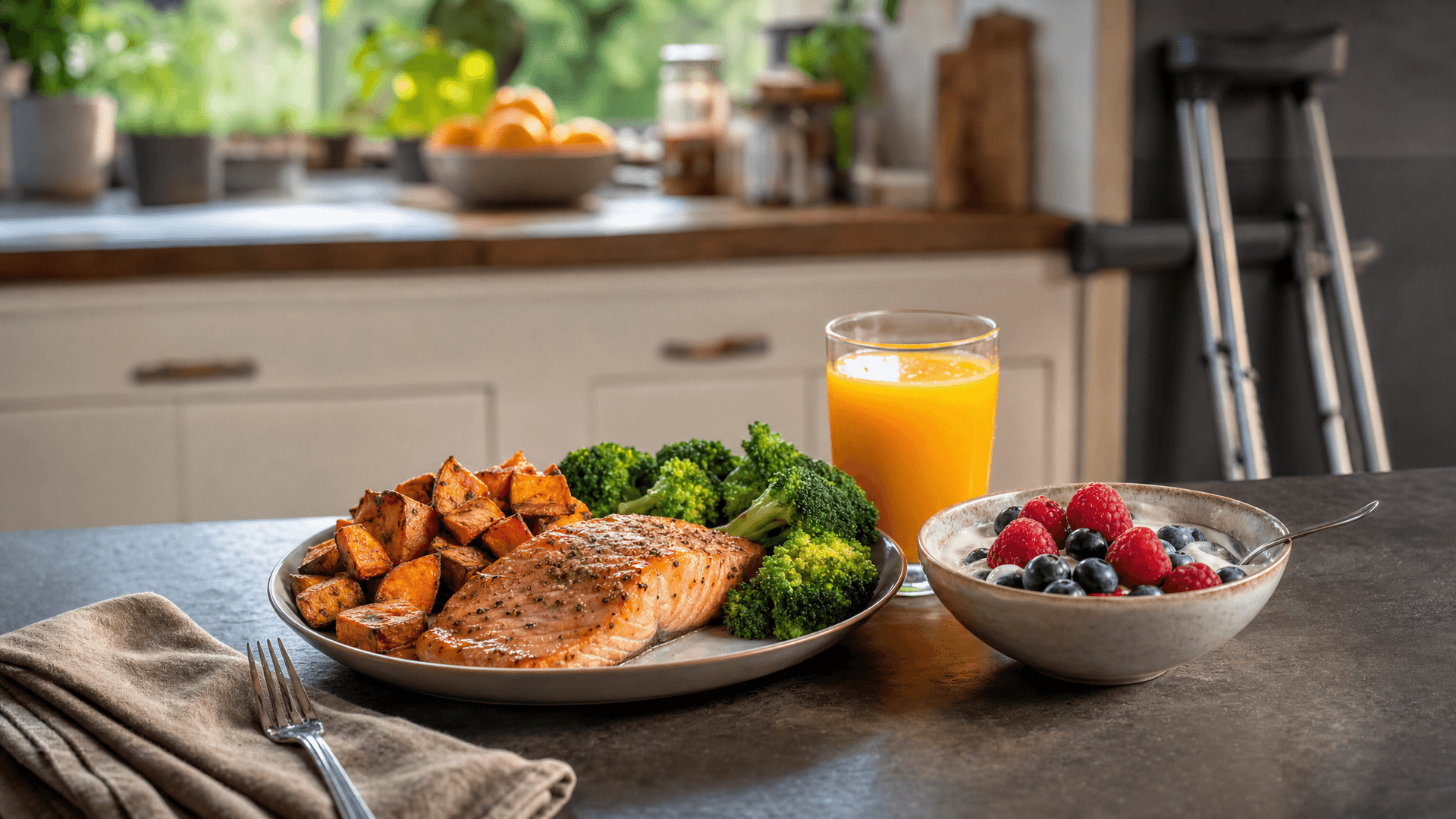
You felt it before you heard it. A pop in the shoulder mid-press, an ankle that rolled on a curb, a knee that just stopped working the way knees are supposed to. Now you're sitting in a doctor's office being told six weeks, maybe eight, and the first thing that hits you isn't the pain.
It's the math. Eight months of grinding. Every meal you forced down. Every rep you didn't want to do. And you're about to watch it drain away while you sit on the couch.
Then someone helpfully tells you: "Well, you're not training, so just eat less. You don't want to get fat."
That advice is not just wrong. It's the single fastest way to lose the muscle you built. Injured tissue increases your nutritional demands — your body is running a construction project 24/7 and you just decided to cut the budget. Let's fix that.
- Don't slash calories — drop to roughly maintenance or 5-10% below, never a deep deficit
- Protein goes UP, not down: aim for the high end of your range while immobilized
- Immobilized limbs develop anabolic resistance, so bigger, more frequent protein doses matter
- Prioritize leucine-rich protein sources at every meal to fight the resistance
- Vitamin C plus gelatin or collagen around light rehab work supports tendon and ligament repair
- Zinc, vitamin A, and adequate carbs drive wound healing and spare protein
- Some fat gain is an acceptable price for keeping your muscle — you can cut later, you can't un-lose muscle easily
Why "Just Eat Less" Is Backwards
Here's the mental model most people have: training burns calories, so no training means fewer calories burned, so eat less or get fat. Simple. Clean. Completely ignores what your body is actually doing.
An injury is a metabolic event. Depending on severity, your resting energy expenditure can go up, not down. Significant trauma — surgery, a fracture, major soft tissue damage — can raise resting metabolic rate by 10-20%. Your immune system is running full tilt. Inflammation is expensive. Tissue synthesis is expensive. Even crutches are expensive: hobbling around on two sticks can burn more energy than walking normally.
Meanwhile, the muscle loss clock is already ticking. Research on limb immobilization is brutal in its consistency — you can lose meaningful cross-sectional area in the affected limb within the first two weeks, and strength drops faster than size does.
Now stack a calorie deficit on top of that. In a deficit, your body needs amino acids for fuel and for healing, and the biggest amino acid reserve you own is your skeletal muscle. You've just told your body that the only available construction material is the thing you spent a year building.
The classic injury spiral: cut calories to avoid fat gain, lose muscle faster, heal slower, stay sidelined longer, lose even more muscle. Two extra pounds of fat is a three-week problem. Losing 9 lb of muscle is a six-month problem.
How Many Calories You Should Actually Eat
Forget the gym-bro instinct to slam the brakes. Here's the framework.
Start by recalculating maintenance for your current activity level. Your old bulking number assumed five training sessions a week, an active lifestyle, and the general energy cost of being a person who moves. That's gone. But your basal metabolic rate — the biggest slice of the pie for most lifters — hasn't gone anywhere. In fact, it may have gone up.
A rough approach that works: take your bodyweight in pounds and multiply by 13-15 for a mostly sedentary injured state, then adjust. For a 175 lb guy, that's roughly 2,300-2,600 calories as a starting point. If you're in an air boot but still walking and doing upper body work, you're at the top of that. If you're post-surgery on the couch, you're at the bottom.
Then apply the injury adjustment based on severity:
| Injury severity | Energy adjustment | Typical examples |
|---|---|---|
| Minor strain, still training around it | Maintenance | Tweaked shoulder, mild tendinopathy |
| Moderate, one limb out | Maintenance to 5% below | Sprained ankle, torn rotator cuff |
| Major surgery or fracture | Maintenance to 10% above | ACL reconstruction, broken femur |
| Recovery phase, returning to training | Small surplus (200-300 cal) | Cleared for progressive loading |
Notice what's missing from that table: any row that says "eat 500 fewer calories." Because there isn't one.
The most aggressive I'd ever get is 5-10% below maintenance, and only for a minor injury where healing demand is low and you're honestly worried about creeping up. That's maybe 150-250 calories off. It's not a cut. It's a nudge.
Weigh yourself daily and use the weekly average. If you're gaining more than about 0.5 lb a week while sidelined, trim 100-150 calories. Don't overreact to a single reading — inflammation and reduced movement both cause water retention that has nothing to do with fat.
Protein Goes Up, Not Down
This is the part everyone gets wrong, and it's the part that matters most.
The logic error is understandable: protein is for building muscle, you're not building muscle, so less protein. But protein isn't just for hypertrophy. It's the raw material for collagen, immune cells, enzymes, and every single structural repair your body is attempting right now.
And there's a nastier problem underneath: anabolic resistance. When a muscle is unloaded — casted, slinged, immobilized — it becomes measurably worse at responding to protein. The same dose of amino acids that would have triggered a strong muscle protein synthesis response two weeks ago produces a blunted one now. Your muscle has gone partially deaf to the signal.
The response to a deaf ear isn't to whisper. It's to shout.
If you normally eat around 0.7-1.0g per lb of bodyweight, go to the top of that range or slightly past it — 0.9-1.1g per lb while immobilized. For that 175 lb lifter, that's 160-200g of protein per day, minimum. If you're not sure where your baseline should be, our breakdown of how much protein you actually need to build muscle walks through the calculation properly.
Dose size matters more than usual
Because of anabolic resistance, the per-meal threshold to trigger a synthesis response goes up. Your normal 25-30g per meal might not cut it anymore.
Target 35-45g of protein per meal, four to five times a day. That's roughly a 6-7 oz cooked chicken breast, a large can of tuna plus a couple of eggs, or a solid shake with milk. Spread it across the day rather than backloading it all onto dinner.
Leucine is the volume knob
Leucine is the amino acid that flips the switch on muscle protein synthesis, and when your muscle is resistant, you need more of it per meal to hit the threshold. Aim for 2.5-3g of leucine per feeding.
| Food source | Serving | Protein | Approx. leucine |
|---|---|---|---|
| Whey isolate | 1 scoop | 25g | 2.7g |
| Chicken breast, cooked | 170g | 52g | 3.9g |
| Greek yogurt | 200g | 20g | 2.0g |
| Whole eggs | 3 large | 19g | 1.6g |
| Cottage cheese | 200g | 24g | 2.4g |
| Lentils, cooked | 200g | 18g | 1.3g |
Animal proteins and whey win here, plainly. If you're plant-based, you'll need larger doses and smarter combining — expect to eat roughly 25-30% more total protein to hit the same leucine numbers.
A slow-digesting protein like casein or cottage cheese before bed gives you an overnight amino acid drip. That matters more when you're injured, because you've lost the training stimulus that normally keeps synthesis elevated for 24-48 hours. Roughly 7 oz of cottage cheese or 40g of casein does the job.
Carbs Are Protein's Bodyguard
Cut carbs while injured and you're forcing your body to make glucose out of something. That something is amino acids. From your muscle.
Adequate carbohydrate intake is protein-sparing — it means the protein you eat gets used for repair and maintenance instead of being burned for fuel. Keep carbs at a minimum of 3-4g per kilogram of bodyweight while sidelined, which for most guys lands somewhere around 250-350g per day.
Carbs also fuel the immune response. Your immune cells are glucose hogs, and the inflammatory phase of healing is when they're working hardest. Chronic low-carb during early recovery is a bad trade.
Don't overthink the sources. Rice, oats, potatoes, fruit, bread. Whole food where convenient, easy carbs where they help you actually hit the number.
The Foods That Actually Help You Heal
This is where the internet gets weird and starts selling you turmeric powder for $60. Let's stick to what has real support.
Vitamin C plus collagen or gelatin
This is the most interesting nutrition intervention in the injury space right now. Collagen synthesis is vitamin C-dependent, and there's promising research that taking 15g of gelatin or hydrolyzed collagen with 50mg of vitamin C, about 30-60 minutes before light loading, increases collagen production markers in connective tissue.
The loading part matters. Tendons and ligaments respond to mechanical signals, so pairing the nutrition with whatever rehab you've been cleared for — isometrics, band work, even just controlled range-of-motion — is the point. Swallowing collagen while sitting still is a much weaker play.
Practical version: 15g collagen peptides + a glass of orange juice, half an hour before your rehab session. Cheap, easy, low downside.
Zinc
Zinc drives cell proliferation and immune function, and deficiency measurably slows wound healing. You don't need to megadose — 15-30mg per day covers it. Beef, oysters, pumpkin seeds, and shellfish are the strongest sources. Skip the 100mg zinc bombs; chronic high-dose zinc causes copper deficiency, which brings its own problems.
Vitamin A
Vitamin A supports epithelial repair and collagen cross-linking. Eggs, liver, dairy, and orange vegetables handle it. If you're eating a varied diet you're almost certainly fine here.
Omega-3s
The honest answer: the picture is nuanced. Omega-3s reduce inflammation, and some inflammation is necessary early in healing — that's the signal that starts the repair process. Blunting it hard in week one may not help. But omega-3s also appear to reduce disuse muscle loss and improve the anabolic response to protein, which is exactly what you need when immobilized.
Reasonable approach: 2-3g of combined EPA and DHA per day, from fatty fish or a decent supplement. Don't go hunting for a mega-dose.
Creatine — keep taking it
If you were on creatine, stay on it. Creatine appears to reduce muscle loss during immobilization and may speed the regain when you start training again. 3-5g per day, no loading phase needed. It's one of the few supplements that earns its shelf space here.
Skip high-dose antioxidant supplements (mega-dose vitamin C or E pills, not food) during the early inflammatory phase. Inflammation is your repair signal — hammering it flat can slow healing. Food-level amounts, yes. Grams of isolated antioxidants, no.
A Sample Day: 2,500 Calories, 180g Protein
For a 175 lb lifter with a knee in a brace, three weeks post-op.
Breakfast — 4 whole eggs scrambled, 2 slices toast, an orange ~600 cal, 32g protein
Mid-morning — Greek yogurt with berries and honey, plus a handful of pumpkin seeds ~400 cal, 26g protein
Pre-rehab — 15g collagen peptides in orange juice, 30 minutes before session ~120 cal
Lunch — 6 oz chicken breast, a cup of rice, roasted vegetables with olive oil ~700 cal, 55g protein
Dinner — 6 oz salmon, potatoes, a large salad ~600 cal, 42g protein
Before bed — 7 oz cottage cheese ~200 cal, 24g protein
That's roughly 2,620 calories and 179g of protein, with vitamin C, zinc, vitamin A, and omega-3s all coming from actual food. No special products required.
If you're eating less than that because you "feel guilty for not training," you're actively working against your own recovery. Non-training days are not automatic fasting days — the same logic we cover in our guide to rest day nutrition while bulking applies here, just amplified.
The Psychology Is the Hardest Part
Nobody warns you about this. Being injured screws with your head in a way that makes good nutrition decisions harder.
You feel like you haven't earned your food. You watch the scale creep and panic. You're not getting the training endorphins that used to regulate your mood and your appetite. And you have a lot of free time and a fridge.
Two failure modes, opposite directions:
The starver. Guilt-driven under-eating. Feels virtuous, destroys muscle, delays healing. This is the more common one among serious lifters, and it's the more damaging one.
The spiraler. Boredom eating, comfort eating, "I'm already off the plan" eating. Adds real fat, which then requires a cut on top of an already-hard comeback.
The fix for both is the same: keep eating on a schedule, not by feel. Same four or five feeding windows you had while bulking, adjusted portions. Structure carries you through when motivation is gone.
Track for at least the first two weeks of an injury, even if you'd stopped tracking before. Your intuition was calibrated to a version of your life that no longer exists. It'll be wrong in one direction or the other — and you won't know which until you look at the numbers.
And do not neglect the other half of recovery. Sleep is when tissue repair actually happens; growth hormone pulses, protein synthesis rates, and inflammatory regulation all lean on it heavily. If you're sleeping badly because you're in pain and frustrated, that's a recovery problem, not just a comfort problem. Our piece on sleep and recovery for muscle growth covers the levers worth pulling.
Train What You Can
This isn't a training article, but it changes the nutrition math, so it matters.
Train the healthy side. The cross-education effect is real — training the uninjured limb produces measurable strength preservation in the immobilized one, through neural pathways. It's free muscle retention and it costs you nothing but a few sets.
Blood flow restriction training, if your physio clears it, lets you generate a hypertrophy stimulus at loads as light as 20-30% of your max. It's one of the best tools available for an immobilized limb.
Keep training everything else. A broken ankle doesn't break your chest. If you can safely do seated pressing, rows, and curls, do them. Maintaining total training volume where possible keeps your body in an anabolic context and justifies the calories you're eating.
Every bit of stimulus you preserve makes your protein work harder.
Common Mistakes
- Cutting calories the day the injury happens. Panic reaction. Costs you muscle in exactly the window where you're most vulnerable to losing it.
- Dropping protein because "you're not building." You're building more than ever — just not the tissue you were focused on.
- Going low-carb to compensate. Turns your muscle into fuel.
- Chasing exotic supplements. Tart cherry, curcumin, bromelain — marginal at best. Get protein, calories, and sleep right first.
- Weighing yourself once and panicking. Post-injury water retention is significant and temporary.
- Stopping creatine. No reason to, and real reasons not to.
- Eating "clean" instead of eating enough. Salads don't heal tendons. Calories and protein do.
- Expecting to come back at the same weights immediately. Muscle memory is real, but rushing it is how you get injured again.
When You're Cleared to Train Again
The moment you get the green light, shift out of protection mode and into rebuild mode.
Move to a modest surplus of 200-300 calories above your new maintenance. Keep protein high — the same 0.9-1.0g per lb range serves you well during the reload phase, when muscle regrowth is happening fast.
Here's the good news that nobody tells you while you're sitting on the couch: muscle memory is a real physiological thing. The myonuclei you added during years of training don't disappear when the muscle atrophies. They sit there waiting. When you reload, they let you rebuild dramatically faster than you built it the first time.
If you protected your muscle by eating properly, you might be back to your old numbers in six to eight weeks. If you starved yourself for two months, you're rebuilding from further back, with worse tissue quality, and a much longer road.
Where FuelTheGains Comes In
The hardest part of eating properly while injured isn't knowing the numbers. It's executing them when you're demoralized, less mobile, and cooking with one arm.
That's the problem FuelTheGains was built for. It builds you a meal plan around a specific calorie and protein target and your actual constraints — and "I can't stand at a stove for 30 minutes right now" is a constraint like any other. Set your target, tell it what you can realistically make, and it handles the rest: what to eat, in what amounts, with a grocery list you can hand to whoever's helping you out.
Which means one less decision on a day where you've already got enough of them. Have a look at if the planning is the part that's slipping.
The Bottom Line
Getting injured means losing training. It does not mean losing your physique — unless you eat like it does.
Hold your calories near maintenance, push protein to the top of your range, keep carbs high enough to spare it, and give your body the raw materials to rebuild. A little extra body fat is a cheap price for walking back into the gym with your muscle still on.
You can cut fat in six weeks. You can't un-lose eight months of muscle nearly that fast. Eat like the guy who's coming back.