
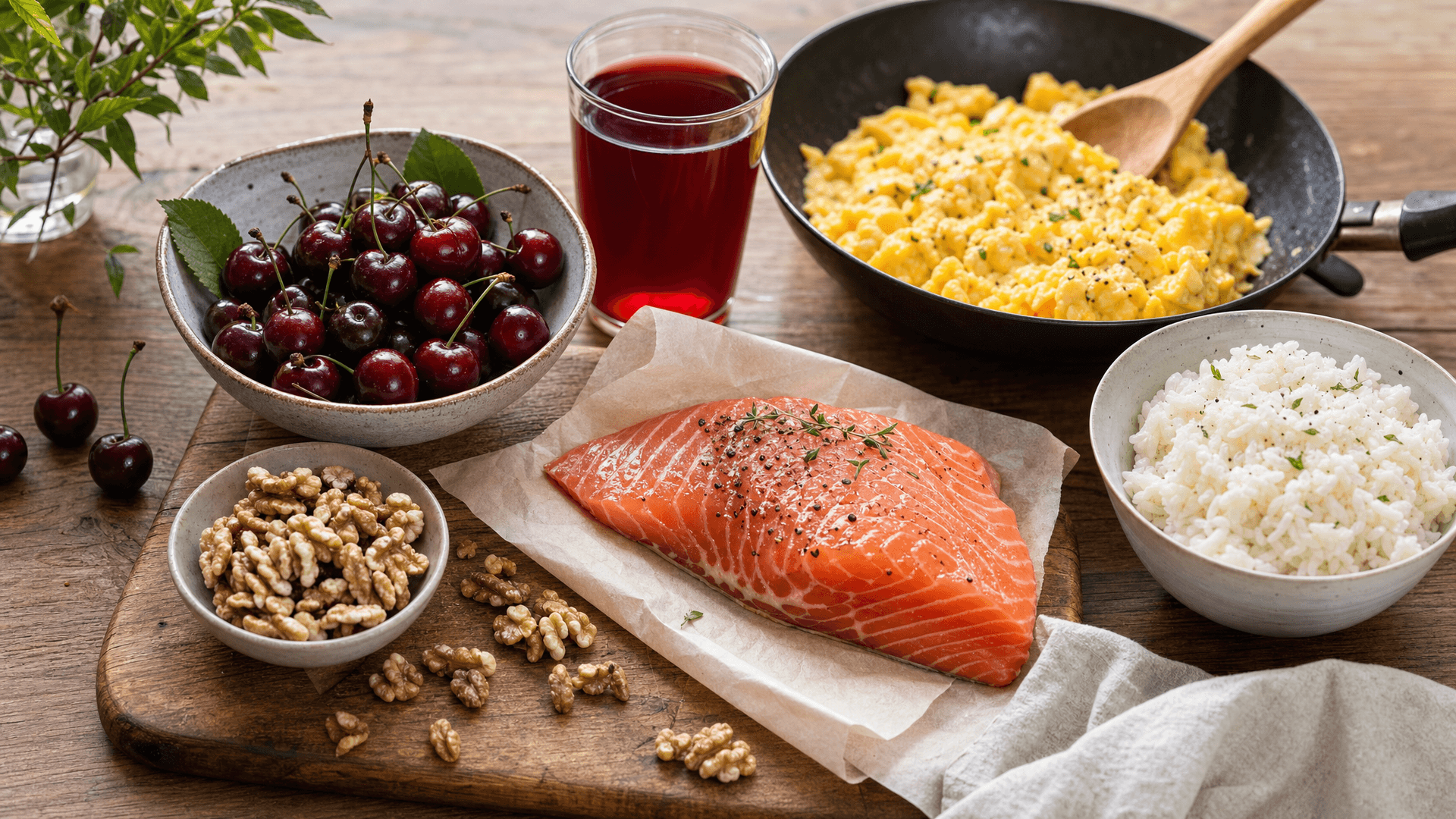
You finished legs on Monday. It's Thursday. Stairs still feel like a personal attack.
So you do what everyone does — you blame the program. Too much volume. Too many sets. Maybe the split is wrong. Maybe you need a deload. Maybe you need a whole new coach.
Here's the thing nobody tells skinny guys: being sore for three days straight isn't a training problem, it's a fuelling problem. Your body is trying to repair muscle tissue using materials you never gave it. It's like asking a builder to fix a wall and handing him half a brick.
If you're eating enough to survive but not enough to rebuild, soreness sticks around. And when soreness sticks around, the next session is worse. And the session after that is worse. Three weeks later you've made zero progress and you're convinced you're "just not built for this."
You're built for it. You're just underfed.
- Chronic under-eating is the single biggest driver of soreness that won't quit
- Total daily protein matters far more than timing — hit 1.6-2.2g per kg every single day
- Carbs are the most underrated recovery tool for skinny guys, and most eat half what they need
- Tart cherry juice and omega-3s have real but modest evidence behind them
- Creatine reduces markers of muscle damage and is dirt cheap
- Dehydration and low sodium make soreness feel worse than it is
- Cold plunges and ice baths right after lifting can blunt the muscle growth you just paid for
What DOMS Actually Is (And What It Isn't)
Delayed onset muscle soreness shows up 12 to 24 hours after a hard session, peaks around 24 to 72 hours, and fades after that. It's not lactic acid. That myth died decades ago — lactate clears from your blood within an hour of finishing.
What's actually happening is microscopic damage to muscle fibres and the connective tissue around them, followed by an inflammatory response as your body cleans up and rebuilds. The soreness is part of the repair process, not the injury itself.
Two things follow from that:
First, some soreness is normal and fine. Especially after a new exercise, a new rep range, or a long layoff. Eccentric work — the lowering part of a rep — causes the most damage, which is why Romanian deadlifts and slow negatives wreck you.
Second, soreness is a terrible measure of how good the workout was. You can grow beautifully without being sore. You can be destroyed for four days and grow nothing. Chasing soreness is one of the dumbest habits in lifting.
What matters is how fast you recover. If you're still limping 72 hours later, session after session, something in the repair pipeline is broken. Nine times out of ten for a skinny guy, that something is in the kitchen.
Most DOMS studies use small groups, unusual protocols (like 100 eccentric reps to failure), and self-reported soreness scores. The effect sizes are modest. So take every "this cures soreness" claim — including the ones below — as "this helps a bit," not "this fixes everything."
Why Skinny Guys Get Hit Hardest
A guy at 210 lbs who's been eating big for five years has a buffer. Glycogen stores that are mostly full. Plenty of circulating amino acids. Body fat to draw on. He can have a sloppy eating day and his recovery barely notices.
A guy at 140 lbs who eats when he remembers to has no buffer at all. Every single day he's running close to empty. One skipped meal and repair slows down.
Three specific things go wrong:
You're in an accidental deficit. Most self-described hardgainers dramatically overestimate what they eat. You think you're eating 3,000 calories. Track it honestly for a week and it's 2,200. Recovery is an energy-expensive process — your body will deprioritise it when calories are tight.
Your glycogen never refills. If you train four times a week and eat low-carb by accident (which happens constantly to guys eating "clean"), you start every session with partially depleted muscles. Training on empty causes more damage and slows repair.
You're missing micronutrients. Zinc, magnesium, vitamin D, vitamin C — all involved in tissue repair and immune function. A repetitive diet of chicken, rice and protein shakes leaves gaps. We covered this in detail in the micronutrients skinny guys miss while bulking, and it's worth reading if your food variety is low.
The Big Three: Calories, Protein, Carbs
Before you spend a cent on tart cherry juice or fancy recovery supplements, fix these. They're responsible for maybe 80% of the outcome.
Calories: Eat in a Surplus
You cannot repair and build tissue in a meaningful deficit. If you're trying to gain muscle and recover fast, you need a surplus — roughly 300-500 calories above maintenance.
Rough maintenance for a hard-training skinny guy: bodyweight in kg × 33-38. So a 150 lb lifter is looking at roughly 2,250-2,600 maintenance, and 2,600-3,000 to grow.
If soreness is dragging and you're stuck at the same weight on the scale week after week, you have your answer. You're not in a surplus. Add 300 calories and reassess in two weeks.
Protein: Total Daily Intake Beats Timing
This is where the evidence is strongest. Adequate protein speeds recovery, reduces soreness scores in most studies, and gives your body the amino acids it needs to rebuild damaged fibres.
The number: 0.7-1.0g per lb of bodyweight daily. For a 155 lb guy that's roughly 110-155g per day.
What matters more than people admit:
| Factor | How much it matters |
|---|---|
| Total daily protein | Enormous |
| Spread across 3-5 meals | Moderate |
| Protein within 30 min of lifting | Small |
| Specific protein source | Small |
| BCAAs on top of adequate protein | Basically zero |
The "anabolic window" panic is overblown. If you're eating 30-45g of protein every 3-4 hours across the day, you're covered. That said, a solid post-workout meal is an easy win — see our list of the best post-workout meals for bulking if you need ideas that aren't another shake.
Skipping breakfast and eating most of your protein at dinner is the most common pattern in guys who stay sore. You go 14-16 hours with almost no amino acids available, right when repair is happening. Get 30g into you within an hour of waking.
Carbs: The Most Underrated Recovery Tool
Here's where skinny guys get wrecked. Fitness culture has spent fifteen years demonising carbs, and now half the guys trying to bulk are eating like they're prepping for a bodybuilding show.
Carbohydrate does three things for recovery:
- Refills muscle glycogen so the next session doesn't start on empty
- Spares protein — if carbs are low, some of your protein gets burned for energy instead of used for repair
- Blunts cortisol post-training, which helps shift you toward repair mode
Target: 1.8-2.7g per lb of bodyweight on training days. A 155 lb guy needs roughly 280-420g of carbs daily. Most skinny guys I've seen tracking are eating 150-200g.
That gap alone explains a lot of persistent soreness.
Cheap carbs that actually work: white rice, potatoes, pasta, oats, bagels, bananas, dried fruit, fruit juice, honey. None of it is exotic and none of it is expensive.
If you struggle to eat that much food, drink some of it. 2.8 oz of oats blended into milk with a banana and honey is ~700 calories and 100g of carbs in about 90 seconds of chewing.
What the Research Actually Supports
Now the supplements. I've sorted these by how much evidence is behind them, not by how hard they're marketed.
Tart Cherry — Genuinely Decent Evidence
Tart cherry (Montmorency specifically) contains anthocyanins with anti-inflammatory and antioxidant properties. Multiple studies show reduced soreness scores and faster strength recovery after damaging exercise, particularly in endurance athletes and in resistance-trained subjects doing eccentric work.
The protocol used in most studies: roughly 240-480ml of tart cherry juice, twice daily, for 4-5 days around the hard session. Or the concentrate equivalent, which is cheaper.
The honest caveat: the effects are real but modest, and because it's an antioxidant, there's a theoretical concern that high-dose antioxidants blunt the training adaptation signal. Use it around competitions, heavy weeks, or a brutal new program — not every single day forever.
Omega-3s — Supportive, Slow-Acting
EPA and DHA reduce inflammatory signalling and are incorporated into muscle cell membranes over weeks. Studies on DOMS are mixed but lean positive, with the best results at 1-3g combined EPA+DHA daily taken consistently for at least a month.
This isn't an acute fix. Take fish oil for six weeks and you might notice less lingering stiffness. Take it the morning after leg day and you'll notice nothing.
Food sources beat capsules where you can manage it: salmon, mackerel, sardines. 5 oz of tinned sardines a couple of times a week is cheap and does the job.
Creatine — Cheap, Boring, Works
Creatine monohydrate is best known for strength and size, but there's a solid secondary body of research showing it reduces markers of muscle damage (creatine kinase, LDH) and improves recovery of force production after damaging exercise.
5g daily, every day, timing irrelevant. It costs about the same as a coffee per month. If you're not taking it, this is the easiest recovery upgrade on the list.
Sodium and Fluids — Boring and Massively Underrated
Dehydration makes soreness feel worse, reduces performance in the next session, and slows nutrient delivery to damaged tissue. Skinny guys who sweat hard and drink water only — no sodium — end up chronically slightly dehydrated.
You don't need an electrolyte brand. You need salt on your food and enough fluid. If you're training hard and sweating, aiming for around 3-5g of sodium a day is reasonable for most active people, which is more than the standard advice because you're losing it in sweat.
Practical check: your morning urine should be pale yellow. Dark means you're behind.
Protein Timing, BCAAs, Glutamine — Skip Them
- BCAAs: If you're hitting your daily protein target, they add nothing. The research is clear. Save your money.
- Glutamine: Popular in the 2000s, doesn't hold up for muscle recovery in healthy trained people.
- Fancy intra-workout formulas: Expensive flavoured sugar with a marketing budget.
- Ice baths right after lifting: This one's important — see below.
Cold water immersion immediately after resistance training appears to blunt hypertrophy signalling and reduce long-term muscle and strength gains. It feels great and reduces soreness in the short term, but you're trading adaptation for comfort. If you're bulking, keep the ice bath away from your lifting sessions — or skip it entirely.
Sleep: The Multiplier You Can't Supplement Around
You can nail every number above and still be permanently sore if you're sleeping five hours a night.
Growth hormone release, protein synthesis, inflammatory regulation and glycogen resynthesis are all tied to sleep quantity and quality. Under-sleeping is functionally similar to under-eating — your body deprioritises repair.
If you're doing the food right and still wrecked, sleep is the next place to look. We went deep on this in sleep and recovery for muscle growth, and for a lot of guys it turns out to be the actual bottleneck.
A Cheap Daily Recovery-Eating Template
Here's what this looks like as actual food. Built for a 155 lb lifter training 4x a week. Scale up or down from there.
Targets: ~3,000 calories, 150g protein, 380g carbs, 90g fat.
Breakfast (within an hour of waking)
- 100g oats cooked in 400ml whole milk
- 1 scoop whey
- 1 banana, 1 tbsp honey
~800 cal, 45g protein, 105g carbs
Mid-morning
- 2 slices wholegrain toast with peanut butter
- 7 oz Greek yogurt
~600 cal, 28g protein, 60g carbs
Lunch
- 7 oz chicken thigh
- 9 oz cooked white rice
- Mixed vegetables, olive oil, salt
~800 cal, 45g protein, 90g carbs
Post-workout
- Shake: 1 scoop whey, 1 banana, 500ml milk, 1 tbsp honey
~500 cal, 35g protein, 70g carbs
Dinner
- 6 oz salmon or beef mince
- Potatoes, salad, salt
~700 cal, 40g protein, 65g carbs
Total lands a bit over target, which is fine — you can trim the mid-morning snack on rest days.
The Weekly Extras
| Item | Frequency | Why |
|---|---|---|
| Creatine 5g | Daily | Damage markers, strength |
| Fish oil 2g EPA+DHA | Daily | Inflammation, slow build |
| Oily fish | 2x per week | Omega-3s from food |
| Tart cherry concentrate | Heavy weeks only | Acute soreness |
| Salt on everything | Daily | Fluid balance |
| Fruit and veg | Every meal | Micronutrients |
Buy frozen. Frozen berries, frozen fish, frozen vegetables — nutritionally equivalent to fresh, often better than what's been sitting in the shop for four days, and roughly half the price. This is how you eat well on a student budget.
How to Tell If It's Working
Give it three weeks. Not three days.
Week 1: Track everything honestly. Most guys discover they're eating 500-800 fewer calories than they assumed. This alone is often the whole story.
Week 2: Hit the protein and carb targets every single day, including rest days. Rest days are when repair actually happens — eating less on those days is backwards.
Week 3: Assess. You should notice:
- Soreness peaks at 24-48 hours instead of dragging to 72+
- You can train the same muscle group again within 72 hours without dreading it
- Scale is moving up 0.5-1 lb per week
- Gym performance is going up, not sideways
If you fix the food and nothing improves after three weeks, then look at your program. Volume might genuinely be too high. But check the kitchen first — it's almost always the kitchen.
Gaining 0.5-1 lb per week is the sweet spot for a lean bulk. Faster than that and you're adding more fat than you need to. Slower than that and you're probably still not in a real surplus.
Common Mistakes That Keep You Sore
1. Eating like it's a diet on rest days. Repair happens on rest days. Cutting food on those days is the exact opposite of what you want.
2. Treating soreness as the goal. Adding volume just to feel destroyed is how you dig a hole you can't climb out of. Progressive overload beats punishment.
3. Stacking new exercises every week. Novel movements cause the most damage. If you rotate exercises constantly, you're permanently in the high-DOMS phase and never adapt.
4. Protein all in one meal. 150g of protein in two meals is worse than 150g across four. Spread it out.
5. Buying supplements before fixing food. Tart cherry juice on top of a 2,200-calorie diet does nothing. Fix the base first.
6. Ignoring salt. Skinny guys often eat very "clean" — unprocessed food, no added salt — while sweating hard four times a week. That's a recipe for feeling flat and sore.
7. Ice bath straight after training. Feels productive. Blunts the adaptation you just earned.
8. Cutting fat too low. Fat is needed for hormone production. Below about 0.8g per kg of bodyweight and testosterone starts drifting down. Don't fear it — it's also the easiest way to add calories.
Where FuelTheGains Comes In
Here's the honest problem with everything above: it's a lot of numbers to hold in your head, every day, forever.
3,000 calories. 150g protein. 380g carbs. Spread across five feedings, on a budget, while you've got lectures or a job and a gym session to fit in. Most guys nail it for nine days and then quietly drift back to two meals and a protein shake.
That's the gap is built to close. It takes your bodyweight, training frequency and actual budget, and turns them into a specific weekly plan — meals, portions, a shopping list — that hits the recovery numbers without you doing arithmetic at every meal. It's built for skinny guys trying to eat more than feels natural, not for people cutting.
You don't need it to follow this article. But if "eat 380g of carbs a day" sounds exhausting to plan from scratch, it removes the part where you have to think about it.
The Bottom Line
Soreness that drags into the next session is a fuel problem far more often than a programming problem. Calories, protein, carbs, fluid and salt do the heavy lifting. Creatine, omega-3s and tart cherry are useful additions, in that order. Everything else is noise.
Fix the base for three weeks and be honest with your tracking. Most guys find out they were never actually eating enough to recover from the training they were already doing.
Your split is probably fine. Go eat.