
You've been tracking every gram for six weeks. The app says you're eating 3,000 calories and 180g of protein like clockwork. But the scale won't budge, your lifts are stalling, and you're starting to think you're one of those "impossible to bulk" guys.
You're probably not. You're just weighing your food wrong — and it's costing you 20-40% of your accuracy without you ever noticing.
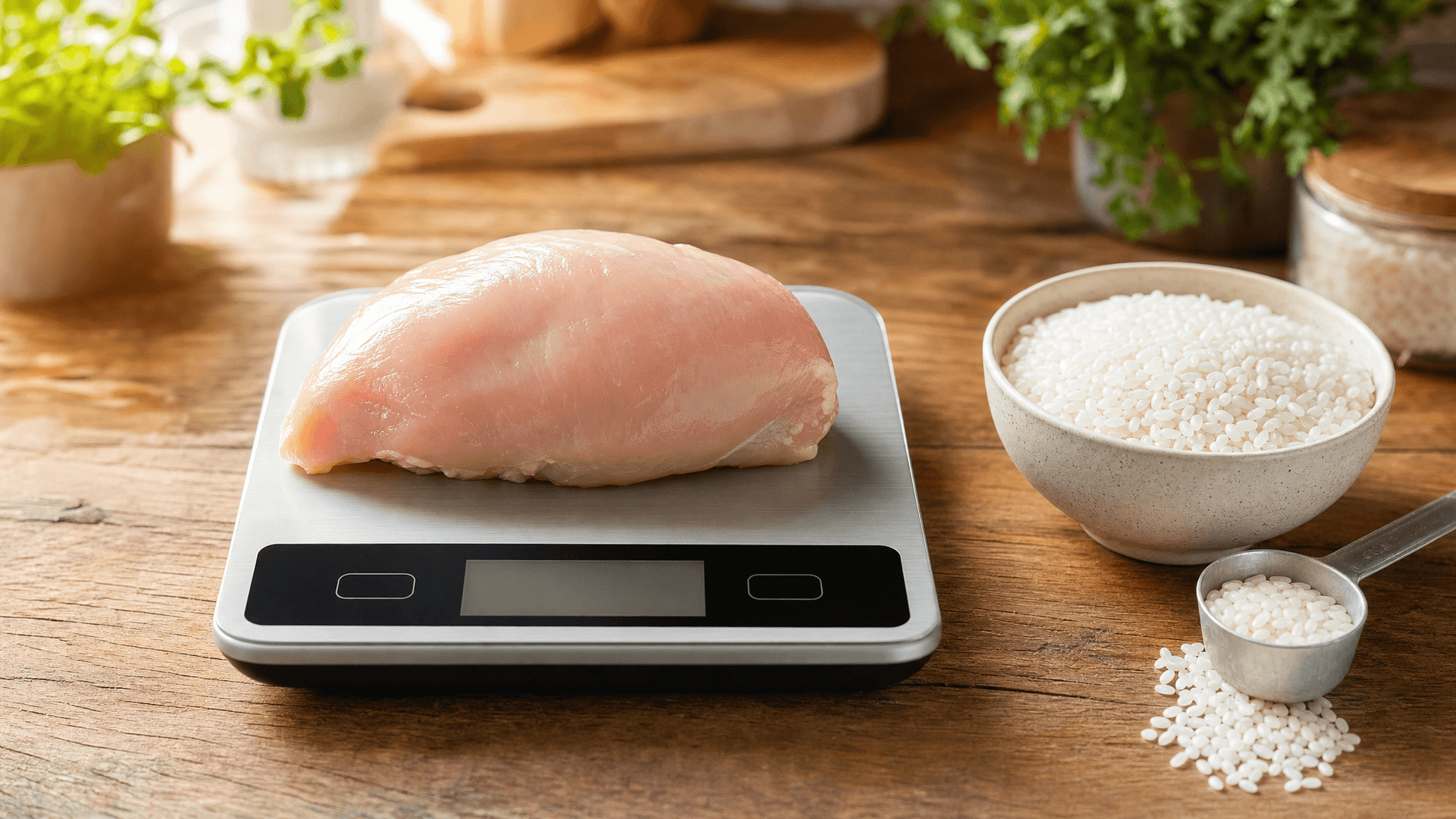
Here's the trap almost every skinny guy falls into: your chicken label says 31g protein per 100g. So you cook a breast, throw it on the scale, see 5.3 oz on the display, and log it. Simple, right? Except that number on the label was for raw chicken. The moment you cooked it, water cooked off and the whole thing shrank. That 5.3 oz of cooked chicken was more like 7.6 oz raw — which means you ate way more protein and calories than you logged.
Do that across every meal, every day, and your "perfect" 3,000-calorie bulk might actually be 3,600 — or the opposite, depending on which way the error runs. Either way, your numbers are fiction.
Let's fix this once and for all.
- Nutrition labels almost always list macros for the RAW weight of food
- Cooking removes water, so cooked food weighs less but is more calorie-dense per gram
- Pick ONE method — weigh raw — and stick to it for every meal
- Use conversion ratios when you can only weigh food after it's cooked
- Rice and oats are the opposite: they gain water and get heavier when cooked
- Being consistent matters more than being perfect
Why cooked vs raw even matters
Food is mostly water. Chicken breast is roughly 75% water by weight before you touch it. When you apply heat, a big chunk of that water evaporates or drips out. The protein and fat stay behind — they don't burn off — but the total weight drops hard.
So imagine 3.5 oz of raw chicken with 31g of protein. You grill it, it loses about 25% of its weight to water, and now you've got 2.6 oz of cooked chicken sitting on your plate. That cooked chunk still has all 31g of protein — the protein didn't go anywhere. It's just packed into a smaller, denser piece.
This is the whole problem in one sentence: cooking concentrates the macros into less weight.
If you weigh that cooked 2.6 oz and log it as if it were raw (using the 31g-per-100g label), the app thinks you ate 23g of protein and around 120 calories. In reality you ate 31g of protein and 165 calories. That's a 25-35% undercount on that single piece of chicken.
Now flip it. Some guys weigh food raw but log it against a "cooked" entry in their tracker — and there are thousands of those floating around in food databases. Same mismatch, opposite direction. You overcount, you think you're eating enough, and you're actually short.
The single most expensive mistake in macro tracking isn't picking the wrong food — it's mixing weighing methods within the same meal. Weigh the chicken raw, the rice cooked, and guess on the oil, and your totals are worthless no matter how precise your scale is.
The one rule that fixes 90% of this
Here it is, the rule that ends the confusion:
Weigh your food raw whenever you possibly can, and log it against the raw label.
That's it. Raw weight is the gold standard for three reasons.
First, the label is already raw. Flip over almost any package of chicken, beef, rice, or oats and the "per 100g" panel refers to the food as sold — uncooked. So weighing raw means the label numbers apply directly, no math required.
Second, raw weight is consistent. Cooked weight depends on how you cooked it. Grill a chicken breast until it's dry and it loses 30% of its weight. Poach it gently and it loses 15%. Same raw chicken, wildly different cooked weights. Raw weight doesn't care about your cooking skills — 7 oz raw is always 7 oz raw.
Third, it's less work. Weigh once, before cooking, log it, done. No conversion ratios, no second-guessing.
If you're just getting your head around macros in the first place, read our complete guide to tracking macros for bulking before you go deeper here — this cooked-vs-raw stuff sits on top of the basics.
Weigh your protein raw for the whole week during meal prep, write the total on a piece of tape on the container, and divide by the number of meals. Now every portion is pre-logged and you never touch the scale on a busy morning.
What to do when you can't weigh it raw
Real life gets in the way. Your girlfriend cooked dinner. You're eating leftovers. The chicken came pre-grilled from the store. You forgot to weigh it before it hit the pan.
You've got two solid options.
Option 1: Use a cooked-specific database entry. Most tracking apps have verified entries like "chicken breast, cooked, roasted." These already account for the water loss, so if you weigh your cooked portion and match it to a cooked entry, your numbers work out. The catch is that user-submitted cooked entries are wildly unreliable — stick to verified or official ones.
Option 2: Convert cooked weight back to raw using a ratio. This is the more accurate route once you know your ratios. You weigh the cooked food, multiply by the conversion factor, and log that raw weight against your normal raw label. We'll get to the exact numbers in a second.
Converting back to raw wins for protein because label data for raw meat is tightly regulated and consistent. Cooked database entries are fine for convenience foods and restaurant meals where you'll never see the raw weight anyway.
The conversion cheat sheet
These are the ratios that matter for the foods skinny guys actually bulk on. To convert cooked weight to raw weight, multiply the cooked weight by the number in the last column.
| Food | Water change when cooked | Cooked → raw multiplier |
|---|---|---|
| Chicken breast | Loses ~25% | × 1.33 |
| Chicken thigh | Loses ~25% | × 1.33 |
| Lean beef (90/10) | Loses ~25% | × 1.33 |
| Steak | Loses ~25% | × 1.33 |
| Pork | Loses ~28% | × 1.39 |
| White fish | Loses ~20% | × 1.25 |
| Salmon | Loses ~18% | × 1.22 |
| Shrimp | Loses ~20% | × 1.25 |
| White rice | GAINS ~150% | × 0.4 |
| Pasta | GAINS ~110% | × 0.48 |
| Rolled oats | GAINS ~200% | × 0.33 |
| Dried lentils | GAINS ~130% | × 0.43 |
Notice the split. Meats and fish lose water — they get lighter, so you multiply by more than 1 to get back to raw. Grains and legumes absorb water — they get heavier, so you multiply by less than 1.
Here's how you'd actually use it. You've got 6.3 oz of cooked chicken breast on your plate. Multiply by 1.33 and you get about 8.5 oz raw. Log 8.5 oz against your raw chicken label. Done.
Or the rice example: you serve yourself 8.8 oz of cooked white rice. Multiply by 0.4 and you get 3.5 oz of dry rice. That's what you log.
These multipliers are averages. Your grill runs hotter than mine, your rice soaks up more water than the next guy's. Treat them as a solid starting point, not gospel. If you want dead-on accuracy, do the calibration trick in the next section.
Dial in your own numbers (10-minute one-time job)
Want ratios that are exact for your kitchen instead of a table average? Calibrate once and reuse forever.
Take a batch of raw chicken — say 1.1 lb — and weigh it before cooking. Write it down. Cook it the way you normally do. Weigh it again once it's cooked, and let's say it comes out to 13.2 oz.
Your personal multiplier is raw divided by cooked: 500 ÷ 375 = 1.33. Now you know that for your grill, your heat, your timing, cooked chicken converts back to raw at 1.33. That number won't change much as long as you cook the same way.
Do this once for chicken, once for rice, once for whatever else you eat in volume, and you've got a custom cheat sheet that beats any generic table.
Snap a photo of your before-and-after weights and keep it in a "macros" album on your phone. When you inevitably forget your rice ratio in three weeks, it's right there.
The foods that trip people up most
A few specific offenders cause the most damage. Let's name them.
Rice and oats — the reverse trap
These are the exact opposite of meat, and it wrecks people going the wrong direction. A skinny guy trying to bulk weighs out 7 oz of cooked rice, sees a big pile, and logs it as if it were 7 oz of dry rice — which is a massive amount of carbs. The app now thinks he ate 700+ calories of rice when he really ate closer to 260. He's chronically undereating and can't figure out why the scale won't climb.
Dry oats are even more dramatic. They roughly triple in weight once they soak up milk or water. 2.8 oz of dry oats becomes something like 8.5 oz of cooked porridge. Always weigh oats dry.
Ground meat and the grease question
When you brown ground beef, some fat renders out and pools in the pan. If you drain that grease, you've physically removed calories that were on the label — so the raw label slightly overcounts your fat. It's a small effect for lean beef (90/10) but real for fattier blends. For simplicity, most people just weigh raw and log raw and accept the tiny margin. If you're draining a lot of grease off 70/30 beef, lean toward a cooked database entry instead.
Nut butters and oils
These don't change weight when heated in any way that matters, but they're calorie bombs where a few grams swing your total hard. Oil is roughly 120 calories per tablespoon, and "one tablespoon" from a free pour is usually two. Weigh your oils and nut butters — this is where hidden calories that actually help you bulk live. If you're hunting for the best bang-for-buck protein, our ranked list of the best protein sources for bulking breaks down cost and convenience.
For a lean bulk, oil and nut butter are your friends — they're the easiest way to add 300-400 calories without feeling stuffed. Just weigh them so those calories are counted, not accidental.
How much does this actually change your total?
Let's run the numbers on a realistic day so you can see why this isn't nitpicking.
Say you eat 7 oz of chicken twice a day, plus a big serving of rice. If you're weighing everything cooked but logging against raw labels, here's roughly what slips through the cracks:
- Chicken (2 meals): you undercount by around 15g of protein and ~90 calories per meal — call it 180 calories and 30g protein lost for the day
- Rice: if you log cooked rice as dry, you can overcount by 400+ calories in a single serving
Depending on which mistakes stack, your daily total can be off by anywhere from 300 to 700 calories. For a guy trying to eat in a modest 300-500 calorie surplus, that's the entire surplus — gone, or doubled. No wonder the scale does nothing.
This is exactly why getting your baseline calorie target right is only half the battle — the other half is measuring what you eat against it accurately. If you haven't nailed your target yet, work through how to calculate your bulking calories step-by-step first, then come back and make sure you're weighing to match.
If you weighed every single thing cooked AND logged against cooked entries, you'd also be accurate. The error only shows up when you MIX methods. Pick a lane. Raw is the better lane, but a consistent wrong-ish method beats a chaotic "right" one.
Your simple weighing system
Let's turn all of this into a routine you'll actually follow. Here's the whole thing in five steps.
- Default to raw. Weigh protein and grains raw, log against the raw label. This is your standard operating procedure.
- Zero the scale (tare) every time. Put your container on, hit tare, then add food. You're weighing food, not the plate.
- Weigh oils and nut butters, always. No free pouring. These are dense and sneaky.
- When you can only weigh cooked, convert. Use the cheat sheet or your calibrated ratio, multiply, log the raw equivalent.
- Don't sweat vegetables. Leafy greens and most non-starchy veg are so low in calories that a weighing error changes almost nothing. Save your precision for protein, grains, and fats.
That's the entire system. It takes maybe two extra minutes a day once it's a habit, and it turns your tracking from a hopeful guess into actual data.
Get a cheap digital scale that reads in single grams and has a tare button. That's the only equipment you need. Spoons and cups are fine for cooking but useless for accurate tracking — a heaping cup of rice can weigh 40% more than a level one.
Where FuelTheGains fits in
Here's the honest truth: even with perfect weighing, hitting a real surplus every single day is a grind. You do the math, you weigh the chicken, and you still come up 500 calories short because whole-food eating fills you up before you hit your target. That's the hardgainer's curse.
That's where FuelTheGains comes in. The whole point is to take the calculated surplus you've dialed in and make it actually easy to hit — high-calorie, high-protein fuel that slots into your day without forcing down a fifth chicken breast. You still weigh and track what you eat; we just make the last few hundred calories effortless instead of a battle.
If you've done the work of learning to track accurately and you're tired of losing the surplus to a small appetite, . It's built for exactly the skinny guy who tracks everything and still can't gain.
The bottom line
Cooked-vs-raw isn't complicated once you know the rule: weigh raw, log raw, and stay consistent. When you can't weigh raw, convert with a ratio. That's the whole game.
Your scale isn't lying to you and your metabolism isn't broken. You've just been feeding your tracker bad data. Fix the weighing, and for the first time your numbers will actually mean something — and the scale will finally start moving in the direction you've been working for.
Weigh it raw. Trust the process. Watch it work.