
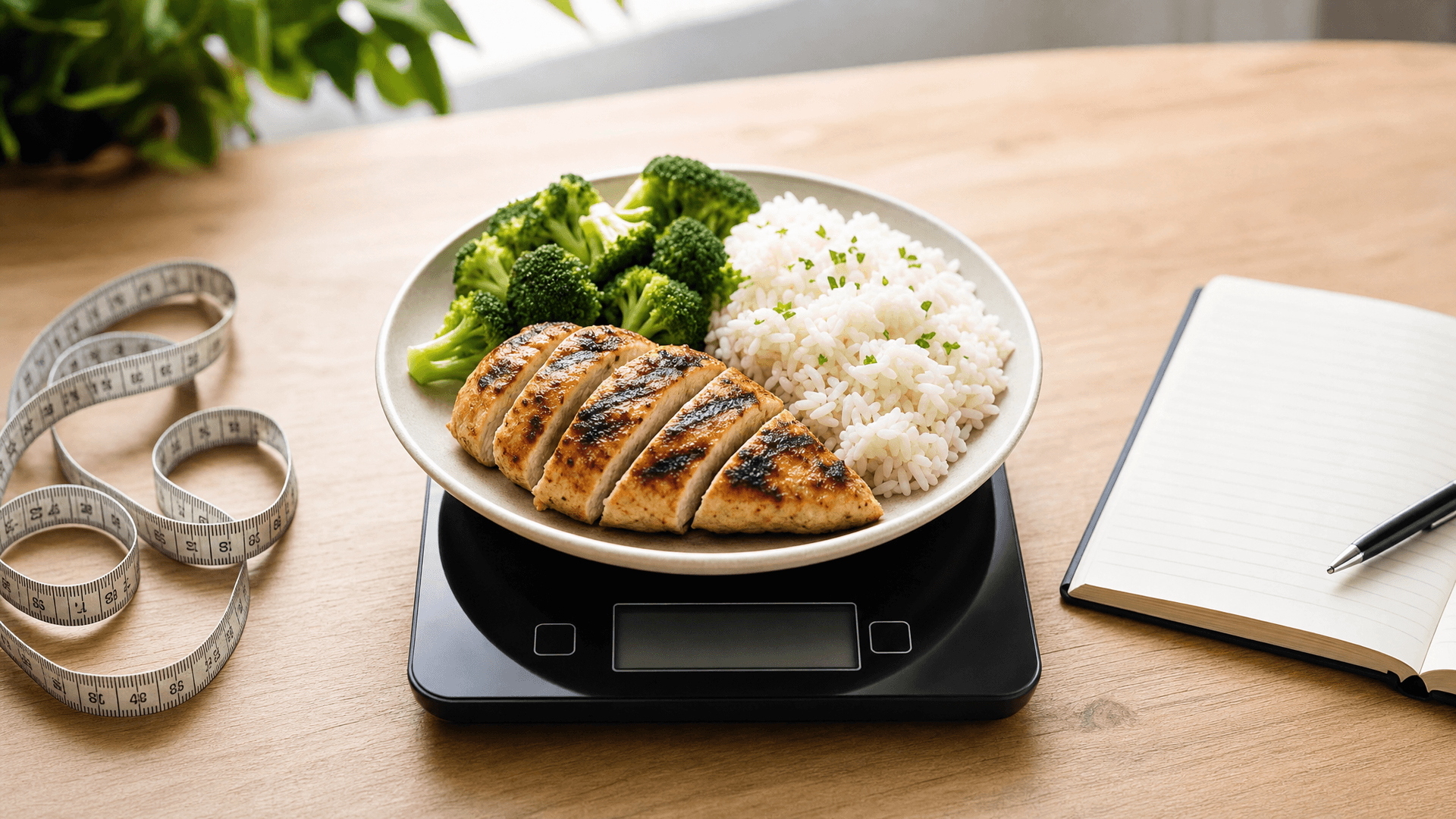
You step on the scale, see the number went up, and feel great. Then you catch your reflection and panic — is that muscle, or is your face just getting rounder?
This is the trap almost every skinny guy falls into. You obsess over one number on the scale, and that number tells you almost nothing about what's actually happening under your skin. The scale can't tell muscle from fat from water from the sandwich you ate an hour ago.
Here's the truth: weight going up is the price of admission, not the goal. The goal is muscle. And to know whether you're building muscle or just padding your gut, you need more than a scale. You need a system.
This post gives you that system — a simple weekly routine of five tracking methods that, together, tell you exactly what's going on. You'll know when the bulk is working, when it's stalling, and when it's time to stop adding calories and think about a cut.
- The scale alone lies — use a 7-day weight average, never a single reading
- Aim to gain 0.25-0.5% of your bodyweight per week, no faster
- Track your waist alongside your weight — if the waist climbs fast, so is fat
- Strength in the gym is your best real-time proof that muscle is being built
- Progress photos every 2-4 weeks catch changes the numbers miss
- If waist grows while strength stalls, you're gaining mostly fat — adjust
Why the Scale Alone Is Useless
Let's kill the scale obsession first, because it ruins more bulks than bad training ever will.
Your bodyweight swings 1-2 kg day to day for reasons that have zero to do with muscle or fat. Water retention, sodium intake, carb load, how much is sitting in your digestive tract, whether you slept well, stress hormones — all of it moves the number. A 165 lb guy can wake up at 163 lb one day and 169 lb two days later without gaining a single gram of actual tissue.
So if you weigh yourself once a week and compare it to last week, you're basically flipping a coin. You might catch a real trend. You might catch noise and completely misread it.
The fix is dead simple: weigh yourself every morning and track the weekly average.
Weigh in first thing after you pee, before you eat or drink, in the same amount of clothing. Consistency in how you weigh matters more than the raw number.
Take all seven daily weigh-ins, add them up, divide by seven. That's your true weight for the week. Compare this week's average to last week's average, and now you're looking at signal instead of noise. The day-to-day chaos cancels out, and the real trend shows up.
If you skip a day or two, no big deal — average whatever you've got. Five readings still beats one. The point is you're smoothing out the randomness instead of reacting to it.
The Right Rate of Weight Gain
Before we get into the other tools, you need a target. Because "the scale went up" isn't good enough — the speed it goes up determines your muscle-to-fat ratio.
Gain too slow and you'll wonder if you're even bulking. Gain too fast and most of that new weight is fat, because your body can only build muscle at a limited rate no matter how much you eat.
Here's the sweet spot: 0.25-0.5% of your bodyweight per week.
For a 154 lb lifter, that's roughly 0.4-0.75 lb per week. For a 176 lb guy, more like 0.4-0.9 lb per week. It feels slow. It looks like almost nothing on any single day. But over three months it adds up to real, mostly-lean weight.
| Your bodyweight | Target weekly gain |
|---|---|
| 60 kg / 132 lb | 0.15-0.30 kg / 0.3-0.7 lb |
| 70 kg / 154 lb | 0.20-0.35 kg / 0.4-0.75 lb |
| 80 kg / 176 lb | 0.20-0.40 kg / 0.4-0.9 lb |
| 90 kg / 198 lb | 0.25-0.45 kg / 0.5-1.0 lb |
If you're a true beginner or coming back from a long layoff, you can push toward the top of that range — your muscle-building potential is highest right now. If you've been lifting for years, stay conservative, because your body is slower to add muscle and quicker to add fat.
In your first year of serious training, "newbie gains" let you build muscle unusually fast — sometimes fast enough to gain muscle and lose a little fat at once. This is the one window where a slightly faster bulk still stays lean. Don't waste it eating like a bird.
For a deeper look at how fast results actually show up, check out our bulking results timeline month by month — it sets realistic expectations so you don't panic in week three.
Tool #1: The Waist Measurement
This is the single most underrated tracking tool, and almost nobody uses it. Your waist is the closest thing you have to a real-time fat gauge.
Here's the logic: muscle gets built in your legs, back, chest, shoulders, and arms. Fat, for most men, gets stored first around the midsection. So if your weight is climbing and your waist is staying roughly flat, that new weight is going where you want it. If your weight climbs and your waist balloons right alongside it, you're gaining fat faster than muscle.
How to measure it right:
- Measure around your belly button, first thing in the morning, before eating
- Relax your stomach — don't suck in, don't push out
- Use a soft tape measure, keep it level around your body
- Measure once a week, same day, same conditions
A little waist growth on a bulk is normal and expected — you're eating in a surplus, some fat comes along for the ride. But the pace matters. If your waist grows more than about 1 cm per month while your weight is climbing at the right rate, fat is winning. If your waist grows 0.8-1.2 in in a single month, you're eating way too much.
Don't measure your waist right after a big carb meal or a salty dinner. Bloat can add 0.8-1.2 in that has nothing to do with fat and will scare you into cutting when you don't need to. Morning, empty stomach, always.
Pair the waist with the weight and you've already got a crude muscle-vs-fat readout. Weight up, waist flat: you're winning. Weight up, waist up fast: pump the brakes.
Tool #2: Body Measurements Beyond the Waist
The waist tells you about fat. A handful of other measurements tell you about muscle. Grab that same tape measure and, once every 2-4 weeks, log these:
- Upper arm (flexed, at the peak of the bicep)
- Chest (around the nipple line, arms relaxed at your sides)
- Thighs (mid-thigh, largest point)
- Shoulders (widest point across, around the delts)
- Calves (largest point)
Write them down in the same place every time. Over a month or two, you're looking for these to creep up while your waist stays relatively flat. That divergence — limbs and chest growing, waist steady — is the visual signature of a clean bulk.
Don't measure these weekly. Muscle growth is slow, and week-to-week tape readings are mostly pump and measurement error. Every 2-4 weeks is the right cadence to see real change without driving yourself crazy.
Measure your arms at the same time of day and in the same state every time — either always cold (before training) or always pumped (right after arm day), but never mixing the two. A pumped arm can read 0.4-0.6 in bigger than a cold one, and that difference is water, not muscle.
One honest warning: tape measurements are noisy. A single reading can be off by half a centimeter just from where you place the tape. That's exactly why you don't panic over one measurement — you look at the trend across several sessions.
Tool #3: Progress Photos
Numbers are great, but your eyes catch things the tape misses. Progress photos are the tool that ties everything together, because muscle and fat look different even when the scale can't tell them apart.
How to shoot them right:
- Same time of day — morning, before eating, is ideal
- Same lighting and same spot in your room every time
- Same poses: relaxed front, relaxed side, relaxed back, plus one front flex
- Same distance from the camera, phone at chest height
- Minimal clothing so you can actually see your midsection and limbs
Take them every 2-4 weeks, not daily. Day-to-day, you'll see nothing and get discouraged. But line up a photo from today next to one from six weeks ago and the changes jump out — fuller shoulders, a thicker chest, more defined arms, or, on the flip side, a softer waistline that tells you to ease off.
You look in the mirror every day, so you never notice change — it's too gradual. A photo freezes a moment in time. Comparing two frozen moments a month apart is the only way to actually see progress that's happening slowly.
Photos are also your gut-check against the numbers. If the scale and tape say you're gaining lean but the photos show your abs disappearing under a layer of softness, believe the photos. They don't lie about where the weight is going.
Tool #4: Gym Strength Logs
Here's the one most people never connect to bulking, and it might be the most important of all: your strength in the gym is the best real-time proof that you're building muscle.
Muscle is what moves weight. If you're getting stronger — adding reps, adding load, grinding through sets that used to crush you — your body has a powerful reason to be building muscle tissue. If your lifts are climbing week over week while you eat in a surplus, that surplus is feeding muscle growth. That's the whole point of a bulk.
So log every workout. It doesn't need to be fancy — a notes app or a cheap notebook works. For your main lifts, write down:
- The exercise
- The weight
- The sets and reps you actually completed
Then, each week, glance back. Are the numbers trending up? Are you doing 135 lb for 8 reps this week where last month you got 6? Did your bench crawl from 155 lb to 165 lb over a few weeks? That's muscle being built, and it's happening in real time — no waiting for the tape or the scale to confirm it.
You don't need to set a personal record every session. Progress means the trend goes up over weeks, not that every single workout beats the last. Sleep, stress, and food all make individual days vary. Look at the month, not the Monday.
Here's the powerful combination: weight up + strength up = you're bulking correctly. That's the two-signal confirmation that your surplus is doing its job. If the scale is climbing but your lifts are flat or falling, something's off — usually not enough training stimulus, not enough sleep, or the surplus is just becoming fat.
Putting It Together: The Weekly Ratio Check
Now let's combine the tools into a simple decision system. You don't need spreadsheets and calculus — you need to read four signals and know what they mean together.
Every week, look at:
- Weight — is the 7-day average up, and is it up at the right rate?
- Waist — is it flat, creeping, or climbing fast?
- Strength — are your main lifts trending up?
- Photos (every few weeks) — do you look fuller, or softer?
Here's how to read the combinations:
| Weight | Waist | Strength | What it means |
|---|---|---|---|
| Up | Flat | Up | Perfect. Keep going. |
| Up | Slow creep | Up | Normal lean bulk. Stay the course. |
| Up | Fast climb | Up | Surplus too big. Cut calories a bit. |
| Up | Fast climb | Flat | Mostly fat. Reduce calories now. |
| Flat | Flat | Up | Recomp — fine for beginners, else eat more. |
| Flat | Flat | Flat | Not enough food. Add calories. |
That table is your dashboard. Nine times out of ten, one glance tells you exactly what to do next. The magic is in reading the signals together — no single one is enough, but the combination is almost impossible to misread.
Don't make changes based on one week of data. Wait for a trend to hold for 2-3 weeks before you adjust calories. Overreacting to a single noisy week is how people sabotage a perfectly good bulk.
For the full framework on keeping fat gain minimal while this all happens, our guide to gaining muscle without getting fat walks through the surplus math in detail.
How to Know When It's Time to Cut
The whole reason you track this stuff is to answer one question: is the bulk still worth continuing, or is it time to cut?
There's no single magic number, but here are the honest signals that your bulk has run its course:
- Your waist has grown past your comfort zone. For most guys, once you're carrying enough fat that your abs are fully gone and your face looks noticeably rounder, the ratio of muscle-to-fat you're adding has gotten worse. Continuing just piles on fat you'll have to diet off later.
- Strength gains have stalled for weeks despite eating and training well. If more food isn't buying more muscle, more food is just buying more fat.
- You've gained the total weight you set out to gain. If you started at 154 lb aiming for 172 lb, and you're there and holding, it may be time to lock it in.
A good rule of thumb: bulk until your waist and midsection tell you the fat is outpacing the muscle, then run a short cut to reveal what you built. The leaner you finish a bulk, the more of your gains actually show.
Timing this well is its own topic — our full breakdown on how long to bulk before cutting covers exactly when to flip the switch based on your starting body fat and goals.
The best bulkers aren't the ones who gained the most weight — they're the ones who gained the most muscle per kilo of total weight. Tracking is what lets you optimize that ratio instead of just guessing.
Common Tracking Mistakes to Avoid
Even guys who track make these errors constantly. Dodge them and your data actually means something.
1. Weighing in at random times. Morning weight and evening weight can differ by 2-4 lb purely from food and water. Same time, same conditions, every day — or your average is garbage.
2. Reacting to single data points. One heavy scale day, one big waist reading, one bad workout. None of these mean anything alone. Trends over 2-3 weeks are the only thing worth acting on.
3. Only tracking the scale. You now know why this is a trap. Weight without waist, strength, and photos is a number with no context.
4. Not tracking strength. If you're not logging your lifts, you're throwing away your single best muscle-building signal. It's free. Do it.
5. Comparing photos taken in different conditions. Different lighting, different time of day, pumped vs. cold — these can make you look like you gained or lost muscle when nothing changed. Standardize everything.
6. Chasing the scale too fast. Seeing the number stall for a week and immediately adding 500 calories is how "lean bulk" becomes "dirty bulk." Be patient.
Keep all your data in one place — a single notes file or a simple app. When weight, waist, strength, and photo dates live together, spotting the trends takes thirty seconds a week instead of digging through five apps.
Where FuelTheGains Fits In
All this tracking answers whether the bulk is working. But it only works if the food is dialed in underneath it — the right surplus, hit consistently, day after day. And that's exactly the part most skinny guys get wrong.
That's where FuelTheGains comes in. Instead of guessing your calorie target and hoping, it calculates your surplus based on your stats and goals, then builds it into meals and shakes designed to hit that number without forcing you to choke down a mountain of food. You get a target you can actually trust — so when your tracking says "eat more" or "ease off," you know exactly how to adjust the intake.
The tracking tells you the direction. Getting the fuel right is what makes the direction matter. Check out and stop guessing whether you're eating enough to grow.
The Bottom Line
The scale is one voice in a choir, and on its own it's tone-deaf. Weight tells you something changed. Your waist, your measurements, your photos, and your strength logs tell you what changed — and whether it's the muscle you wanted or the fat you didn't.
Run the weekly check. Weigh in daily and average it, measure your waist, log your lifts, and shoot photos every few weeks. Read the four signals together, wait for real trends before you adjust, and you'll always know exactly where you stand.
Do this, and you'll never again have to wonder whether your bulk is working. You'll know — and you'll know exactly when it's time to stop bulking and show off what you built.