
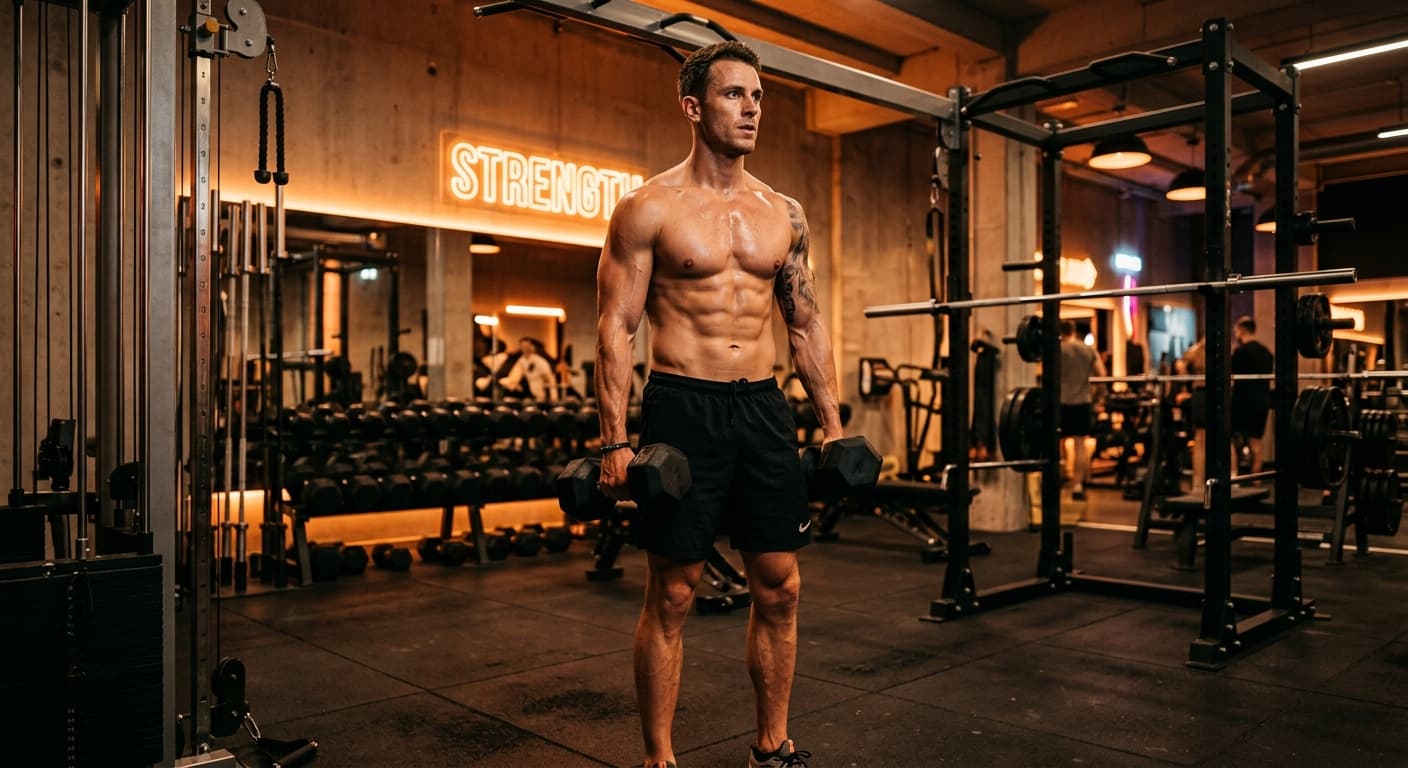
You're not overweight. You're not jacked. You're stuck in the worst middle ground in fitness: skinny fat.
Your arms are thin, your chest is flat, but somehow you've got a soft belly and love handles that won't quit. You look "normal" in clothes but feel like garbage with your shirt off. And every piece of advice online seems designed for someone else — either the 300-pound guy who needs to lose weight, or the rail-thin hardgainer who just needs to eat more.
Neither of those is you. And that's exactly why this is so confusing.
Here's the truth: being skinny fat isn't a body type — it's a nutrition and training problem. And it's completely fixable. You just need a different playbook than the standard "eat big, get big" advice that works for naturally lean guys.
This guide breaks down exactly what to do — step by step.
- Skinny fat means low muscle mass plus moderate body fat — it's not genetic, it's fixable
- Most skinny-fat beginners should lean bulk immediately rather than cutting first
- Use a modest surplus of 200-300 calories above maintenance to build muscle without excess fat
- Prioritize compound lifts and progressive overload — training is more important than diet tweaks
- Eat 1.6-2.2g of protein per kg of bodyweight to maximize muscle protein synthesis
- Track your waist measurement weekly to catch fat gain early
- Body recomposition happens naturally in your first 6-12 months of proper training
What "Skinny Fat" Actually Means
Let's define this clearly. Skinny fat — technically called normal weight obesity — means you carry a relatively high body fat percentage despite being at a normal (or even low) bodyweight.
A skinny-fat guy might be 5'9" and 160 lbs with 22-25% body fat. On paper, his BMI is "healthy." In the mirror, he's got a soft stomach, narrow shoulders, and no visible muscle definition.
The underlying issue is simple: not enough muscle, too much fat relative to lean mass. It's the ratio that's off, not necessarily the total weight.
Why Does This Happen?
A few common causes:
- No resistance training history. If you've never lifted seriously, your baseline muscle mass is low. Even a modest amount of body fat looks pronounced on a small frame.
- Chronic undereating + no training. Crash diets or just eating poorly (low protein, low calories) cause muscle loss. You get lighter but not leaner.
- Cardio-only fitness. Running, cycling, or playing sports without lifting builds endurance but doesn't add significant muscle mass.
- Genetics play a small role. Some guys naturally store fat around the midsection first. But genetics don't determine your trajectory — training does.
The key insight: you don't need to lose weight. You need to change your body composition. That means adding muscle while keeping fat gain minimal.
The Big Question: Should You Cut or Bulk First?
This is where most skinny-fat guys get paralyzed. You want to lose the belly, but you also know you need more muscle. Cutting feels pointless because there's nothing underneath. Bulking feels scary because you'll just get fatter.
Here's the decision framework:
Bulk First If...
- Your body fat is under ~22-24%
- You've never followed a real lifting program
- You're a beginner (less than 6 months of consistent training)
- You feel small rather than fat
- Your primary goal is to look better, not just weigh less
This applies to most skinny-fat guys. If you cut first, you'll end up looking like a smaller version of the same problem — still no muscle, just less of everything. It's demoralizing and counterproductive.
Cut First If...
- Your body fat is clearly above 25%
- You have visible rolls when sitting
- You've been lifting consistently for 6+ months and already have a base
- You feel genuinely overweight, not just "soft"
For the majority reading this, bulking first is the right call. And here's the good news: as a beginner, you're in a unique position to build muscle and lose fat simultaneously — something experienced lifters can't easily do.
How to Set Your Calories (The Smart Way)
Standard bulking advice says add 500 calories to your TDEE. That works great for naturally lean guys who struggle to gain any weight. For skinny-fat guys, it's too aggressive — you'll gain muscle, but you'll also gain fat you don't want.
Instead, use a lean bulk approach:
Step 1: Find Your Maintenance Calories
Your Total Daily Energy Expenditure (TDEE) is the number of calories where your weight stays stable. The quickest way to estimate it:
Bodyweight in lbs × 15 = approximate TDEE
So a 160 lb guy would estimate: 160 × 15 = 2,400 calories.
This is a starting point. Track your weight for 2 weeks at this intake. If weight is stable, you've found maintenance.
For a more detailed breakdown, check out our guide on how to calculate your bulking calories.
Step 2: Add a Small Surplus
For skinny-fat bulking, add only 200-300 calories above maintenance. Not 500. Not 700.
Why smaller? Because:
- You have enough body fat to partially fuel muscle growth
- Beginners build muscle efficiently — you don't need a massive surplus
- A smaller surplus minimizes fat gain while still supporting muscle growth
- You can always increase later if progress stalls
For our 160 lb example: ~2,600-2,700 calories per day.
Step 3: Set Your Macros
| Macro | Target | For 160 lb guy |
|---|---|---|
| Protein | 0.9g per lb | 144g |
| Fat | 0.45g per lb | 72g |
| Carbs | Remaining calories | ~310g |
Protein is non-negotiable. At 0.9g per lb, you're maximizing muscle protein synthesis. If you want a deeper dive, read our complete protein guide.
Fat at 0.45g per lb keeps your hormones healthy — testosterone production depends on adequate fat intake. Don't go below 0.35g per lb.
Carbs fill the rest. They fuel your training and recovery.
If you're not used to eating this much protein, start by adding one protein source to every meal. A scoop of whey in your morning oats, chicken at lunch, Greek yogurt as a snack. Small changes compound fast.
The Training Program That Fixes Skinny Fat
Diet matters, but training is what actually transforms a skinny-fat physique. Without a proper lifting program, no amount of calorie manipulation will give you the body you want.
The Principles
-
Compound movements first. Squats, deadlifts, bench press, overhead press, rows, and pull-ups. These recruit the most muscle mass and drive the fastest strength gains.
-
Progressive overload. Add weight, reps, or sets over time. If you're doing the same weights month after month, you're not growing.
-
Train 3-4 days per week. Full-body or upper/lower splits work best for beginners. You don't need a 6-day bro split.
-
Don't neglect any body part. Skinny-fat guys often skip legs and focus on arms. Bad move — your legs and back are the biggest muscle groups and drive the most growth hormone response.
A Simple Starter Program
Here's a 3-day full-body template:
Day A
| Exercise | Sets × Reps |
|---|---|
| Barbell Squat | 3 × 8 |
| Bench Press | 3 × 8 |
| Barbell Row | 3 × 8 |
| Overhead Press | 3 × 10 |
| Bicep Curl | 2 × 12 |
Day B
| Exercise | Sets × Reps |
|---|---|
| Romanian Deadlift | 3 × 8 |
| Incline Dumbbell Press | 3 × 10 |
| Pull-ups (or Lat Pulldown) | 3 × 8 |
| Dumbbell Lunges | 3 × 10 each |
| Tricep Pushdown | 2 × 12 |
Day C
| Exercise | Sets × Reps |
|---|---|
| Deadlift | 3 × 5 |
| Dumbbell Shoulder Press | 3 × 10 |
| Cable Row | 3 × 10 |
| Leg Press | 3 × 10 |
| Face Pulls | 3 × 15 |
Alternate A/B/C across the week (Mon/Wed/Fri). Add weight whenever you hit all prescribed reps with good form.
Cardio: Yes, But Smart
You don't need to run yourself into the ground. But 2-3 sessions of low-intensity cardio (20-30 minutes of walking, cycling, or light swimming) per week helps with:
- Insulin sensitivity (helps partition calories toward muscle)
- Recovery between lifting sessions
- Cardiovascular health
- Keeping body fat in check during your bulk
Don't do HIIT more than once a week during a bulk. It's too taxing on recovery and can eat into your surplus.
Body Recomposition: The Skinny-Fat Advantage
Here's something most people won't tell you: being a skinny-fat beginner is actually an advantage.
When you're new to lifting and carrying excess body fat, your body is primed for body recomposition — simultaneously building muscle and losing fat. This is the holy grail that experienced lifters chase with complicated protocols, but it happens almost automatically for beginners.
Why? Two reasons:
-
Newbie gains are real. Your muscles are hypersensitive to training stimulus. You'll build muscle faster in your first year than at any other point in your lifting career.
-
Stored body fat is available energy. Your body can pull from fat stores to partially fuel muscle growth, meaning you don't need as large a caloric surplus.
Studies show that untrained individuals can gain 1-2 lbs of muscle per month while simultaneously losing fat — even eating at or slightly above maintenance. After 6-12 months, this effect diminishes as you become more trained.
Translation: Your first year of proper training and nutrition will produce the most dramatic transformation. Don't waste it.
What to Eat: Practical Meal Ideas
You know the macros. Here's what this actually looks like on a plate.
Breakfast (~600 cal, ~40g protein)
- 3 whole eggs scrambled with spinach
- 2 slices whole grain toast with butter
- 1 cup Greek yogurt with berries
Lunch (~700 cal, ~45g protein)
- 7 oz grilled chicken breast
- 1 cup brown rice
- Mixed vegetables with olive oil
- Side salad
Afternoon Snack (~400 cal, ~30g protein)
- Protein shake with whole milk and a banana
- Handful of almonds
Dinner (~650 cal, ~40g protein)
- 6 oz salmon fillet
- Sweet potato
- Steamed broccoli with butter
Evening Snack (~250 cal, ~20g protein)
- Cottage cheese with honey
- Rice cakes with peanut butter
Daily total: ~2,600 calories, ~175g protein.
Need more meal ideas? Our bulking meal plan for skinny guys has a full week of meals laid out.
You don't need expensive supplements or organic everything. Rice, eggs, chicken thighs, oats, peanut butter, and whole milk are cheap, calorie-dense, and protein-rich. Check our budget bulking grocery list for the full breakdown.
How to Track Progress (Without Going Crazy)
The scale alone is a terrible metric for skinny-fat guys. You might gain 4 lbs in 3 months and look dramatically better — or worse — depending on whether that weight is muscle or fat.
Here's what to actually track:
1. Weekly Weigh-ins (Morning Average)
Weigh yourself every morning after using the bathroom, before eating. Take the weekly average — daily fluctuations are noise.
Target rate of gain: 1-2 lbs per month. If you're gaining faster, you're probably adding too much fat. Slow down.
2. Waist Measurement
Measure your waist at the navel every week, same time. This is your fat-gain early warning system.
- Waist staying the same or shrinking while weight goes up? Perfect — you're recomping.
- Waist growing faster than 0.25 inches per month? Reduce your surplus by 100 calories.
3. Progress Photos
Take front, side, and back photos every 2 weeks in the same lighting, same time of day. You see yourself daily, so changes are invisible in the mirror. Photos don't lie.
4. Strength Numbers
Are your lifts going up? Then you're building muscle. Track your key compound lifts. Strength progress in the first year should be dramatic:
| Lift | Beginner Target (within 6-12 months) |
|---|---|
| Squat | 225 lbs |
| Bench Press | 155 lbs |
| Deadlift | 275 lbs |
| Overhead Press | 115 lbs |
These are rough targets for an average-sized male. Don't stress if you're not there exactly — the trend matters more than the number.
7 Mistakes Skinny-Fat Guys Make
1. Cutting Before Building a Base
The #1 mistake. You cut down to 140 lbs and look like a deflated balloon. There's no muscle underneath to reveal. Build first, cut later.
2. Eating Too Little Protein
You can mess up your carbs, fats, and total calories a bit and still make progress. But if protein is under 0.6g per lb, you're leaving muscle on the table.
3. Program Hopping
Doing a different workout every week because you saw it on Instagram. Pick one program. Follow it for 12 weeks minimum. Progressive overload only works with consistency.
4. Avoiding Compound Lifts
Leg extensions and bicep curls won't transform your physique. Squats, deadlifts, presses, and rows will. Do the hard stuff.
5. Bulking Too Aggressively
"I need to eat 4,000 calories to grow." No, you don't. Not as a beginner, and especially not as a skinny-fat beginner. A small surplus builds the same amount of muscle — the excess just becomes fat.
6. Obsessing Over Abs
You want abs. Everyone wants abs. But chasing ab definition while you weigh 150 lbs with no muscle mass will make you look sick, not aesthetic. Build your frame first. Abs come during the cut — and they'll look 10× better with actual muscle behind them.
7. Not Sleeping Enough
Sleep is when muscle growth happens. 7-9 hours per night, non-negotiable. Poor sleep tanks testosterone, increases cortisol, and kills recovery. Check our sleep and recovery guide for science-backed strategies.
The Timeline: What to Expect
Let's set realistic expectations:
Month 1-2: You'll feel stronger. Lifts start going up. The scale might not move much — this is recomp happening. Your clothes may fit differently (tighter in the shoulders, same or looser in the waist).
Month 3-4: Visible changes in the mirror. Arms look slightly fuller. Chest starts filling out. The belly hasn't gotten worse — it may even look flatter as your shoulders widen.
Month 5-8: Other people start noticing. "Have you been working out?" Strength gains are significant. You've probably gained 7-11 lbs of muscle with minimal fat gain.
Month 9-12: You barely recognize old photos. The skinny-fat look is gone, replaced by a legitimately athletic physique. At this point you can decide: keep lean bulking, or do your first cut to reveal the muscle you've built.
Take a "before" photo today. Right now. You'll thank yourself in 6 months when you can see how far you've come. Progress feels slow when you're living it — photos make it real.
When to Switch to a Cut
After 8-12 months of lean bulking, you'll have built a solid base of muscle. At that point, if your body fat has crept up to 18-20%, it's a great time for your first cut.
A proper cut for a former skinny-fat guy looks like this:
- Deficit: 300-500 calories below maintenance
- Protein: Keep it high — 0.9-1.1g per lb
- Training: Continue lifting heavy. Don't switch to "light weight, high reps"
- Duration: 8-12 weeks
- Target fat loss: 1 lb per week
The cut is where the magic becomes visible. All that muscle you built? Now it has definition. Your shoulders pop. Your arms have veins. Your waist shrinks while everything else stays.
This is the body you've been working toward — and it was built during the bulk.
Where FuelTheGains Fits In
The hardest part of this whole process isn't the training — it's hitting your nutrition targets consistently. Figuring out what to eat, hitting your macros, making sure you're in the right surplus without going overboard.
That's exactly what is built for. You tell it your stats, your goals, and your food preferences, and it generates a personalized meal plan calibrated to your lean bulk. No guesswork, no spreadsheets, no decision fatigue at 7 PM when you're staring at an empty fridge.
It's especially useful for skinny-fat guys because it keeps your surplus precise — close enough to grow, controlled enough to avoid adding unnecessary fat.
The Bottom Line
Being skinny fat isn't a life sentence. It's a starting point — and honestly, not a bad one. You have body fat to fuel recomposition, you're primed for newbie gains, and the transformation over your first year will be more dramatic than almost any other starting point.
The formula is simple: lift heavy, eat enough protein, keep the surplus modest, and be patient.
Six months from now, you'll wish you started today.