
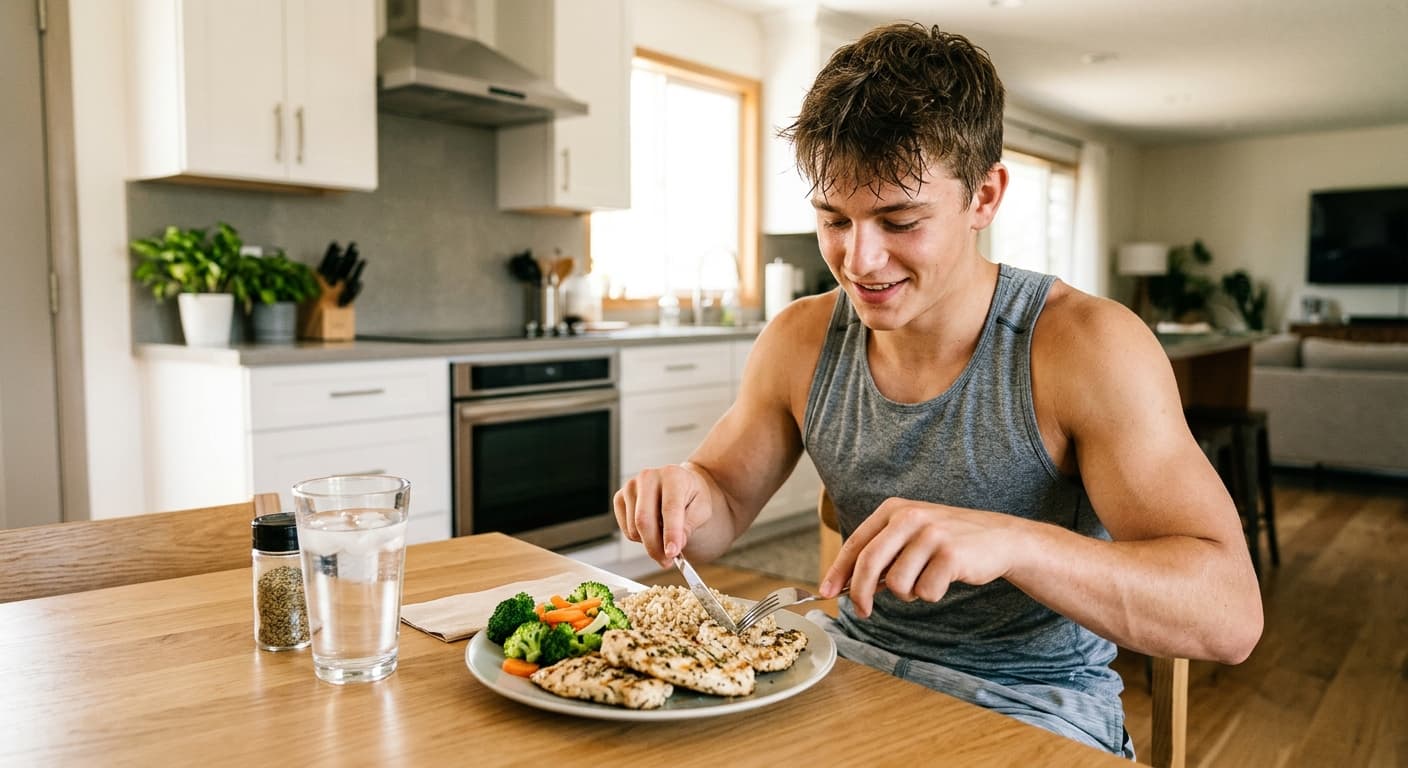
Being the skinny kid in high school sucks. You eat what feels like a ton of food, you hit the gym a few times a week, and somehow — nothing changes. Your friends seem to put on muscle just by looking at a dumbbell, while you're stuck at the same weight you were six months ago.
Here's the thing: it's not your genetics. It's not that you're "not meant to be big." It's almost always that you're not eating enough — and the way you train probably needs some work too.
Bulking as a teenager is actually one of the best things you can do. Your body is literally designed to grow right now. Testosterone levels are at their natural peak, growth hormone is pumping, and your recovery is faster than it'll ever be again. You just need to give your body the raw materials to work with.
This guide covers everything — calories, macros, training, meal plans, and the mistakes that keep most skinny teens stuck.
- Teenagers have a natural hormonal advantage for building muscle — use it
- Calculate your TDEE and add 300-500 calories for a lean bulk
- Aim for at least 1.6g of protein per kg of bodyweight daily
- Focus on compound lifts and progressive overload, not fancy exercises
- Eat 4-5 meals per day on a schedule, not when you feel hungry
- Sleep 8-9 hours — this is when most muscle growth actually happens
- Track your weight weekly and adjust calories every 2-3 weeks
Why Teenagers Have It Easier Than They Think
Let's start with the good news. As a teenager, you have a biological cheat code that adults would kill for.
Between ages 14 and 20, your body produces more testosterone and growth hormone than at any other point in your life. These are the two most powerful muscle-building hormones in existence. Adults spend hundreds of dollars on supplements trying to boost these by a few percentage points — and you've got them maxed out for free.
Your recovery is also insane. While a 35-year-old might need 72 hours to recover from a hard leg day, you can bounce back in 48 hours or less. That means you can train more frequently, which means more growth stimulus over time.
The catch? None of this matters if you're not eating enough. Hormones don't build muscle out of thin air. They need calories and protein to work with.
Think of it like this: testosterone and growth hormone are the construction crew. Calories and protein are the building materials. Right now, you've got the best crew in the world standing around with nothing to build with.
Step 1: Figure Out How Many Calories You Actually Need
This is where most skinny teens go wrong. You think you eat a lot, but when you actually track it, you're probably hitting 1,800-2,200 calories on most days. That's maintenance or even a deficit for an active teenager.
Calculate Your TDEE
Your Total Daily Energy Expenditure (TDEE) is the number of calories you burn in a day. As a teenager, this is higher than you'd expect because:
- Your basal metabolic rate is elevated (you're still growing)
- You're probably more active than you realize (school, sports, walking)
- Your body burns more calories processing food at this age
Here's a quick estimate based on bodyweight:
| Activity Level | Multiplier | Example (140 lb teen) |
|---|---|---|
| Sedentary (no sports, light gym) | BW × 15 | ~2,100 cal |
| Moderate (gym 3-4x/week) | BW × 16-17 | ~2,350 cal |
| Active (gym + sports) | BW × 18-19 | ~2,650 cal |
| Very active (daily training + sport) | BW × 20+ | ~2,800+ cal |
Add Your Surplus
Once you know your TDEE, add 300-500 calories on top. That's your bulking target.
- +300 calories: Slower, leaner gains. Best if you're skinny-fat
- +500 calories: Faster gains with slightly more fat. Best if you're very lean
For most skinny teens weighing 120-150 lbs, your bulking target will land somewhere between 2,600 and 3,200 calories per day.
If you're genuinely skinny and have visible abs without trying, just start at 2,800-3,000 calories. You can adjust after 2-3 weeks based on the scale.
For a deeper dive on calculating your exact numbers, check out our complete guide to calculating bulking calories.
Step 2: Nail Your Macros
Calories get you growing. Macros determine whether that growth is muscle or fat.
Protein: The Non-Negotiable
Aim for 0.7-1.0g per lb of bodyweight in protein every day. For a 140 lb teen, that's roughly 100-140g of protein daily.
This is the single most important number. Hit it every day, no excuses.
Best protein sources for teens on a budget:
- Eggs — cheap, versatile, ~6g protein each
- Chicken thighs — cheaper than breast, more calories, almost as much protein
- Ground beef — great calorie-to-protein ratio
- Greek yogurt — 15-20g protein per cup
- Whole milk — 1 cup = 8g protein + easy calories
- Whey protein — convenient for hitting your target
If you want a complete breakdown, read our guide on how much protein you need to build muscle.
Carbs: Your Energy Source
Carbs fuel your workouts and help with recovery. Aim for 45-55% of your total calories from carbs.
At 3,000 calories, that's roughly 340-410g of carbs per day. Sounds like a lot, but it's just rice, pasta, oats, potatoes, and bread — foods you probably already eat.
For the best carb sources, check out our guide to the best carbs for bulking.
Fats: Don't Fear Them
Fill the rest of your calories with fats — roughly 25-30% of total calories. At 3,000 calories, that's about 83-100g of fat per day.
Fats are calorie-dense (9 calories per gram vs. 4 for carbs and protein), which makes them your best friend when you're struggling to eat enough.
Quick Macro Cheat Sheet
| Bodyweight | Calories | Protein | Carbs | Fat |
|---|---|---|---|---|
| 120 lbs | 2,600 | 110g | 325g | 75g |
| 140 lbs | 2,900 | 130g | 360g | 85g |
| 160 lbs | 3,200 | 145g | 400g | 95g |
| 180 lbs | 3,500 | 160g | 435g | 105g |
Step 3: Build a Meal Schedule That Works Around School
Here's the reality: you can't just eat whenever you feel like it. Skinny guys don't get hungry enough to eat the calories they need. You have to eat on a schedule.
The goal is 4-5 meals per day, spaced roughly 3-3.5 hours apart. Here's a realistic schedule that works around a typical school day:
| Meal | Time | Goal |
|---|---|---|
| Breakfast | 7:00 AM | 600-700 cal |
| Lunch | 12:00 PM | 700-800 cal |
| After-school snack | 3:30 PM | 400-500 cal |
| Dinner | 6:30 PM | 700-800 cal |
| Night snack | 9:00 PM | 300-400 cal |
| Total | 2,700-3,200 cal |
Sample Day of Eating
Breakfast (7:00 AM) — 680 cal, 38g protein
- 3 eggs scrambled with cheese
- 2 slices whole grain toast with butter
- 1 cup whole milk
Lunch (12:00 PM) — 750 cal, 42g protein
- 5 oz chicken thigh
- 1.5 cups white rice
- Steamed broccoli
- Drizzle of olive oil
After-school snack (3:30 PM) — 480 cal, 35g protein
- Protein shake: 1 cup whole milk, 1 scoop whey, 1 banana, 2 tbsp peanut butter
Dinner (6:30 PM) — 780 cal, 40g protein
- 6 oz ground beef
- Large serving of pasta with tomato sauce
- Side salad with olive oil dressing
Night snack (9:00 PM) — 360 cal, 25g protein
- 7 oz Greek yogurt with granola and honey
Daily Total: ~3,050 cal, 180g protein
If you can't eat a big breakfast, drink it instead. A shake with milk, oats, protein powder, and peanut butter can hit 600+ calories and goes down in 2 minutes.
For more meal plan ideas, check out our bulking meal plan for skinny guys.
Step 4: Training — What Actually Works for Teen Beginners
You don't need a fancy 6-day bodybuilder split. What you need is a simple program built around compound lifts with progressive overload.
The Big Lifts
These exercises should form the backbone of every workout:
- Squat — builds legs, core, and overall strength
- Bench press — chest, shoulders, triceps
- Deadlift — back, hamstrings, grip, everything
- Overhead press — shoulders and upper chest
- Barbell row — back and biceps
- Pull-ups/chin-ups — back and biceps (bodyweight is fine to start)
Recommended Split: Upper/Lower, 4 Days
| Day | Focus | Key Exercises |
|---|---|---|
| Monday | Upper | Bench press, barbell row, overhead press, curls, tricep pushdowns |
| Tuesday | Lower | Squat, Romanian deadlift, leg press, calf raises |
| Wednesday | Rest | Eat and recover |
| Thursday | Upper | Overhead press, pull-ups, incline dumbbell press, face pulls, curls |
| Friday | Lower | Deadlift, front squat, lunges, leg curls |
| Sat-Sun | Rest | Eat and recover |
Progressive Overload — The Only Thing That Matters
Progressive overload means doing more over time. More weight, more reps, or more sets. If you bench 95 lbs for 3 sets of 8 this week, aim for 3 sets of 9 next week. When you hit 3 sets of 12, add 5 lbs and go back to 3 sets of 8.
Write everything down. Use a notebook or an app. If you don't track your lifts, you have no idea whether you're actually progressing.
Don't ego lift. Bad form leads to injuries, and an injury at 16 can haunt you for years. Learn proper technique first — even if that means starting with just the bar. Nobody in the gym cares what weight you're lifting.
Step 5: Sleep Is Not Optional
This is the part every teenager ignores, and it's probably costing you more gains than anything else.
You need 8-9 hours of sleep per night. Not 6. Not 7. Eight to nine.
Here's why: the majority of your growth hormone is released during deep sleep. If you're staying up until 1 AM scrolling TikTok and waking up at 6:30 for school, you're cutting your growth hormone production by up to 60%.
That's not an exaggeration. Studies consistently show that sleep-deprived teenagers produce significantly less growth hormone and testosterone than those who get adequate sleep.
Sleep tips for gains
- Set a consistent bedtime (even on weekends, within an hour)
- No screens 30 minutes before bed (blue light suppresses melatonin)
- Keep your room cool — around 65-68°F
- Have a casein protein shake or Greek yogurt before bed to feed your muscles overnight
For more on how sleep affects muscle growth, read our sleep and recovery guide.
Step 6: Supplements — What's Worth It and What's Not
Let's keep this simple. Most supplements are a waste of money, especially for teenagers.
Worth it
- Whey protein — only if you struggle to hit your protein target through food. It's not magic, it's just convenient protein
- Creatine monohydrate — the most researched supplement in existence. 5g per day. Safe, effective, cheap. Helps with strength and recovery
- Vitamin D — if you don't get much sun, which most students don't. 2,000-4,000 IU daily
Not worth it (for now)
- Mass gainers — overpriced sugar. Make a homemade shake instead
- BCAAs — useless if you're eating enough protein
- Pre-workout — you're 16, you don't need stimulants. Eat a banana and drink some coffee if you need energy
- Testosterone boosters — complete scam. Your testosterone is already at its peak
Save your money on supplements and spend it on food instead. An extra dozen eggs per week will do more for your gains than any supplement bottle.
For a deeper look at what actually works, check out our complete supplement guide for bulking.
Common Mistakes That Keep Skinny Teens Stuck
1. "I Eat So Much but Can't Gain Weight"
No, you don't. Track your food for one week — accurately, with a food scale — and you'll see the truth. Almost every skinny guy who says this is eating 1,500-2,000 calories when they think they're eating 3,000.
The days you eat a lot are canceled out by the days you skip breakfast, have a small lunch, and forget to snack. Consistency is everything.
2. Skipping Meals on Weekends
You grow every day, not just on school days. Weekend eating matters just as much. In fact, if you train on Saturday, your weekend nutrition is arguably more important.
3. Program Hopping
Pick one program and stick with it for at least 12 weeks before changing anything. You can't evaluate a program in 3 weeks. Progress is slow and invisible at first, then suddenly obvious.
4. Only Training "Mirror Muscles"
Chest and biceps every day won't build an impressive physique. You need legs, back, and shoulders too. The compound lifts we covered above hit everything — that's why they work.
5. Comparing Yourself to Social Media
That jacked 17-year-old on Instagram has been training for 4 years, has perfect genetics, great lighting, and possibly some pharmaceutical assistance. Compare yourself to yourself from 3 months ago. That's the only comparison that matters.
6. Not Drinking Enough Water
Dehydration kills performance, recovery, and appetite. Aim for at least 80-100 oz of water per day. More if you're training hard or playing sports.
How to Track Your Progress
Weigh Yourself Correctly
- Same time every day (morning, after bathroom, before eating)
- Track the weekly average, not daily fluctuations
- Aim for 0.5-1 lb per week of weight gain
What the Scale Should Tell You
| Weekly change | What it means | Action |
|---|---|---|
| No change | Not eating enough | Add 200 calories |
| 0.5-1 lb gain | Perfect pace | Keep going |
| 1-2 lbs gain | Gaining too fast (more fat) | Cut 200 calories |
| Weight loss | Way under-eating | Add 400-500 calories |
Take Progress Photos
Take a front, side, and back photo every 2 weeks. Same lighting, same time of day. You see yourself in the mirror every day, so you won't notice gradual changes. Photos don't lie.
Track Your Lifts
If your squat goes from 95 lbs to 175 lbs and your bodyweight goes from 132 lbs to 154 lbs, you built muscle. Period. Strength gains are the most reliable indicator of muscle growth, especially for beginners.
Realistic Timeline: What to Expect
Let's set honest expectations so you don't quit after 6 weeks of "nothing happening."
| Timeline | What to expect |
|---|---|
| Weeks 1-4 | Scale goes up, mostly water/glycogen. Strength starts increasing. You feel fuller. |
| Months 2-3 | Visible changes in arms and shoulders. Clothes fit tighter. People start noticing. |
| Months 4-6 | Significant strength gains. Noticeable muscle mass. You look like you lift. |
| Months 6-12 | Major transformation. 10-20 lbs of total weight gain, mostly muscle if done right. |
| Year 1-2 | You're a different person. Seriously. |
The first year of lifting with proper nutrition is when you'll make the most dramatic gains of your life. This is your window. Don't waste it.
For a more detailed breakdown, read our bulking results timeline guide.
Talking to Your Parents About Bulking
This might seem weird to include, but it matters. If your parents buy the groceries and cook the meals, they're a huge part of your success.
How to approach it
- Don't say "I want to bulk." Say "I want to eat healthier and build strength for sports/health."
- Ask to help with grocery shopping. Offer to cook some of your own meals
- Show them this isn't a fad diet. It's whole foods — chicken, rice, eggs, vegetables, milk. Nothing weird
- Offer to help with the budget. Bulking foods are cheap. A budget grocery list can actually save money compared to junk food
Most parents will support you when they see you're eating real food, exercising, and taking your health seriously. It beats the alternative of energy drinks and fast food.
Where FuelTheGains Comes In
The hardest part of bulking as a teenager isn't the training — it's consistently hitting your calories and macros every single day, especially when you're juggling school, homework, sports, and a social life.
That's exactly what is built for. You plug in your stats — weight, height, activity level, goal — and it generates a personalized meal plan with the exact calories and macros you need. No guesswork, no calorie counting apps, no spreadsheets.
It even adjusts as you grow. When you gain 7 lbs and need to bump your calories, the plan updates automatically. It's like having a nutrition coach in your pocket, minus the cost.
The Bottom Line
You're at the best age to build muscle. Your hormones are maxed out, your recovery is elite, and your body is literally built to grow right now.
The formula is dead simple: eat enough food, lift heavy things, sleep like it's your job, and be patient. Do this consistently for 12 months and you won't recognize yourself.
Stop waiting for Monday. Stop looking for the perfect program. Start eating, start lifting, and start growing. Future you will be grateful.