
You've done the math. You know you need to eat more. But staring at a mountain of chicken and rice that you're supposed to somehow shove down — that's where most skinny guys tap out.
Here's the thing most bulking guides get wrong: they tell you to "just eat more" like it's some groundbreaking revelation. Thanks, genius. The problem was never knowing what to do — it's actually doing it without feeling like you're going to explode.
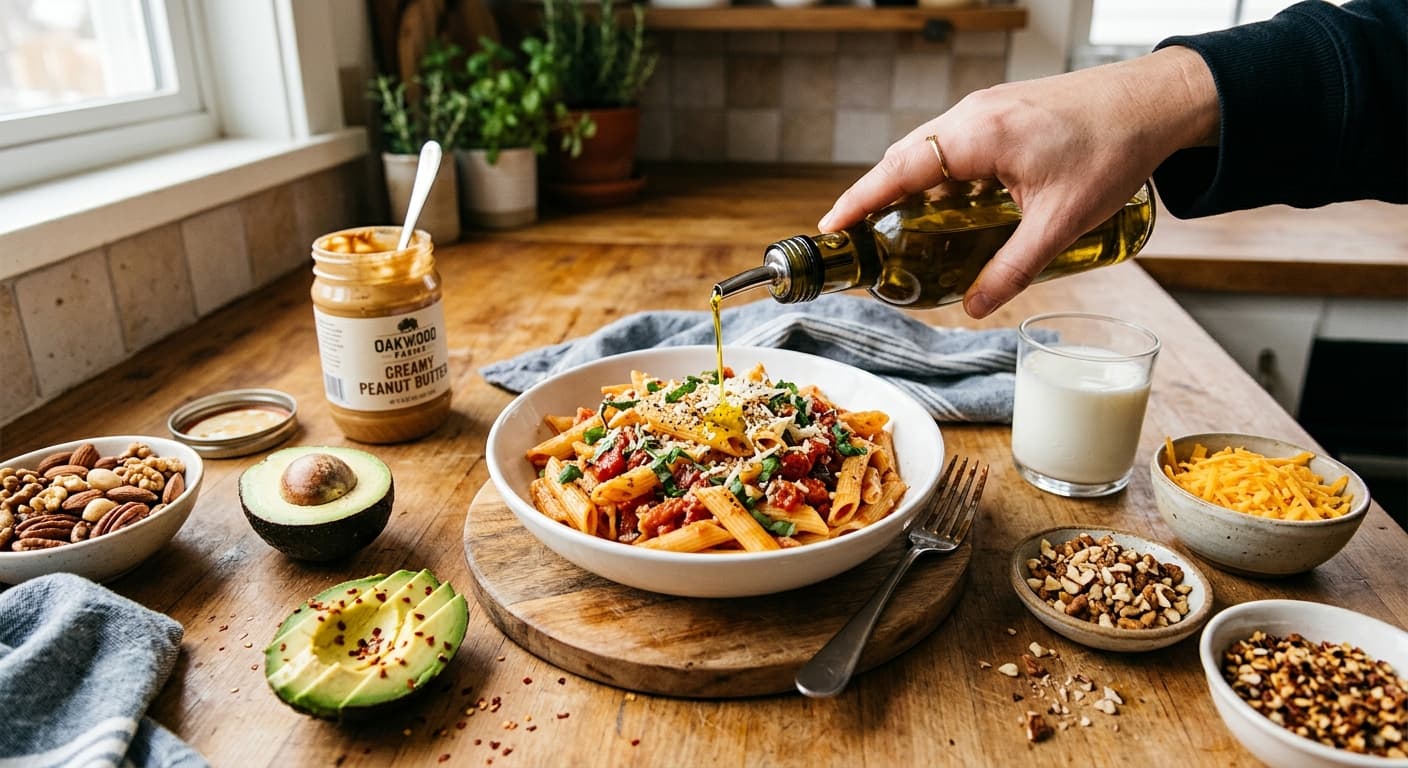
The real hack isn't eating more food. It's making the food you already eat more calorie-dense. Small additions, big impact. We're talking about turning a 400-calorie meal into a 900-calorie meal without adding much volume to your plate.
- Adding calories to existing meals is easier than eating more food
- Fats are your best friend at 9 calories per gram vs. 4 for carbs and protein
- Liquid calories bypass fullness signals and add up fast
- Simple swaps like cooking oil, cheese, and nut butters can add 300-500 calories with zero extra effort
- Layer multiple small additions for the biggest calorie boost without the bloat
Why Adding Calories Beats Eating More Food
Your stomach has a limit. It physically can only hold so much volume before stretch receptors tell your brain "we're full, stop eating." This is why eating a massive salad fills you up on 200 calories while a handful of nuts barely registers at 400.
The key difference is calorie density — how many calories are packed into each gram of food.
| Food | Serving | Calories | Calorie Density |
|---|---|---|---|
| Lettuce | 3.5 oz | 15 | Very low |
| Chicken breast | 3.5 oz | 165 | Moderate |
| White rice (cooked) | 3.5 oz | 130 | Moderate |
| Peanut butter | 3.5 oz | 588 | High |
| Olive oil | 3.5 oz | 884 | Very high |
| Almonds | 3.5 oz | 579 | High |
See the pattern? Fats dominate. At 9 calories per gram (vs. 4 for protein and carbs), fat is literally more than twice as calorie-dense. This is your secret weapon.
That doesn't mean you should chug olive oil (please don't). It means strategically adding small amounts of calorie-dense ingredients to meals you already eat.
The Calorie-Boosting Toolkit
Think of these as your go-to additions. Each one adds 100-300 calories with minimal volume. Stack 2-3 of them on any meal and you've got your extra 500 without changing what you eat.
Fats & Oils
These are the MVPs of calorie boosting. A little goes a long way.
| Addition | Amount | Calories Added |
|---|---|---|
| Olive oil (drizzle) | 2 tbsp | 240 |
| Butter | 2 tbsp | 200 |
| Coconut oil | 1 tbsp | 120 |
| Avocado | 1 whole | 240 |
| Cream cheese | 2 oz | 200 |
Cook your rice and pasta in butter or olive oil instead of plain water-draining. It adds 100-200 calories with zero extra effort or volume.
Nut Butters & Nuts
The calorie density of nuts is almost unfair. A small handful can pack more calories than a whole chicken breast.
- Peanut butter — 2 tbsp = 190 cal
- Almond butter — 2 tbsp = 200 cal
- Mixed nuts — 1.5 oz handful = 230 cal
- Cashews — 1.5 oz = 220 cal
- Walnuts — 1 oz = 185 cal
These work on almost anything: oatmeal, shakes, yogurt, toast, rice bowls, stir-fries, or just eaten by the handful between meals.
Dairy Add-Ons
If you tolerate dairy, it's one of the easiest calorie boosters available. Check out our complete guide to dairy products for bulking for more options.
| Addition | Amount | Calories |
|---|---|---|
| Shredded cheese | 1.5 oz | 160 |
| Heavy cream (in coffee or shakes) | 3 tbsp | 150 |
| Sour cream | 3 tbsp | 90 |
| Whole milk (swap from water) | 1 cup | 150 |
| Cream cheese | 2 tbsp | 100 |
Carb Boosters
Sometimes you just need more energy-dense carbs on the plate.
- Granola on yogurt — 1.75 oz = 220 cal
- Dried fruit — 1.5 oz = 130 cal
- Honey or maple syrup — 2 tbsp = 120 cal
- Extra bread — 1 thick slice = 100-120 cal
- Tortilla wrap instead of nothing — 1 large = 200 cal
Meal-by-Meal Calorie Boosting Playbook
Let's get specific. Here's how to apply this to every meal of the day.
Breakfast: +500 Calories
Base meal: 2 eggs + toast = ~350 cal
Boosted version: Same 2 eggs cooked in butter (+100), toast with peanut butter (+190), glass of whole milk (+150), drizzle of honey (+60)
New total: ~850 cal. That's +500 without eating more food — just smarter food.
More breakfast boosting ideas:
- Oatmeal: Add peanut butter, banana, honey, and a splash of heavy cream. Takes a 300-cal bowl to 700+. Check our best oatmeal recipes for bulking for more combos.
- Yogurt: Use full-fat Greek yogurt, add granola, nuts, and honey. Easy 600+ cal bowl.
- Smoothie: Swap water for whole milk, add a banana, peanut butter, and oats. Our homemade mass gainer shakes guide has recipes hitting 800+ calories.
If you struggle with morning appetite, start with a liquid breakfast. A calorie-dense shake goes down much easier than solid food when you're not hungry yet.
Lunch: +500 Calories
Base meal: Grilled chicken sandwich = ~450 cal
Boosted version: Add avocado (+120), cheese (+110), mayo (+100), side of nuts (+180)
New total: ~960 cal.
More lunch boosting ideas:
- Rice bowls: Cook rice in broth with butter, top with cheese and avocado. Turns a 400-cal bowl into 750+.
- Wraps: Use a large tortilla (+200 cal over bread), load with extra cheese, sauce, and a drizzle of olive oil.
- Pasta: Toss in olive oil and parmesan after cooking. Add ground beef instead of chicken breast for extra fat and calories.
- Sandwiches: Always use thick-cut bread, add cheese on both sides, and don't skip the mayo or oil-based dressing.
Dinner: +500 Calories
Base meal: 7 oz chicken breast + 5.3 oz rice + veggies = ~550 cal
Boosted version: Switch to chicken thighs (+80 over breast), cook rice in butter (+100), drizzle olive oil on veggies (+120), add a side of bread with butter (+200)
New total: ~1050 cal.
The chicken thigh swap alone is a game changer. Thighs have almost twice the fat content of breast meat, which means more calories without more volume. They also taste better — which means you'll actually want to eat them.
Snacks: +500 Calories
If you can't boost your main meals enough, a single well-designed snack can fill the gap. For a full list of options, see our best bulking snacks guide.
| Snack | Calories |
|---|---|
| PB&J on thick bread | 450-550 |
| Trail mix (3 oz) | 400-450 |
| Banana + 2 tbsp peanut butter | 290 |
| Cheese and crackers | 300-400 |
| Handful of nuts + dried fruit | 350 |
| Full-fat yogurt with granola | 350-450 |
The Liquid Calorie Cheat Code
Here's something most hardgainers don't realize: your body doesn't register liquid calories the same way as solid food. Drinks bypass most of the fullness signals that solid food triggers.
This is why a 700-calorie shake feels like nothing, while a 700-calorie plate of food leaves you groaning.
The Base Shake Formula
Start here and customize:
- 2 cups whole milk — 300 cal
- 1 banana — 100 cal
- 2 tbsp peanut butter — 190 cal
- 1 scoop whey protein — 120 cal
Total: 710 calories in about 90 seconds of drinking.
Shake Boosters
Want to push it even higher? Add any of these:
| Addition | Calories Added |
|---|---|
| 1.5 oz oats | 150 |
| 1 tbsp honey | 60 |
| 1 tbsp coconut oil | 120 |
| 2 tbsp heavy cream | 100 |
| 1 oz dark chocolate chips | 160 |
Stack a few and you've got a 1,000+ calorie shake that goes down in under two minutes. That's legitimately half your daily surplus in a single drink.
Have your shake between meals — not with them. Drinking it alongside a full meal will just fill you up faster. Mid-morning and before bed are the sweet spots.
The "Stealth Calories" Strategy
These are additions so small you won't even notice them. But over a full day, they compound into serious numbers.
Morning Coffee
Switch from black coffee to coffee with:
- 2 tbsp heavy cream — 100 cal
- 1 tbsp sugar or honey — 50 cal
That's 150 extra calories from something you drink every day anyway. Over a week, that's 1,050 free calories.
Cooking Method Swaps
| Instead of... | Do this... | Calories saved/added |
|---|---|---|
| Boiling pasta | Tossing in olive oil after draining | +120 per tbsp |
| Steaming veggies | Sautéing in butter | +100-200 |
| Non-stick spray | Cooking with real oil | +120 per tbsp |
| Water in oatmeal | Whole milk in oatmeal | +100 per cup |
| Plain rice | Rice cooked with butter/ghee | +100-200 |
Sauces and Condiments
Never eat dry food again. Sauces are calorie goldmines:
- Mayo — 1 tbsp = 100 cal
- Ranch dressing — 2 tbsp = 130 cal
- Pesto — 2 tbsp = 160 cal
- Hummus — 2 oz = 100 cal
- BBQ sauce — 2 tbsp = 60 cal
- Tahini — 1 tbsp = 90 cal
Pesto is the unsung hero of bulking sauces. It's calorie-dense, made from olive oil and nuts, and makes literally everything taste better — pasta, chicken, sandwiches, eggs, rice bowls.
The Stacking Method: Putting It All Together
The magic happens when you combine multiple small additions. No single change feels like much, but stacked together they're transformative.
Here's a real example for a 150 lb guy eating 2,800 calories:
Before (2,300 calories)
| Meal | What | Calories |
|---|---|---|
| Breakfast | 2 eggs + plain toast + black coffee | 350 |
| Lunch | Chicken breast sandwich | 450 |
| Snack | Apple | 80 |
| Dinner | Chicken breast + plain rice + steamed broccoli | 550 |
| Evening | Nothing | 0 |
| Total | 1,430 |
Yeah — that's not even close to enough for building muscle.
After (2,800+ calories)
| Meal | What Changed | Calories |
|---|---|---|
| Breakfast | Eggs in butter, PB on toast, coffee + cream | 650 |
| Shake | Whole milk + banana + PB + whey (between breakfast and lunch) | 710 |
| Lunch | Added avocado, cheese, mayo to sandwich | 780 |
| Snack | Apple + handful of almonds + cheese stick | 330 |
| Dinner | Chicken thighs, rice with butter, broccoli in olive oil, bread | 900 |
| Evening | Greek yogurt + honey + granola | 400 |
| Total | 3,770 |
That's almost 2,300 extra calories from additions alone — no new meals invented, no forcing yourself to eat until you feel sick.
Common Mistakes When Boosting Calories
1. Going All-In on Day One
Don't try to add 1,000 calories overnight. Your digestive system needs time to adjust. Start by adding 200-300 calories per day and increase every 3-4 days. If you rush it, you'll end up bloated, gassy, and hating food. Read our guide on fixing digestion problems while bulking if this happens.
2. Only Adding Junk Food
There's a difference between calorie-dense and nutritious vs. calorie-dense and garbage. A handful of almonds and a spoonful of peanut butter give you healthy fats, fiber, and micronutrients. A bag of chips gives you... sodium and regret.
This doesn't mean you need to eat "clean" 100% of the time. It means your primary calorie boosters should be nutrient-rich: nuts, oils, avocado, dairy, whole grains. If you want the full breakdown on this, check out our clean bulk vs. dirty bulk comparison.
3. Forgetting Protein
Adding 500 calories of pure fat won't build muscle. You still need to hit your protein target — roughly 0.7-1.0g per lb of bodyweight. Make sure at least some of your additions include protein: cheese, milk, yogurt, protein powder, nuts.
4. Not Tracking (At Least Initially)
"I added some peanut butter and extra cheese" could mean 200 calories or 600 calories depending on your portions. For the first 2-3 weeks, actually measure your additions. After that, you'll be able to eyeball it accurately. Our macro tracking guide walks you through the process.
5. Skipping Meals and Trying to Make Up Later
Adding 500 calories to dinner because you skipped breakfast is a recipe for feeling terrible. Spread your calories across the day. Each meal is an opportunity to add a little — that's the whole point of this strategy.
A Week of Calorie-Boosted Meals
Here's what a full week looks like when you apply these strategies consistently. All meals are based on normal food — nothing fancy, nothing expensive.
Monday
- Breakfast: Scrambled eggs in butter + whole wheat toast with PB + coffee with cream
- Shake: Whole milk + banana + chocolate whey + oats
- Lunch: Chicken thigh wrap with cheese, avocado, and ranch
- Dinner: Ground beef stir-fry with rice cooked in butter + sesame oil drizzle
Tuesday
- Breakfast: Oatmeal with whole milk, honey, almonds, and banana
- Shake: Whole milk + PB + strawberries + whey
- Lunch: Double meat sub with cheese and mayo
- Dinner: Pasta tossed in olive oil and parmesan + grilled chicken thighs
Wednesday
- Breakfast: Full-fat Greek yogurt bowl with granola, walnuts, and honey
- Shake: Whole milk + PB + banana + cocoa powder + oats
- Lunch: Rice bowl with ground beef, cheese, sour cream, and salsa
- Dinner: Baked salmon + mashed potatoes with butter and cream + veggies in olive oil
Thursday
- Breakfast: 3-egg omelette with cheese and toast with butter
- Shake: Whole milk + vanilla whey + PB + banana
- Lunch: Grilled chicken sandwich with pesto, mozzarella, and avocado
- Dinner: Chicken thigh curry with coconut milk over rice
Friday
- Breakfast: Protein pancakes with maple syrup and banana
- Shake: Whole milk + chocolate whey + oats + PB + honey
- Lunch: Tuna melt with extra cheese on sourdough
- Dinner: Beef tacos with cheese, sour cream, guacamole + rice and beans
Saturday & Sunday
Same approach, bigger meals. Weekends are when you have time to cook — make batch meals and calorie-dense breakfasts. Check our meal prep guide for weekend prep strategies.
How FuelTheGains Makes This Easier
The hardest part of this whole strategy isn't knowing what to add — it's remembering to do it consistently and knowing exactly how many calories you're actually eating.
That's where FuelTheGains comes in. Instead of guessing whether your "extra drizzle of olive oil" was 100 or 300 calories, you get a personalized meal plan that already has these calorie boosters built in. Every meal is designed for your exact calorie and macro targets, so you never have to do math at the dinner table.
It takes the mental overhead out of bulking and lets you just eat.
The Bottom Line
You don't need to eat until you're miserable to hit a calorie surplus. You need to eat smarter — adding calorie-dense ingredients to meals you're already eating.
Start with one meal. Pick 2-3 additions from the toolkit. Practice it for a week until it becomes automatic. Then boost the next meal.
Small changes, stacked consistently, will get you to your calorie target faster than any "eat big" motivation ever will. The best bulking diet is the one you can actually stick to — and this is how you make it stick.