
You know the feeling. You're halfway through a meal, your stomach is screaming "I'm done," and you've barely hit 400 calories. Meanwhile, your buddy across the table is casually demolishing twice as much food without blinking.
If you're a naturally skinny guy trying to bulk, this is the single biggest battle you'll face. Not the training. Not the supplements. Just... eating enough damn food.
Here's the thing most bulking guides miss: not all calories are created equal when it comes to fullness. Some foods pack hundreds of calories into a few bites while barely registering in your stomach. Others fill you up on 200 calories and leave you miserable for hours.
This guide is about the first kind — the foods that let you hit your calorie surplus without feeling like you're going to explode after every meal.
- Focus on calorie-dense, low-volume foods to hit your surplus without feeling stuffed
- Liquid calories are the easiest way to add 500-800 calories without any fullness
- Fats are your best friend at 9 calories per gram vs. 4 for carbs and protein
- Strategic food swaps can add 300-500 calories per meal with zero extra volume
- Eat your protein first, then fill remaining calories with the foods on this list
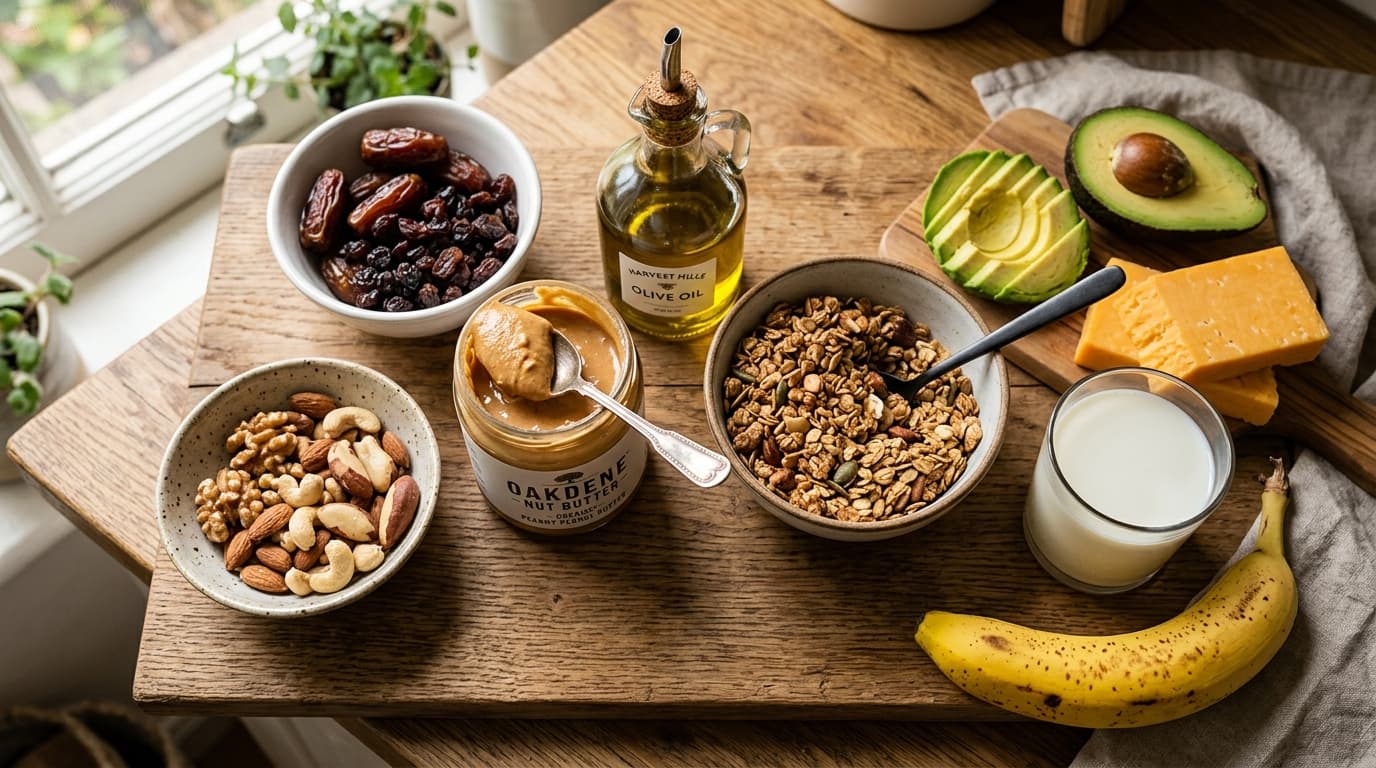
- Dried fruit, nut butters, oils, and granola are the top-tier hardgainer foods
Why Some Foods Fill You Up More Than Others
Before we get to the list, it helps to understand why some foods are so much harder to eat in volume. Three factors matter:
1. Fiber Content
Fiber absorbs water and expands in your stomach. It also slows digestion, keeping you full longer. Great for fat loss — terrible for bulking.
A 7 oz bowl of broccoli has about 70 calories but takes up a huge amount of space in your stomach. Compare that to 7 oz of granola at over 900 calories.
2. Water Content
Foods with high water content (fruits, vegetables, soups, salads) are physically large relative to their calorie content. Your stomach has stretch receptors that signal fullness based on volume, not calories.
This is why a 10.5 oz watermelon slice (90 calories) makes you feel fuller than a 1 oz handful of macadamia nuts (200 calories).
3. Protein-to-Calorie Ratio
Protein is the most satiating macronutrient. Foods that are almost pure protein (chicken breast, egg whites, white fish) fill you up fast relative to their calories.
You still need protein — aim for 0.7-1.0g per lb of bodyweight. But once you've hit that target, fill the rest of your calories with fats and carbs from low-satiety sources.
Researchers have actually ranked foods by how filling they are per calorie. Boiled potatoes top the chart (most filling), while croissants, cake, and peanuts rank near the bottom (least filling per calorie). For bulking, you want foods near the bottom of that index.
The Top Calorie-Dense, Low-Fullness Foods
Here's your arsenal. These are ranked by how many calories you can consume before your stomach starts pushing back.
Tier 1: Liquid Calories (The Cheat Code)
Liquids bypass most of your body's fullness signals. They empty from your stomach faster than solids and don't require chewing, which itself triggers satiety hormones.
Whole milk — 1 cup = 150 calories, 8g protein. Drink 4 cups throughout the day and that's 600 calories you'll barely notice.
Homemade mass gainer shakes — Blend milk, protein powder, banana, oats, and peanut butter. You can easily hit 800-1,000 calories in a single shake that goes down in 2 minutes. Check out our homemade mass gainer shake recipes for ideas.
Fruit juice — 1 cup of orange juice is 110 calories with almost zero fullness effect. Not ideal as a health food, but as a calorie booster it's hard to beat.
Chocolate milk — 2 cups = 400+ calories with decent protein. Also tastes amazing, which helps.
Drink calories between meals, not during. Having a 600-calorie shake with your meal won't add to your daily total if it makes you eat less food at the table.
Tier 2: Nut Butters and Nuts
Nut butters might be the single best bulking food ever invented. They're calorie-dense, taste great, require minimal chewing (especially the butter form), and barely fill you up.
| Food | Serving | Calories | Protein |
|---|---|---|---|
| Peanut butter | 2 tbsp | 190 | 7g |
| Almond butter | 2 tbsp | 196 | 7g |
| Cashew butter | 2 tbsp | 188 | 6g |
| Mixed nuts | 2 oz | 350 | 10g |
| Trail mix | 2 oz | 320 | 8g |
| Macadamia nuts | 2 oz | 430 | 5g |
Two tablespoons of peanut butter is about 190 calories and you can eat it straight from the jar without even feeling like you ate anything. Add it to shakes, spread it on toast, mix it into oatmeal, or just eat spoonfuls between meals.
For a deeper dive on the best options, read our complete guide to nuts and seeds for bulking.
Buy the big 2.2 lb jars of natural peanut butter from Costco or your local warehouse store. It's the cheapest calorie source per dollar you'll find — often under $0.05 per 100 calories.
Tier 3: Oils and Fats
Pure fats are the most calorie-dense foods on earth at 9 calories per gram. A single tablespoon of olive oil is 120 calories. You can drizzle it on literally anything and add significant calories with zero volume.
Best cooking/drizzling oils:
- Extra virgin olive oil — 120 cal/tbsp, heart-healthy fats
- Avocado oil — 124 cal/tbsp, high smoke point for cooking
- Coconut oil — 121 cal/tbsp, works great in shakes and oatmeal
Other high-fat additions:
- Butter — 100 cal/tbsp, makes everything taste better
- Heavy cream — 50 cal/tbsp, add to coffee, shakes, or sauces
- Cream cheese — 50 cal/tbsp, spread on bagels or mix into scrambled eggs
The olive oil hack: Cook your rice, pasta, or vegetables in a tablespoon of olive oil and drizzle another tablespoon on top. That's 240 extra calories to a meal that tastes better and adds zero fullness.
Tier 4: Dried Fruit
Fresh fruit is mostly water. Remove the water and you've got a calorie bomb that's easy to eat by the handful.
| Fresh vs. Dried | 3.5 oz Fresh | 3.5 oz Dried |
|---|---|---|
| Grapes → Raisins | 69 cal | 299 cal |
| Plums → Prunes | 46 cal | 240 cal |
| Apricots → Dried apricots | 48 cal | 241 cal |
| Dates (fresh → dried) | 75 cal | 282 cal |
| Cranberries → Dried cranberries | 46 cal | 308 cal |
Dried fruit is 3-5x more calorie-dense than fresh fruit. A small 3 oz bag of dates has about 225 calories and goes down in under a minute. Mix dried fruit with nuts for a calorie-dense snack that travels well and needs zero prep.
Tier 5: Granola and Cereals
Most people think of cereal as a light breakfast. It's not. Dense granola is one of the most calorie-packed foods you can eat, and it barely fills you up because the pieces are small and crunchy.
- Granola — 3.5 oz = 450-500 calories
- Muesli — 3.5 oz = 350-400 calories
- Honey Nut Cheerios — 3.5 oz = 380 calories
Pour 3 oz of granola into a bowl of whole milk and top with a sliced banana and honey. That's a 700+ calorie snack that takes 5 minutes to eat and won't make you feel overly full.
Tier 6: Cheese and Dairy
Full-fat dairy products are calorie goldmines. They're also rich in protein and calcium, making them ideal for muscle-building.
- Cheddar cheese — 1 oz = 113 calories
- Mozzarella — 1 oz = 85 calories
- Cream cheese — 1 oz = 99 calories
- Full-fat Greek yogurt — 7 oz = 190 calories, 18g protein
- Whole milk — 2 cups = 300 calories, 16g protein
Shred cheese on top of everything — eggs, rice, pasta, potatoes, salads. A 2 oz serving adds 200+ calories and makes food taste infinitely better.
For more on the best dairy choices, check our dairy products for bulking guide.
Tier 7: Starches and Grains
White rice, pasta, and bread are your bulking staples. They're calorie-dense when cooked, relatively low in fiber (especially white varieties), and easy to eat in large portions.
- White rice (cooked) — 10.5 oz = 390 calories
- Pasta (cooked) — 10.5 oz = 470 calories
- White bread — 2 slices = 160 calories
- Bagel — 1 large = 270 calories
- Tortilla wraps — 1 large = 210 calories
Why white over brown? Brown rice and whole wheat pasta have more fiber, which means they fill you up faster. For bulking, white varieties give you the same calories with less fullness. You can always add fiber from other sources if gut health is a concern.
Calorie-Boosting Food Swaps
Sometimes the easiest way to add calories is to swap what you're already eating for a more calorie-dense version. No extra food, no extra volume — just more energy.
| Instead of... | Switch to... | Calories Saved/Added |
|---|---|---|
| Water with meals | Whole milk | +150 per glass |
| Skim milk | Whole milk | +70 per glass |
| Plain oatmeal | Oatmeal + PB + honey | +300 per bowl |
| Dry toast | Toast + butter + jam | +200 per 2 slices |
| Plain rice | Rice cooked in oil + butter | +250 per serving |
| Chicken breast | Chicken thighs | +80 per serving |
| Salad dressing (light) | Full-fat dressing | +100 per serving |
| Black coffee | Coffee + heavy cream + sugar | +120 per cup |
| Fresh fruit snack | Trail mix snack | +250 per serving |
| Steamed vegetables | Roasted veggies in olive oil | +120 per serving |
These swaps alone can add 500-1,000 calories per day without eating a single extra bite of food.
How to Structure Your Day Around These Foods
Knowing which foods are calorie-dense is only half the battle. Here's how to actually structure a day to maximize calorie intake without constant discomfort.
The Hardgainer's Daily Blueprint
Meal 1 (Breakfast): Start with a solid meal — eggs, toast with peanut butter, and a glass of whole milk. Aim for 600-700 calories.
Snack 1 (Mid-morning): A handful of trail mix and a glass of juice. 300 calories in 3 minutes.
Meal 2 (Lunch): Your biggest solid meal. Rice or pasta with a protein source, cooked in oil, with cheese on top. 700-800 calories.
Snack 2 (Afternoon): Calorie shake. Milk, protein powder, banana, oats, peanut butter. 600-800 calories that go down easy.
Meal 3 (Dinner): Another solid meal. Similar structure to lunch. 600-700 calories.
Snack 3 (Before bed): Granola with whole milk, or a peanut butter and banana sandwich. 400-500 calories.
That's roughly 3,200-3,500 calories with three meals and three snacks. For a 150 lb skinny guy, that's a solid bulking surplus. Need more? Check our 3,500-calorie meal plan for a complete day-by-day breakdown.
Set alarms on your phone for snack times. Hardgainers often don't feel hungry between meals, so you need external reminders. Eat by the clock, not by hunger.
The 80/20 Rule for Hardgainers
80% of your calories should come from calorie-dense, low-satiety foods — the ones on this list.
20% of your calories should come from nutrient-dense foods that might be more filling (vegetables, lean proteins, fruits) to cover your micronutrient needs.
This isn't a license to eat garbage. It's permission to prioritize calorie density over "clean eating" perfection. A hardgainer who eats 3,500 calories of "mostly good" food will build more muscle than one who eats 2,200 calories of "perfectly clean" food.
The 5-Minute Calorie Bombs
When you're running low on time or just can't face another full meal, these quick combos pack serious calories in minutes:
1. The PB&J Power Stack
Two slices of white bread + 3 tbsp peanut butter + 2 tbsp jam = 550 calories. Takes 90 seconds to make.
2. The Banana Boat
One large banana sliced lengthwise + 2 tbsp peanut butter + drizzle of honey + sprinkle of granola = 500 calories.
3. The Midnight Cereal Bowl
3 oz granola + 1 cup whole milk + 1 sliced banana + 1 tbsp honey = 650 calories.
4. The Office Snack Bag
2 oz mixed nuts + 1.5 oz dried fruit + 1 cheese stick = 470 calories. Zero prep, zero refrigeration needed.
5. The Lazy Shake
2 cups whole milk + 2 tbsp peanut butter + 1 banana + 2 tbsp honey. Skip the protein powder if you've already hit your protein goal. 620 calories in 60 seconds.
For more quick high-calorie snack ideas, check out our best bulking snacks guide.
Common Mistakes Hardgainers Make
1. Eating Too "Clean"
Chicken breast, brown rice, and steamed broccoli is a great fat-loss meal. For bulking? It's a recipe for undereating. You'll be full at 2,000 calories and miserable trying to force more down.
2. Drinking Too Much Water Before Meals
Water has zero calories but takes up stomach space. Stop chugging water 30 minutes before meals. Sip during meals if needed, but save the heavy hydration for between meals.
3. Loading Up on Vegetables
Vegetables are healthy. They're also mostly water and fiber — the two things that fill you up fastest. Don't skip them entirely, but don't let them take up prime stomach real estate. Eat them after your calorie-dense foods, not before.
4. Relying Only on Solid Food
If you're trying to hit 3,000+ calories purely from solid meals, you're making this way harder than it needs to be. At least one of your daily calorie sources should be liquid. Shakes, milk, juice — whatever works.
5. Eating the Same Thing Every Day
Appetite fatigue is real. If you eat the same meals every day, your brain will eventually revolt and your appetite will tank. Rotate your meals, try new recipes, and keep things interesting. Our high-calorie rice recipes and chicken recipes for bulking can help you mix things up.
6. Skipping Meals When Not Hungry
Your body doesn't care if you're hungry. Your muscles need fuel regardless. Eat on a schedule, and rely on calorie-dense, low-volume foods for the meals where your appetite is weakest.
Tracking Your Progress
How do you know this approach is working?
Weigh yourself daily, first thing in the morning, after using the bathroom. Track the weekly average, not daily fluctuations.
Target weight gain: 0.5-1 lb per week. Faster than that and you're probably gaining too much fat. Slower and you need to add more calories.
If the scale isn't moving after 2 weeks:
- Add one extra snack from the list above (~300-400 calories)
- Switch one water-based drink to whole milk
- Add a tablespoon of olive oil to two meals
Small changes compound. You don't need to overhaul everything — just keep nudging calories up until the scale responds.
Where FuelTheGains Comes In
Tracking all of this — the calories, the macros, the meal timing, the weekly averages — is a lot to manage, especially when you're still learning what works for your body.
That's exactly why we built . It calculates your exact calorie and macro targets based on your body, your goals, and your activity level. It builds you a personalized meal plan using the calorie-dense foods that actually work for hardgainers — not generic "healthy eating" templates that leave you underfed.
No guesswork. No spreadsheets. Just a clear plan that tells you what to eat, when to eat it, and how much.
The Bottom Line
Bulking as a hardgainer isn't about forcing yourself to eat until you're sick. It's about choosing the right foods — calorie-dense, low-volume options that let you hit your surplus without a constant battle against your appetite.
Prioritize liquid calories, nut butters, oils, dried fruit, and full-fat dairy. Make smart food swaps. Eat on a schedule. And stop trying to bulk on chicken breast and broccoli alone.
Your stomach has a size limit. Work with it, not against it.