
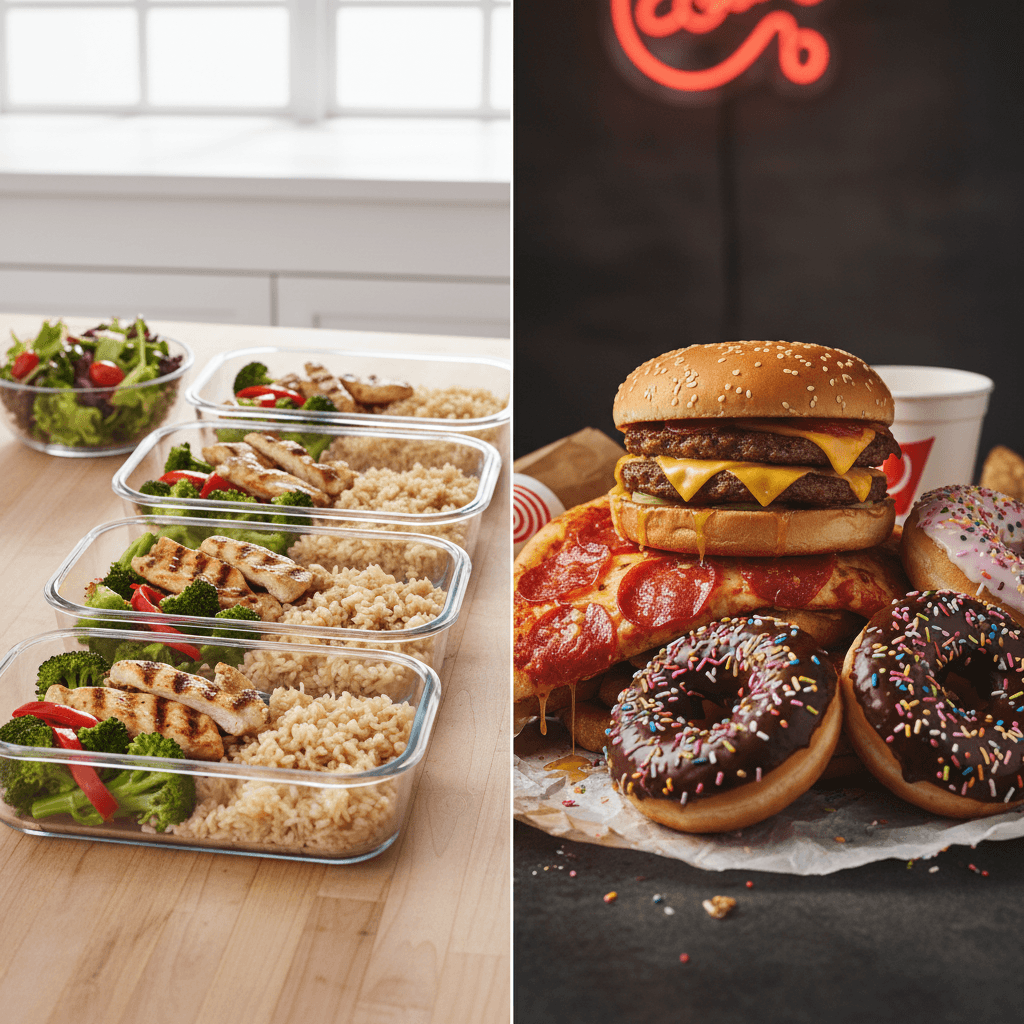
- Clean bulking builds more muscle relative to fat gain
- Dirty bulking is faster but you'll need a longer, harder cut afterward
- A 300-500 calorie surplus is optimal for either approach
- Food quality affects energy, recovery, and long-term health — not just the scale
- The best bulk is the one you can actually stick to consistently
The internet loves to argue about this. In one corner: the clean bulkers eating chicken breast and broccoli six times a day. In the other: the dirty bulkers crushing pizza, ice cream, and burgers in the name of gains.
So who's right? Let's break it down with actual science — not gym bro dogma.
What Is a Clean Bulk?
A clean bulk means eating in a moderate calorie surplus (300-500 calories above maintenance) while prioritizing nutrient-dense, whole foods.
What you eat:
- Lean meats, eggs, fish
- Rice, oats, potatoes, whole grains
- Fruits and vegetables
- Healthy fats (olive oil, nuts, avocado)
- Dairy (milk, yogurt, cottage cheese)
What you avoid (mostly):
- Processed junk food
- Excessive sugar and fried food
- Empty-calorie snacks
Pros of Clean Bulking
- Better muscle-to-fat ratio. A smaller surplus means more of your weight gain is muscle, less is fat.
- Better energy and recovery. Micronutrients, fiber, and food quality directly affect how you feel and perform.
- Shorter cut afterward. You gain less fat, so you spend less time dieting it off.
- Healthier long-term. Your heart, gut, and hormones will thank you.
Cons of Clean Bulking
- Slower scale movement. If you're impatient, watching the scale crawl up 0.5 lb/week can feel frustrating.
- More meal prep. Whole foods require more cooking and planning than grabbing fast food. (Our meal prep guide makes this way easier.)
- Harder if you have a small appetite. Eating 3,000+ calories of chicken and rice is genuinely tough for some people.
What Is a Dirty Bulk?
A dirty bulk means eating in a large calorie surplus (700-1,500+ calories above maintenance) with little regard for food quality. The goal is simple: eat everything, get big.
What you eat:
- Whatever you want — fast food, pizza, ice cream, mass gainers
- Still hitting protein targets, but the rest is whatever
Pros of Dirty Bulking
- Weight goes up fast. If you're extremely underweight, a dirty bulk gets you out of the danger zone quickly.
- Easy to hit calorie targets. Junk food is calorie-dense by nature — no struggling to eat enough.
- Psychologically easier. No restrictions, no meal prep stress.
Cons of Dirty Bulking
- Significantly more fat gain. Research shows that surpluses above 500 calories don't build more muscle — the excess just gets stored as fat.
- Longer, harder cut. You'll spend months dieting off the fat you gained, potentially losing muscle in the process.
- Worse energy and performance. Living on pizza and burgers tanks your energy, sleep quality, and gym performance.
- Digestive issues. High-sugar, high-fat processed diets wreck your gut over time.
A surplus above 500 calories does NOT build more muscle. Your body has a maximum rate of muscle growth (~0.5-1 lb per week for most people). Everything beyond that surplus just becomes fat.
The Science: What Actually Happens in Your Body
Here's what research tells us about muscle growth and calorie surplus:
Muscle Protein Synthesis Has a Ceiling
Your body can only build so much muscle per day, regardless of how much you eat. For most natural lifters, that ceiling is roughly 0.5-1 lb of muscle per week under optimal conditions (training, sleep, nutrition, recovery).
This means:
- A 300-500 calorie surplus provides enough raw materials for maximum muscle growth
- A 1,000+ calorie surplus doesn't build more muscle — it just adds fat on top
Fat Gain Is Proportional to Surplus Size
| Daily Surplus | Weekly Weight Gain | Muscle : Fat Ratio |
|---|---|---|
| 250-300 cal | ~0.5 lb | ~70:30 |
| 400-500 cal | ~0.75-1 lb | ~50:50 |
| 750-1,000 cal | ~1.5-2 lbs | ~30:70 |
| 1,500+ cal | ~3+ lbs | ~15:85 |
The numbers speak for themselves. Past 500 calories, you're mostly just getting fatter — not more muscular.
So Which Should You Choose?
Choose a Clean Bulk if:
- You want to stay relatively lean year-round
- You care about long-term health, not just size
- You're willing to be patient (6-12 month bulk)
- You don't want to go through a brutal cut later
- You're an intermediate or advanced lifter
Choose a Dirty Bulk if:
- You're severely underweight and need to gain weight urgently
- You physically cannot eat enough clean food (extremely small appetite)
- You're a complete beginner and just need to build a base
- You're okay with a significant cut phase afterward
Choose a "Lean Bulk" (the sweet spot):
For most people, the answer is somewhere in the middle. A lean bulk means:
- Surplus: 300-500 calories above maintenance
- Food quality: 80% whole foods, 20% whatever you want
- Protein: 0.8-1g per lb of bodyweight
- Tracking: At least loosely — know your daily totals
This gives you the benefits of clean bulking (less fat gain, better energy) with the flexibility of not being a food robot. You can still have pizza on Friday. You just don't make it your entire diet.
The 80/20 rule works perfectly for bulking. 80% of your calories from whole, nutrient-dense foods. 20% from whatever you enjoy. This is sustainable, effective, and doesn't make you hate food.
Real-World Comparison: 6-Month Bulk
Let's say two guys start at the same weight (160 lbs) and train the same way for 6 months.
Guy A: Clean Bulk (400 cal surplus)
| Metric | Start | After 6 Months |
|---|---|---|
| Weight | 160 lbs | 172 lbs |
| Muscle gained | — | ~8 lbs |
| Fat gained | — | ~4 lbs |
| Body fat % | 14% | 15% |
| Cut needed | — | 2-3 weeks |
Guy B: Dirty Bulk (1,000 cal surplus)
| Metric | Start | After 6 Months |
|---|---|---|
| Weight | 160 lbs | 186 lbs |
| Muscle gained | — | ~8 lbs |
| Fat gained | — | ~18 lbs |
| Body fat % | 14% | 22% |
| Cut needed | — | 10-14 weeks |
Same muscle gain. Wildly different fat gain. Guy B now has to spend 3 months cutting — during which he'll likely lose some of that hard-earned muscle. Guy A just keeps training and looks great.
Common Myths Debunked
"You need to eat big to get big"
Partly true. You need a surplus. But "big" means 300-500 extra calories, not 1,500. There's no bonus for overshooting.
"Dirty bulking is better for hardgainers"
If you can't eat enough clean food, adding some calorie-dense "dirty" foods is fine. But that's not the same as abandoning food quality entirely. A PB&J sandwich and a glass of whole milk is calorie-dense AND nutritious.
"You can't build muscle on a clean bulk — the surplus is too small"
The science disagrees. A 300-500 calorie surplus maximizes your muscle-building potential. Your body doesn't need more — it just stores the excess.
"I'll just cut later"
Famous last words. Cutting is harder than bulking. You're hungry, your strength drops, and if you cut too aggressively, you lose muscle. The less fat you gain during a bulk, the easier everything becomes.
How FuelTheGains Helps You Nail the Perfect Bulk
Whether you choose clean, lean, or somewhere in between, the hardest part is consistency. Knowing what to eat every day, hitting your targets, and adjusting as your body changes.
handles all of that:
- Sets your optimal surplus based on your body and goals
- Generates weekly meal plans that hit your macros with foods you actually enjoy
- Tracks your weight and adjusts calories when progress stalls
- Balances food quality — mostly whole foods with room for flexibility
- Updates every week so you never eat the same boring plan twice
No spreadsheets. No calorie counting apps. Just a plan that works.
The Bottom Line
Clean bulking builds the same amount of muscle as dirty bulking — with a fraction of the fat gain. The science is clear on this.
A moderate surplus (300-500 calories), high protein intake, and consistent training is all you need. Add some flexibility with the 80/20 rule so you don't lose your mind, and you've got a sustainable approach that works for months and years — not just weeks.
The best bulk is the one you can stick to. For most people, that's a lean bulk with real food, sensible portions, and a system to keep you on track.
Now stop debating and start eating. 💪