
You've got a protein problem, but it's not the one you think.
You're not short on protein because you don't know it matters. You're short because every high-protein option you reach for is either expensive, boring, or so filling that it wrecks the next meal. That chicken breast at 2pm means you're still full at 6pm. That shake at 4pm means dinner feels like a chore.
That's the hardgainer trap. You need more calories AND more protein, but the foods that deliver protein are the same foods that shut down your hunger.
Cottage cheese is the weird exception. A single cup packs about 25g of protein for roughly 200 calories in the full-fat version — and somehow it barely registers as a meal. You eat it, you feel fine, you still eat dinner. It's the only protein source I know that stacks on top of your day instead of replacing part of it.
And it's cheap as hell. We're talking half the cost per gram of protein compared to Greek yogurt, and a fraction of what you'd pay for whey.
- One cup of cottage cheese delivers about 25g of protein, mostly slow-digesting casein
- Full-fat (4%) is the right call on a bulk — more calories, better texture, better satiety profile for your goals
- Cost per gram of protein beats Greek yogurt, whey, chicken, and eggs in most markets
- Casein digests over 5-7 hours, making it the single best protein to eat before bed
- Simple mix-ins turn a 200-calorie tub into a 600-900 calorie meal in under two minutes
- The texture is the only real obstacle, and there are five fixes that work
Why Cottage Cheese Beats Everything on Cost
Let's get the money conversation out of the way, because for most guys reading this, that's the whole reason to care.
Bulking is expensive. You're eating 3,500-4,500 calories a day with a real protein target, and if you're a student or early in your career, the grocery bill hits different. Protein is the priciest macro per calorie, so anything that lowers your cost per gram of protein is worth knowing about.
Here's roughly how the common options stack up:
| Protein Source | Protein per serving | Approx. cost per 25g protein |
|---|---|---|
| Cottage cheese (1 cup) | 25g | $0.60 - $0.90 |
| Greek yogurt (1 cup) | 22g | $1.20 - $1.80 |
| Whey isolate (1 scoop) | 25g | $1.00 - $1.60 |
| Chicken breast | 25g | $1.10 - $1.70 |
| Eggs (4 large) | 24g | $1.00 - $1.50 |
| Steak | 25g | $2.50 - $4.00 |
Prices swing by country and store, but the ranking holds almost everywhere. Cottage cheese is consistently the cheapest complete protein you can buy that requires zero cooking.
And that last part matters more than people admit. Chicken is competitive on paper, but chicken requires you to buy it, thaw it, season it, cook it, and clean the pan. Cottage cheese requires you to open a lid. When you're tired at 10pm and the alternative is eating nothing, "open a lid" wins every time.
The 16 oz tubs are almost always cheaper per gram than the small single-serve cups, sometimes by 40%. Buy two big tubs a week. They keep for 7-10 days sealed and about 5 days once opened.
Full-Fat vs Low-Fat: Not Even Close
Walk into any store and you'll find cottage cheese in three flavors of fat content: fat-free (0%), low-fat (2%), and full-fat (4%). On a bulk, you want the 4%. Here's why.
The calorie math
Per cup, the differences look small until you multiply them across a week:
| Type | Calories | Protein | Fat | Carbs |
|---|---|---|---|---|
| Fat-free (0%) | 105 | 25g | 0g | 8g |
| Low-fat (2%) | 165 | 26g | 5g | 8g |
| Full-fat (4%) | 220 | 25g | 10g | 8g |
That's a 115-calorie gap between fat-free and full-fat for essentially identical protein. Eat two cups a day and full-fat gives you 230 extra calories daily — about 1,600 calories a week — with zero extra effort, zero extra chewing, and zero extra money in most cases.
For a hardgainer, that's not a rounding error. That's the difference between gaining and stalling.
The texture argument
The other reason is simpler: full-fat tastes dramatically better. The fat coats the curds, smooths the mouthfeel, and cuts the sourness. Fat-free cottage cheese has a chalky, squeaky, slightly sad quality that turns a lot of people off permanently.
If you tried cottage cheese once, hated it, and never went back — there's a decent chance you tried the fat-free version. Try 4% before you write off the whole food.
The satiety angle
Yes, fat is more satiating per gram than carbs. But cottage cheese fat comes in such small absolute amounts (10g per cup) that it doesn't meaningfully blunt your appetite. You're not eating a stick of butter. You're eating the fat equivalent of about two teaspoons of oil, delivered inside a food that's already easy to get down.
Watch the sodium. Cottage cheese is salted during production and a cup can carry 400-700mg. Two cups a day plus a normal diet can push you past where you want to be, especially if you're already salting your food. Look for low-sodium versions if you're eating three cups a day, or balance it with high-potassium foods like bananas and potatoes.
The Casein Advantage
Cottage cheese is about 80% casein and 20% whey by protein content — the same ratio as milk, because that's what it's made from.
Whey digests fast. It hits your bloodstream in 30-60 minutes, spikes amino acids hard, and clears out within a couple hours. Great post-workout.
Casein does the opposite. It curdles in your stomach acid and forms a gel that empties slowly, releasing amino acids in a steady drip for 5 to 7 hours. That's not marketing — that's a physical property of how the protein behaves in an acidic environment.
For muscle growth, this matters in one specific window: overnight.
Why the overnight window matters
You sleep for 7-9 hours. During that time you're not eating, so your body has no incoming amino acids. Muscle protein synthesis and muscle protein breakdown are both happening constantly, and when amino acid availability drops, the balance shifts toward breakdown.
Eating 30-40g of casein before bed keeps amino acids elevated through most of that window. Research on pre-sleep protein consistently shows higher overnight muscle protein synthesis rates when casein is consumed before sleep versus a placebo.
Two cups of full-fat cottage cheese before bed gives you about 40g of protein, 440 calories, and a slow-release amino acid drip until roughly 4am. That's the entire pre-bed protein protocol in one bowl.
If you want to go deeper on what else works in that window, we covered the full lineup in our guide to the best bedtime snacks for muscle growth — but cottage cheese is the one that wins on cost, protein density, and effort simultaneously.
Eat it 30-60 minutes before you actually lie down, not right as you're getting into bed. Casein forms a gel in your stomach and lying down immediately after can make it feel heavy. Give it a head start.
How to Hit 900+ Calories With Mix-Ins
Here's where cottage cheese goes from "decent protein source" to "hardgainer weapon."
Plain cottage cheese is 220 calories a cup. That's fine but not exciting. The magic is that cottage cheese is a nearly neutral base that accepts almost any addition without fighting it. You can load it to 900+ calories in about 90 seconds of assembly.
The building blocks
| Mix-in | Amount | Calories | Protein |
|---|---|---|---|
| Cottage cheese 4% (base) | 2 cups | 440 | 50g |
| Peanut butter | 2 tbsp | 190 | 7g |
| Honey | 2 tbsp | 130 | 0g |
| Granola | ½ cup | 240 | 5g |
| Banana | 1 medium | 105 | 1g |
| Olive oil | 1 tbsp | 120 | 0g |
| Walnuts | 1 oz | 185 | 4g |
| Dark chocolate chips | 2 tbsp | 140 | 1g |
Pick a base of two cups (440 cal, 50g protein) and add three or four items. You're at 900-1,000 calories with 55-60g of protein in a bowl that takes two minutes and doesn't feel like a full meal.
Three combos that actually work
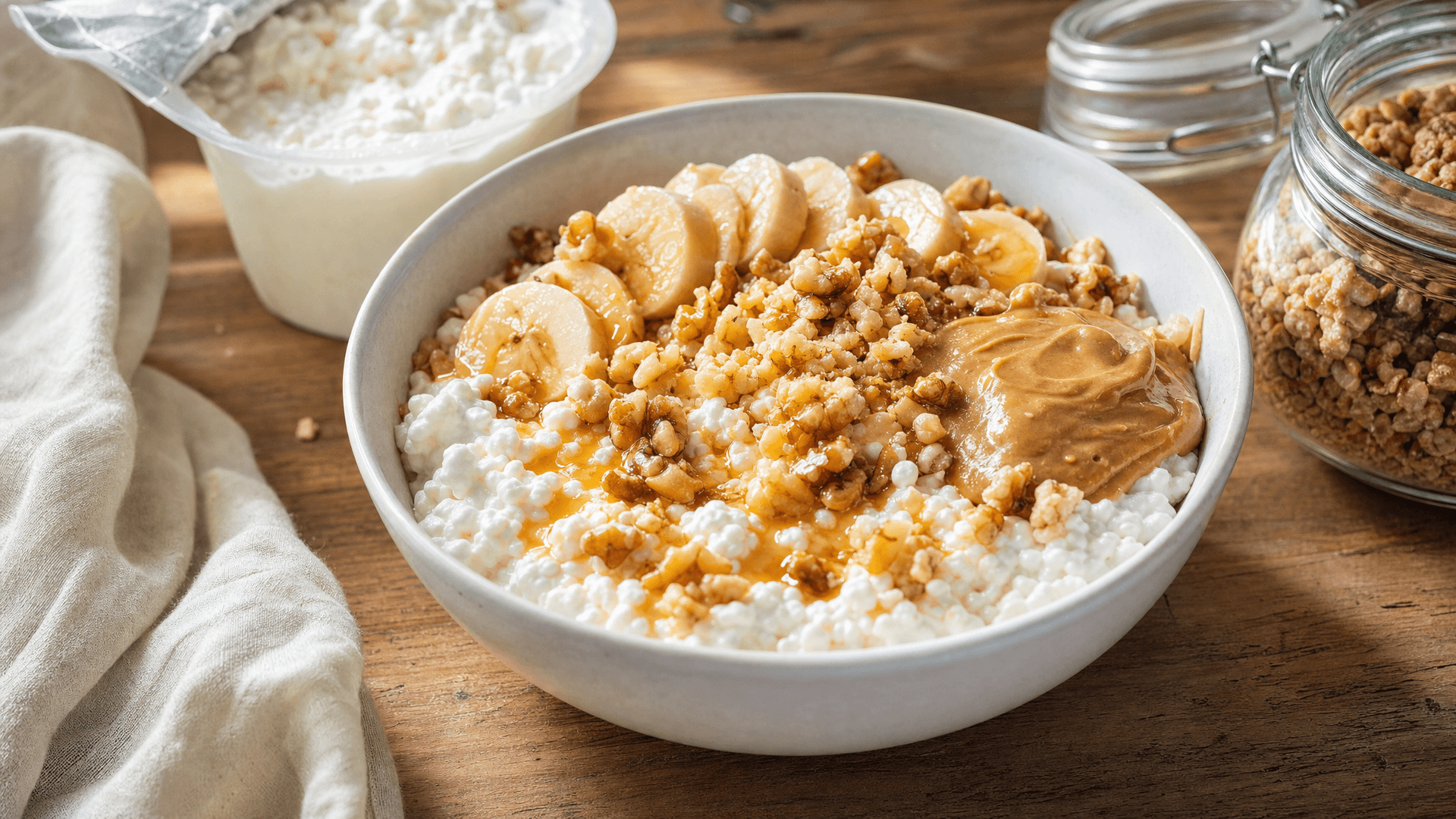
The Dessert Bowl (940 cal, 58g protein) Two cups cottage cheese, 2 tbsp peanut butter, 2 tbsp honey, ½ cup granola, dark chocolate chips on top. Blend the cottage cheese first if texture bugs you. This tastes like cheesecake filling and hits like a full meal.
The Savory Bowl (780 cal, 56g protein) Two cups cottage cheese, 1 tbsp olive oil, cracked black pepper, everything bagel seasoning, 2 oz of chopped smoked salmon, sliced cucumber. Eat with crackers or on toast. This one's underrated — savory cottage cheese is a completely different food and hits different when you're sick of sweet.
The Speed Bowl (690 cal, 54g protein) Two cups cottage cheese, one banana, 2 tbsp peanut butter, cinnamon. Mash it all together with a fork. Twenty seconds of assembly, no measuring, no thinking.
Stack it on toast
Two slices of thick sourdough (about 3 oz), a full cup of cottage cheese spread over both, drizzle of olive oil, salt, pepper, and chili flakes. That's about 500 calories and 30g of protein for something that eats like a snack, not a meal.
Keep a "cottage cheese shelf" in your fridge — the tub, a jar of peanut butter, honey, and a bag of granola all in one spot. Removing the decision-making is how a habit survives past week two.
Fixing the Texture Problem
Let's be honest about the actual reason most guys quit after one tub: the texture is weird. Lumpy, wet, curdy. It's a food that some people love immediately and a lot of people have to be talked into.
Here are five fixes, ranked by how well they work.
1. Blend it
This is the single best fix and it's not close. Thirty seconds in a blender or with an immersion blender turns cottage cheese into something with the consistency of thick, tangy Greek yogurt. All lumps gone. Same macros, completely different eating experience.
Blend a full 16 oz tub at once, put it back in a container, and you've got a smooth base for the whole week. Add a splash of milk if it's too thick.
Blended cottage cheese also works as a substitute in things you'd normally use yogurt or sour cream for — pasta sauce base, dip base, dressing base.
2. Mix in something with crunch
If blending feels like too much work, go the opposite direction and lean into the texture contrast. Granola, chopped nuts, seeds, crushed crackers, or cereal all mask the curd texture by giving your mouth something else to focus on. The lumps disappear into the crunch.
3. Go savory
A lot of the "weird" feeling comes from expecting cottage cheese to behave like yogurt — sweet and smooth. When you treat it like a soft cheese instead (olive oil, salt, pepper, herbs, spread on toast), your brain recalibrates and the texture stops being strange. It's just cheese now.
4. Buy the small-curd version
Small-curd cottage cheese is noticeably smoother than large-curd. Same product, smaller lumps. If you're texture-sensitive, this alone might solve it. Also look for brands labeled "creamed" or "whipped" — those are pre-blended.
5. Hide it in cooking
Cottage cheese melts into things. Stir it into scrambled eggs (adds protein and creaminess), fold it into pancake batter, layer it into lasagna instead of ricotta, blend it into mac and cheese sauce. Once heated and mixed, the curds disappear entirely.
Don't boil it. High direct heat makes cottage cheese split and go grainy. Add it at the end, off the heat, or fold it into batters where it's protected. Low and slow is the rule.
If texture is your general problem with bulking food, not just cottage cheese, we wrote a whole piece on making bulking food actually taste good that goes deep on fixing the foods you're forcing down.
Cottage Cheese vs Greek Yogurt
These two get compared constantly, so let's settle it.
| Metric | Cottage cheese (1 cup, 4%) | Greek yogurt (1 cup, 5%) |
|---|---|---|
| Calories | 220 | 220 |
| Protein | 25g | 20g |
| Casein/whey ratio | 80/20 | 80/20 |
| Sodium | 400-700mg | 60-80mg |
| Cost per 25g protein | $0.60-0.90 | $1.20-1.80 |
| Texture | Lumpy | Smooth |
| Sweet applications | Good | Excellent |
| Savory applications | Excellent | Good |
Cottage cheese wins on protein density and cost. Greek yogurt wins on sodium and texture.
The real answer is that you should rotate both. Variety is what keeps a bulk sustainable past month two, and these two foods fill slightly different roles. Yogurt for breakfast bowls and smoothies, cottage cheese for pre-bed and savory applications.
If you want the full breakdown of the yogurt aisle including skyr and the high-protein options, we ranked them in our guide to the best yogurt for bulking.
How Much Should You Actually Eat?
Let's put numbers on this.
Your protein target on a bulk should be somewhere around 0.7-1.0g per lb of bodyweight. For a 155 lb guy, that's roughly 112-154g of protein a day. For an 175 lb guy, 128-176g.
Cottage cheese should cover 30-40% of that at most. Not because more is dangerous, but because protein variety matters for micronutrients and because eating the same thing four times a day is how bulks die.
A realistic daily setup
For a 165 lb lifter targeting 140g of protein and 3,800 calories:
| Time | Food | Calories | Protein |
|---|---|---|---|
| 8am | Eggs, oats, whole milk | 750 | 40g |
| 12pm | Chicken, rice, olive oil | 900 | 45g |
| 4pm | Cottage cheese bowl with granola + PB | 700 | 30g |
| 7pm | Beef, potatoes, veggies | 950 | 45g |
| 10pm | Cottage cheese, 2 cups, honey | 500 | 50g |
That's 3,800 calories, 210g of protein, and cottage cheese is doing serious work in two of the five slots while requiring roughly four minutes of total prep.
Scaling up
If you're a bigger guy — 200 lb and up — or you're pushing 4,500+ calories, three cups a day is reasonable. Just watch the sodium and rotate in yogurt or milk-based options a few days a week.
Cottage cheese is lower in lactose than milk (the whey and most of the lactose drain off during production), but it's not lactose-free. If dairy is a problem for you, test one cup before committing to a 16 oz tub a day. Some people tolerate cottage cheese fine while milk destroys them.
Common Mistakes
1. Buying fat-free. Covered above, but it bears repeating. You're leaving 115 calories per cup on the table and getting worse texture in exchange for nothing.
2. Eating it plain and expecting to enjoy it. Plain cottage cheese is a base, not a meal. Nobody eats plain oats either. Add something.
3. Treating it as a meal replacement. The whole point is that it stacks on top of your existing meals. If you're eating cottage cheese instead of dinner, you're not gaining anything — you're just eating less.
4. Ignoring the expiry date. Cottage cheese has a shorter shelf life than yogurt. Buy two tubs at a time, not five. A spoiled tub is a wasted meal and a bad memory that makes you skip it next week.
5. Only eating it before bed. Pre-bed is where casein shines, but cottage cheese works at any time of day. Breakfast, mid-afternoon, post-workout alongside a faster protein — it all counts.
6. Not blending when you should. If you're forcing it down and gagging slightly every time, that habit dies within two weeks. Spend the 30 seconds. Blend the tub.
Tracking Whether It's Working
Adding two cups of full-fat cottage cheese a day is roughly 440 extra calories and 50g of protein. If you actually stack it on top of your existing intake rather than displacing food, you should see movement.
Weigh yourself every morning, same conditions, and use the weekly average — daily fluctuation from water and food volume will drive you insane otherwise.
Target gain rate for a lean bulk is about 0.5-1 lb per week. If you're gaining faster than 1.5 lb a week consistently, you're adding more fat than you need to. If the scale hasn't moved in two weeks, add another 200-300 calories.
Also track strength. If your working weights are climbing month over month and the scale is moving slowly upward, the extra calories are going where you want them.
Where FuelTheGains Fits
Here's the honest problem with everything above: knowing that cottage cheese is a great bulking food doesn't tell you how much of it you specifically need, on top of what else, to hit a surplus that actually works for your body.
That's the gap. Most guys either wing it and undereat by 500 calories a day without realizing, or they overshoot and gain fat they'll spend three months cutting off.
That's where comes in. It builds a bulking meal plan around your actual numbers — your bodyweight, your training, your budget, and importantly, the foods you'll actually eat. If cottage cheese is your thing, it gets built in. If dairy wrecks you, it works around it.
You get a specific calorie and protein target, meals that hit it, and a grocery list that matches. No guessing whether two cups is enough or three is too many.
The Bottom Line
Cottage cheese is the most underrated food in bulking, and it's underrated for a dumb reason: it's lumpy.
Get past the texture — blend it, crunch it up, or go savory — and you've got the cheapest complete protein in the store, delivering slow-digesting casein that keeps amino acids elevated for 5-7 hours, in a form that stacks on top of your day instead of replacing part of it.
Buy a 16 oz tub of 4%. Blend half of it. Eat two cups before bed tonight with honey and peanut butter.
Do that for two weeks and check the scale. That's the whole experiment.