
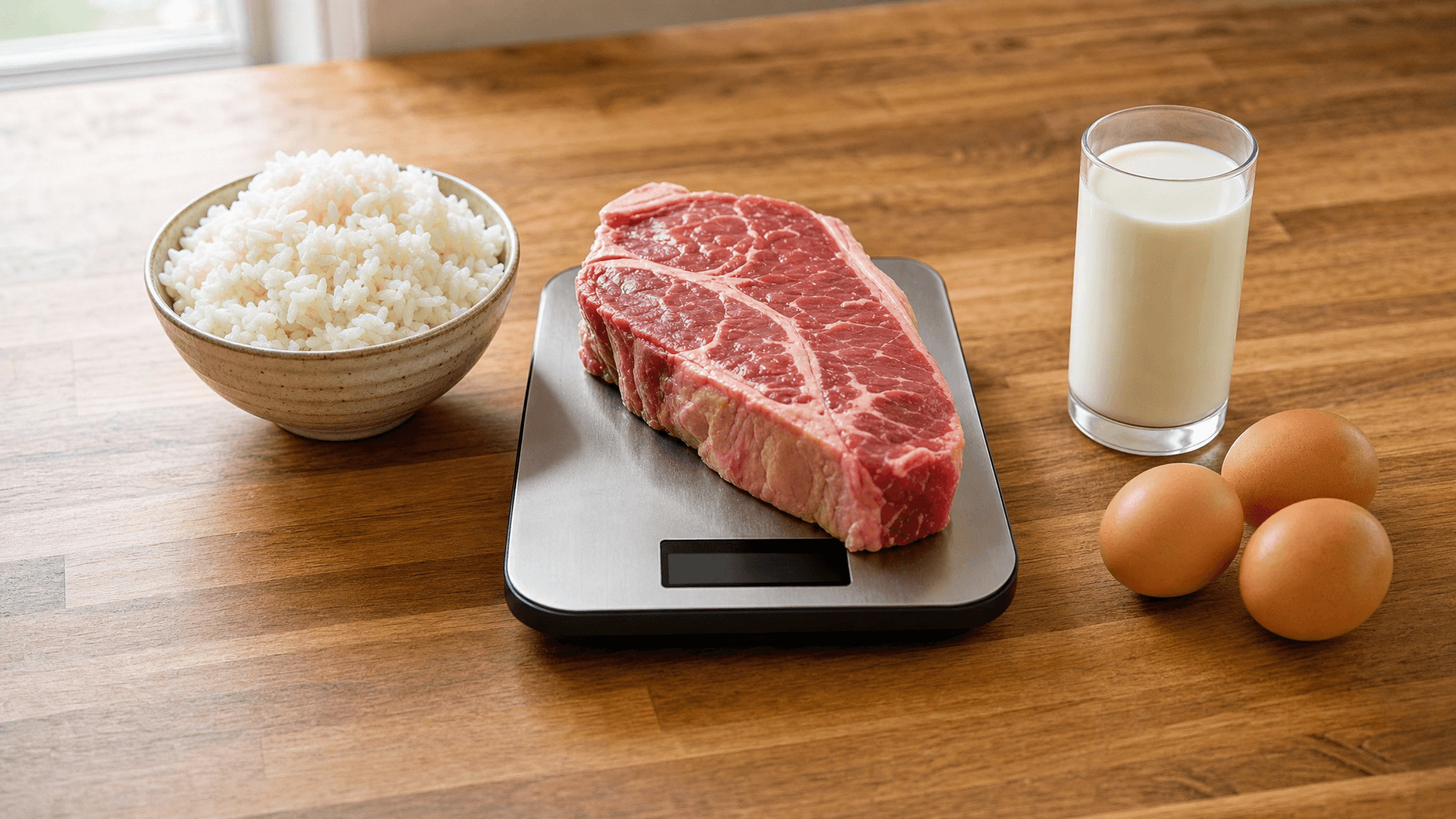
You've heard it a hundred times: 3,500 calories equals one pound. Eat 3,500 extra, gain a pound. Cut 3,500, lose a pound. It shows up in every fitness article, every calculator, every gym bro's explanation of why you should be eating more.
Here's the thing nobody tells you: that number describes fat. Not muscle. Fat.
And if you build your entire bulk around a number that describes body fat, you should not be surprised when what you gain is body fat. That's the trap. Skinny guys read "3,500 calories per pound," decide they want to gain a pound a week, do the math to a 500-calorie daily surplus, then get impatient and push it to 1,000. Twelve weeks later they're up 15 lbs, their arms look the same, and their jeans don't fit.
The math wasn't wrong. It was answering a different question.
Let's answer the right one.
- The 3,500 calorie per pound rule describes fat tissue, not muscle
- A pound of muscle costs roughly 2,300-2,800 calories to build, including the energy cost of protein synthesis
- Muscle is about 70-75% water, which is why it is far cheaper to build than fat is to store
- You cannot build muscle faster than 1-2 pounds per month as a beginner, no matter how much you eat
- Reverse-engineer your surplus from a realistic gain rate, not from a calorie-per-pound formula
- Anything above roughly 300-500 calories over maintenance is going almost entirely to fat
- Protein at 1.6-2.2g per kg of bodyweight is what turns those surplus calories into tissue
Where the 3,500 Number Actually Comes From
The 3,500 figure comes from a 1958 paper by a researcher named Max Wishnofsky. He looked at the composition of adipose tissue — body fat — and did some straightforward arithmetic.
Pure fat contains about 9 calories per gram. A pound is 454 grams. So a pound of pure fat would be roughly 4,100 calories.
But body fat isn't pure fat. Adipose tissue is roughly 87% lipid, with the rest being water, protein and cellular structure. Multiply 4,100 by 0.87 and you land at about 3,555 calories. Round it down and you get the number that's been repeated for nearly seventy years.
It's a decent estimate — for fat. It says nothing about muscle, and applying it to muscle is where everything falls apart.
The 3,500 rule assumes a linear response forever, which isn't how bodies work. As you lose weight, your maintenance drops. That's why a diet that worked for eight weeks stalls in week twelve. Same principle applies in reverse on a bulk — as you gain, your maintenance climbs and your surplus shrinks.
Muscle Is Mostly Water
Here's the fact that reframes everything: skeletal muscle is roughly 70-75% water.
Take a pound of muscle. Somewhere around 11-12 oz of it is just water. Water has zero calories. You don't eat water to build it — you drink it, and your body handles the rest.
What's left is about 20-22% protein, plus small amounts of glycogen, fat, minerals and connective structure. So in a pound of muscle you're looking at roughly 3.5-3.9 oz of actual protein.
Protein contains 4 calories per gram. So the raw material cost of a pound of muscle is:
| Component | Amount in 1 lb muscle | Calorie content |
|---|---|---|
| Water | ~330g | 0 |
| Protein | ~105g | ~420 |
| Glycogen | ~10g | ~40 |
| Fat, minerals, other | ~15g | ~60 |
| Raw material total | ~520 |
Five hundred and twenty calories. That's the stored energy sitting in a pound of new muscle.
Which raises an obvious question: if the material only holds ~520 calories, why does everyone say a pound of muscle costs 2,300-2,800?
Because building it is expensive.
The Real Cost: Construction, Not Materials
Storing fat is cheap. Your body is extremely good at it — it takes only a small metabolic overhead to move a fat molecule into a fat cell. It's essentially a warehouse operation.
Building muscle is a manufacturing operation, and manufacturing has overhead.
Protein synthesis costs energy
Every peptide bond your body forms costs ATP. Assembling amino acids into a functional muscle protein requires roughly 4-5 ATP per bond, and there are thousands of bonds in a single protein chain. Estimates put the direct energy cost of protein synthesis at around 20-25% of the energy content of the protein being built.
But it doesn't stop there.
The turnover tax
This is the part almost everyone misses. Your muscle isn't built once and left alone. It's constantly being broken down and rebuilt — that's protein turnover, and it runs 24/7. Roughly 1-2% of your total muscle protein is degraded and resynthesized every single day.
To net one new pound of muscle, your body doesn't synthesize 3.7 oz of protein and stop. It synthesizes far more than that, because it's simultaneously tearing down existing tissue. You only bank the difference.
Training and recovery overhead
Add in the cost of the training that triggers the growth, the elevated metabolic rate for 24-48 hours after a hard session, the inflammatory and repair processes, satellite cell activity, and the increased blood supply and connective tissue that new muscle requires.
Stack all of that on the ~520 calories of raw material and you arrive at the consensus range: roughly 2,300-2,800 calories to net one pound of muscle.
Notice this is still well below the 3,500 figure. A pound of muscle is genuinely cheaper to build than a pound of fat is to store. Muscle just has a hard cap on how fast it can be built, and fat doesn't.
The Rate Cap Is the Whole Story
If muscle only costs ~2,500 calories per pound, and fat costs ~3,500, you'd think a huge surplus would just produce muscle faster. It doesn't, and this is the single most important idea in this article.
Muscle growth is rate-limited by biology, not by calories.
Your body can only synthesize so much new contractile tissue per day. That ceiling is set by your training stimulus, your hormonal environment, your training age, your sleep, and your genetics. Calories are a permissive factor — you need enough of them, but past "enough," more doesn't help.
Here's what realistic muscle gain looks like:
| Training experience | Muscle gain per month | Muscle gain per year |
|---|---|---|
| Beginner (year 1) | 1-2 lb | 12-24 lb |
| Intermediate (years 2-3) | 0.5-1 lb | 6-12 lb |
| Advanced (year 4+) | 0.25-0.5 lb | 2-5 lb |
These are rough figures for natural lifters, and they're generous at the top end. If you're a beginner gaining 2 lb of muscle in a month, that's about 2 lb of lean tissue costing roughly 5,000 calories total over 30 days.
Divide that out. About 165 extra calories per day.
Read that again. The actual energy your body needs to build muscle at a beginner's maximum rate is under 200 calories a day.
So what happens to the other 835 calories in your 1,000-calorie surplus?
You know the answer. It goes in the warehouse.
Why Bigger Surpluses Don't Build More Muscle
Let's run the numbers on a 12-week bulk for a beginner who's doing everything right in the gym and eating enough protein. We'll assume the same maximum muscle gain rate in both scenarios — because that's the point, the rate doesn't change.
Scenario A: 300-calorie daily surplus
- Total surplus over 12 weeks: 25,200 calories
- Muscle gained: ~4 lb → costs ~10,000 calories
- Remaining: ~15,200 calories → ~4.3 lb of fat
- Total gain: ~8.3 lb, roughly half muscle
Scenario B: 1,000-calorie daily surplus
- Total surplus over 12 weeks: 84,000 calories
- Muscle gained: still ~4 lb → costs ~10,000 calories
- Remaining: ~74,000 calories → ~21 lb of fat
- Total gain: ~25 lb, roughly 16% muscle
Same muscle. Five times the fat. And now you've got a cut ahead of you that will eat three months and probably some of that hard-earned muscle with it.
The "I'll just cut later" plan is where most skinny guys lose a year. A dirty bulk followed by an aggressive cut usually lands you within a few pounds of where you started, except now you're demoralized and you've learned nothing about your own maintenance intake.
This is why every credible surplus recommendation lands in the same narrow window. We broke down exactly where that window sits and how to pick your number in our guide to sizing a bulking calorie surplus — the short version is that 300-500 calories over maintenance is where the returns stop and the fat starts.
Reverse-Engineering Your Surplus From a Gain Rate
Forget calorie-per-pound formulas as a planning tool. They tell you what a pound costs, not what you should eat. The right way to set a surplus is to work backwards from a target rate of scale weight gain.
Step 1: Pick a realistic weekly gain rate
Use a percentage of bodyweight, not a fixed number. A 132 lb guy and a 210 lb guy should not be gaining at the same speed.
| Experience level | Weekly gain target |
|---|---|
| Beginner | 0.25-0.5% of bodyweight |
| Intermediate | 0.25% of bodyweight |
| Advanced | 0.1-0.15% of bodyweight |
For a 154 lb beginner, 0.4% is about 0.6 lb per week. That's slow. It's supposed to be slow.
Step 2: Convert the rate to a surplus
You're gaining a mix of muscle, fat, glycogen and water, so use a blended cost. In practice, aiming for roughly a 1:1 muscle-to-fat ratio as a beginner, the effective cost lands around 3,000 calories per pound of scale weight.
0.6 lb per week × 3,000 = 1,800 calories per week ÷ 7 = roughly 250-260 calories per day.
Step 3: Find your actual maintenance first
None of this works if your baseline is a guess. Calculators give you an estimate with a margin of error of several hundred calories, which is larger than the surplus you're trying to add. Track your intake at a steady weight for two weeks and use what the scale actually does. Our step-by-step guide to calculating bulking calories walks through the whole process.
Step 4: Adjust from the scale, not the spreadsheet
Weigh yourself daily, first thing, after the bathroom, before food. Take the weekly average and compare it to last week's. If you're gaining faster than your target, drop 150 calories. Slower, add 150. Your maintenance is a moving target — as you get heavier, it climbs.
Adjust on a four-week rolling view, not week to week. Water weight, sodium, glycogen and digestive contents can swing your scale by 2-4 lbs in a day. One week of data is noise.
Where the Calories Have to Come From
You can nail your surplus number and still fail if the composition is wrong. Two guys eating identical calories can end up in completely different places.
Protein is the raw material
You cannot build a pound of muscle without providing the 3.5+ oz of protein it's made of, plus a healthy margin for turnover and oxidation.
Target 0.7-1.0g per lb of bodyweight. For a 165 lb lifter, that's roughly 120-165g per day. Going meaningfully above that range doesn't do much for muscle in most studies, but falling below it absolutely limits what you can build.
Spread it across 4-5 feedings of 30-40g each rather than dumping 120g into dinner. Muscle protein synthesis responds to each meal, and there's a ceiling per feeding.
Carbs fuel the training that triggers growth
The stimulus for muscle growth comes from the gym, not the kitchen. Under-eating carbs on a bulk means worse sessions, less volume, and less growth signal. Aim for 3-5g per kg of bodyweight on training days and keep them concentrated around your workouts.
Fat handles hormones and calorie density
Keep fat at 0.8-1g per kg minimum for hormonal health, then use it as your calorie lever. Fat is 9 calories per gram — 1 oz of almonds is about 170 calories in three bites. If you struggle to eat enough, this is your easiest tool.
Most skinny guys don't have a discipline problem. They have a stomach volume problem. 7 oz of chicken breast, 7 oz of cooked rice and a plate of broccoli is a big meal that lands around 600 calories. Add 0.5 oz of olive oil and a handful of cashews and you're at 850 without any extra chewing.
What This Looks Like in Practice
Let's take a real example. Sam is 5'10", weighs 145 lbs, trains four days a week, and has been lifting seriously for about eight months.
Maintenance: tracked over two weeks at a stable weight — 2,550 calories.
Target rate: 0.35% of bodyweight per week ≈ 0.5 lb per week.
Surplus: 0.5 lb × 3,000 = 1,500 calories per week ÷ 7 = 215 calories per day. Round to 250.
Intake: 2,800 calories.
Macros:
| Macro | Target | Calories |
|---|---|---|
| Protein | 140g | 560 |
| Fat | 85g | 765 |
| Carbs | 370g | 1,480 |
| Total | 2,805 |
Over 12 weeks at that rate, Sam gains about 6 lbs on the scale. Realistically that's around 4 lb of muscle and 2 lb of fat, because he's still early enough in his training career to partition well.
Four pounds of muscle in three months doesn't sound like much written down. On a 145 lb frame, it's the difference between "you look like you lift now" and not. If you want a month-by-month picture of what that actually looks like in the mirror, we mapped it out in our bulking results timeline.
Compare that to the alternative: Sam eats 3,800 calories because a calculator told him to "eat big," gains 20 lbs in the same 12 weeks, and roughly 15 of those pounds are fat.
Same four pounds of muscle. One guy has a visible upper body. The other has a bulk he has to undo.
Common Mistakes
1. Treating 3,500 as a muscle number. It's an adipose tissue estimate from 1958. It has nothing to say about lean mass.
2. Front-loading calories. You can't build a pound of muscle in a day by eating 2,500 extra calories. Protein synthesis happens over days and weeks. Excess on any single day goes to fat regardless of your intentions.
3. Ignoring maintenance drift. As you gain weight, your maintenance rises — more tissue to feed, more energy to move it. A surplus that worked in week 1 might be maintenance by week 10. Recalculate every 4-6 weeks.
4. Chasing the scale instead of the trend. Daily weight is noisy. Weekly averages are signal. Never make a decision off a single morning.
5. Under-eating protein while over-eating calories. This is the most common version of "I bulked and just got fat." The calories were there. The building blocks weren't.
6. Skipping the training progression. Calories are permissive, not causal. If your lifts aren't going up over months, extra calories have nowhere useful to go.
7. Bulking without knowing your starting point. If you never established maintenance, you're not running a surplus — you're guessing and calling it a plan.
How to Know It's Working
Four checkpoints, in order of usefulness:
Strength on compound lifts. Over a 12-week block, your main lifts should move. Not every session — but if your squat, press and row are the same in week 12 as week 1, you didn't build much.
Weekly average scale weight. Trending up at roughly your target rate. If you're two weeks flat, add 150 calories. If you're up 2 lbs in a week, pull back.
Waist measurement. Measure at the navel, same time, once a week. Waist should stay close to flat while bodyweight climbs. If it's growing at the same pace as your weight, your surplus is too big — that's the clearest single signal you'll get.
Progress photos. Same lighting, same spot, same time of day, every four weeks. You won't see change day to day, but a 12-week comparison is undeniable.
If your waist is up 1.5 in and your lifts haven't moved in six weeks, stop adding calories. You're not bulking, you're just eating.
When Eating Enough Is the Hard Part
Everything above assumes you can actually hit your number. For a lot of naturally skinny guys, that's the whole problem.
You do the math, land on 2,800 calories, and then discover that eating 2,800 calories every single day — not on the good days, every day — is genuinely difficult when your appetite tops out around 2,000. You forget a meal. You get busy. You end up eating maintenance four days out of seven and wondering why nothing's changing.
That's where FuelTheGains comes in. It's built for exactly this problem: you put in your stats and your goal, and it gives you a meal plan that hits your calories and protein with food you'll actually eat, not a spreadsheet you have to interpret at 7am. No guessing what 5 oz of protein looks like across a day, no rebuilding your plan from scratch when your maintenance climbs.
The math in this article is the easy part. Eating it, day after day for twelve weeks, is where bulks are won or lost. If that's your sticking point, take a look at .
The Bottom Line
A pound of muscle costs roughly 2,300-2,800 calories to build — less than the 3,500 everyone quotes, because muscle is mostly water. But you can only build it at 1-2 pounds a month at best, which works out to under 200 extra calories a day.
Every calorie you eat beyond that is a bet that your body will break its own rate limit. It won't. It'll just store the difference.
Eat 300-500 over maintenance, get your protein in, add weight to the bar, and let it take the time it takes. Slower on the scale is faster in the mirror.