
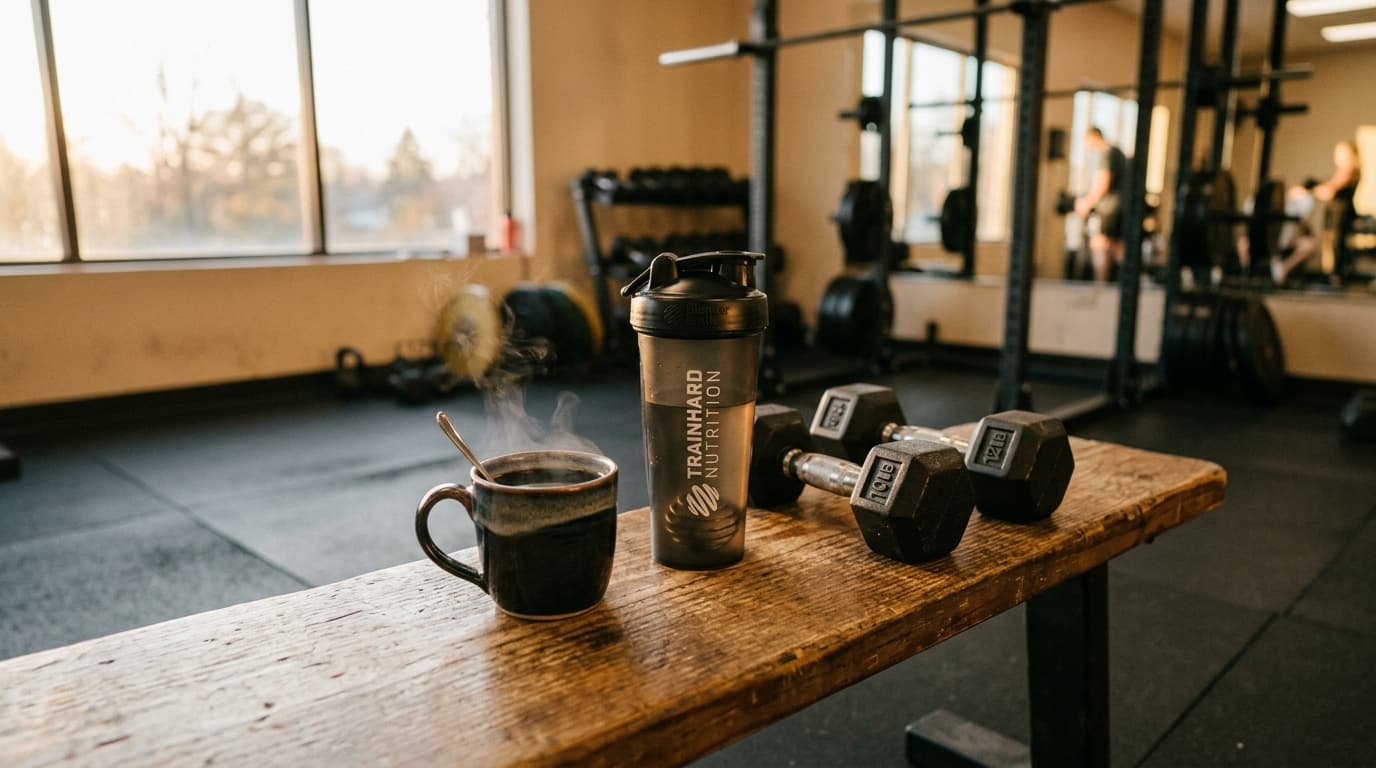
You're trying to eat 3,000+ calories a day, but your morning coffee kills your appetite until noon. Sound familiar?
Caffeine is the most widely used performance enhancer on the planet. Over 90% of adults consume it daily. But if you're a skinny guy trying to bulk, caffeine creates a weird paradox — it boosts your training but can sabotage your eating.
Let's break down exactly how caffeine affects your bulk, when to use it strategically, and when to back off so it doesn't torpedo your calorie goals.
- Caffeine improves strength, power output, and endurance by 3-7% — a real advantage for training
- It suppresses appetite for 1-3 hours, which is a problem if you're already struggling to eat enough
- Time your coffee strategically: after breakfast, not instead of it
- 3-6 mg per kg of body weight is the performance sweet spot
- Cut off caffeine 8-10 hours before bed to protect sleep and recovery
- Black coffee has nearly zero calories — it won't break your bulk, but it might delay it
How Caffeine Actually Works
Caffeine blocks adenosine receptors in your brain. Adenosine is the chemical that makes you feel tired and sleepy throughout the day. When caffeine blocks it, you feel more alert, focused, and energized.
But that's just the brain side. Caffeine also:
- Increases adrenaline — priming your body for physical performance
- Mobilizes fatty acids — making them available for fuel
- Reduces perceived effort — meaning the same weight feels slightly easier
- Enhances calcium release in muscles — improving force production at the cellular level
This is why caffeine is one of the few legal supplements with strong, consistent evidence for improving exercise performance. The International Society of Sports Nutrition considers it an effective ergogenic aid, full stop.
The Performance Benefits (Why Lifters Love It)
Here's what the research actually shows about caffeine and resistance training:
Strength and Power
A meta-analysis in the Journal of the International Society of Sports Nutrition found that caffeine increases maximal strength by about 3-4% and muscular endurance by 5-7%. That doesn't sound like much, but over weeks and months, those extra reps add up.
For a 154 lb guy benching 176 lbs, a 3% strength boost means an extra 5 lbs on the bar. That's the difference between getting stuck at 5 reps and pushing through to 7.
Training Volume
More reps per set means more total training volume. And volume is the primary driver of muscle growth. One study found that caffeine increased total training volume by an average of 11.5% across a workout session.
That's significant. If you normally do 50 reps of bench press across your sets, caffeine might push that to 55-56 reps. Over a 12-week bulk, that's hundreds of extra reps — and hundreds of extra growth signals.
Perceived Effort
This might be the most underrated benefit. Caffeine makes hard sets feel less miserable. When your RPE drops from a perceived 9 to an 8, you're more likely to push through that last rep instead of racking the bar early.
For hardgainers who already find it tough to eat enough and train hard, this psychological edge matters more than people think.
| Benefit | Effect Size | Practical Impact |
|---|---|---|
| Max strength | +3-4% | 1-2 extra reps on heavy sets |
| Muscular endurance | +5-7% | More volume per session |
| Perceived effort | Reduced | Harder training feels easier |
| Power output | +3-5% | More explosive lifts |
| Focus & alertness | High | Better mind-muscle connection |
The Problem: Appetite Suppression
Here's where it gets tricky for skinny guys.
Caffeine is a well-documented appetite suppressant. It increases levels of peptide YY and GLP-1 — hormones that signal fullness — while reducing levels of ghrelin, the hunger hormone. The effect typically lasts 1-3 hours after consumption.
If you're someone who already struggles to eat enough, this is a real issue. Let's say you wake up, pound a large black coffee at 7 AM, and don't feel hungry until 10 AM. That's three hours of potential eating — gone. On a bulk where you need to eat every 3-3.5 hours, losing a whole meal window is devastating.
The Math Problem
Let's say you need 3,200 calories per day to bulk. You're eating 5 meals. That's ~640 calories per meal. If coffee pushes your first real meal from 7:30 AM to 10:30 AM, you now need to cram 5 meals into about 10 hours instead of 13.
That's the difference between eating every 2.5 hours (uncomfortable) and every 3.25 hours (manageable). For guys with small appetites, that gap matters enormously.
If you love morning coffee, eat breakfast FIRST, then drink your coffee 20-30 minutes later. You get the caffeine benefits without nuking your appetite during your most important meal window.
Caffeine and Sleep: The Hidden Gains Killer
This is the part most people ignore — and it might be more important than everything else combined.
Caffeine has a half-life of 5-6 hours in most people. That means if you drink a coffee with 200mg of caffeine at 3 PM, you still have ~100mg in your system at 8-9 PM. That's equivalent to half a cup of coffee buzzing through your brain while you're trying to fall asleep.
Why This Destroys Your Bulk
Sleep is when the magic happens. During deep sleep:
- Growth hormone peaks — up to 75% of daily GH is released during sleep
- Muscle protein synthesis is elevated — your body is literally building muscle
- Testosterone production occurs — poor sleep can drop testosterone by 10-15%
- Cortisol drops — giving your body a break from the stress hormone that promotes muscle breakdown
A study in JAMA found that sleeping only 5 hours per night (vs. 8) reduced lean mass gains by 55% during a caloric surplus. More than half your gains — gone — just from bad sleep.
If caffeine is cutting your deep sleep by even 20-30 minutes, you're leaving muscle on the table every single night.
The "I can drink coffee at 8 PM and sleep fine" crowd — research shows caffeine still reduces deep sleep quality even when you fall asleep normally. You might not feel it, but your muscles do.
The Caffeine Curfew
Set a hard cutoff: no caffeine after 12-2 PM, depending on your bedtime.
| Bedtime | Last Caffeine |
|---|---|
| 10 PM | 12 PM (noon) |
| 11 PM | 1 PM |
| 12 AM | 2 PM |
Yes, this means no pre-workout for evening gym sessions. We'll cover alternatives below.
How Much Caffeine Should You Use?
The performance research is clear on dosing:
- Minimum effective dose: 3 mg per kg of body weight
- Optimal range: 3-6 mg per kg
- Diminishing returns: Above 6 mg per kg
- Side effects likely: Above 9 mg per kg
For a 150 lb skinny guy, that's:
| Dose | Amount | Equivalent |
|---|---|---|
| 3 mg/kg | ~200 mg | 1 large coffee |
| 6 mg/kg | ~400 mg | 2 large coffees |
| 9 mg/kg | ~600 mg | 3 large coffees (too much) |
For most guys, 200-400 mg per day is the sweet spot. That's 1-2 cups of strong coffee or 1 scoop of most pre-workout supplements.
Drip coffee (large): 200-300mg. Espresso shot: 63mg. Black tea: 47mg. Green tea: 28mg. Energy drink (16oz): 150-300mg. Pre-workout (1 scoop): 150-350mg.
Caffeine Sources: Not All Are Created Equal
Black Coffee
Calories: ~5 per cup. Zero impact on your bulk from a calorie standpoint. Rich in antioxidants. Cheap. The gold standard for clean caffeine.
The problem is when you add nothing to it. If you're drinking black coffee as a meal replacement (whether intentional or not), you're sabotaging your calorie intake.
Bulking hack: Make your coffee work FOR your bulk. Add heavy cream (50 cal per tablespoon), whole milk, or blend it into a shake. A coffee smoothie with protein powder, banana, milk, and peanut butter can hit 500+ calories while giving you your caffeine fix.
Pre-Workout Supplements
Most pre-workouts contain 150-350mg of caffeine plus other ingredients like citrulline, beta-alanine, and creatine. They're fine for bulking as long as you:
- Don't use them as a meal replacement
- Take them early enough to not wreck sleep
- Don't exceed 400mg total daily caffeine
If you train in the evening, look for stim-free pre-workout options. They still contain performance ingredients like citrulline and beta-alanine without the caffeine. You'll miss the alertness boost, but your sleep stays intact.
Energy Drinks
Here's where it gets interesting for bulkers. A standard energy drink has 150-300mg caffeine AND 200-300 calories from sugar. For a hardgainer, those calories aren't necessarily bad — they're easy to consume and contribute to your surplus.
But don't rely on them. The sugar spikes and crashes aren't ideal, and they're expensive compared to coffee or caffeine pills. Use them occasionally, not daily.
Caffeine Pills
The most precise option. A standard pill is 200mg — you know exactly what you're getting. No calories, no taste, no prep time. Pop one 30-45 minutes before training and you're set.
Caffeine pills are the cheapest source per milligram. A bottle of 100 pills costs about the same as a week of daily Starbucks runs. If you're bulking on a budget, this is a no-brainer.
The Strategic Caffeine Protocol for Bulking
Here's how to get all the performance benefits without killing your appetite or sleep:
Step 1: Eat First, Caffeinate Second
Wake up. Eat breakfast within 30 minutes. Then have your coffee. This ensures you get a full meal in before appetite suppression kicks in.
Your morning meal should be calorie-dense — think high-calorie breakfast options like eggs with avocado toast, overnight oats with protein powder, or a big bowl of oatmeal with peanut butter and banana.
Step 2: Use Caffeine as a Pre-Training Tool
Time your main caffeine dose 30-60 minutes before training. This lines up the peak plasma concentration (which occurs 30-75 minutes after consumption) with your workout.
If you train at 7 AM: Eat at 6:00, coffee at 6:30, gym at 7:00.
If you train at 12 PM: Eat at 10:30, coffee at 11:15, gym at 12:00.
If you train at 6 PM: Consider going stim-free (see caffeine curfew above).
Step 3: Don't Let Coffee Replace Meals
This sounds obvious, but it happens constantly. You get busy at work, grab another coffee instead of eating, and suddenly it's 3 PM and you've only had 800 calories.
Set alarms for meals if you have to. Your meal timing schedule is more important than your coffee schedule.
Step 4: Cycle Your Intake
Caffeine tolerance builds fast — within 1-2 weeks of daily use. When you're tolerant, you need more caffeine for the same effect, which means more appetite suppression and more sleep disruption.
Try this cycle:
- 3 weeks on: Use caffeine pre-workout (200-400mg)
- 1 week off: No caffeine at all (expect 2-3 days of headaches and fatigue)
During your off-week, your adenosine receptors reset. When you start again, that 200mg coffee hits like it did the first time. Your workouts get that extra edge back without needing to escalate the dose.
Caffeine and Creatine: Do They Clash?
You might have heard that caffeine "cancels out" creatine. This comes from a single 1996 study that showed caffeine reduced the ergogenic effect of creatine on repeated knee extensions.
The current evidence? It's not a real concern. Multiple studies since then have found that combining caffeine and creatine works just fine for most people. The International Society of Sports Nutrition's position stand on creatine doesn't list caffeine as a contraindication.
If you're taking creatine for your bulk, keep taking it. Your coffee won't cancel it out.
Caffeine and Protein Absorption
Another myth: "caffeine blocks protein absorption." There's no credible evidence for this. Caffeine can speed up gastric emptying (how fast food leaves your stomach), but it doesn't impair your body's ability to absorb and use protein.
Your post-workout meal works just fine with a cup of coffee alongside it.
When to Skip Caffeine Entirely
Caffeine isn't for everyone. Consider avoiding it if:
- You have severe anxiety — caffeine amplifies anxiety symptoms, which can also suppress appetite
- You're already sleeping poorly — fix sleep first, caffeine second
- You can't eat enough as-is — if appetite is your #1 bottleneck and caffeine makes it worse, the tradeoff isn't worth it
- You're under 18 — adolescent brains are more sensitive to caffeine's effects on sleep architecture
- You get digestive issues — caffeine increases stomach acid production, which can cause heartburn or discomfort that makes eating harder
If you fall into any of these categories, you can still build plenty of muscle without caffeine. It's a performance enhancer, not a requirement.
High-Calorie Coffee Recipes for Bulkers
If you're going to drink coffee anyway, make it earn its place in your bulk:
The Bulk Brew
- 1 cup strong brewed coffee
- 1 cup whole milk
- 1 scoop vanilla whey protein
- 1 tbsp honey
Total: ~350 cal, 30g protein. Blend with ice for an iced latte that counts as a mini-meal.
The Peanut Butter Mocha
- 1 cup cold brew coffee
- 1 cup whole milk
- 1 scoop chocolate protein powder
- 2 tbsp peanut butter
- 1 banana
Total: ~620 cal, 42g protein. This is basically a mass gainer shake with caffeine built in.
The Simple Calorie Add
Not a recipe person? Just add to your regular coffee:
- 2 tbsp heavy cream (+100 cal)
- 1 tbsp coconut oil (+120 cal)
- Whole milk instead of water (+80 cal)
Even small additions turn your zero-calorie coffee into a 100-300 calorie drink. Over a week, that's an extra 700-2,100 calories you didn't have to chew.
Common Caffeine Mistakes on a Bulk
1. Using coffee as an appetite suppressant on purpose. Some guys carry over habits from a cut. On a bulk, suppressing appetite is the opposite of what you want.
2. Drinking pre-workout for evening sessions. The pump feels great. The 4 hours of tossing and turning at midnight does not.
3. Escalating doses when tolerance builds. Going from 200mg to 400mg to 600mg is a losing game. Cycle off instead.
4. Forgetting that energy drinks have calories that count. Two Monsters per day is 500+ calories. That's fine if you're tracking them, but many guys forget.
5. Skipping breakfast for coffee. This is the single most common caffeine mistake for hardgainers. Eat first. Always.
What FuelTheGains Does For You
Tracking caffeine timing alongside your meals, macros, and training schedule is a lot of moving parts. That's exactly the kind of thing handles for you — a personalized meal plan that accounts for your schedule, your training times, and your preferences, so you never have to wonder whether you're eating enough or at the right times.
Instead of juggling spreadsheets and alarms, you get a clear plan that works around your life — coffee habit included.
The Bottom Line
Caffeine is a powerful tool for your bulk — but only if you use it strategically. Drink it after breakfast, time it before training, cut it off by early afternoon, and cycle it every few weeks.
The performance boost is real. The appetite suppression is real too. Manage both, and caffeine becomes one of the best free advantages in your bulking toolkit.
Don't let your coffee habit steal your gains. Make it work for them instead.