
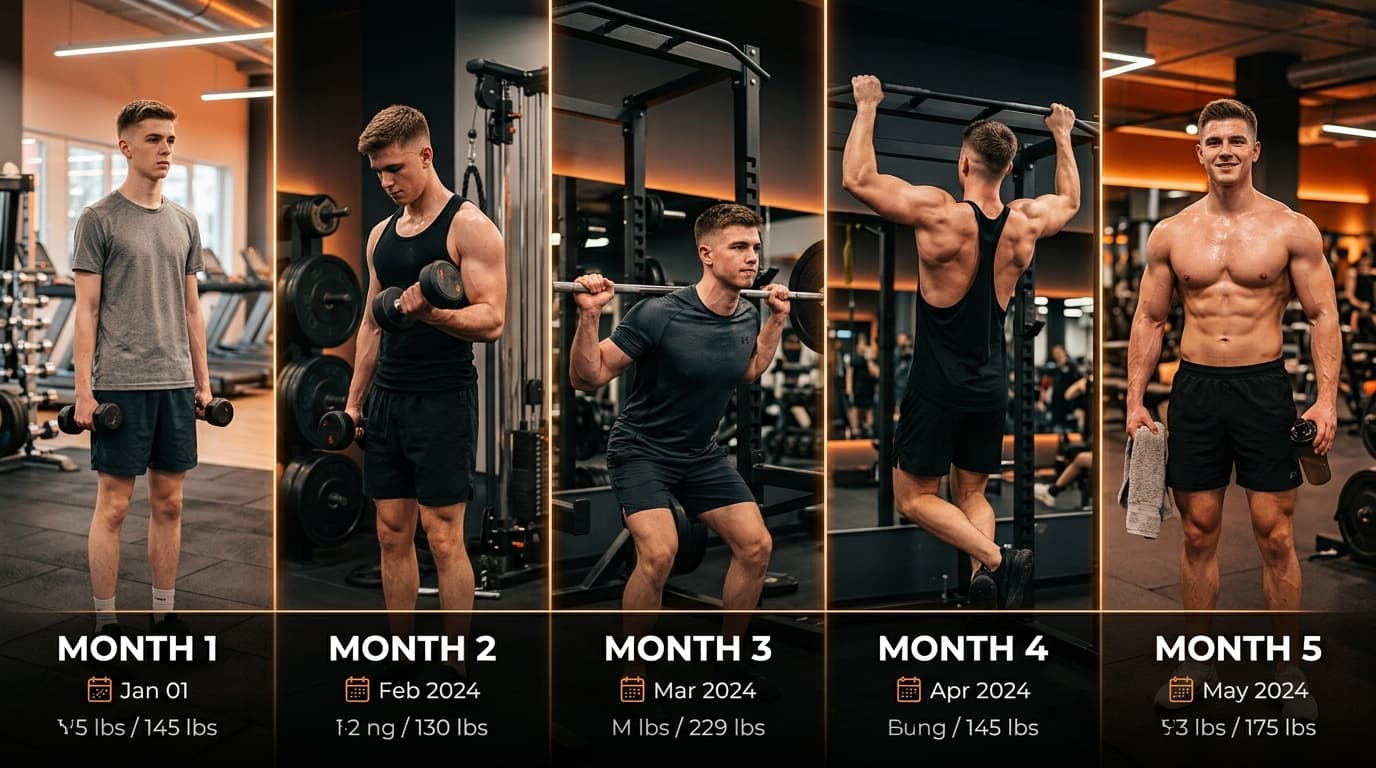
You've been eating more, lifting hard, and checking the mirror every morning. Two weeks in, you look... exactly the same.
So you start wondering: is this even working? Am I doing something wrong? Should I switch programs?
Here's the truth nobody tells you upfront — building muscle is painfully slow, especially at first. The guys posting dramatic "3-month transformations" online either had a lot of muscle memory, great genetics, or are leaving out some important details.
But that doesn't mean it's not working. It means you need a realistic timeline so you don't quit right when the magic is about to happen.
This is the month-by-month breakdown of what actually happens when a skinny guy commits to a proper bulk. No fairy tales. Just what the science and real-world experience say you should expect.
- The first month is mostly neural adaptation and water weight — don't expect visible muscle yet
- Noticeable changes typically appear around months 2-3 for most skinny guys
- Months 3-6 is where the real transformation happens if you stay consistent
- Expect to gain roughly 1-2 lbs of muscle per month as a beginner
- After 12 months of consistent bulking, most guys gain 13-22 lbs of lean mass
- Progress photos every 4 weeks are more reliable than the mirror or scale alone
Before We Start: Setting the Baseline
Before you can track progress, you need to know where you're starting from.
On day one of your bulk, do this:
- Weigh yourself first thing in the morning, after using the bathroom, before eating. Record it.
- Take progress photos — front, side, and back. Same lighting, same spot, every time.
- Measure key areas with a tape measure: chest, shoulders, arms (flexed), waist, and thighs.
- Record your starting lifts — bench press, squat, deadlift, overhead press, barbell row.
Write all of this down. You'll thank yourself at month 3 when the mirror is lying to you but the numbers tell the real story.
Take your progress photos in the same bathroom, same time of day, same lighting. Morning light after waking up is the most consistent. Flexed and unflexed for each pose.
How Much Muscle Can You Actually Gain?
Research and real-world coaching data point to roughly these rates for natural lifters:
| Training Experience | Monthly Muscle Gain | Annual Muscle Gain |
|---|---|---|
| Beginner (year 1) | 1.5-2 lbs | 18-26 lbs |
| Intermediate (year 2-3) | 0.8-1.5 lbs | 9-18 lbs |
| Advanced (year 4+) | 0.25-0.8 lbs | 2-9 lbs |
These numbers assume you're in a proper caloric surplus, training with progressive overload, sleeping enough, and staying consistent. Miss any of those, and results slow down significantly.
The good news? As a skinny guy who's never seriously trained before, you're sitting in the "beginner" row. That means you have the fastest potential growth rate of your entire lifting career ahead of you.
Don't waste it.
Month 1: The Foundation Phase
What the scale says: Up 3-7 lbs.
What the mirror says: Maybe a little fuller, but nothing dramatic.
What's actually happening: A lot more than you think.
The First Two Weeks
Your body is adjusting to two new stimuli: eating more food and lifting weights. Most of the initial weight gain is water, glycogen, and gut content — not muscle. And that's completely normal.
Your muscles store glycogen (carb energy) along with water. When you increase carbs, your muscles fill up. You'll look slightly pumped even on rest days. That's the glycogen doing its job, not actual tissue growth yet.
On the strength side, you'll notice your lifts jumping up fast — maybe 5-10% in the first couple of weeks. This is mostly neural adaptation. Your nervous system is learning to recruit more muscle fibers for each lift. You're not building new muscle tissue yet. You're learning to use what you already have.
Weeks 3-4
By the end of month one, a few things click:
- Your appetite starts to adjust. Eating 2,800-3,200 calories feels less forced.
- Your strength is noticeably up. Bench press and squat probably jumped 10-15%.
- You feel "bigger" in clothes, but progress photos won't show much yet.
- Soreness decreases as your recovery systems adapt.
Around week 3-4, a lot of skinny guys freak out because their stomach looks a bit softer. This is normal. You're eating more food, carrying more water, and your body is adjusting. Do not cut calories. Stay the course.
Month 1 Checklist
- Weight trending up on a weekly average basis
- Main lifts (squat, bench, deadlift) up 10-15%
- Eating at your target calories consistently (80%+ of days)
- Sleeping 7-9 hours most nights
- Taking weekly progress photos
Realistic muscle gain in month 1: 1-2 lbs of actual muscle tissue. The rest is water and glycogen.
Month 2: First Signs of Change
What the scale says: Up 7-11 lbs total from your starting weight.
What the mirror says: Your shoulders look a bit wider. Shirts fit slightly tighter in the chest and arms.
What your friends say: Probably nothing yet. They see you every day.
This Is Where It Gets Interesting
Month 2 is when actual hypertrophy (muscle tissue growth) really kicks in. Your body has adapted to the training stimulus. Your nervous system is firing properly. Now the structural changes begin.
You'll notice it in a few specific places first:
- Shoulders and traps — these respond fast to pressing and pulling movements
- Chest — especially the upper chest if you're doing incline work
- Arms — your biceps and triceps will have a slightly more "filled out" look
Legs are growing too, but unless you're wearing shorts, you might not notice for a while.
Strength Is Still Climbing Fast
Month 2 is usually when beginners experience their fastest strength gains. You might be adding weight to the bar every single session. This is called linear progression, and it's the most exciting phase of your lifting career.
Typical month 2 strength levels (for a 150 lb guy who started from zero):
| Lift | Starting Weight | Month 2 |
|---|---|---|
| Bench Press | 85 lbs | 120-135 lbs |
| Squat | 110 lbs | 155-175 lbs |
| Deadlift | 135 lbs | 200-225 lbs |
| Overhead Press | 55 lbs | 75-90 lbs |
If you're not progressing at roughly this rate, check three things: Are you eating enough calories? Are you sleeping 7-9 hours? Are you following a real program with progressive overload?
If you're still stalling on lifts in month 2, the answer is almost always food. Eat more. It's not sexy advice, but it's usually right.
Month 3: The "Something's Different" Phase
What the scale says: Up 11-15 lbs from start.
What the mirror says: Clearly different from your day-one photos. Shoulders are wider, arms are bigger, chest has more shape.
What your friends say: "Have you been working out?"
The Three-Month Mark Is Special
Month 3 is when most skinny guys have their first real "wow" moment. Not because they're suddenly jacked — but because the cumulative effect of 12 weeks of consistent training and eating becomes visible.
You'll probably notice:
- Clothes fit differently. T-shirts that used to hang loose now fit snugly around your shoulders and chest. You might need to go up a size.
- Your face looks fuller. This is a combination of water retention, slightly higher body fat, and just generally not looking gaunt anymore.
- Veins start appearing on your forearms and biceps (especially during/after training).
- Posture improves. Stronger back and shoulder muscles naturally pull your shoulders back.
The Comparison That Matters
This is exactly why you took those day-one photos. Put your month-1 photo next to your month-3 photo. The difference will be obvious — even though it happened so gradually that the mirror never showed it.
Side-by-side progress photos every 4 weeks are the single most motivating tool you have. Use them.
When to Adjust Calories
By month 3, you might need to bump your calories up. Your body has gained weight, which means your maintenance calories have increased. If the scale hasn't moved in 2+ weeks while hitting your calories consistently, add 200-300 calories per day (mostly from carbs) and reassess after another 2 weeks.
Check out our guide on how to calculate your bulking calories if you're not sure where to start with the adjustment.
Months 4-6: The Real Transformation Window
What the scale says: Up 15-26 lbs from start.
What the mirror says: You look like someone who lifts. Even in a regular t-shirt.
What your friends say: "Dude, you got big."
This Is the Payoff Zone
If months 1-3 are about building the foundation, months 4-6 are about building the house. This is where consistency separates the guys who transform from the guys who spin their wheels.
By now, you've probably:
- Dialed in your nutrition to a reliable routine
- Found a training program that works for you
- Built the habit of eating enough every single day
- Learned which foods make hitting your macros easiest
And the results show. At the 6-month mark, a dedicated skinny guy who started at 140 lbs could realistically be sitting at 158-165 lbs, with a significant portion of that being actual muscle tissue.
Strength Slows Down (And That's OK)
Linear progression — adding weight every session — starts to stall somewhere around month 3-5. This is not a plateau. It's the natural end of your "newbie gains" on the strength side.
You'll need to switch to a more intermediate-style program with weekly progression instead of session-to-session. This means smaller jumps, more volume, and working within rep ranges rather than just pushing for a new max every workout.
Don't panic when this happens. Muscle growth is still happening — it's just that the nervous system adaptations are leveling off while the actual hypertrophy continues.
The Diet Gets Harder
Here's an uncomfortable truth: eating in a surplus gets harder the longer you do it. By month 4-5, a lot of guys start feeling:
- Less hungry (your body adapts to the higher intake)
- Tired of eating the same foods
- Bloated or sluggish from consistently high calories
This is where having a solid meal prep system becomes critical. You can't rely on motivation to eat. You need systems. Prep your meals on Sunday, have calorie-dense snacks ready at all times, and keep a high-calorie shake in rotation for those days when chewing feels like a chore.
When the bulk starts feeling like a grind around month 4-5, switch up your recipes. New flavors and textures reset your appetite. Check out our best bulking snacks for fresh ideas.
Months 7-9: The Intermediate Phase
What the scale says: Up 22-33 lbs from start.
What the mirror says: You look athletic and muscular — noticeably different from where you started.
What strangers say: People at the gym ask you for advice. People who haven't seen you in months do a double-take.
Growth Slows, but Quality Improves
By now, you're firmly in "intermediate" territory. Monthly muscle gain slows to roughly 0.8-1.5 lbs. That's still progress — it's just less dramatic than the first 6 months.
What changes is the quality of muscle you're building. Your muscles start developing more shape and definition. Your chest gets a better split, your shoulders get rounder, your back gets wider. You're not just "bigger" — you're starting to look built.
Should You Cut?
This is the big question at months 7-9. If you've been bulking for 6+ months straight, you've probably accumulated some body fat alongside the muscle. Most guys feel a bit fluffy at this point.
Here's the general rule:
- If you're still under 18-20% body fat: Keep bulking. You have room to grow.
- If you're over 20% body fat and it bothers you: Consider a moderate cut of 6-8 weeks, then resume bulking.
- If you're unsure: Err on the side of continuing the bulk. Cutting too early is the number one mistake skinny guys make.
Do not start a cut just because your abs disappeared. If you were skinny before, your abs were only visible because you had no muscle. Building actual ab muscle under a thin layer of fat is still progress. You can reveal them later with a short cut.
Training Needs to Evolve
If you're still running the same beginner program from month 1, it's time to change. Your body needs more volume, more exercise variety, and more targeted work for lagging body parts.
Typical progression:
- Months 1-3: Full body, 3x per week (Starting Strength, StrongLifts, etc.)
- Months 4-6: Upper/Lower split, 4x per week
- Months 7+: Push/Pull/Legs or similar, 5-6x per week
The key is matching your training volume to your recovery capacity — which has increased significantly since you started.
Months 10-12: The One-Year Mark
What the scale says: Up 26-40 lbs from start (including some fat gain).
What the mirror says: A different person. Genuinely.
What you think: "Why didn't I start sooner?"
The Year-One Transformation
A year of consistent bulking as a skinny beginner is one of the most dramatic physical transformations a natural lifter will ever experience. Here's what a typical trajectory looks like for a 5'11" guy:
| Metric | Day 1 | Month 12 |
|---|---|---|
| Body weight | 140 lbs | 170-176 lbs |
| Lean muscle gained | — | 18-24 lbs |
| Body fat gained | — | 7-11 lbs |
| Bench press | 85 lbs | 185-210 lbs |
| Squat | 110 lbs | 245-285 lbs |
| Deadlift | 135 lbs | 310-350 lbs |
| Arm circumference | 11-12 in | 14-14.5 in |
Those numbers aren't exceptional. They're not genetic outliers. They're what consistent, dedicated skinny guys achieve in year one with proper nutrition, progressive training, and adequate sleep.
What Separates Month-12 Guys from Month-3 Quitters
It's not genetics. It's not supplements. It's not the "perfect program."
It's showing up every day even when you don't feel like it.
The guys who hit month 12 with real results are the ones who:
- Ate their meals even when they weren't hungry
- Trained on days they felt tired
- Tracked their food even when it was boring
- Didn't jump ship to a new program every 4 weeks
- Didn't let one bad week turn into a bad month
This is a boring answer, but it's the real one.
Common Mistakes That Slow Your Timeline
Here are the biggest reasons skinny guys take 18 months to get 12-month results:
1. Not Eating Enough (Every. Single. Time.)
This is the number one mistake and it's not even close. Skinny guys consistently overestimate how much they eat. If you're not gaining 0.7-1 lb per week on average, you need more food. Period.
If tracking macros feels like too much work, at minimum follow a structured meal plan so you know you're hitting your numbers.
2. Program Hopping
Switching programs every 4-6 weeks because you saw something cool on social media is a guaranteed way to stall. Pick a well-regarded program, stick with it for 12+ weeks, and only change when you're no longer progressing on it.
3. Skipping Sleep
You don't build muscle in the gym. You build it while sleeping. Growth hormone peaks during deep sleep, and protein synthesis is highest during the 7-9 hour mark. If you're sleeping 5-6 hours, you're leaving muscle on the table.
4. Inconsistent Weekends
Monday through Friday is perfect. Saturday and Sunday you sleep until noon, skip two meals, and eat pizza for dinner. Sound familiar? Those two days of inconsistency can wipe out a significant chunk of your weekly surplus.
5. Comparing Yourself to Social Media
That guy on Instagram who gained 33 lbs of pure muscle in 3 months is either lying, using performance-enhancing drugs, or had significant muscle memory from previous training. Stop comparing your chapter 1 to someone else's chapter 10.
How to Track Your Progress Properly
The scale and mirror both lie. Here's how to actually know if your bulk is working:
Weekly Weight Averages
Weigh yourself every morning under the same conditions. Calculate the weekly average. Compare weekly averages, not individual days. Your weight can fluctuate 2-4 lbs in a single day based on water, food, and sodium intake.
Target: Weekly average going up by 0.7-1 lb.
Monthly Progress Photos
Same spot, same lighting, same time of day. Front, side, back. Flexed and relaxed. Compare month to month, never day to day.
Monthly Measurements
Tape measure around chest, shoulders, arms (flexed), waist, and thighs. These are more reliable than the mirror for tracking growth in specific areas.
Strength Logbook
If your lifts are going up, you're building muscle. It's that simple. Track every workout — sets, reps, and weight. If the numbers trend up over weeks and months, you're growing.
Use a simple spreadsheet or notes app. Fancy tracking apps are fine, but the best system is the one you actually use consistently.
What If You're Not Seeing Results?
If you've been at it for 2-3 months and the scale isn't moving and photos look the same, run through this troubleshooting checklist:
Nutrition:
- Are you actually eating in a surplus? Track everything for 7 days — everything, including cooking oils, sauces, and drinks.
- Are you hitting at least 0.7-1g per lb of protein daily? If not, check our guide on the best protein sources for bulking.
- Are you eating consistently on weekends and rest days?
Training:
- Are you following a structured program with progressive overload?
- Are you training at least 3x per week?
- Are your lifts going up? If not, something is wrong.
Recovery:
- Are you sleeping 7-9 hours per night?
- Are you managing stress? Chronic stress elevates cortisol, which can impair muscle growth.
- Are you taking rest days? More training is not always better.
If all three pillars are solid and you're still not progressing after 3 months, consider getting bloodwork done. Low testosterone, thyroid issues, or vitamin deficiencies can all impair muscle growth.
How FuelTheGains Helps You Stay On Track
Tracking all of this — calories, macros, meal timing, workout nutrition — is a lot to manage on your own. That's exactly why we built .
FuelTheGains creates a personalized bulking plan tailored to your body, your schedule, and your food preferences. It calculates your surplus, builds your meal plan, adjusts as you gain weight, and makes sure you're never guessing about what or how much to eat.
Instead of spending 30 minutes every day trying to figure out your meals, you get a plan that tells you exactly what to eat and when. So you can focus on what actually matters: showing up, lifting hard, eating enough, and being patient.
The Bottom Line
Building muscle as a skinny guy is a slow, unglamorous process. There's no hack, no supplement, and no program that changes this fundamental reality.
But it works. Every single time. If you eat in a surplus, train with progressive overload, sleep enough, and stay consistent for 12 months — you will look like a different person.
The timeline isn't the problem. Your expectations are. Adjust them to reality, trust the process, and let the compound effect of daily consistency do its thing.
The best time to start was a year ago. The second best time is today.