
You've been eating "a lot." You've been hitting the gym consistently. But the scale barely moves, and the mirror doesn't lie — you still look the same as you did three months ago.
Here's the thing: it's probably not your genetics. It's not your metabolism. It's the bad advice rattling around in your head — myths you picked up from forums, TikTok, or that jacked dude at your gym who's been training for 10 years and forgot what it's like to be skinny.
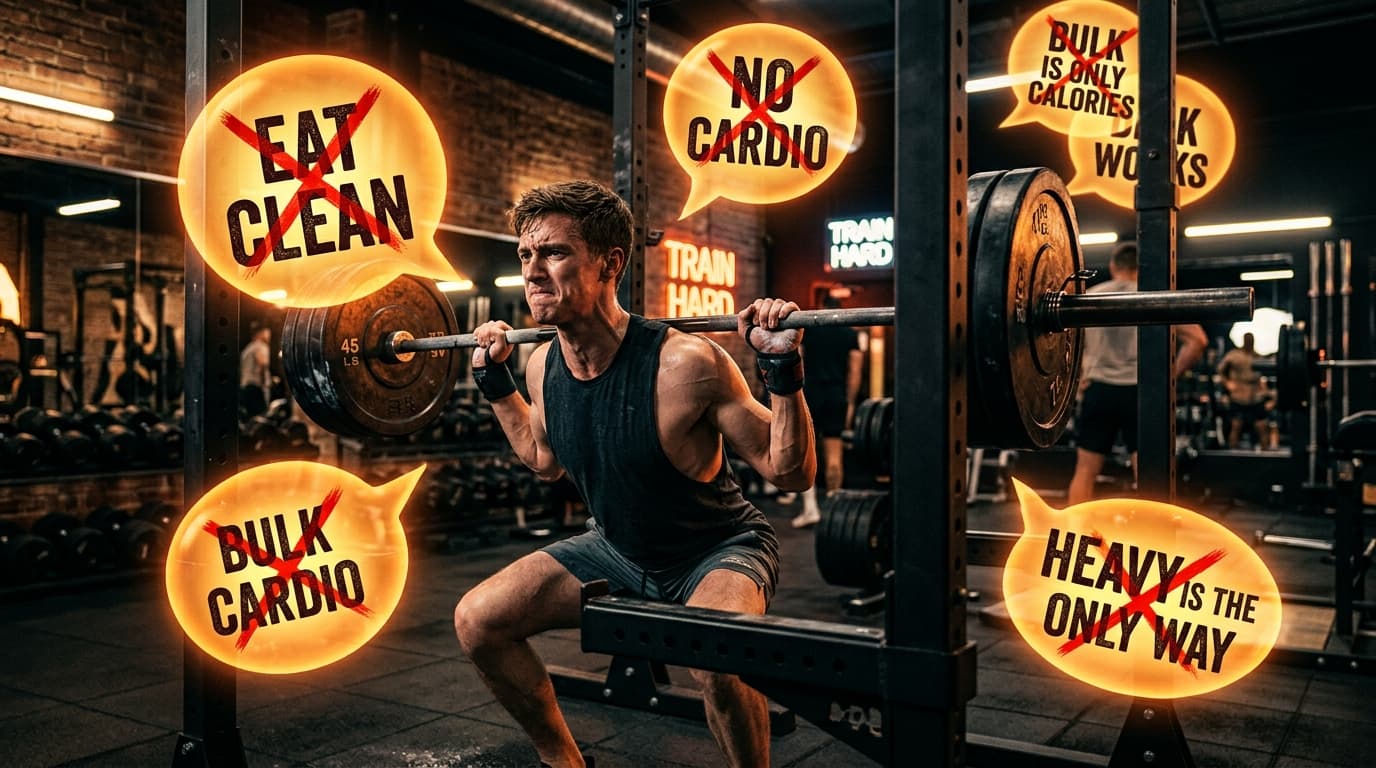
Bulking myths are everywhere, and they're the single biggest reason hardgainers stay hard gainers. Let's kill the 12 worst ones so you can finally start growing.
- "Eating clean" doesn't matter if you're not in a calorie surplus
- You don't need 2g of protein per pound — science says much less works
- Cardio doesn't kill gains when done right
- Your metabolism isn't as fast as you think — you're just not eating enough
- Supplements won't save a bad diet
- You can train the same muscle more than once per week — and probably should
- Bulking doesn't mean getting fat on purpose
- You don't need to eat every 2 hours to build muscle
- Soreness is not a reliable indicator of a good workout
- Rest days are when you actually grow — don't skip them
- You can absolutely build muscle without expensive supplements
- Age doesn't matter nearly as much as consistency does
Myth 1: "I Eat a Lot But Can't Gain Weight"
This is the king of all bulking myths. Every skinny guy says it. Almost none of them are right.
Here's the reality: if you're not gaining weight, you're not eating enough. Full stop. It doesn't matter how much food you think you're eating. Your body doesn't care about your perception — it responds to actual calories consumed versus calories burned.
Studies consistently show that people who struggle to gain weight dramatically overestimate their calorie intake. One study found that self-described "hardgainers" overestimated their intake by up to 50%. They thought they were eating 3,000 calories. They were actually eating around 2,000.
What to Do Instead
Track everything you eat for one week. Every meal, every snack, every splash of oil in the pan. Use an app, a notebook, whatever works. You'll be shocked at how little you're actually consuming.
If you need help figuring out your target, check out our guide on how to calculate your bulking calories. The math doesn't lie.
If you've "tried everything" but haven't tracked calories for at least 2 weeks, you haven't actually tried everything.
Myth 2: "You Need 2g of Protein Per Pound of Bodyweight"
This one refuses to die. Somewhere along the line, the fitness industry decided that more protein is always better, and now guys are chugging 6 protein shakes a day wondering why they feel bloated and broke.
The actual science? A meta-analysis published in the British Journal of Sports Medicine found that muscle protein synthesis maxes out at around 0.73g per lb of bodyweight per day. Going higher showed no additional benefit for muscle growth.
For a 154 lb guy, that's roughly 112g of protein per day. Not 300g. Not even 200g. Just 112g.
Now, there's nothing wrong with eating a bit more — up to 1g per lb is the commonly cited upper range. But if you're stressing about hitting 2g per pound, you're wasting mental energy and probably money too.
What to Do Instead
Aim for 0.7-1.0g per lb of bodyweight. Spend the rest of your calories on carbs and fats — they fuel your workouts and recovery. For a deeper dive into how much protein you actually need, read our complete protein guide.
Myth 3: "Cardio Kills Your Gains"
This might be the most damaging myth on this list, because it gives skinny guys an excuse to skip cardio entirely. And skipping cardio doesn't just hurt your health — it actually hurts your gains too.
Here's why: cardiovascular fitness improves nutrient delivery to your muscles, enhances recovery between sets, and keeps your appetite regulated. Guys who do zero cardio often have worse work capacity in the gym, which means fewer quality sets and less muscle stimulus.
The research backs this up. A 2012 meta-analysis found that concurrent cardio and resistance training didn't impair muscle growth as long as the cardio wasn't excessive. We're talking about running a marathon while bulking — that's a problem. Two or three 20-minute sessions a week? That's beneficial.
Want a detailed breakdown of how to program cardio without hurting your bulk? We wrote a complete guide to cardio while bulking.
What to Do Instead
Do 2-3 sessions of low-to-moderate intensity cardio per week. Walking, light cycling, or the elliptical. Keep sessions under 30 minutes. If you're eating enough, this won't touch your gains — and your heart will thank you.
If you're already struggling to eat enough calories, adding lots of cardio obviously makes it harder. In that case, stick to daily walks and save structured cardio for after you've nailed your nutrition.
Myth 4: "You Have a Fast Metabolism"
Every skinny guy's favorite excuse. "I have a fast metabolism, bro. I can eat whatever I want and not gain weight."
Let's put this to bed. Research on resting metabolic rate (RMR) shows that the variation between individuals of the same size is about 200-300 calories per day. That's the difference between one tablespoon of peanut butter and two. It's not the reason you're skinny.
The real reasons skinny guys struggle to gain weight:
- You skip meals without realizing it. Breakfast is coffee, lunch is a sandwich, and dinner feels big but it's only 700 calories.
- You eat big one day, then barely eat the next. Consistency matters more than any single meal.
- You're more active than you think. Fidgeting, pacing, walking everywhere — this is called NEAT (non-exercise activity thermogenesis), and it can burn 300-800 extra calories per day.
What to Do Instead
Stop blaming your metabolism and start building an eating schedule. Same meals, same times, every single day. If you struggle to eat enough, we have a full strategy for how to eat more when you're not hungry.
Myth 5: "Dirty Bulking Is the Fastest Way to Get Big"
Pizza, burgers, ice cream — just eat everything in sight and you'll get huge, right? This is the dirty bulk fantasy, and while it will make the scale go up, a lot of what you're gaining is fat, not muscle.
Your body can only build about 0.5-1 lb of muscle per week under ideal conditions. Any calories beyond what's needed for muscle growth get stored as fat. So if you're eating 5,000 calories when your body only needs 3,200, you're not building muscle faster — you're just getting fatter faster.
The aftermath is even worse. You end up spending months cutting to get rid of the fat, losing some of the muscle you built in the process. It's one step forward, two steps back.
What to Do Instead
Run a lean bulk with a 300-500 calorie surplus above your TDEE. This is enough to maximize muscle growth without excessive fat gain. Not sure where to start? Our comparison of dirty bulk vs clean bulk breaks down exactly when each approach makes sense.
Myth 6: "You Need Supplements to Build Muscle"
Walk into any supplement store and they'll have you believing you need a pre-workout, intra-workout, post-workout, BCAAs, creatine, a multivitamin, fish oil, ZMA, and a testosterone booster. That's $200/month on pills and powders.
The truth? The supplement industry is worth $50 billion globally, and most of it is marketing hype. The vast majority of supplements have little to no evidence supporting their muscle-building claims.
Here's the shortlist of what actually works:
| Supplement | Effective? | Why |
|---|---|---|
| Creatine monohydrate | ✅ Yes | Most researched supplement ever. Increases strength and muscle volume |
| Whey protein | ✅ Yes | Convenient protein source. Not magic — just food in powder form |
| Caffeine | ✅ Yes | Improves workout performance. Coffee works just as well |
| BCAAs | ❌ No | Waste of money if you eat enough protein |
| Testosterone boosters | ❌ No | Don't work. Period |
| Mass gainers | ⚠️ Maybe | Overpriced calories. Make your own shake instead |
If you're interested in the one supplement that's actually worth your money, read our deep dive on creatine for bulking.
What to Do Instead
Spend your money on food. A dozen eggs, a bag of rice, and a tub of peanut butter will do more for your gains than a cabinet full of supplements. If you're on a budget, check out our bulking grocery list — it proves you can bulk for less than $50 a week.
Myth 7: "You Should Only Train Each Muscle Once Per Week"
The classic "bro split" — chest Monday, back Tuesday, legs Wednesday (maybe), arms Thursday, shoulders Friday. Each muscle gets annihilated once and then has a full week to recover.
This approach was popularized by bodybuilders in the '80s and '90s, many of whom were on performance-enhancing drugs that dramatically improved their recovery and protein synthesis. For natural lifters, it's suboptimal.
Research shows that muscle protein synthesis (MPS) stays elevated for only 24-48 hours after a training session. If you train chest on Monday and don't hit it again until the following Monday, you're leaving 5 days of potential growth on the table.
What to Do Instead
Train each major muscle group 2-3 times per week. Upper/lower splits or full-body routines work great for this. You don't need to destroy a muscle in one session — spread the volume across multiple sessions for better results.
If you're training 3-4 days per week, a full-body routine is your best bet. If you can train 4-5 days, an upper/lower split is ideal.
Myth 8: "You Need to Eat Every 2-3 Hours"
This myth comes from the idea that your body can only absorb 30g of protein per meal, so you need to spread your intake across 6-8 meals per day. Miss the window? Muscle wasting! Catabolism! Gains gone!
None of this is true.
Your body is perfectly capable of digesting and utilizing large amounts of protein in a single sitting. A 9 oz steak with 60g of protein doesn't go to waste. Your digestive system isn't that stupid — it slows down absorption to handle bigger meals.
As for meal frequency, a 2015 systematic review found no significant difference in muscle growth between eating 3 meals per day versus 6 meals per day, as long as total daily protein and calories were the same.
What to Do Instead
Eat as many meals as you can comfortably manage. For most hardgainers, 4-5 meals works well because it's easier to hit a calorie surplus with more eating opportunities. But if you prefer 3 bigger meals, that works too. Total daily intake is what matters, not how you split it up.
For a structured approach to meal timing that works with your schedule, read our bulking meal timing guide.
Myth 9: "If You're Not Sore, You Didn't Work Hard Enough"
Soreness — technically called delayed onset muscle soreness (DOMS) — is probably the most misunderstood signal in fitness. Guys chase soreness like it's proof of a good workout. If they can walk normally the day after leg day, they feel like they failed.
Here's the problem: soreness is primarily an indicator of novelty, not effectiveness. You get sore when you do something your body isn't used to — a new exercise, more volume, or a longer range of motion. As your body adapts, soreness decreases even if you're still making progress.
In fact, excessive soreness can actually hurt your gains. If you're so sore that you can't train that muscle again for 5 days, you've blown through your recovery capacity and reduced your weekly training frequency — which we just established is important.
What to Do Instead
Track your performance, not your soreness. Are you adding weight to the bar over time? Are you doing more reps with the same weight? Is your bodyweight going up? Those are the real indicators of progress. Some mild soreness is fine, but if you're hobbling around after every session, you're overdoing it.
Myth 10: "Rest Days Are Wasted Days"
This is the opposite side of the coin from guys who skip the gym. Some skinny dudes get so obsessed with training that they hit the gym 7 days a week, thinking more is always better.
Here's a reality check: you don't build muscle in the gym. You damage muscle in the gym. You build muscle during recovery — when you're sleeping, eating, and resting. Without adequate rest, you're essentially tearing down a house faster than you can rebuild it.
Overtraining syndrome is real, and its symptoms are brutal: plateaued strength, chronic fatigue, poor sleep, irritability, and even loss of appetite (the last thing a hardgainer needs).
What to Do Instead
Take 2-3 rest days per week. On rest days, focus on:
- Eating at maintenance or surplus — your muscles are rebuilding and need fuel
- Sleeping 7-9 hours — growth hormone peaks during deep sleep
- Light movement — a walk or some stretching, not another gym session
For a complete breakdown of how to eat on rest days, check out our rest day nutrition guide.
Myth 11: "You Can't Build Muscle After 30"
This one stops guys from even starting. "I'm 32, it's too late for me." Absolute nonsense.
Research shows that men in their 30s, 40s, and even 50s can build significant muscle mass when they train and eat properly. A 2009 study in Medicine & Science in Sports & Exercise found that untrained men aged 35-50 gained nearly the same amount of muscle as men aged 18-22 over a 16-week resistance training program.
Yes, testosterone levels naturally decline with age — about 1% per year after 30. But the decline is gradual and doesn't significantly impact muscle-building potential until much later in life. And even then, proper training and nutrition can offset a lot of the age-related decline.
The biggest advantage younger guys have isn't biology — it's time. They have fewer responsibilities, more recovery capacity (often because they sleep more), and fewer injuries to work around.
What to Do Instead
Start now, regardless of age. The best time to start building muscle was 10 years ago. The second best time is today. Adjust your expectations slightly — recovery might take a bit longer, and you might need more warm-up sets — but the fundamentals of bulking don't change with age.
Myth 12: "You Need to Eat Clean to Build Muscle"
"Clean eating" is one of those terms that means everything and nothing. Brown rice is clean. White rice is dirty. Chicken breast is clean. Chicken thighs are dirty. It's arbitrary, inconsistent, and completely misses the point.
Your muscles don't care whether your carbs come from sweet potatoes or white bread. They care about total calories, total protein, and whether you showed up to the gym and trained hard. That's it.
Now, this doesn't mean nutrition quality is irrelevant. Whole foods provide micronutrients, fiber, and satiety that processed foods don't. But obsessing over "clean" eating often backfires for hardgainers because clean foods tend to be very filling and low in calorie density. Try hitting 3,500 calories per day eating only chicken breast, broccoli, and brown rice. It's miserable.
What to Do Instead
Follow the 80/20 rule: get 80% of your calories from nutrient-dense whole foods, and let the other 20% come from whatever you enjoy. Ice cream, pizza, cereal — whatever helps you hit your calorie target. This approach is sustainable, satisfying, and just as effective for muscle growth.
If you're not sure what a well-balanced bulking diet looks like, start with our 3000-calorie meal plan. It mixes whole foods with flexible options so you actually enjoy eating.
The Real Formula for Skinny Guys
Now that we've cleared out the noise, here's what actually matters for building muscle as a hardgainer:
1. Calorie Surplus
Eat 300-500 calories above your Total Daily Energy Expenditure (TDEE). Track your intake for at least the first 4-6 weeks until you can eyeball portions accurately.
2. Adequate Protein
Hit 0.7-1.0g per lb of bodyweight daily. Spread it across 3-5 meals. Don't overthink it beyond that.
3. Progressive Overload
Add weight, reps, or sets to your lifts over time. If you're doing the same workout with the same weights for months, your body has no reason to grow.
4. Consistency
This is the unsexy one, and it's the most important. Show up to the gym 3-4 times per week. Eat your meals every day. Sleep enough. Do this for 6 months straight and you'll look like a different person.
5. Patience
Natural muscle growth is slow. Expect to gain 1-2 lbs per month when everything is dialed in. That's 13-26 lbs in your first year. It won't happen overnight, but it will happen.
How FuelTheGains Helps You Cut Through the BS
Information overload is half the problem. You're drowning in contradictory advice, and every YouTube video tells you something different. That's exactly why we built .
Instead of spending hours calculating macros, planning meals, and second-guessing your nutrition, FuelTheGains gives you a personalized bulking plan based on your body, your goals, and your schedule. It tells you exactly what to eat, how much to eat, and when to eat it — so you can stop researching and start growing.
No myths. No bro science. Just a clear plan that works.
The Bottom Line
Most of what's holding you back isn't genetics or metabolism. It's misinformation. Stop chasing soreness, stop fearing cardio, stop obsessing over clean eating, and start focusing on the basics: eat enough, train hard, rest well, and be patient.
The guys who actually build muscle aren't the ones with the best genetics. They're the ones who stop overcomplicating things and just do the work — consistently, month after month, year after year.
You've got the knowledge now. Go use it.