
You spent all winter grinding. Five meals a day, shakes before bed, tracking every gram. By May you'd finally put on 9 lb and you could see it in the mirror.
Then July hit. And now the exact same meal plan — the one you executed flawlessly for five months — feels physically impossible. You look at the chicken and rice you portioned out and your body says no. You skip the afternoon shake because it's 33°C in your apartment and the last thing you want is more food. You "make up for it later," except you never do.
Three weeks in, the scale is 3 lb lower than it was in June. All that winter work, quietly leaking away.
Here's the thing nobody tells skinny guys: this isn't a discipline problem. Heat physically suppresses your appetite through mechanisms you don't control. Fighting it with willpower is like trying to out-stubborn gravity. What actually works is restructuring how and when you eat so your calorie target survives the summer.
- Heat suppresses hunger through core temperature, digestion-competing blood flow, and hormonal shifts — it's physiology, not weakness
- Cold liquid calories are the single highest-leverage fix: a cold shake goes down when a hot plate won't
- Shift your biggest meals to the coolest hours — early morning and late evening
- Kill the oven and the stovetop; hot cooking makes hot rooms hotter and appetite worse
- Salt aggressively — sweat losses drive fatigue that gets misread as "not hungry"
- Prioritise fat for calorie density: more calories in less physical volume
- Expect scale noise of up to 4-5 lb from hydration swings; judge weekly averages only
Why Heat Actually Kills Your Appetite
This isn't in your head. There are three separate things happening at once, and they stack.
1. Your body is trying not to overheat
Digestion generates heat. It's called the thermic effect of food, and it's a real metabolic cost — roughly 10% of the calories you eat get burned just processing them. Protein is the worst offender at 20-30%.
When your core temperature is already elevated, your brain's temperature-regulating centre in the hypothalamus does the sensible thing: it downregulates the desire to add more internal heat. That means suppressing hunger signals. Your body is essentially choosing not to overheat over choosing to grow.
This is why a big protein-heavy meal feels genuinely awful on a hot day. You're not being dramatic. You're being physiologically discouraged.
2. Blood flow gets reprioritised
To dump heat, your body shunts blood toward your skin so it can radiate warmth out. Vasodilation at the surface, less blood available elsewhere.
"Elsewhere" includes your digestive tract. Less splanchnic blood flow means slower gastric emptying — food sits in your stomach longer. You feel full sooner and stay full longer, on fewer calories. For a guy trying to eat 3,500 calories a day, that's brutal. Your stomach becomes the bottleneck.
Ingesting cold fluid actively lowers core temperature — cold water absorbs heat as it warms to body temperature. That's a real, measurable cooling effect. So a cold, calorie-dense shake isn't just "easier to swallow" — it's actively reducing the thermal signal that's suppressing your hunger in the first place.
3. Sodium loss creates fake fatigue
You can lose a lot of sodium in sweat — anywhere from 400 to over 1,500 mg per litre depending on genetics and how heat-adapted you are. Train hard in summer heat and you can drop 2 litres of sweat in a session easily.
Low sodium plus high fluid intake gets you a specific, recognisable feeling: flat, heavy-headed, unmotivated, mildly nauseous. Most guys interpret that as "I'm just not hungry today." It's actually an electrolyte problem wearing an appetite costume.
That's the hidden one. And it's the easiest to fix.
The Real Cost of a Summer Slide
Let's put numbers on it, because guys underestimate this.
Say you're a 155 lb hardgainer eating 3,400 calories to gain roughly 0.7 lb a week. Heat knocks 500 calories a day off your intake — one skipped shake and a smaller dinner. That's not dramatic. That's a Tuesday.
| What happens | Daily gap | Over 10 weeks |
|---|---|---|
| Skip one shake | -500 cal | -35,000 cal |
| Net effect | Maintenance or below | Roughly 4 kg of gain never happens |
Ten weeks of summer at maintenance doesn't just pause progress. You lose the momentum, the appetite adaptation you built up, and often some of the actual weight. September you starts from a worse place than June you.
The guys who stay big through summer aren't tougher. They restructured.
Rule 1: Drink Your Calories, and Drink Them Cold
If you take one thing from this article, take this. Cold liquid calories are the highest-leverage tool in hot-weather bulking.
Liquids bypass most of the mechanical fullness problem. They empty from the stomach faster than solid food, they don't require chewing effort you don't have the enthusiasm for, and when they're cold they feel like relief instead of work.
A blended shake can carry 700-900 calories in 17 fl oz. Try getting 800 calories of chicken and rice down in 34°C heat and report back.
A hot-weather shake formula
Build every summer shake on this skeleton:
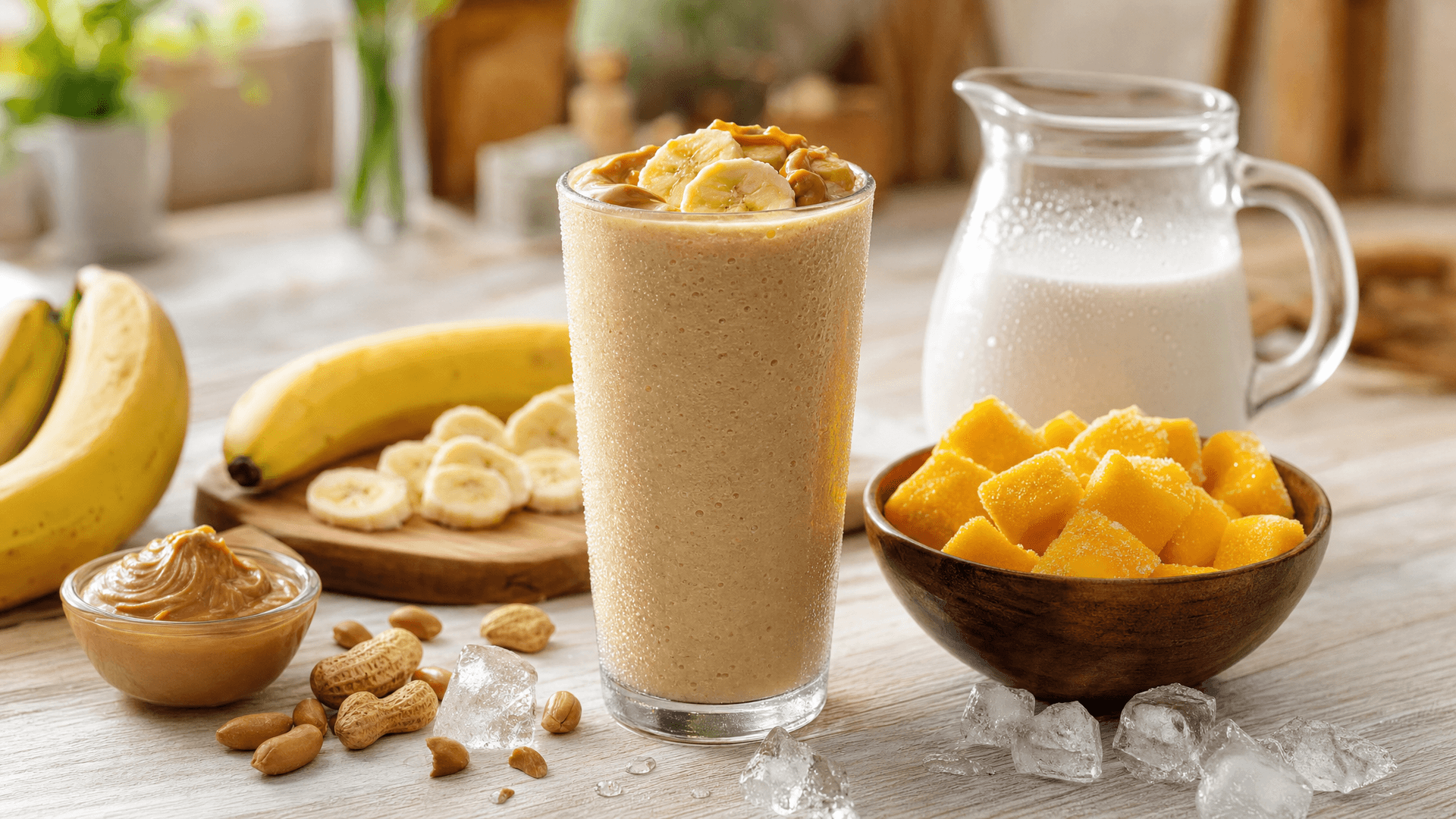
- Frozen fruit instead of fresh — 5 oz frozen banana or mango. Frozen fruit does the job of ice without diluting anything.
- A cold liquid base — whole milk straight from the fridge, or milk plus a splash of cream if you need more density.
- A fat source — 2 tbsp of peanut butter, or 1 oz of cashews. This is where the calories actually come from.
- Protein — one scoop of whey, or 7 oz of Greek yogurt if you'd rather use whole food.
- Something starchy — 1.8 oz of oats blended smooth. You won't taste them.
- A pinch of salt. Yes, really. See Rule 4.
That's comfortably 800+ calories that goes down in three minutes. We've got a full set of recipes in our guide to high-calorie shakes for weight gain — in summer, just make them cold and lean harder on frozen fruit than ice.
Pre-portion shake ingredients into freezer bags on Sunday — frozen fruit, oats, nut butter, protein powder. Dump a bag in the blender, add cold milk, done in 90 seconds. When it's hot, every extra step of friction is a reason to skip.
Other cold liquid calories that work
- Kefir or drinkable yogurt with honey blended in
- Cold overnight oats, thinned out until you can practically drink them
- Frozen smoothie "slushies" — more frozen fruit, less liquid, eat with a spoon
- Iced coffee with whole milk and a scoop of protein — 14 fl oz of that is 350 easy calories
- Chocolate milk. Unsexy, unbeatable, and genuinely one of the best hot-weather bulking tools there is
Rule 2: Move Your Biggest Meals to the Coolest Hours
Your appetite isn't uniformly dead all day. It's dead when it's hot. So stop distributing calories evenly and start distributing them by temperature.
Most of the year, guys front-load lunch and dinner. In summer, that's exactly backwards — 1pm to 6pm is when your kitchen is an oven and your hunger has left the building.
The reshuffled summer day
| Time | Old plan | Hot-weather plan |
|---|---|---|
| 6:30-8:00am | Small breakfast | Biggest solid meal of the day |
| 10:00am | Snack | Cold shake |
| 1:00pm | Big lunch | Light, cold, high-fat |
| 4:00pm | Shake | Cold shake or frozen smoothie |
| 7:00pm | Big dinner | Moderate solid meal |
| 9:30-10:30pm | — | Second big meal or dense night shake |
Early morning is the coolest your body and your apartment will be all day. Use it. A guy who eats 5 oz of oats, four eggs and a banana at 7am has banked 900 calories before the heat even shows up.
Then treat late evening as a second breakfast. Once the sun's down and the room drops a few degrees, appetite comes back — often surprisingly hard. Don't waste that window on a snack. Eat a real meal.
Don't let "eat when it's cool" turn into skipping the middle of the day entirely. Two big meals plus nothing is how guys end up 800 calories short without noticing. The midday slots become liquid — they don't become empty.
Rule 3: Turn Off the Oven
There's a feedback loop most people miss: cooking hot food makes your home hotter, which suppresses your appetite further, which makes the hot food you just cooked less appealing.
An oven running for 40 minutes can raise a small kitchen by several degrees, and it lingers. If you live in a flat without air conditioning, roasting a tray of chicken thighs at 200°C in July is an act of self-sabotage.
No-heat, high-calorie meal ideas
Cold protein bowls. 7 oz of pre-cooked rotisserie chicken (buy it, don't make it), cold rice from the fridge, olive oil, avocado, feta. Around 800 calories, zero cooking.
Tinned fish, generously. Two tins of sardines or mackerel in olive oil — and drink the oil, don't drain it. That's 500 calories with 5 oz of bread.
Smoked salmon and cream cheese bagels. 4 oz of salmon, a heavily loaded bagel, capers. 700 calories, three minutes, no appliance.
Cottage cheese with everything. 9 oz of full-fat cottage cheese, honey, 1.4 oz of walnuts, granola on top. Genuinely refreshing when cold.
Cold noodle salads. Boil pasta or rice noodles once, late at night, for the whole week. Toss portions with peanut sauce, sesame oil, shredded chicken and cucumber. Eat straight from the fridge.
Overnight oats, but calorie-loaded. 3.5 oz of oats, whole milk, 2 tbsp of nut butter, honey, 1 oz of chocolate chips. Around 850 calories, made the night before.
The pattern: fridge food, oil-based fat, and things you can buy already cooked. If a summer meal takes more than five minutes and generates heat, it won't survive contact with real life in August.
Rule 4: Salt Like You Actually Mean It
This is the most underrated fix in the whole playbook.
If you're training hard in the heat and drinking a lot of water, you're diluting a shrinking sodium pool. The result is the flat, foggy, appetite-free feeling that gets blamed on "summer."
Bulking guys are usually told to fear sodium because of bloating and blood pressure headlines. In a hot-weather surplus with heavy sweating, that concern is largely inverted. You probably need more sodium in July than in February, not less.
What to actually do
- Salt your food visibly. Not a delicate pinch — actually season it.
- Add salt to shakes. A quarter teaspoon disappears into any chocolate or peanut butter shake and makes it taste better, not saltier.
- Drink something with electrolytes during and after training, not plain water. An electrolyte tab, or DIY: water, a pinch of salt, a squeeze of lemon, 2 tbsp of honey.
- Eat salty carbs deliberately — pretzels, salted crackers, olives, pickles. Cheap calories that make you thirsty, which drives more fluid, which keeps you functional.
Salt makes food taste better and makes you drink more. Both help a hot-weather bulk. If your appetite disappears specifically after training in the heat, try 500 mg of sodium in cold water immediately post-session and see how you feel 30 minutes later. For a lot of guys, that's the whole fix.
And don't over-correct on plain water either. Drowning your appetite in 200 fl oz of water leaves no room for calories and makes the sodium problem worse. Sensible targets and the full sodium/potassium picture are in our complete hydration guide for bulking — the short version is that fluid and electrolytes have to move together.
Rule 5: Prioritise Fat for Density
When stomach capacity is the limiting factor, calorie density stops being a nice-to-have and becomes the entire strategy.
Fat is 9 calories per gram. Carbs and protein are 4. That means fat delivers more than double the calories per unit of physical volume in your stomach.
| Food | Amount | Calories | Physical volume |
|---|---|---|---|
| Olive oil | 3 tbsp | 360 | Tiny |
| Cashews | 1 small handful | 300 | Small |
| Watermelon | Large bowl | 90 | Enormous |
| Cooked rice | Large bowl | 400 | Large |
Summer is exactly when guys drift toward high-volume, low-calorie foods — salads, melon, iced tea, cucumber, "light" stuff. It feels right. It also guarantees you fall short.
Density moves that cost you nothing
- Drizzle olive oil over cold bowls and salads — 1 tbsp is 120 calories that you cannot feel
- Use full-fat everything: whole milk, full-fat yogurt, full-fat cottage cheese
- Keep 7 oz of nuts in a jar on the counter and grab a handful every time you walk past
- Don't drain oil-packed tinned fish
- Add half an avocado to anything
- Use cream in your iced coffee instead of milk
Keep protein where it should be — roughly 0.7-1.0 g per lb of bodyweight — and then let fat do the heavy lifting on the calorie side. Fighting to force down another 9 oz of chicken in the heat is a losing battle when 3 tbsp of olive oil gets you the same calories with no effort.
If your appetite is the core bottleneck rather than the heat specifically, the broader tactics in our guide on how to increase your appetite for bulking stack neatly on top of everything here.
Rule 6: Train Cooler
Your appetite after training is a big chunk of your daily intake. If every session leaves you overheated and nauseous, you've lost that window.
- Train early or late. A 7am or 9pm session in an air-conditioned gym beats a 5pm session in a hot one, every time.
- Ice water on hand, always. Sip through the whole session, not just at the end.
- Cut rest-period wandering. Sit down, stay cool, don't pace around generating more heat.
- Shorten sessions in extreme heat. A focused 50 minutes that leaves you able to eat is worth more than 90 minutes that kills your appetite for the rest of the day.
- Cold shower immediately after. Dropping core temperature fast is the single fastest way to switch hunger back on.
That last one is almost a cheat code. Train, cold shower, then eat within 20 minutes while your core temperature is still coming down. You'll get a meal in that you would otherwise have skipped.
Reading the Scale in Summer Without Losing Your Mind
Summer weight data is noisy as hell. Sweat losses, sodium swings and glycogen shifts mean a 175 lb guy can genuinely see a 4-5 lb spread across a single week without any real change in tissue.
Rules for staying sane:
- Weigh at the same time daily — first thing, after the bathroom, before drinking.
- Use the 7-day average only. Compare this week's average to last week's. Never compare two individual days.
- Expect one flat week. Heat-driven fluid shifts can mask two weeks of genuine gain, then it shows up all at once.
- Track intake honestly for two weeks in July. This is the one time of year I'd tell an experienced lifter to go back to logging. You are almost certainly eating less than you think — that's the entire premise of this article.
- Use the mirror and the tape. If weight is flat but arms and shoulders are measuring bigger, you're fine.
Don't chase the scale by suddenly slamming 2 lb of salty food and litres of water the night before you weigh in. You'll get a number you like and learn nothing. Fix the intake, then trust the weekly average.
A Sample Hot-Weather Bulking Day
Here's what this looks like assembled — roughly 3,600 calories for a 160 lb lifter, with almost no cooking.
6:45am — Big cool breakfast (950 cal) 3.5 oz of overnight oats made with whole milk, 2 tbsp peanut butter, honey, banana, plus 3 boiled eggs made the night before.
9:30am — Iced protein coffee (350 cal) Cold brew, whole milk, one scoop of whey, ice.
12:30pm — Cold protein bowl (750 cal) Cold rice, 6 oz of shop-bought rotisserie chicken, avocado, feta, olive oil, salt.
3:30pm — Frozen calorie shake (800 cal) Frozen banana, frozen mango, whole milk, oats, 2 tbsp cashew butter, whey, pinch of salt.
5:30pm — Train, electrolyte drink throughout. Cold shower after.
7:00pm — Moderate meal (450 cal) Cold noodle salad with peanut sauce and shredded chicken.
10:00pm — Second appetite window (450 cal) 9 oz of full-fat cottage cheese, granola, honey, 1 oz of walnuts.
Note what's absent: no oven, no stovetop after Sunday, nothing hot after breakfast, and two of the day's biggest calorie hits are drinkable.
Common Summer Bulking Mistakes
- Treating lost appetite as a character flaw. It's thermoregulation. Change the plan, not your self-image.
- Keeping the winter meal plan unchanged. The plan was built for a different environment. It's supposed to change.
- Going all-in on "clean" summer foods. Salads, melon and grilled fish are fine foods and terrible bulking foods at volume.
- Cutting fat because it "feels heavy." Fat is the one macro that solves your actual problem.
- Drinking only plain water. More fluid, less sodium, worse appetite.
- Cooking hot meals in a hot kitchen. You're paying twice: once in effort, once in appetite.
- Panicking after one bad week on the scale. Weekly averages, not daily readings.
- Skipping the late-evening window. That's your best appetite of the day and most guys sleep through it.
Where FuelTheGains Fits
The hard part of hot-weather bulking isn't knowing this stuff. It's rebuilding your entire week around it — every July, from scratch, when you've got the least energy to plan anything.
That's what FuelTheGains handles. You give it your bodyweight, your calorie target, your training schedule and what you actually like eating, and it builds the plan around your constraints — including "no cooking" and "cold meals only" if that's what your summer needs. It generates the meals, the macros, and the grocery list, so a hot-weather restructure takes ten minutes instead of a weekend of guesswork.
The point isn't that you couldn't work it out yourself. It's that the guys who keep their gains through summer are the ones who don't have to re-plan every time conditions change. Have a look at fuelthegains.com if you want the plan built for you instead of by you.
The Bottom Line
Summer doesn't stop you gaining. Summer stops you executing the plan you made in winter — and those are completely different problems with completely different fixes.
Get your calories cold, get them liquid, get them in during the coolest hours, salt your food properly, and let fat carry the density. Do that and July looks like every other month on your weekly average.
The heat lasts eight weeks. What you do with those eight weeks decides whether September starts from a peak or from a hole.