
You've been bulking for four months. The scale is finally moving, your shirts fit differently, and for the first time in your life you look like you lift.
Then you catch your reflection under the bathroom's overhead light and your stomach drops. The corners look thinner. There's hair in the shower drain that wasn't there last spring. And somewhere in the back of your head a voice says: the creatine did this.
So you do what every guy does. You open Reddit at 1am, read forty conflicting comments, and by morning you've either dumped your creatine down the sink, cut 500 calories out of your surplus, or both. You've torpedoed the one thing that was actually working.
Let's slow down. Because the honest answer here is messier — and a lot less scary — than the internet version. Some of what you're seeing is genetics that were always coming. Some of it is lighting and paranoia. And some of it, the part almost nobody talks about, is a real nutrient hole you dug during the skinny years, not the bulking ones.
- The infamous creatine study measured DHT in 20 rugby players and never looked at a single hair follicle
- No study has ever shown creatine causes hair loss — the 2009 result has not been replicated in over 15 years
- A fast surplus increases scalp oil and can trigger temporary shedding, but it does not create male pattern baldness
- Low ferritin, zinc and vitamin D from years of under-eating cause real diffuse thinning, and a bulk is when you notice it
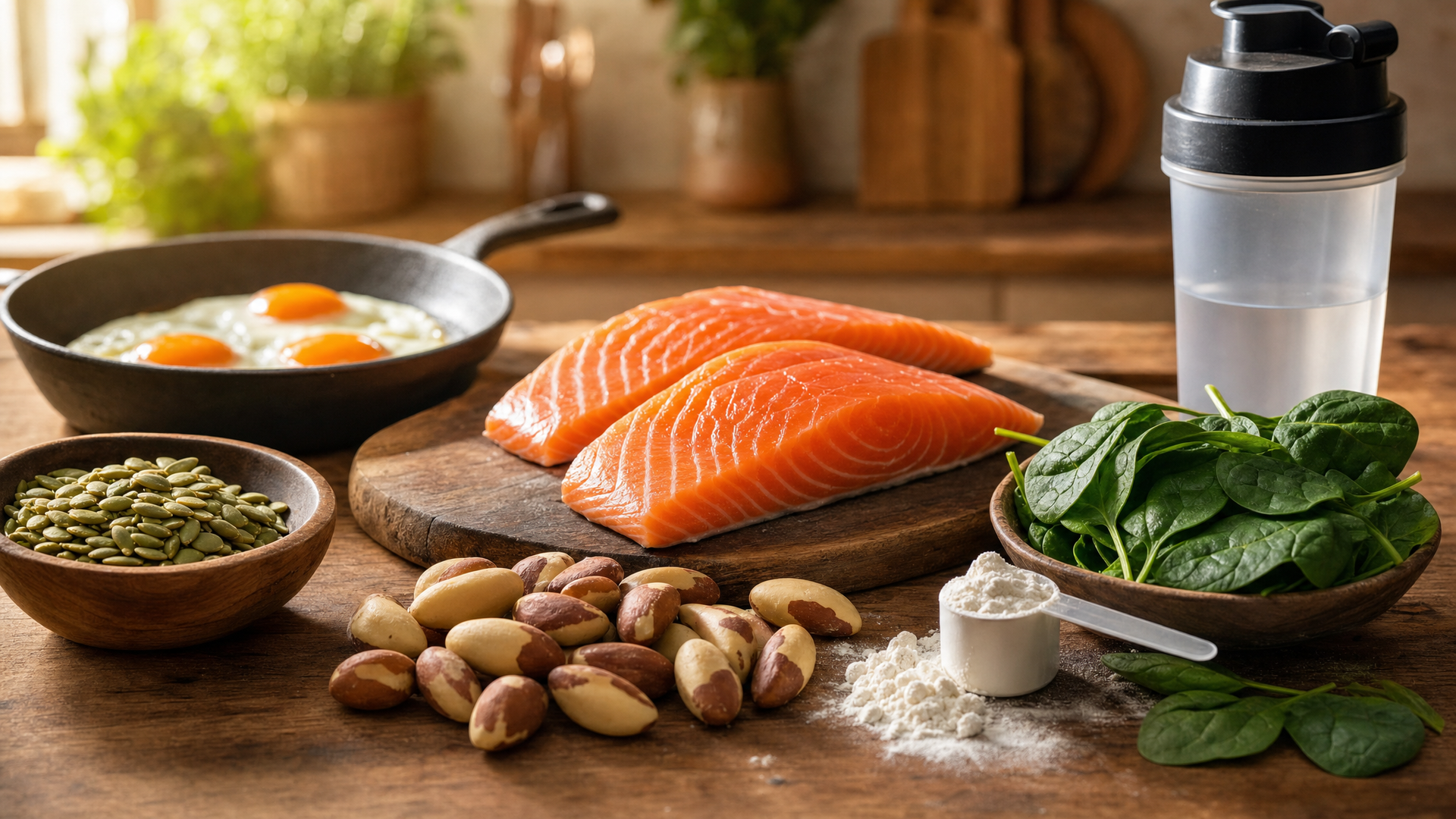
- Eat liver, oysters, eggs, salmon and red meat weekly to close the gaps that actually matter
- If your hairline is receding in a pattern, that's genetics — treat it properly instead of blaming your protein shake
First: two completely different things are happening
When guys say "hair loss," they're lumping together two processes that look nothing alike under a dermatologist's scope.
Androgenetic alopecia — male pattern baldness — is genetic, progressive, and patterned. It hits the temples and the crown. It's driven by follicles that are inherently sensitive to DHT, a hormone your body has been making since puberty. It does not cause sudden shedding. It causes slow miniaturization: each hair grows back a little finer, a little shorter, until it stops.
Telogen effluvium is diffuse shedding. Hair comes out from everywhere, in handfuls, usually 2-3 months after some kind of stressor — a crash diet, illness, a big drop in calories, low iron, a new training block that doubled your weekly volume. It's temporary. It reverses. It's the thing people mistake for going bald.
Here's why this distinction decides everything: if you've got pattern loss, cutting your bulk does nothing. If you've got effluvium, cutting your bulk usually makes it worse, because under-eating is one of the main triggers.
So before you change a single thing about your diet, figure out which one you're looking at.
| What you're seeing | Likely cause | What helps |
|---|---|---|
| Temples receding, crown thinning, no extra shedding | Androgenetic (genetic) | Dermatologist, proven treatments |
| Handfuls coming out evenly all over | Telogen effluvium | Fix calories, iron, zinc, vitamin D |
| Scalp feels greasy, hair looks flat and limp | Sebum and styling, not loss | Wash more, adjust fat sources |
| Patchy round bald spots | Alopecia areata (autoimmune) | See a doctor, not a forum |
The creatine study everyone misquotes
Almost every "creatine causes baldness" claim on the internet traces back to a single paper: a 2009 study on 20 college-aged rugby players in South Africa.
Here's what actually happened. The players loaded creatine at 25g per day for 7 days, then dropped to 5g per day for 14 days. Researchers measured testosterone and DHT in their blood. After loading, DHT rose about 56%. After the maintenance phase it settled around 40% above baseline.
That's the entire finding. That's it.
Now here's what the study did not do, and this is the part that never makes it into the screenshot someone posts under your comment:
- It never measured hair. Not follicle counts, not shedding, not scalp density, not a single photo. Nobody in that study was checked for hair loss.
- The DHT values stayed inside the normal physiological reference range. They went up within normal, not above it.
- The sample was 20 guys, which is small enough that a few outliers move the average meaningfully.
- The testosterone-to-DHT ratio shifted, but total testosterone didn't change much — meaning conversion rate moved, not overall androgen load.
And the biggest one: it has never been replicated. In the 15+ years since, multiple studies and at least one systematic review have looked specifically at creatine and androgens. None of them reproduced the DHT spike. A 2021 review in the Journal of the International Society of Sports Nutrition examined the broader body of evidence and concluded there's no consistent evidence creatine meaningfully alters testosterone or DHT, and zero evidence it causes hair loss.
"One small study found a hormone marker moved within its normal range, and nobody has been able to repeat it" is a very different sentence than "creatine makes you go bald." The second sentence has never been supported by a single piece of published research.
Could creatine slightly accelerate something in a guy who was already genetically destined to lose his hair? Theoretically, we can't fully rule it out. But "theoretically can't rule out" describes about a thousand things, including your morning coffee. If you've got the genes, you were going to lose it. If you don't, a 40% shift inside the normal DHT range isn't going to invent sensitivity your follicles don't have.
The practical read: creatine is the most-studied, best-supported supplement in the entire sports nutrition world, and quitting it over this costs you real strength and real size for a myth. If you want the full breakdown of how to actually use it, we covered it in our complete creatine guide for skinny guys.
What a fast surplus genuinely does to your scalp
Okay — so creatine's mostly off the hook. But you're not imagining that things changed when you started eating big. A few real mechanisms are in play, and none of them are "bulking causes baldness."
More food means more sebum
When you jump from maintenance to a 500-700 calorie surplus, and a chunk of that comes from dairy, fried foods, and refined carbs, your skin's oil production goes up. Insulin and IGF-1 both stimulate sebaceous glands, and your scalp is covered in them.
Greasier scalp means hair clumps into strands, lies flatter, and shows more scalp. Your hairline looks thinner in the mirror even though follicle count hasn't changed at all. This is the same mechanism behind bulking breakouts — we went deep on it in our guide to eating big without wrecking your skin, and the dietary fixes overlap almost perfectly.
Faster gains mean more shedding, briefly
If you went from eating like a bird to slamming 4,200 calories and adding four sessions a week, that's a genuine systemic stressor in the short term — even though it's a good one. Rapid body composition change, big jumps in training volume, and poor sleep during the adjustment period can all nudge follicles into the resting phase early.
The result shows up as increased shedding roughly 8-12 weeks later, which is exactly why guys blame whatever they started three months ago. The timeline is a trap. Whatever you changed in month one shows up on your pillow in month three.
Your washing habits changed
You're training more. You're sweating more. A lot of guys respond to a greasier scalp by washing less — bad instinct. Sebum buildup plus sweat plus dry shampoo is a recipe for irritation and flaking, which makes shedding worse and hair look thinner.
Do not respond to hair panic by cutting calories. Dropping into a deficit is a far more reliable trigger for telogen effluvium than any surplus. You'd be trading a cosmetic problem for an actual one — and killing your gains at the same time.
The real culprit nobody checks: what happened before the bulk
Here's the part that matters most, and it's almost never discussed.
Most guys who start a serious bulk spent the previous several years under-eating without realizing it. A 145 lb guy at 5'10" who "eats a lot" is frequently running on 2,000-2,300 calories with a diet built from chicken, rice, pasta and protein shakes. That diet is low in exactly the nutrients hair follicles need most.
Hair is a high-turnover, metabolically expensive, completely non-essential tissue. When your body is short on resources, hair is one of the first things it deprioritizes. And those deficits take months to show up — which means the shedding you're seeing during month three of your bulk was very likely seeded by month thirty of your under-eating.
Ferritin and iron
This is number one, by a mile. Ferritin — your stored iron — is the single most consistently implicated nutrient marker in diffuse hair shedding. You can have normal hemoglobin, be told "your iron is fine," and still have ferritin low enough to stall follicle growth. Many dermatologists want to see ferritin comfortably above 40-70 ng/mL for hair health, well above the bottom of the standard lab range.
Guys who eat mostly chicken breast, whey and rice get very little heme iron. Years of that adds up.
Zinc
Zinc is required for follicle protein synthesis and helps regulate the enzyme pathway that converts testosterone to DHT. Low zinc is associated with hair shedding in multiple clinical contexts. Zinc is also one of the minerals lost in sweat — so the guy training six days a week has higher needs than the couch-sitter, not lower.
Vitamin D
Vitamin D receptors sit directly in the hair follicle and play a role in cycling follicles back into their growth phase. Deficiency is extremely common in anyone who trains indoors and lives north of a certain latitude — which is most of us, most of the year.
Protein — genuinely enough of it
Hair is essentially keratin, a protein. If you've been eating 1.0-1.2g per kg of bodyweight and calling it high-protein, you're short for someone training hard. Aim for 0.7-1.0g per lb of bodyweight.
And the one that's mostly hype: biotin
Biotin supplements are marketed relentlessly for hair. Actual biotin deficiency is rare in anyone eating eggs and normal food, and supplementing it when you're not deficient does nothing — except mess with thyroid and cardiac lab results, which can send you down a genuinely stressful diagnostic rabbit hole. Skip it.
If you want the full picture of which micronutrients quietly sabotage a bulk, we broke it down in the micronutrients skinny guys miss while bulking.
The shopping list that actually protects your hair
Good news: every single one of these gaps is closed with food, and the foods are cheap and calorie-dense — which means they're doing double duty on your bulk.
Weekly non-negotiables
| Food | Serving | What it delivers |
|---|---|---|
| Beef or chicken liver | Once a week | Heme iron, vitamin A, B12, copper |
| Oysters or mussels | Once a week | Zinc — the single best source there is |
| Fatty fish (salmon, mackerel, sardines) | 2-3x per week | Vitamin D, omega-3s, protein |
| Red meat | 3-4x per week | Heme iron, zinc, protein, creatine |
| Whole eggs | Daily | Biotin, choline, cholesterol, protein |
| Dark leafy greens | Daily | Non-heme iron, folate, vitamin C |
How that looks in practice
- 3.5 oz of beef liver once a week covers your iron, copper and vitamin A for days. Chop it fine and hide it in a bolognese with 14 oz of ground beef if the flavor puts you off.
- A tin of 3 oz smoked oysters is under three bucks and delivers several times your daily zinc.
- 6 oz of salmon two or three times a week handles vitamin D and omega-3s together.
- 7 oz of ground beef at 15% fat gives you roughly 500 calories, heme iron, zinc and creatine in one pan.
- 1 oz of pumpkin seeds on your oats adds zinc, magnesium and about 170 calories you won't notice eating.
- Pair your plant iron with vitamin C. 5 oz of lentils plus a squeeze of lemon absorbs dramatically better than lentils alone.
Don't slam coffee or tea with your iron-rich meals. Tannins and polyphenols meaningfully block non-heme iron absorption. Move the coffee an hour either side and you've just upgraded every meal for free.
If your shedding is genuinely diffuse and it's been going on more than three months, ask your doctor for a panel: ferritin, full iron studies, vitamin D, zinc, and TSH. That one blood draw answers more questions than six months of forum reading.
Pace your bulk so your body isn't fighting you
Rate of gain matters here — not because gaining fat causes hair loss, but because a controlled surplus keeps your hormones, skin and sleep stable while a reckless one stresses all three.
Target 0.25-0.5% of bodyweight per week. For a 155 lb guy that's roughly 0.4-0.8 lb per week, or somewhere around 2-3 lb a month. Over a full year that's a very real 22-26 lb, and almost all of it usable.
Compare that to the classic dirty bulk: 1,000+ calorie surplus, 2.2 lb a week, mostly fast food. You get the oily scalp, the breakouts, the terrible sleep, the blood sugar rollercoaster, and you have to diet half of it off anyway. Slower is genuinely better here, and not for hair reasons alone.
A few structural things that help more than any supplement:
- Sleep 7-9 hours. Poor sleep elevates cortisol, and chronically elevated cortisol is bad news for follicle cycling.
- Don't add training volume and calories and a new job stressor in the same month. Stack changes one at a time.
- Wash your hair when it's dirty. Two to four times a week for most guys who train. A gentle shampoo, actually rinsed out.
- Stop pulling on it. Constant checking, tugging at the temples, tight caps worn all day. It's a small effect but it's real, and the checking behavior also feeds the anxiety loop.
- Take photos, not vibes. Same spot, same lighting, same angle, once a month. Memory is a terrible instrument for measuring hair.
If it really is genetic, here's the adult response
Suppose you do the blood work, fix your diet, wait six months, and the temples are still going. That means you drew the genetic card — the same one roughly half of men draw by their 50s, and plenty by their 20s.
That is not a nutrition problem, and no amount of liver and oysters will reverse it. What it is, is a well-understood medical condition with treatments that have decades of data behind them. Talk to a dermatologist or a GP. Real options exist, they work best when started early, and they're vastly more effective than anything you'll find in a supplement aisle.
What you should absolutely not do is quit creatine, drop your protein, or abandon your surplus. Losing your hair is out of your control. Being 26 lb more muscular is entirely in it. Of the two things, one you can still win — and honestly, a guy who's built, confident, and keeps his hair short looks a hell of a lot better than a guy who's skinny and desperately combing it forward.
Making the "eat for your hair" part effortless
Here's the practical problem. Everything above — hitting a controlled surplus, getting liver in weekly, actually hitting 0.9g per lb of protein, keeping iron and zinc topped up — is genuinely easy to understand and genuinely annoying to execute. It means knowing your numbers, then building meals that hit them without eating the same four things forever.
That's what we built for. You put in your stats and your goal, and it builds a bulking plan with the surplus set at a sane rate, the protein target where it should be, and meals built from real, nutrient-dense food — the red meat, the eggs, the fish, the greens — instead of a wall of chicken and rice. You get the grocery list, you cook, you stop guessing.
It won't regrow a hairline. Nothing in a meal plan will. But it closes every nutritional gap on this page automatically, while also doing the thing you actually came for: putting weight on you.
The bottom line
That one rugby study measured a hormone in 20 guys and never looked at a single hair. Fifteen years and zero replications later, it's still the entire basis for "creatine makes you bald." Don't throw out the best supplement in sports nutrition over it.
What is worth your attention: the ferritin, zinc and vitamin D you probably ran down during years of eating too little, the greasy scalp from a surplus built on junk, and a rate of gain fast enough to stress your whole system.
Fix those with food. Get the blood work. Take a monthly photo instead of staring in the mirror at midnight. And if it turns out to be genetics, see a doctor about your hair and keep the barbell exactly where it is.
You came here to get bigger. Keep doing that.