
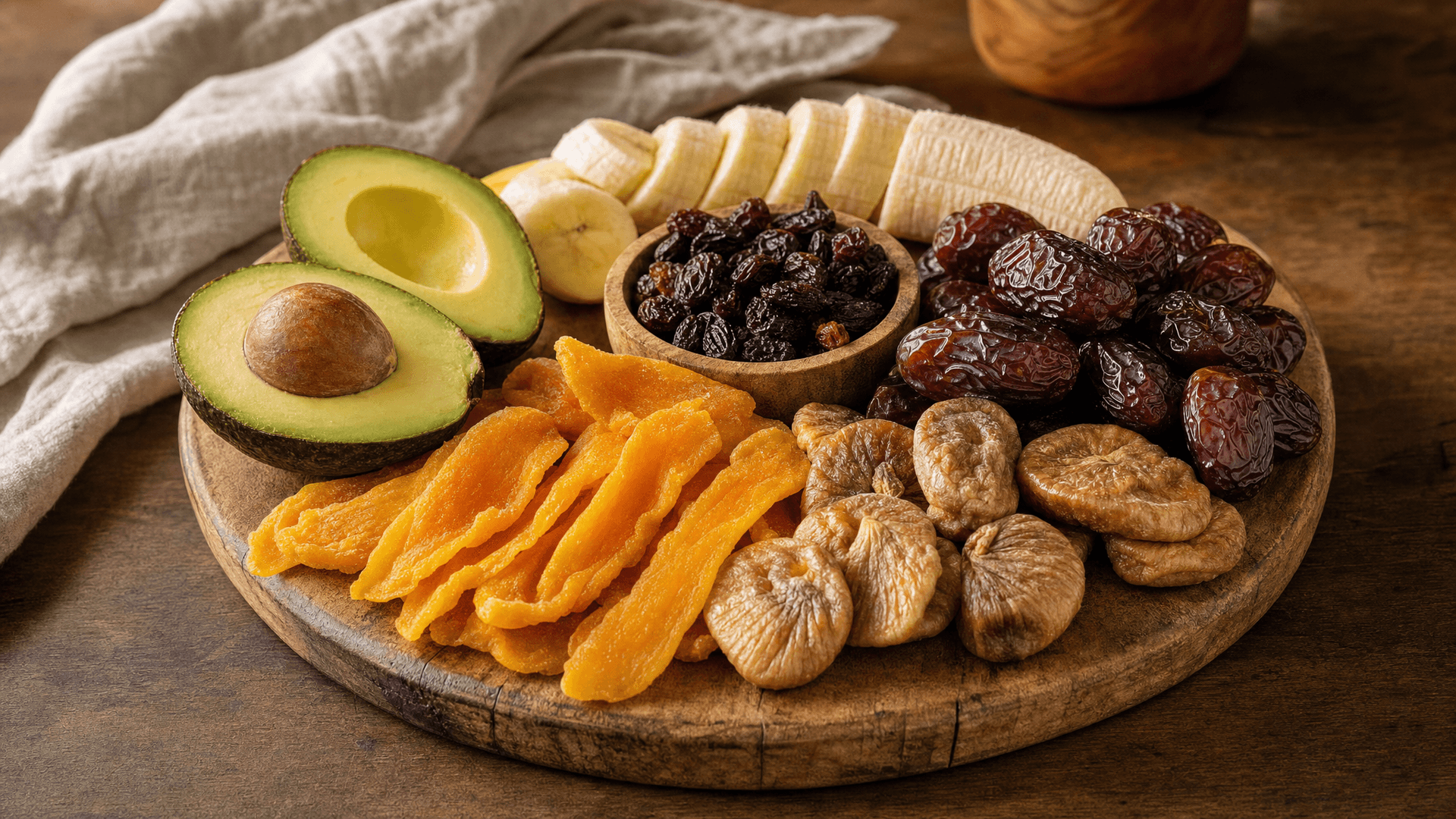
Ask a skinny guy what he eats to bulk and he'll list rice, chicken, oats, peanut butter. Ask him about fruit and he'll shrug. "Fruit's basically water and sugar, right? That's diet food."
That belief is quietly costing you calories every single day.
Here's the thing: fruit is one of the easiest, cheapest, most portable ways to bury a few hundred extra calories in your day without feeling like you're force-feeding yourself. But only if you pick the right fruit. A stick of celery-tier apple won't move the needle. A handful of medjool dates absolutely will.
Every other food group on this blog has gotten the deep-dive treatment — carbs, shakes, calorie-dense add-ons. Fruit's been sitting on the bench. Time to fix that.
This is the ranked list of the 10 fruits that actually help you gain, why they work, and exactly how to weaponize them for a surplus instead of nibbling on low-cal snacks that leave you hungry an hour later.
- Most fruit is low-calorie, but the right picks (dates, dried fruit, avocado, banana) are surplus rocket fuel
- Dried fruit packs 3-4x the calories of fresh because the water is gone — same nutrients, way more density
- Fat-based fruits like avocado and coconut hit 9 calories per gram, the highest of any food
- Blend fruit into shakes, don't just snack on it — liquid calories are the easiest to overeat
- Pair fruit with a fat source (nut butter, full-fat yogurt) to turn a light snack into a 400+ calorie hit
- Aim to add 300-500 surplus calories a day from fruit-based combos without ever feeling stuffed
Why Fruit Gets a Bad Rap (And Why That's Dumb for Bulkers)
The "fruit is diet food" myth comes from the fat-loss world. For someone cutting, fruit is great because it's filling, high in fiber and water, and relatively low in calories. Big volume, small calorie hit. Perfect for staying full while eating less.
Flip that logic for bulking and you get the problem: filling and low-calorie is exactly what you don't want when you're trying to hit a surplus. If a fruit fills your stomach without delivering calories, it's actively working against you.
But that's an argument against the wrong fruit, not fruit itself. A raw cucumber-tier watermelon and a fistful of medjool dates are both technically fruit, and they're on completely opposite ends of the calorie spectrum. One is 30 calories per 3.5 oz. The other is nearly ten times that.
The trick is knowing which fruits punch above their weight, and then either removing the water (dried), adding fat, or blending them into something you can drink fast. Do that, and fruit becomes one of the most underrated tools in a hardgainer's kitchen.
Calorie density is calories per gram. Water and fiber lower it; sugar and fat raise it. Fresh fruit is watery, so it's usually low-density. Concentrate that fruit — dry it, blend it, or pick the fatty ones — and the density shoots up. That's the whole game.
Fruit also brings things white rice and protein powder don't: potassium, vitamin C, antioxidants, and gut-friendly fiber that keeps your digestion moving when you're eating big. When you're shoveling in 3,000+ calories a day, your digestive system needs the help. Fruit is the easiest way to give it.
How We Ranked These
Two things matter for a bulking fruit: calorie density (how many calories per bite) and how easy it is to actually eat a lot of it. A fruit can be dense but so filling you can only manage a little. Dried fruit wins because it's both dense and easy to over-consume — a handful of dried mango disappears in seconds and carries 300+ calories per 3.5 oz.
Every entry below lists an approximate calorie count and how to use it. Numbers are rounded, real-world estimates — your bananas aren't lab-calibrated, and that's fine.
Let's get into it.
The 10 Best Fruits for Bulking, Ranked
1. Medjool Dates — The King
If there's a single fruit built for gaining, it's the medjool date. These things are basically nature's candy, and I mean that as the highest compliment.
A single large medjool date runs about 66-75 calories. Eat five with your afternoon coffee and you've casually added 350 calories to your day in under two minutes, no cooking, no dishes. They're sticky, sweet, and weirdly satisfying.
One medjool weighs around 0.7-0.85 oz, so a 3.5 oz serving — roughly five dates — lands near 280 calories. Stuff each one with a bit of almond butter and you've got a snack that's pushing 120 calories a piece.
Pit a date, jam in a teaspoon of peanut butter, close it back up. Three of these "snickers bites" is a 350-calorie dessert that feels like cheating but isn't.
2. Avocado — The Fat Bomb
Most people forget avocado is a fruit. Your muscles won't. Avocado is fat-dominant, and fat carries 9 calories per gram versus 4 for carbs, which makes it one of the most calorie-dense whole foods on earth.
One medium avocado weighs around 7 oz and delivers roughly 320 calories, almost all from heart-healthy monounsaturated fat. Mash it on toast, blend it into a shake (it makes them insanely creamy without changing the flavor much), or slice it onto literally anything.
Because the calories come from fat, not sugar, avocado won't spike your blood sugar, and it slots into savory meals where sweet fruit feels weird. It's the single best fruit for someone who struggles to eat enough because it adds calories without adding much volume.
3. Dried Mango — The Sneaky Monster
Fresh mango is decent — around 60 calories per 3.5 oz. Dried mango is a completely different animal. Strip the water out and the same 3.5 oz jumps to 320 calories.
The danger — well, "danger" for everyone else, superpower for you — is that dried mango is dangerously snackable. A bag disappears without you noticing. That's a disaster on a cut and a gift on a bulk. Keep some in your gym bag and graze.
Dried fruit is calorie-dense, which is the point, but it's also a fiber and sorbitol bomb. Ramp up slowly. Going from zero to 7 oz of dried fruit in one sitting is a fast track to a very uncomfortable afternoon and a lot of bathroom trips.
4. Banana — The Reliable Workhorse
The banana is the everyman of bulking fruit. Not the densest, but the most convenient, cheapest, and most versatile. One medium banana is about 105 calories, weighs roughly 4 oz, and requires zero prep.
Where bananas shine is as a base. They thicken shakes, sweeten oatmeal, and pair with anything. Two bananas with two tablespoons of peanut butter is a 400-calorie snack that takes 30 seconds to assemble.
They're also loaded with potassium and fast carbs, making them a solid pre- or post-workout option. Freeze them and they become the backbone of thick, ice-cream-textured shakes. If you want the full rundown on carb sources like this, check out our guide to the best carbs for bulking.
5. Dried Figs — The Fiber-Rich Heavyweight
Dried figs are underrated as hell. A 3.5 oz serving carries around 250 calories, and unlike a lot of dried fruit, figs bring serious calcium and fiber along for the ride.
They've got a jammy, seedy texture that works chopped into oatmeal, yogurt, or trail mix. Four or five dried figs is an easy 150-200 calorie add-on that doesn't feel like a chore to eat.
6. Dried Dates' Cousin: Raisins — The Cheap Bulk Add-On
Raisins are the budget champion. They're cheap, shelf-stable forever, and pack about 300 calories per 3.5 oz. A small box you toss in a bag, a handful into your morning oats, and you've added 130 calories for pocket change.
They mix into everything — cereal, granola, yogurt, homemade trail mix. Nobody's excited about raisins, but they're one of the most cost-effective ways to bump your daily total, and on a student budget that matters.
Build a "gainer trail mix": raisins, chopped dates, cashews, dark chocolate chips. A single 2 oz handful clears 300 calories and you'll eat it without thinking.
7. Coconut (Fresh or Dried) — The Other Fat Fruit
Coconut is the second fat-dominant fruit on this list, and it's brutally calorie-dense. Dried, unsweetened coconut flakes hit around 660 calories per 3.5 oz — that's one of the highest numbers you'll find in any food, period.
You won't sit and eat 3.5 oz of coconut plain, and you shouldn't try. Use it as a topping: a couple of tablespoons of coconut flakes on yogurt or oatmeal, a spoon of coconut cream in a smoothie. Small amounts, big calorie payoff.
Don't confuse the two. Coconut water is the thin liquid — barely 20 calories per 3.5 oz, basically fancy hydration. Coconut flesh, cream, and flakes are where the calories live. For bulking, you want the flesh, not the water.
8. Grapes — The Effortless Grazer
Grapes are sneaky. Individually tiny, but a full bowl adds up fast because you eat them mindlessly while doing other things — watching TV, studying, scrolling. That passive eating is exactly what a hardgainer needs.
Fresh grapes run about 70 calories per 3.5 oz, so a big 10 oz bowl is 210 calories you barely registered eating. Freeze them for a summer snack that feels like sorbet. And if you want the concentrated version, raisins (see above) are just dried grapes doing the same job at four times the density.
9. Fresh Mango & Pineapple — The Tropical Volume
Fresh tropical fruits sit in the middle: not dense enough to carry a bulk on their own, but sweeter and higher-calorie than most fresh fruit. Mango and pineapple both land around 55-60 calories per 3.5 oz.
Their real value is as shake fuel. Blended with full-fat yogurt, milk, and a scoop of protein, a couple of cups of tropical fruit turns a plain shake into a 500-calorie tropical smoothie you'll actually look forward to. On their own they're a light snack; in a blender they're a weapon.
10. Prunes (Dried Plums) — The Digestion Insurance
Prunes close out the list for a reason beyond calories. Yes, they're dense — around 240 calories per 3.5 oz — but their real value is keeping you regular when you're eating way more food than your body's used to.
Constipation is a real and rarely discussed part of aggressive bulking. Prunes fix that quietly. A few chopped into your oatmeal add calories and keep the plumbing working. Underrated dual-purpose fruit.
The Fruit Calorie Cheat Sheet
Here's everything in one place so you can scan and grab. All values are approximate per 3.5 oz unless noted.
| Fruit | Approx. Calories | Best Use |
|---|---|---|
| Dried coconut flakes | 660 | Topping (small amounts) |
| Avocado | 160 (320 per fruit) | Shakes, toast, savory meals |
| Dried mango | 320 | Snack, gym bag grazing |
| Raisins | 300 | Oatmeal, trail mix |
| Medjool dates | 280 | Stuffed snacks, dessert |
| Dried figs | 250 | Oatmeal, yogurt |
| Prunes | 240 | Oatmeal, digestion |
| Banana | 89 (105 per fruit) | Shakes, everything |
| Grapes | 70 | Mindless grazing |
| Fresh mango/pineapple | 60 | Smoothies |
Notice the pattern: the top of the list is either dried or fatty. Removing water or adding fat is what turns "diet food" into "gainer fuel." That's the whole strategy in one table.
How to Actually Use Fruit to Gain
Knowing the fruits is half the battle. The other half is technique. Snacking on fresh fruit alone gets you nowhere fast. Here's how to squeeze real calories out of it.
Blend, Don't Chew
Liquid calories are the cheat code of bulking. Your body registers them less than solid food, so you can drink a 700-calorie smoothie and still be hungry for dinner. Fruit is the perfect smoothie base — banana for creaminess, mango for flavor, dates for sweetness and density.
A basic gainer smoothie: two frozen bananas, 5 oz frozen mango, a scoop of protein, 10 fl oz whole milk, two tablespoons of peanut butter. That's 700+ calories you drink in five minutes. For more recipes built exactly like this, see our high-calorie shakes for weight gain.
Pair Fruit With Fat
Fresh fruit alone is light. Add a fat source and it transforms. This is the single highest-leverage move on the list.
- Banana + 2 tbsp peanut butter = 300 calories
- Apple slices + 2 tbsp almond butter = 250 calories
- Dates + walnuts = 200+ calories per small handful
- Berries + full-fat Greek yogurt + granola = 400 calories
Every one of these takes a light snack and doubles or triples it. The fruit brings the flavor and micronutrients; the fat brings the density.
Keep a jar of nut butter next to your fruit bowl. Making fruit-plus-fat your default snack instead of fruit alone is the easiest 150-200 calories you'll add all day, and you'll barely notice the difference in effort.
Stack It Onto Meals You Already Eat
You don't need new meals. You need denser versions of the ones you've got. Chop a banana and a handful of raisins into your morning oatmeal. Add dried figs to your yogurt. Mash avocado onto your lunch sandwich. Each move quietly adds 100-200 calories to food you were eating anyway.
This is the low-effort, high-consistency path — and consistency is what actually builds size. If you want a full system for this, we broke it down in how to add 500 calories to any meal.
Time It Around Training
Fruit's fast carbs make it genuinely useful around your workout. A banana and some dates before you lift gives you quick, easy energy. A shake with fruit after training refills glycogen and rides the post-workout window when your body's primed to use the calories.
This isn't magic — total daily calories still matter most — but it's a smart place to slot your fruit rather than random grazing.
Common Mistakes to Avoid
Even with the right fruit, people trip over the same things. Watch for these.
-
Eating only watery fruit. Watermelon, cucumber-tier melons, and celery-adjacent picks are near-worthless for bulking. Filling but empty. Save them for summer, don't count on them for calories.
-
Snacking on fruit instead of a meal. Fruit should be additive. If you replace a real meal with an apple, you've gone backwards. Add it on top, don't swap it in.
-
Fearing fruit sugar. For a lean, active person in a surplus, the sugar in fruit is a non-issue — it comes packaged with fiber, water, and micronutrients. You're not going to get fat from bananas while you're trying to gain and lifting four times a week.
-
Ignoring dried fruit because "it's high in sugar." That high sugar and calorie density is precisely why it's on this list. What's a downside for a dieter is the entire point for you.
-
Forgetting fat pairings. Eating fruit naked leaves calories on the table. Always ask: can I add a fat here? Usually the answer is yes.
Don't go overboard on dried fruit in week one. It's easy to eat 400 calories of dried mango in one sitting, but the fiber load can wreck your gut if you're not used to it. Build up over a couple of weeks and your digestion will adapt.
A Sample Day With Fruit Worked In
To make this concrete, here's how the right fruit choices can add a clean 600-700 calories across a normal day without any extra meals:
| When | Fruit Add-On | Calories |
|---|---|---|
| Breakfast | Banana + raisins in oatmeal | 200 |
| Mid-morning | 3 dates stuffed with peanut butter | 350 |
| Lunch | Avocado mashed on sandwich | 160 |
| Post-workout | Mango in protein shake | 90 |
| Evening | Figs + full-fat yogurt | 250 |
That's over 1,000 calories of surplus fuel, spread across the day, from foods that never once felt like a chore to eat. Scale it up or down depending on how far you are from your target. Even hitting half of it moves you meaningfully closer to gaining.
Where FuelTheGains Fits In
Fruit is a fantastic surplus tool, but let's be honest about its ceiling: to hit a real gainer target every single day, you'd need to eat a lot of it, and there are days you just can't be bothered to blend a smoothie or stuff dates.
That's where FuelTheGains comes in. It's built for exactly the guy this article is written for — the hardgainer who knows he needs more calories but keeps falling short because real food takes time, prep, and appetite he doesn't always have. It gives you a dense, convenient calorie base you can build your fruit and whole-food add-ons around, so a busy day never means a missed surplus.
Think of it as the reliable floor. Fruit, nut butter, and whole meals stack on top for flavor, micronutrients, and variety — but you're never starting from zero. If you're tired of doing the math and still coming up short at the end of the day, take a look at and let the base calories take care of themselves.
The Bottom Line
Fruit isn't diet food when you use it right. The "it's too light to matter" myth only holds if you're eating watermelon and calling it a strategy.
Pick the dense ones — dates, dried mango, avocado, coconut, figs — blend them, pair them with fat, and stack them onto meals you already eat. Do that and fruit quietly becomes one of the easiest few hundred calories you'll add all day.
Grab a bag of medjool dates on your next shop, keep dried mango in your gym bag, and start treating fruit like the gainer tool it actually is. Your surplus will thank you.