
- You're not eating as much as you think — track everything for one week
- Eat 4-5 meals per day to spread out your calories
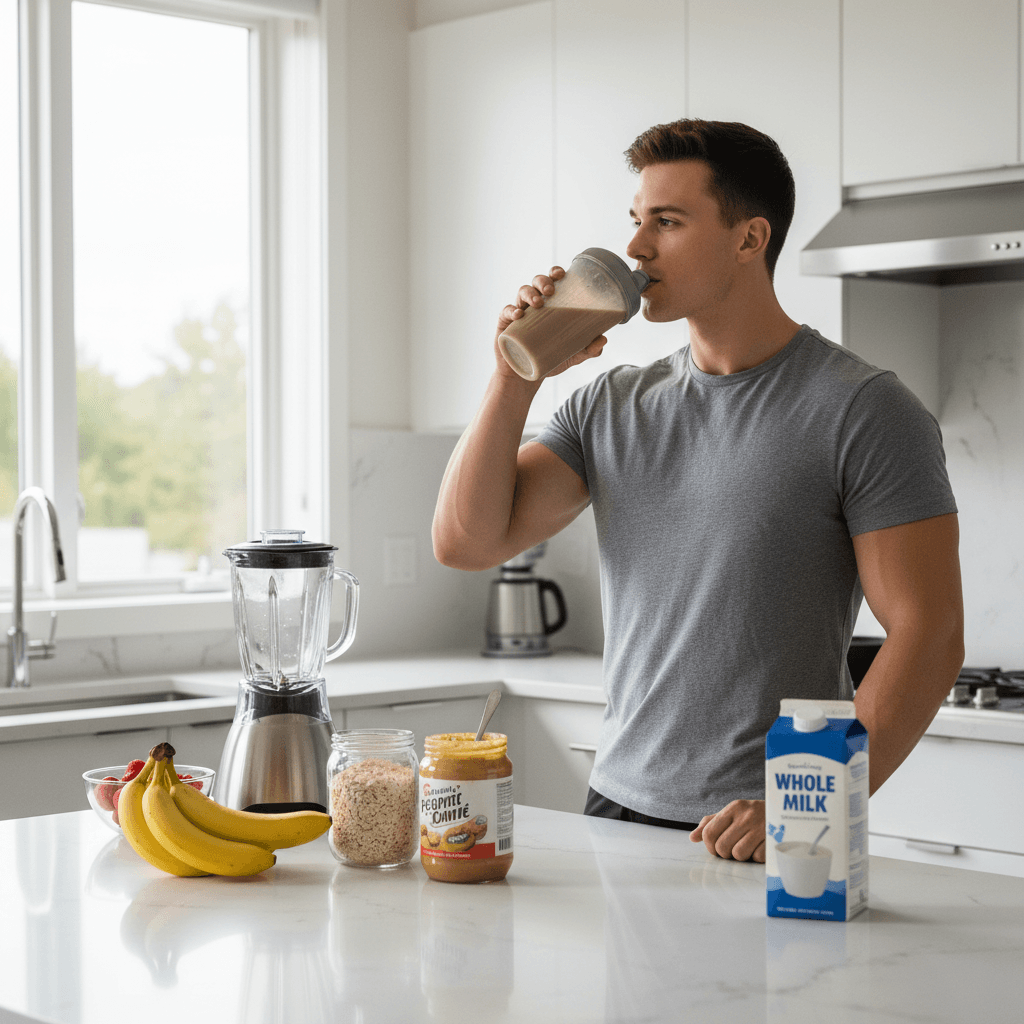
- Drink your calories — one 800-cal shake per day is a game-changer
- Use progressive eating: add 200 calories per week, not 1,000 overnight
- Aim for 0.5-1 lb per week and adjust based on your weekly weigh-in average
If you've ever Googled "how to gain weight fast for skinny guys naturally," you already know the frustration. You eat what feels like a ton of food. You try to hit the gym. And the scale barely moves — or doesn't move at all.
Here's the truth nobody wants to hear: you're not eating as much as you think you are. And your metabolism probably isn't the villain you've made it out to be.
This guide walks you through exactly how to gain weight naturally — no supplements, no magic powders, no BS. Just real food strategies that work, backed by how your body actually operates.
Let's get into it.
Your Metabolism Isn't "Too Fast" — You're Just Not Eating Enough
This is the number one myth that keeps skinny guys skinny.
"I have a fast metabolism" sounds scientific enough to be convincing. But research tells a different story. Studies on metabolic rate show that the difference between a "fast" and "slow" metabolism among people of similar size is roughly 200-300 calories per day. That's a tablespoon of peanut butter and a banana. It's not the reason you're 140 lbs.
What's actually happening? You're overestimating how much you eat.
You might crush a huge dinner and think you ate a lot. But then you skipped breakfast, had a small lunch, and didn't snack. Add it all up and you're at 1,800 calories when you need 2,800.
This is called inconsistent eating, and it's the real enemy. Not your genetics. Not your metabolism. The solution isn't eating "more." It's eating consistently more, every single day.
Why 4-5 Meals a Day Beats 3 (Every Time)
If you're a naturally skinny guy trying to gain weight on three meals a day, you're playing the game on hard mode.
To gain weight, most skinny guys need somewhere between 2,500 and 3,500 calories per day. Splitting that across three meals means each meal needs to be 800-1,100+ calories. That's a LOT of food in one sitting.
Now split that same target across five meals:
- Meal 1 (7 AM): 600 calories
- Meal 2 (10 AM): 500 calories
- Meal 3 (1 PM): 650 calories
- Meal 4 (4 PM): 550 calories
- Meal 5 (7 PM): 700 calories
Total: 3,000 calories. And no single meal is overwhelming.
This approach works because:
- You never feel stuffed. Each meal is manageable, so you're not dreading food.
- Digestion stays smooth. Smaller, more frequent meals mean less bloating.
- You build a routine. Eating becomes a habit, not a chore.
Plan your meals the night before. When you wake up and have to figure out five meals on the fly, you won't. You'll default to whatever's easy — which usually means fewer calories than you need.
Liquid Calories: The Skinny Guy's Secret Weapon
If there's one hack that makes the biggest difference for hardgainers, it's this: drink your calories.
Solid food fills you up. Liquid food doesn't — at least not nearly as much. Your body processes liquid calories differently, and they don't trigger the same fullness signals.
Here are some high-calorie shakes you can make with zero supplements — just real food:
The PB Powerhouse (~900 calories)
- 2 cups whole milk
- 2 tbsp natural peanut butter
- 1 large banana
- 1/2 cup oats
- 1 tbsp honey
The Tropical Mass Builder (~750 calories)
- 1.5 cups coconut milk
- 1 cup frozen mango
- 1/2 avocado
- 1/2 cup Greek yogurt
- 1 tbsp honey
The Chocolate Classic (~850 calories)
- 2 cups whole milk
- 2 tbsp cocoa powder
- 2 tbsp peanut butter
- 1 banana
- 1/2 cup oats
One shake a day can be the difference between maintaining your weight and actually gaining.
Calorie-Dense Foods That Make Gaining Weight Easy
Not all foods are created equal when it comes to bulking. A massive salad might look impressive on the plate, but it's mostly water and fiber — terrible for gaining weight.
You want foods that pack a lot of calories into a small volume:
Fats (most calorie-dense macronutrient):
- Peanut butter & almond butter
- Olive oil (drizzle on everything)
- Avocados
- Nuts and trail mix
- Whole eggs
- Cheese
Carbs (energy and fuel):
- White rice
- Pasta
- Oats
- Potatoes and sweet potatoes
- Bread and bagels
- Granola
Protein (for building muscle, not just weight):
- Chicken thighs (more calories than breast)
- Ground beef (80/20)
- Salmon
- Whole milk and Greek yogurt
- Eggs
If it feels light and airy, it's probably low-calorie. If it feels heavy and dense, it's probably high-calorie. Eat more of the heavy stuff.
Progressive Eating: The Concept That Changes Everything
You've probably heard of progressive overload in the gym — adding more weight to the bar each week. Progressive eating is the same concept, applied to food.
If you're currently eating around 2,200 calories a day, don't try to jump to 3,200 overnight. You'll feel awful and quit within a week.
Instead, do this:
- Week 1: Eat your current amount and track it. Just observe. Find your baseline.
- Week 2: Add 200 calories. That's one extra high-calorie snack — a handful of nuts and a glass of milk.
- Week 3: Add another 200 calories. Maybe a shake before bed.
- Week 4: Another 200. You're now 600 calories above your starting point.
Within a month, you've gone from maintaining to gaining — and it didn't feel like torture.
This works because your appetite adapts. Your stomach literally gets used to more food over time. The guys who try to eat 1,000 extra calories on day one are the same guys who burn out by day four.
Tracking Your Weight Gain: What to Expect
You weigh yourself. Consistently.
Here's the protocol:
- Weigh yourself every morning after using the bathroom, before eating or drinking.
- Take the weekly average. Daily weight fluctuates due to water, sodium, and digestion.
- Compare weekly averages, not daily numbers.
What you're looking for:
- 0.5 to 1 lb per week = perfect. You're gaining mostly muscle (assuming you're training).
- Less than 0.5 lb per week = you need more calories. Add another 200.
- More than 1.5 lbs per week = you're probably gaining too much fat. Scale it back.
Here's what a realistic first two months might look like:
| Week | Average Weight | Change |
|---|---|---|
| 1 | 145.2 lbs | Baseline |
| 2 | 145.5 lbs | +0.3 lbs |
| 3 | 146.1 lbs | +0.6 lbs |
| 4 | 146.8 lbs | +0.7 lbs |
| 5 | 147.4 lbs | +0.6 lbs |
| 6 | 148.2 lbs | +0.8 lbs |
| 7 | 148.9 lbs | +0.7 lbs |
| 8 | 149.5 lbs | +0.6 lbs |
That's 4.3 lbs in two months. Doesn't sound sexy? It's over 25 lbs in a year. That's a completely different physique.
The Training Side (Brief but Important)
Eating in a calorie surplus without lifting weights means you'll gain fat, not muscle. You need to give your body a reason to build muscle tissue.
You don't need a complicated program. The basics work:
- Compound lifts: Squats, deadlifts, bench press, overhead press, rows
- 3-4 days per week
- Progressive overload: Add weight or reps over time
- Consistency over intensity
The nutrition fuels the growth. The training directs where that growth goes. You need both.
Why Most Skinny Guys Fail (And How to Be the Exception)
- No plan. You wake up with good intentions but no structure. By the end of the day, you've eaten 2,000 calories instead of 3,000.
- No tracking. You think you're eating enough because one meal was big. But you're not looking at the full picture.
- No consistency. You eat well for 4 days, slack for 3, and end up right where you started.
- No adjustments. The scale doesn't move and you don't know whether to eat more or just wait.
The guys who succeed have one thing in common: they follow a system. They know what to eat, when to eat it, and they track whether it's working.
Stop Figuring It Out Alone
Everything in this article works. But knowing what to do and actually doing it are two very different things.
What meals hit 3,000 calories? What do you buy at the grocery store? What do you eat on Tuesday when you're busy? What do you adjust when the scale stalls?
That's what is built for.
Here's what it does:
- Custom meal plans tailored to your surplus target
- Weekly adjustments based on your actual weigh-ins
- Grocery lists so you know exactly what to buy
- Progress tracking that shows you what's working
- Adapts as you grow — your plan evolves with your body
You already know what to do. FuelTheGains makes sure you actually do it.
Quick Recap
- Accept that you're under-eating. Your metabolism isn't broken — your intake is too low.
- Eat 4-5 meals a day. Spread your calories so no single meal is overwhelming.
- Add liquid calories. One 800-calorie shake a day is a game-changer.
- Focus on calorie-dense foods. Nuts, oils, whole milk, rice, pasta, eggs.
- Use progressive eating. Add 200 calories per week.
- Track your weekly weight. Aim for 0.5-1 lb per week and adjust.
- Lift weights. Give your body a reason to build muscle.
- Follow a plan. Structure beats motivation every time.
You're not broken. You're not cursed with bad genetics. You just need to eat more food, more consistently, with a system that keeps you on track.
Now go eat. 💪