
You spent eleven months grinding. Tracking macros, forcing down food you weren't hungry for, adding a rep here and a plate there. And then Ramadan shows up and you watch it all leak out over 30 days.
That's the story most skinny guys tell after their first serious Ramadan as a lifter. They come out the other side lighter, flatter, weaker, and quietly convinced that fasting and building muscle just don't mix.
They do. But not if you treat Ramadan like a normal month with the meals shoved into a smaller box.
Here's the actual problem: if you're a hardgainer eating 3,200 calories across 14 waking hours, you're already fighting your appetite. Now compress that into roughly 8 hours — and put most of it after sunset, when you're tired, when your stomach has shrunk against you, and when a big family meal makes you want to lie down instead of eat more.
This is the playbook. Calorie splits, what to eat before dawn so you're not wrecked by 2pm, how to time training, and how to get 1,500+ calories into one sitting without feeling like you're going to be sick.
- Keep your bulking calories the same — do not "eat less because you're fasting"
- Split roughly 35% at suhoor, 45% at iftar, 20% at a late third meal
- Suhoor should be slow-digesting: fat, fibre, casein-style protein, plenty of water
- Break your fast in two stages so you don't kill your appetite in ten minutes
- Train 60-90 minutes before iftar or 2 hours after — never at 3pm on empty
- Liquid calories and dates are the highest-leverage foods of the entire month
- Aim to maintain or gain slowly; a flat scale for 30 days is a win, not a failure
What Actually Happens to Your Muscle in 30 Days
Let's kill the panic first. Fasting for 12-16 hours does not melt muscle. Your body is annoyingly good at holding onto lean tissue when protein intake and training stimulus stay in place.
The research on Ramadan and body composition is pretty consistent: lifters who keep total calories and protein up, and keep training, hold onto their lean mass. The ones who lose muscle lose it for boring reasons — they ate 800 fewer calories a day, they skipped suhoor entirely, they trained twice all month, and they slept five hours a night.
So muscle loss during Ramadan isn't a fasting problem. It's a logistics problem.
For a guy sitting between 140-190 lbs, the difference between coming out of Ramadan the same size and coming out 4-7 lbs lighter comes down to three things: whether you hit your calories, whether you hit your protein, and whether you kept lifting heavy things.
Ramadan is not the month you add 7 lbs. Aim to maintain or gain slowly — 0.5 lb a week at most. Protecting eleven months of work is the whole objective.
Step 1: Do Not Lower Your Calories
This sounds obvious. Almost nobody does it.
The instinct is to think, "I'm only eating for eight hours, so a smaller target makes sense." Your body doesn't care about your eating window. Your maintenance is set by your size, your activity and your training — none of which drop just because you're fasting.
Keep the same target you had in February. If you were eating 3,200 calories to gain, eat 3,200 during Ramadan. If you truly can't get there some days, protect the floor: never dip below maintenance.
Quick sanity check on your number. Estimate maintenance at roughly 15 calories per pound of bodyweight if you train 4-5 times a week and move a fair bit. A 155 lb guy lands around 2,300 calories maintenance, so a bulk sits at 2,600-2,800. A 180 lb guy is closer to 3,000-3,200.
Protein stays at 0.8-1.0g per lb of bodyweight. This is the number you defend hardest. Everything else can wobble; protein can't. With only two or three feeding opportunities, that means 50-70g of protein per meal, which is more than most guys have ever eaten in one sitting.
Step 2: The Calorie Split That Actually Works
Here's the framework. Three feeding windows, not two.
| Meal | When | Share of daily calories | Example at 3,200 cal |
|---|---|---|---|
| Suhoor | 45-60 min before dawn | 35% | ~1,100 cal |
| Iftar | At sunset, staged | 45% | ~1,450 cal |
| Late meal | 2-3 hours after iftar | 20% | ~650 cal |
Most guys collapse this into one enormous iftar and a token suhoor of a glass of water and a biscuit. That's the fastest way to lose weight during Ramadan — the stomach simply cannot absorb 3,200 calories in a single 40-minute sitting, and your appetite will shut the door long before the calories are in.
Three meals gives your appetite three separate chances to reset. That's the entire trick.
Do not skip suhoor to sleep in. Skipping it doesn't just cost you 1,100 calories you'll never get back that day — it makes the fast itself brutal, which makes training worse, which makes the whole month unravel.
Step 3: Suhoor — Build the Meal That Carries You to 6pm
The goal at suhoor isn't just calories. It's calories that digest slowly, so you're not hollow and shaky by early afternoon.
That means three things: fat, fibre, and slow protein.
What to build around
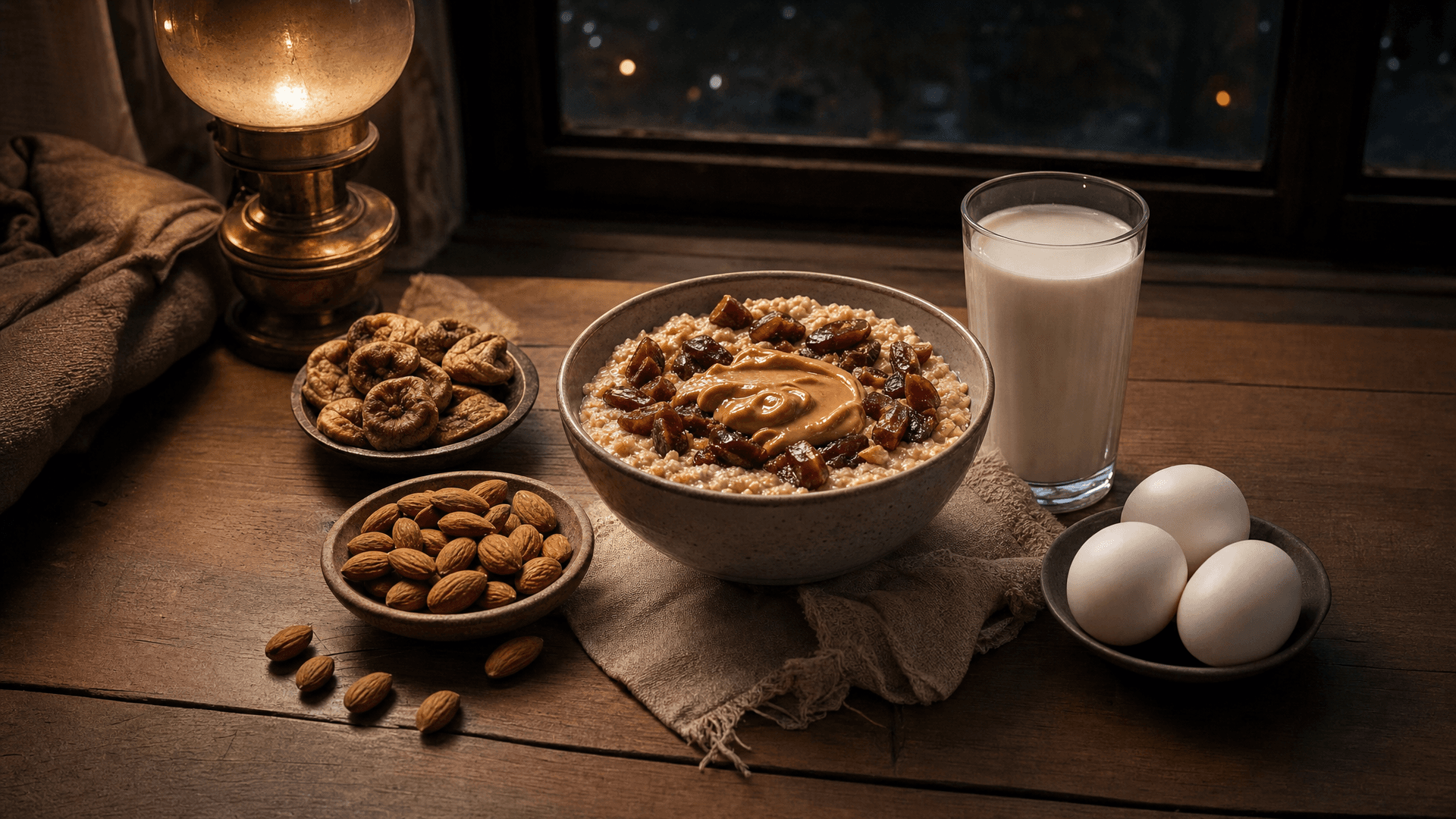
Slow protein. Dairy is your best friend before dawn. Greek yogurt, cottage cheese, milk — casein digests over hours instead of minutes. Eggs work too. A base of 9 oz of Greek yogurt plus three whole eggs already gets you around 40g of protein.
Fat, generously. Fat is 9 calories a gram and it slows gastric emptying, which is exactly what you want at 4am. Three tablespoons of olive oil across your eggs and salad, 1.4 oz of almonds or walnuts, two tablespoons of peanut butter in your oats. That's 600 calories of fat without any volume worth mentioning.
Slow carbs with fibre. Oats, whole grain bread, sweet potato, dates. 2.8 oz of dry oats cooked in whole milk is a genuinely dense breakfast that sits well.
Salt and water. Under-salting is a rookie mistake. You're going 14+ hours without fluid, and sodium helps you hold onto what you drink. Salt your suhoor properly and drink 500-750 ml of water with it — plus more across the night, not all in one go at 4am, which just sends you to the bathroom.
A suhoor that hits ~1,100 calories
| Food | Calories | Protein |
|---|---|---|
| Oats (80 g) cooked in whole milk (400 ml) | 570 | 25 g |
| Peanut butter (2 tbsp) | 190 | 8 g |
| Greek yogurt (200 g) | 130 | 20 g |
| Banana + honey (1 tbsp) | 160 | 1 g |
| Walnuts (20 g) | 130 | 3 g |
| Total | 1,180 | 57 g |
That takes about ten minutes to assemble and most of it can be prepped the night before. If chewing at 4am is genuinely hard for you — and for a lot of guys it is — half of that meal can be blended and drunk.
Prep suhoor before Taraweeh, not at 4am. Overnight oats in a jar, yogurt portioned out, eggs already boiled. Decisions you make at 4am are bad decisions, and the main one you'll make is "I'll just go back to sleep."
Step 4: Iftar — Break It in Two Stages
This is where most of the damage happens, and it's completely avoidable.
You've been fasting 14 hours. You sit down, you eat a mountain of food in fifteen minutes, and forty minutes later you feel like you've been hit by a truck, you're bloated, your appetite is gone for the night, and you've eaten maybe 1,100 calories. Then you can't face the late meal either. That's a 1,500-calorie day and a bad night's sleep.
Break it into two stages instead.
Stage 1: Open the fast (200-350 calories)
Dates and water or milk. Three to five dates gives you 60-100 calories of fast carbs, potassium and a small blood sugar bump that takes the edge off the desperation. This is tradition and it also happens to be excellent sports nutrition — few foods are as calorie-dense per bite as dates.
Then pray, or wait, or take fifteen minutes. Do not go straight into the main plate.
That gap is the most important fifteen minutes of your day. It lets the initial "I'm starving" signal settle, so when you sit down for the real meal you're eating deliberately instead of inhaling.
Stage 2: The main plate (~1,100-1,250 calories)
Now build a proper bulking meal:
- 7 oz of chicken thigh, lamb, or salmon — 45-50g of protein
- 9 oz cooked rice, couscous or pasta — the calorie backbone
- Two to three tablespoons of olive oil, ghee or tahini over the top
- A modest amount of vegetables — enough for digestion, not enough to fill you up
Note that last point. Ramadan is not the month for a huge salad. Volume is your enemy when you've got limited stomach real estate. Half a cup of greens is plenty; the rest of the plate does the work.
Go easy on the deep-fried openers too. Not because they're unhealthy — the calories are useful — but because a plate of samosas eaten in ten minutes buys you 400 calories and kills your appetite for the 1,000 that were supposed to follow. Eat them after your protein and rice, not before.
Fizzy drinks at iftar are a trap. Carbonation distends your stomach, you feel full on air, and you lose several hundred calories of real food. Drink water, milk, or juice instead — juice at least gives you calories back.
Step 5: The Late Meal Is Where Your Bulk Is Won
Two to three hours after iftar — usually after Taraweeh — you get one more shot. Most people are asleep on the sofa by then. You're going to eat 650 calories.
This meal should be almost effortless. Nobody wants to cook at 10:30pm, so it needs to be something you can pour, blend, or grab.
Good options:
- A high-calorie shake: whole milk, whey, oats, peanut butter, banana, honey — 700-900 calories in about ninety seconds
- Greek yogurt with granola, honey and nuts
- Two slices of whole grain bread with peanut butter and jam, plus a glass of milk
- Leftover rice and chicken from iftar, eaten cold if you can't be bothered to heat it
If you only automate one thing this month, automate this meal. A blender and four ingredients is the difference between a maintenance month and a growth month. Our full breakdown of high-calorie shakes for weight gain has recipes that scale up or down depending on how much you still need to hit.
And if the real obstacle is that you simply don't feel hungry at 10:30pm — which is extremely common after a big iftar — the tactics in our guide on how to eat when you're not hungry transfer directly. Liquid calories, calorie density, and eating on a clock instead of on appetite.
Step 6: When to Train
There's no single best answer here, but there is a clearly worst one: training at 2 or 3pm, fasted, ten hours into your fast, with another four hours before you can drink water. Your performance will be garbage and it's the one scenario where muscle loss becomes a genuine risk.
Here are the three realistic slots, ranked.
Option 1: 60-90 minutes before iftar (best for most people)
You train fasted, but you finish right as the fast ends. That means protein and carbs hit within minutes of your last set, and you've got the entire evening to eat and recover.
The downside is that you're training on empty at the end of a long fast. Expect to drop 5-10% off your working weights, especially on high-rep sets. That's fine and completely temporary.
Option 2: Two hours after iftar
Best raw performance. You're fed, hydrated, and you'll actually hit your normal numbers. The catch is scheduling — it collides with Taraweeh for a lot of people, and training at 10pm can wreck already-limited sleep.
If you can make it work, this is the strongest option for holding onto strength.
Option 3: After suhoor, before dawn
Rare, but it works for some. You're fully fed from a big suhoor, and you can go back to sleep afterwards. The problem is you then fast for 14 hours post-workout with no food. Not ideal, but far better than nothing.
Cut your training volume by about 20-30% this month and keep the intensity. Drop from four sets to three, trim the accessory work, but keep loading heavy on the compounds. Intensity preserves strength and muscle; volume is what your recovery can't afford right now.
Three to four sessions a week is plenty. Cardio and conditioning can wait until Eid — every calorie you burn is one you have to claw back in an eight-hour window.
Step 7: Sleep, and the Thing Nobody Plans For
Sleep is the silent killer of the Ramadan bulk. Between late iftar, Taraweeh, and a 4am suhoor, most people end up on five or six broken hours a night — which raises cortisol, hurts recovery, and destroys appetite.
Fix it by planning the split deliberately instead of falling into it. Two blocks: sleep from roughly midnight to 3:30am, eat suhoor, then sleep again from 5am until whenever you have to be up. Or sleep straight through the night and nap for 60-90 minutes in the afternoon.
Either works. Drifting with no plan doesn't.
The afternoon nap is also a bonus appetite tool — the hours between 2pm and 5pm are the hardest part of the fast, and being asleep for some of them makes the whole day easier.
Common Mistakes That Cost People Their Gains
- Skipping suhoor. The single biggest one. It costs you a third of your daily calories and makes the fast far harder.
- Eating one massive iftar and nothing else. Your stomach can't do it. Three meals, always.
- Lowering calorie targets "because you're fasting." Your maintenance didn't change.
- Filling up on salad and soup. Volume without calories is a straight trade against your bulk.
- Training at 3pm fasted. Worst performance, worst recovery, highest risk.
- Under-hydrating. Aim for 2.5-3 litres spread across the eating window, not chugged at suhoor.
- Weighing yourself daily and panicking. You'll drop 2-3 lbs of water and gut content in week one. It isn't muscle and it comes straight back.
- Doing cardio to "stay lean." You've got eight hours to eat. Don't spend calories you can't replace.
How to Know It's Working
Forget daily weight. Take a weekly average, measured at the same point in the cycle — ideally right after suhoor, same conditions every week.
A flat weekly average during Ramadan means you're winning. A gain of 0.5 lb a week means you nailed it. A drop of more than 1 lb a week past the first week means you're under-eating — add 300 calories to the late meal and reassess in seven days.
Track your lifts too. If your working sets are within 10% of your pre-Ramadan numbers by week three, your muscle is fine no matter what the scale says.
One more useful data point: waist measurement. If your waist is stable and your lifts are stable, you haven't lost meaningful muscle. Period.
Worth saying — if you found the fasting structure itself worked well for you, that's not a coincidence. There's a broader discussion of whether intermittent fasting and bulking can coexist for skinny guys, and a lot of the same mechanics apply year-round.
Where FuelTheGains Fits
The hardest part of all of this isn't discipline. It's arithmetic at 4am.
Figuring out how to hit 3,200 calories and 150g of protein across exactly three meals, with the foods your family actually cooks, with dates and rice and lamb rather than a generic meal plan template — that's a lot of planning for a month when you're already tired and hungry.
That's what we built for. You give it your bodyweight, your target and the foods you actually eat, and it builds the meal structure around your constraints — including a compressed eating window. So instead of guessing whether your suhoor was big enough, you know, and you can spend the month training and praying instead of doing macro maths half-asleep.
It won't eat the food for you. But it will make sure that when you sit down at iftar, you know exactly what's supposed to be on the plate.
The Bottom Line
Ramadan doesn't take your gains. Bad logistics do.
Keep your calories where they were. Split them across three meals instead of two. Make suhoor slow and fatty, break your fast in stages, and put a shake in your hand at 10:30pm every single night.
Do that, train three or four times a week with heavy compounds, and protect your sleep — and you'll walk into Eid the same size you were, or bigger, while everyone around you complains about losing their progress.
Thirty days is short. Your gains can absolutely survive it.