
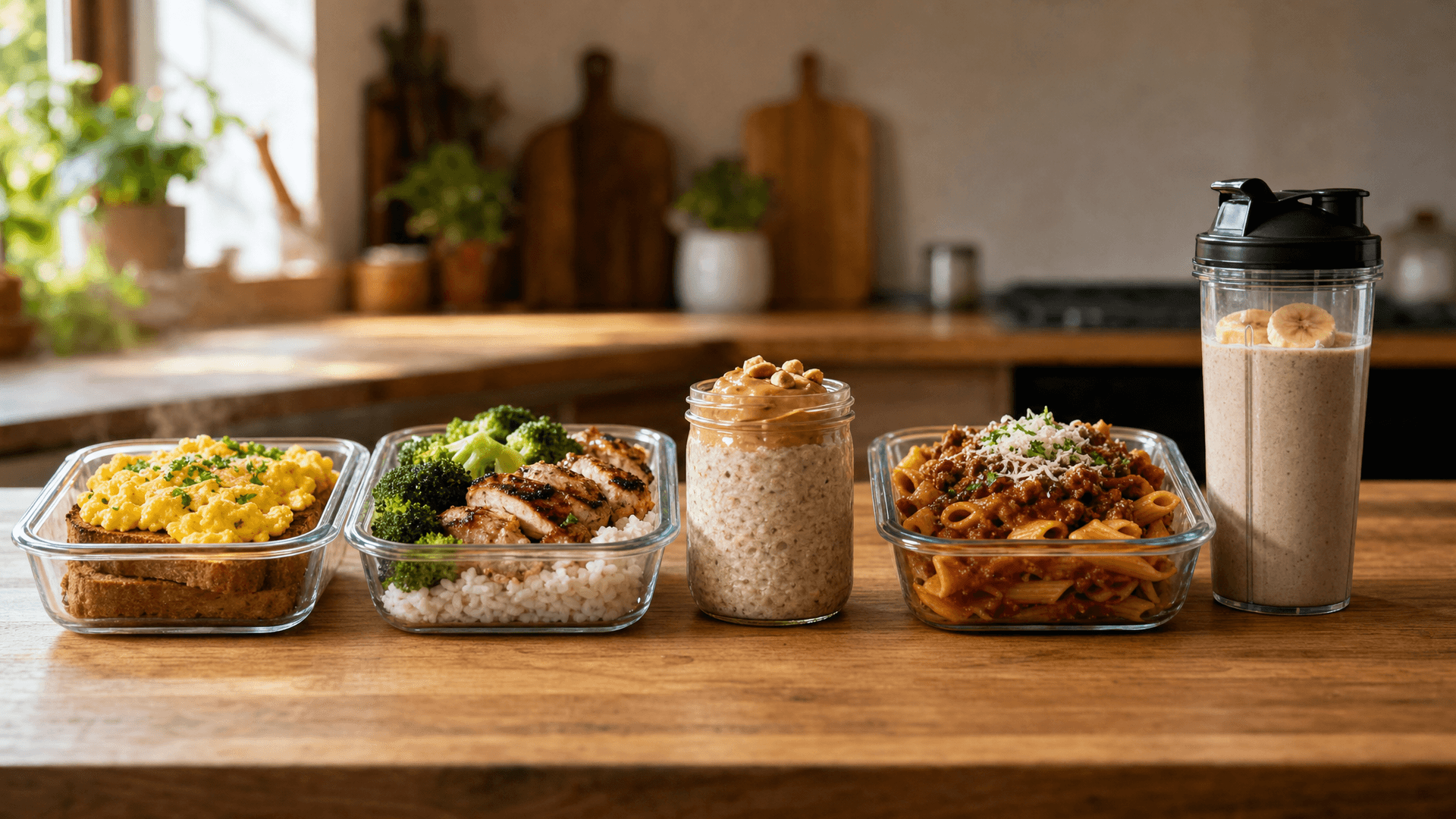
You've probably spent hours figuring out what to eat. Chicken or beef? White rice or oats? Whey or mass gainer? Meanwhile you've barely thought about the question that actually decides whether you'll hit your calories: how often should you eat?
Here's the thing nobody tells skinny guys. When you're trying to grow, the hard part isn't the food itself. It's the sheer volume. Cramming 3,500 calories into three sit-down meals means each one is enormous — and by meal two you're already forcing it down, feeling bloated, and quietly deciding to skip the last third of your plate.
That's not a discipline problem. That's a structure problem. Your appetite has a ceiling per sitting, and if you keep slamming into it, you'll stall on eating long before you stall on training.
So let's answer the real question. Not "what should I eat to bulk," but "how many times a day should I eat so that hitting my calories feels doable instead of miserable."
- Meal frequency doesn't magically build more muscle — total daily calories and protein do
- But frequency changes whether you can actually hit those numbers without forcing food
- Most hardgainers do best on 5-6 eating occasions a day, not 3 giant plates
- Spreading protein into 4-5 doses of 30-45g each maximizes muscle protein synthesis
- Liquid calories between meals are the secret weapon when solid food fills you up too fast
- Pick a schedule you can repeat on autopilot — consistency beats the "perfect" split
Does Meal Frequency Actually Matter for Building Muscle?
Let's kill the biggest myth first, because it goes both directions.
Myth 1: "You have to eat every 3 hours or you'll lose muscle." False. Your body doesn't dump muscle because you went four hours without a meal. The whole "stoke the metabolic furnace" idea — that eating more often burns more calories — has been tested repeatedly and the effect is basically zero. Six small meals and three big meals with the same total calories produce nearly identical results on the scale.
Myth 2: "Frequency is irrelevant, just hit your calories however." Also misleading, and this is where skinny guys get burned. Technically true in a lab where someone hands you a milkshake. In real life, how you split your food determines whether you actually finish it.
So here's the honest answer: for muscle growth, total daily calories and protein are king. Meal frequency is not a direct muscle-building lever. But it's a massive adherence lever — and adherence is the entire game for hardgainers.
Think about it. A 150 lb guy trying to bulk might need 3,200-3,600 calories a day. Split into three meals, that's roughly 1,100 calories per plate. That's a lot of chewing when your appetite is naturally small. Split into six, it's around 550 per occasion — which suddenly feels like a normal-sized meal plus a couple of snacks.
Frequency doesn't build muscle. Getting the calories in builds muscle. Frequency is just the delivery system that makes the calories possible. Choose the system you can run every single day.
Where frequency does have a small, legit physiological edge is protein distribution. We'll get to that — but first, the schedules.
3 vs 5 vs 6+ Meals: Which Is Right for You?
There's no universal number. There's the number that lets you hit your target without white-knuckling it. Here's how the common splits actually play out for a hardgainer.
The 3-Meal Approach
Three big meals: breakfast, lunch, dinner. Simple, minimal prep, fits a normal work schedule.
The problem for skinny guys: each meal has to be huge. If your target is 3,400 calories, that's roughly 1,130 per meal. For someone with a big appetite, fine. For a natural hardgainer whose "full" signal fires early, this is where bulks die. You physically run out of room and start leaving food behind.
Who it works for: Guys with a genuinely large appetite, or those on a moderate surplus (say, a 190 lb guy who already eats a lot). If you can crush three 1,000+ calorie plates without misery, keep it simple.
The 5-Meal Approach
Three meals plus two substantial snacks (or one snack plus one shake). This is the sweet spot for most hardgainers.
At 3,400 calories, five occasions is around 680 each — a normal meal, or a hefty snack. Way more manageable. You get four to five protein hits across the day, which is ideal for muscle protein synthesis, and you're never forcing down a mountain of food.
Who it works for: Most skinny guys bulking on a real surplus. This is my default recommendation.
The 6+ Meal Approach
Three meals plus three snacks/shakes, eating roughly every 2.5-3 hours. Each occasion is small — around 550-600 calories — so nothing ever feels heavy.
The downside is logistics. Six eating windows means more planning, more prep, more remembering to eat, and more dishes. But if your appetite is really small — the classic "I get full after half a chicken breast" guy — breaking the day into smaller pieces might be the only way you hit a big number.
Who it works for: Extreme hardgainers, guys on a very high calorie target (4,000+), or anyone who feels sick eating large portions.
| Split | Calories/meal (at 3,400) | Prep effort | Best for |
|---|---|---|---|
| 3 meals | ~1,130 | Low | Big appetites, moderate surplus |
| 5 meals | ~680 | Medium | Most hardgainers |
| 6+ meals | ~570 | High | Small appetites, very high targets |
Don't pick the split that looks best on paper. Pick the one you'll still be doing in week eight. A "worse" schedule you follow beats a "perfect" one you abandon by Thursday.
What the Research Says About Protein Distribution
Okay, this is the one place frequency has a real, measurable physiological benefit — and it's about protein, not total calories.
Building muscle depends on muscle protein synthesis (MPS) — the process of turning dietary protein into new muscle tissue. When you eat protein, MPS spikes for a few hours, then settles back down. Here's the key finding: a single dose of protein maxes out MPS at roughly 0.4g per kg of bodyweight, or about 30-45g for most guys. Eating way more in one sitting doesn't crank MPS higher — the extra still counts toward your daily total and isn't wasted, but it doesn't give you a bigger synthesis spike.
So if you eat all your protein in one or two giant doses, you're only triggering that MPS spike once or twice. Spread the same protein across four to five doses and you trigger it four to five times.
For a 176 lb lifter aiming for around 160g of protein a day, that means something like:
- 4 doses of 40g — a clean, research-backed distribution
- Roughly every 3-4 hours across your waking day
- One dose ideally near training and one before bed
Aim for a daily protein intake around 0.7-1.0g per lb of bodyweight. Then split it so no single meal is doing all the heavy lifting.
A slow-digesting protein before sleep — think casein, Greek yogurt, or cottage cheese — feeds muscle recovery through the overnight fast. It's one of the few genuinely useful timing tweaks. Around 30-40g does the job.
Notice the practical implication: hitting 4-5 protein doses of 30-45g each basically forces you into a 4-5 meal structure anyway. The optimal protein pattern and the optimal appetite-management pattern point at the same answer. That's not a coincidence — it's why the 5-meal approach works so well.
If you want to go deeper on the when — pre-workout, post-workout, and the actual size of the anabolic window — we broke it all down in our bulking meal timing guide. For today, just internalize the headline: spread your protein, don't hoard it.
How to Structure Your Bulking Day
Let's turn all this into an actual schedule. Here's a sample 5-meal day for a hardgainer targeting around 3,400 calories and 170g of protein. Adjust portions to your own numbers.
Meal 1 — Breakfast (7:00 AM)
Big, protein-forward, easy to eat first thing. Four eggs, oats cooked in whole milk, a banana, and a spoon of peanut butter. Around 700 calories, 40g protein.
If you're not hungry in the morning — a super common hardgainer trait — this is exactly where a shake beats a plate. More on that below.
Meal 2 — Mid-Morning (10:00 AM)
A snack that punches above its weight. Greek yogurt with granola and honey, or a shake with 1 oz of whey and a handful of nuts. Around 450 calories, 30g protein. Zero cooking, eat it at your desk.
Meal 3 — Lunch (1:00 PM)
The workhorse meal. 7 oz of chicken or beef, a big serving of rice, veggies, and olive oil for easy calories. Around 750 calories, 45g protein.
Meal 4 — Pre/Post Workout (4:30 PM)
Timed around your training. If you lift late afternoon, this is your fuel. Rice cakes with honey and a shake, or a rice-and-chicken bowl. Around 600 calories, 35g protein.
Meal 5 — Dinner (7:30 PM)
Salmon or lean beef, potatoes or pasta, and something green. Follow it a couple hours later, if you can, with Greek yogurt or cottage cheese before bed for that overnight protein drip. Around 900 calories, 40g protein.
That's five occasions, no single one over ~900 calories, and protein landing in clean 30-45g doses across the whole day. For a full week of plug-and-play meals built exactly like this, grab our complete bulking meal plan for skinny guys — it does the portioning math for you.
Don't back-load your whole day. If you skip breakfast and try to make it up at dinner, you'll be stuffing 1,500+ calories into one sitting at night — the exact miserable scenario we're trying to avoid. Front-load and spread.
The Liquid Calorie Cheat Code
Here's the single biggest lever for skinny guys, and it fits into any meal frequency you choose.
Solid food fills you up. That's literally its job — chewing and fiber and volume all signal fullness. But when you're trying to overeat on purpose, fullness is the enemy. Liquid calories bypass the whole problem. A shake sits lighter, digests faster, and lets you add 500-800 calories to a day without adding a single "meal" you have to force down.
This is why a well-built shake is a hardgainer's best friend between solid meals. A blend of whole milk, whey, oats, a banana, and peanut butter can hit 700+ calories and 40g protein — and you'll drink it in two minutes without feeling stuffed.
Freeze your bananas in advance and use frozen berries instead of ice. It makes the shake thick and cold without diluting the calories the way ice does.
A few ways to deploy liquid calories:
- The "I'm not hungry" breakfast — replace a plate you'd skip with a shake you'll actually finish
- The gap filler — a shake in the 10 AM or 3 PM slot turns a 3-meal day into a 5-meal day effortlessly
- The pre-bed drip — casein or milk-based shake for overnight recovery
For a 154 lb guy who genuinely can't stomach big plates, two shakes a day can be the difference between hitting 7.5 lb of monthly gain and spinning your wheels. If low appetite is your core blocker, we wrote a whole playbook on it: how to eat more when you're not hungry.
Fat is your calorie multiplier. At 9 calories per gram versus 4 for carbs and protein, a spoon of peanut butter, a drizzle of olive oil, or a handful of nuts adds serious calories with almost no extra volume in your stomach.
Common Meal Frequency Mistakes
Even with a good plan, hardgainers trip on the same things. Watch for these.
-
Chasing frequency instead of calories. Six meals of 300 calories is 1,800 total — a deficit, not a bulk. Frequency is a tool to hit your number, not a substitute for it. Do the math first, then split.
-
Waiting until you're hungry to eat. As a hardgainer, if you eat by hunger you'll under-eat every day. Eat by the clock. Set alarms if you have to. Your appetite is a liar when you're trying to grow.
-
Making every meal a cooking project. If all five occasions require a stove, you'll quit. Two or three real meals and two grab-and-go options (yogurt, shakes, trail mix, jerky) is sustainable. Convenience is a legitimate strategy.
-
Neglecting protein at breakfast. Skinny guys love a carb-only breakfast — cereal, toast, a banana — then wonder why they can't hit protein. That's a wasted MPS window. Get 30g+ in early.
-
Overthinking meal timing down to the minute. The 3-hour rule isn't sacred. If life pushes a meal by 45 minutes, nothing bad happens. Consistency across the day matters far more than hitting exact clock times.
-
Going too big, too fast. Jumping from 3 meals straight to 6 overnight usually flops. Add one eating occasion at a time and let your appetite adapt over a couple of weeks.
Your stomach capacity and hunger cues adjust to your habits. The guy who "can't eat 5 meals" in week one is often the guy who's hungry for meal five in week four. Give it time before you conclude a schedule doesn't work.
How to Know Your Frequency Is Working
You don't judge a meal schedule by how it feels on day two. You judge it by two things over a few weeks.
The scale. Weigh yourself every morning, same conditions, and track the weekly average — not the daily noise. Daily weight bounces around with water, sodium, and gut content. If your weekly average is climbing by roughly 0.5-1 lb a week, your frequency is doing its job of getting the calories in. Flat for two-plus weeks? You're not eating enough, regardless of how many meals that is — add a shake or bump portions.
Adherence. Be brutally honest: are you actually finishing every meal, every day? Or are you leaving food on three plates out of five? If you're consistently not finishing, your split is too big-per-meal — go to more, smaller occasions. If you're bored and skipping snacks, maybe you do better with fewer, larger meals. Let the reality of what you finish guide the structure.
The right frequency is simply the one where the scale moves and you're not fighting your food. Both have to be true. If the scale moves but you're miserable, you won't last. If you're comfortable but the scale's flat, you're not eating enough.
Where FuelTheGains Fits In
Here's the honest truth about everything above: knowing you need 5 meals and 170g of protein spread into 40g doses is the easy part. Actually planning it, portioning it, and adjusting when the scale stalls — week after week — is where most skinny guys give up.
That's exactly what we built for. You put in your bodyweight, your target, and how your appetite actually behaves, and it builds a meal structure around you — the right number of eating occasions, protein landing in optimal doses, and liquid-calorie options slotted in for the days solid food fills you up too fast. When the scale stops moving, it adjusts the plan instead of leaving you guessing.
It's the difference between knowing the theory and having a system that runs on autopilot. For hardgainers, that system is usually the whole ballgame — because the plan you'll actually follow is the only plan that grows muscle.
The Bottom Line
Stop obsessing over the perfect number of meals. There isn't one. There's the number that lets you hit your calories and protein without forcing down food you don't want.
For most skinny guys, that's 5 eating occasions a day — three real meals plus two snacks or shakes — with protein spread into 30-45g doses and liquid calories filling the gaps. Start there, track your weekly weight, and adjust based on what you actually finish.
Get the frequency right and eating big stops feeling like a chore. That's when the gains finally start showing up.