
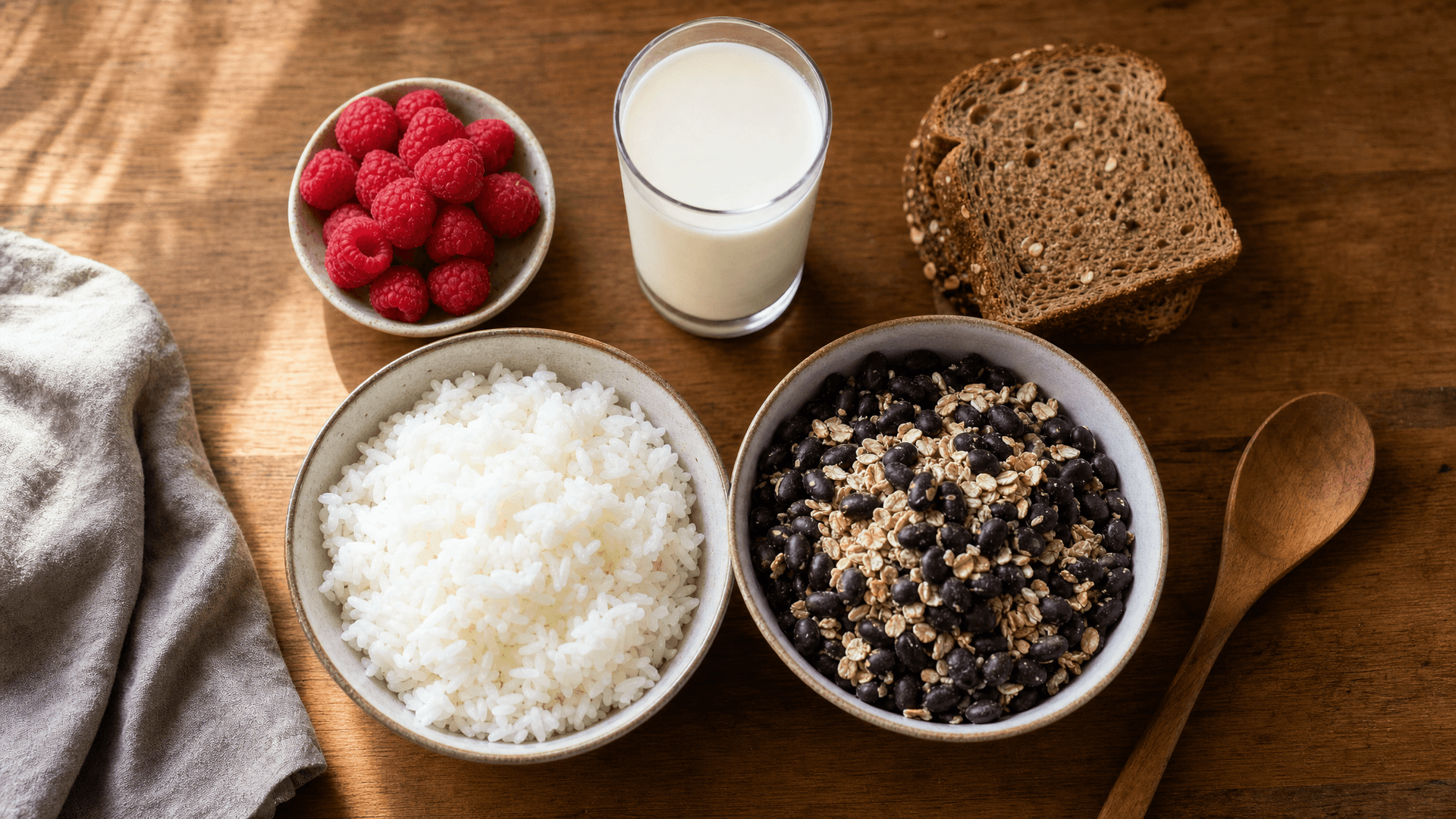
You're eating 3,500 calories a day. Oats for breakfast, brown rice and black beans at lunch, a big pile of broccoli with dinner, an apple and a handful of almonds between meals. Textbook clean bulk.
And by 8pm you're staring at your last 700 calories like they're a punishment. Your stomach feels like a bowling ball. You're not hungry, you're not full in a good way — you're just packed.
Here's what nobody told you: you probably ate 55 grams of fiber today. That's not a health win on a bulk. That's the reason you can't finish your food.
Fiber is the single most overlooked dial on a hardgainer's diet. Turn it too high and you physically can't hit your surplus. Turn it too low and you're constipated within four days of jumping to 4,000 calories. Almost nobody talks about the middle setting, which is where you actually want to live.
- Target 25-35g of fiber per day on a bulk, not the 14g per 1,000 calories the standard guidelines suggest
- Strip fiber out of pre-workout meals and the last 800 calories of your day
- Keep fiber in breakfast and your first two meals, where appetite isn't the bottleneck
- Soluble fiber slows gastric emptying — that's the mechanism killing your appetite
- Going under 15g on a high-calorie diet backs you up fast, especially with low water intake
- Refined carbs like white rice, cream of rice and sourdough are your surplus tools, not cheating
- Every 10g of fiber you cut is roughly 200-400 more calories you can actually fit in
Why Fiber Is Different When You're Bulking
Every piece of nutrition advice you've read about fiber was written for someone trying to eat less.
That's not an exaggeration. The entire public health case for fiber — 25-38g per day, eat more whole grains, load up on vegetables — is built around populations that are overeating calorie-dense processed food. Fiber helps because it's filling. It slows digestion, blunts blood sugar spikes, and makes people stop eating sooner.
Read that last sentence again. Makes people stop eating sooner. That is the entire point of the recommendation.
You're a guy at 150 lb trying to get to 172 lb. "Makes people stop eating sooner" is not a feature for you. It's the exact problem you're fighting every single day.
This isn't a reason to hate fiber. You still need it — I'll get to what happens when you go too low, and it's genuinely miserable. But you need to stop treating fiber as a number to maximize and start treating it as a number to set.
What Fiber Actually Does to Your Appetite
Two mechanisms, and they work differently. Knowing which is which lets you cut the right foods instead of just eating less salad and hoping.
Soluble fiber slows your stomach down
Soluble fiber — oats, beans, lentils, psyllium, chia, apples, sweet potato — dissolves in water and forms a gel. That gel physically slows how fast food leaves your stomach.
Gastric emptying is the rate-limiting step in how often you can eat. If a meal sits in your stomach for four hours instead of two and a half, you get half as many real eating opportunities per day. On a 2,200 calorie maintenance diet that doesn't matter. On a 3,800 calorie bulk it's the whole game.
This is why a bowl of oats with chia and berries feels heavier for longer than the same calories from cream of rice with honey and whey. Same energy. Wildly different residence time.
Insoluble fiber takes up space
Insoluble fiber — vegetable skins, wheat bran, broccoli stalks, leafy greens, corn — doesn't dissolve. It just adds bulk and passes through.
10.5 oz of steamed broccoli is about 100 calories and takes up more room in your stomach than a 7 oz ribeye at 500. Your stretch receptors don't measure calories. They measure volume.
Soluble fiber hurts your next meal by delaying it. Insoluble fiber hurts your current meal by filling you up mid-plate. Different problems, different fixes.
The Actual Number
Standard guidelines say roughly 14g of fiber per 1,000 calories. At 3,600 calories that's a little over 50g per day.
Fifty grams of fiber is a legitimately hard amount of food to eat. If you're pushing to hit that number while also hitting a surplus, you've given yourself two competing jobs and one stomach.
Here's what I'd actually target:
| Daily calories | Guideline says | Bulk target | Real-world range |
|---|---|---|---|
| 2,800 | 39g | 25-30g | 22-35g |
| 3,200 | 45g | 28-33g | 24-38g |
| 3,600 | 50g | 30-35g | 25-40g |
| 4,000+ | 56g | 30-38g | 25-42g |
Notice what happens as calories climb: the guideline number scales linearly, and the bulk target basically flattens out. That's deliberate. Your gut's need for fiber does not double because you went from 2,000 to 4,000 calories. Your need for room in your stomach absolutely does.
Roughly 30 grams a day is the sweet spot for most bulking lifters. Enough that your digestion runs normally. Low enough that you've got real capacity left for calories.
If you're currently at 50g and you don't know it, dropping to 30 is like being handed an extra 400-600 calories of appetite for free. Not because fiber has calories worth counting — because of the room it was occupying.
Do not read this as "fiber is bad, go to 10g." That's a genuinely unpleasant place to be, and I'll explain exactly why in a minute. The target is 30, not zero.
Where to Strip the Fiber Out
You don't cut fiber evenly across the day. You cut it surgically, from the meals where appetite and comfort are your binding constraints.
Pre-workout and intra-workout
Anything you eat in the 90 minutes before you train should be close to fiber-free.
A meal loaded with beans and vegetables sitting undigested in your stomach while you're under a heavy squat bar is how you end up nauseous on set three, cutting the session short, and blaming your "bad energy day."
Pre-workout, you want fast carbs and easy protein. White rice. Cream of rice. White bread with honey. A ripe banana. Whey. Rice cakes. Total fiber for that meal: under 3g.
Same logic for anything you're sipping during the session. Intra-workout carbs should be pure and boring — dextrose, cyclic dextrin, plain juice. Zero fiber, zero fat, nothing that lingers.
The last 800 calories of your day
This is the one that changes everything.
Almost every hardgainer's failure mode is the same: they hit 2,800 by 6pm and then completely stall out. The problem isn't willpower. It's that dinner is usually the most fiber-heavy meal of the day — a huge plate of vegetables, brown rice, maybe legumes — and it's landing on top of a stomach that's already been working since breakfast.
Flip it. Your evening food should be the most calorie-dense, lowest-fiber food you eat all day.
Think: pasta with olive oil and parmesan. Rice with fatty ground beef. A shake with whole milk, whey, peanut butter and honey. Full-fat Greek yogurt with granola and jam. Eggs fried in butter on white toast. Cheese. Ice cream, honestly.
If you want a deeper list, we broke this down in high-calorie foods that don't fill you up — it's basically a catalogue of low-fiber, low-volume calories, which is exactly what your last two meals should be built from.
Any meal you're forcing down
If you're eating something because the number says you have to, not because you want it, strip the fiber out of it. Forced meals should be as frictionless as physically possible. Swap the whole wheat wrap for a white one. Skip the side salad. Cook the rice, not the quinoa.
Make one meal a day your designated "no fiber" meal and treat it as a rule, not a decision. Mine's the 9pm one. Removing the choice is what makes it stick.
Where to Keep It
Now the other half, because this is where people overcorrect.
Breakfast. You've had 8-10 hours without food. Your stomach is empty, your appetite is as good as it'll be all day, and the fiber has the entire day to move through you. 3.5 oz of dry oats brings about 10g of fiber and roughly 380 calories. Perfect placement.
Your second meal. Same logic. Still early, still got capacity. This is where beans, lentils and whole grains belong if you like them — around 5 oz of cooked black beans gets you 11-12g of fiber alongside real calories and protein.
Fruit, up to a point. A couple of pieces of fruit a day is fine and genuinely useful for gut health. Just be aware that 7 oz of raspberries is 13g of fiber and about 100 calories — one of the worst calorie-to-fiber ratios in the entire food supply. Bananas, grapes and mango are far better bulking fruit.
One vegetable serving with one meal. Not three. One. You get the micronutrients, the gut benefit, and the "I'm not just eating beige food" psychological win, without donating a third of your stomach volume to something that's 30 calories.
That's your 30 grams, comfortably, without a single evening meal having to carry any of it.
The Flip Side: What Happens When You Go Too Low
I need to be blunt here, because guys read the first half of an article like this and go to 8g of fiber overnight.
On a 4,000 calorie diet, low fiber isn't neutral. It's actively bad, and it hits within about three or four days.
You're pushing enormous volumes of food through your gut. Fiber is what gives stool bulk and holds water in it. Cut it too low while eating that much, and you get hard, slow, painful bowel movements — or none for two days, followed by a very unpleasant afternoon. And ironically? Constipation makes you feel more full and less hungry than the fiber ever did. You've traded one appetite problem for a worse one.
The other thing that suffers is your gut microbiome. Fermentable fiber is what feeds the bacteria that produce short-chain fatty acids, which keep your gut lining healthy. Starve them for months and you'll notice — more bloating, more gas, more unpredictable digestion, not less.
Under 15g a day on a bulk is where things start going wrong. Under 10g and you're basically guaranteeing yourself problems.
If you're already dealing with bloating, cramping or unpredictable digestion, don't assume fiber is the culprit — there's usually more going on with meal spacing, fat intake and how fast you're eating. We covered the full diagnostic in how to fix digestion problems while bulking, and it's worth reading before you start cutting things.
Cutting fiber without raising water intake is the fastest way to get constipated on a bulk. Fiber pulls water into your stool. Less fiber plus the same water plus way more food equals a problem. Aim for at least 100-120 fl oz a day when you're eating 3,500-plus.
The Swap List
This is the practical part. Same calories, dramatically less fiber, way less stomach real estate.
| Swap this | For this | Fiber saved |
|---|---|---|
| Brown rice | White jasmine rice | ~4g per serving |
| Whole wheat pasta | Regular semolina pasta | ~6g per serving |
| Whole grain bread | Sourdough or white bread | ~4g per 2 slices |
| Steel-cut oats + chia | Cream of rice + honey | ~9g |
| Black beans as a side | Extra oil and cheese on the main | ~11g |
| Raspberries / blackberries | Banana, grapes, mango | ~9g |
| Almonds and walnuts | Macadamias or nut butter | ~3g |
| Big salad with dinner | Small side, or skip it | ~5g |
| Sweet potato with skin | Peeled potato, or white rice | ~4g |
| Whole wheat tortilla | Flour tortilla | ~5g |
None of these are "unhealthy." White rice is not a moral failing. This is the same food logic that makes an athlete's pre-race meal look like plain toast and jam — you're prioritizing what your body needs to do right now over a generic health checklist.
Run three or four of these swaps and you'll drop from 50g to 30g without changing a single macro target.
How to Set Your Fiber Without Tracking Every Gram
You don't need to log fiber forever. You need to know your number once, then use rules.
Step one: track it for three days. Any tracking app already shows fiber — you've just never looked at that row. Log three normal days, including the weekend, and get an honest average.
Step two: compare to your target. Take your daily calories, divide by 1,000, multiply by 9. That's a reasonable bulking target. At 3,400 calories: 3.4 × 9 ≈ 31g.
Step three: adjust with swaps, not with less food. If you're 20g over, pick two or three items from the swap table above. Never fix a fiber problem by eating less — fix it by eating the same calories from different sources.
Step four: check your output. Not glamorous, but it's the only real feedback loop. You want one to two comfortable bowel movements a day, no straining, no urgency. If you're going three or four times or feeling gassy and bloated, you're too high. If you're going every other day and it's a project, you're too low or too dry.
Adjust fiber by no more than 10g every 4-5 days. Your gut bacteria need time to adapt in either direction. Big overnight swings cause gas and bloating even when the destination is correct.
A Sample 3,500 Calorie Day, Fiber-Mapped
Here's what good distribution actually looks like. Notice the fiber loads front-to-back.
7:30am — Breakfast (750 cal, 11g fiber) 3.5 oz oats cooked in whole milk, one banana, 2 tbsp peanut butter, scoop of whey. Your heaviest fiber meal, eaten when your stomach is completely empty.
11:00am — Meal 2 (700 cal, 10g fiber) Chicken, 5 oz cooked black beans, white rice, avocado, a small handful of greens. Beans go here because you've still got eight hours of digestion ahead of you.
2:30pm — Pre-workout (550 cal, 2g fiber) White rice with soy sauce, 6 oz lean beef, a ripe banana. Deliberately clean and fast.
5:30pm — Post-workout (550 cal, 1g fiber) Whey, 2 oz cream of rice, 2 tbsp honey, a glass of whole milk. Liquid calories, effectively zero fiber, straight through.
8:00pm — Dinner (650 cal, 4g fiber) Pasta with olive oil, parmesan and ground beef. One small side of roasted zucchini. That's your entire vegetable serving for the evening and it's intentional.
10:00pm — Before bed (300 cal, 1g fiber) Full-fat Greek yogurt with honey and granola.
Total: 3,500 calories, 29g fiber. Twenty-one of those grams landed before noon. The last 1,500 calories of the day carry a combined 6g, which is exactly why they're finishable.
If your problem is that you genuinely can't face food at all by evening — not just that it's uncomfortable — the fiber fix helps but it isn't the whole answer. How to eat more when you're not hungry goes through the appetite side properly.
Common Mistakes
1. Treating fiber as "more is better." It's a range, not a maximization target. You wouldn't try to maximize sodium or maximize water. Same logic.
2. Loading vegetables at dinner. The single most common structural error. It's cultural — dinner is the "proper meal" — but it puts your bulkiest, lowest-calorie food at the exact moment your capacity is lowest.
3. Adding a fiber supplement on top of a whole-food diet. Psyllium is a great tool for someone eating 1,800 calories of processed food. On a 3,600 calorie whole-food bulk you're almost certainly already covered.
4. Cutting fiber and water at the same time. Guaranteed constipation. If you cut fiber, water goes up.
5. Going low-fiber and low-fat simultaneously. Fat helps things move. If you strip both, transit slows badly. Keep dietary fat generous — you need the calories anyway.
6. Blaming fiber for a fat problem. Very high fat meals eaten fast are their own source of bloating and nausea. Don't cut broccoli when the real issue was 2 oz of butter in one sitting.
7. Changing everything in one day. Your microbiome adapts over weeks. Make one swap, hold for four days, then make the next.
Where FuelTheGains Fits
The hard part of all this isn't understanding it. It's building a week of actual meals that hit 3,500 calories, land 30g of fiber in the right places, and still leave you able to eat dinner.
That's the problem was built for. You give it your stats and your target, and it builds a real meal plan with the calorie-dense, low-friction food placed where you actually have capacity for it — not a generic template that puts a mountain of brown rice and broccoli in front of you at 8pm and calls it a bulk.
No spreadsheet, no manual fiber math, no guessing why you keep stalling out at 2,900 calories. Just a plan you can eat.
The Bottom Line
Fiber isn't your enemy and it isn't a score to run up. It's a dial, and yours is probably set 20 grams too high.
Target 30 grams a day. Load most of it before noon. Keep your pre-workout meal and your last 800 calories nearly fiber-free. Drink more water than feels necessary. Adjust slowly and let your gut catch up.
Do that and you'll notice within a week that the food you've been failing to finish is suddenly finishable. Nothing about your plan changed except where the bulk went.
That's usually the whole difference between a bulk that stalls and one that works.