
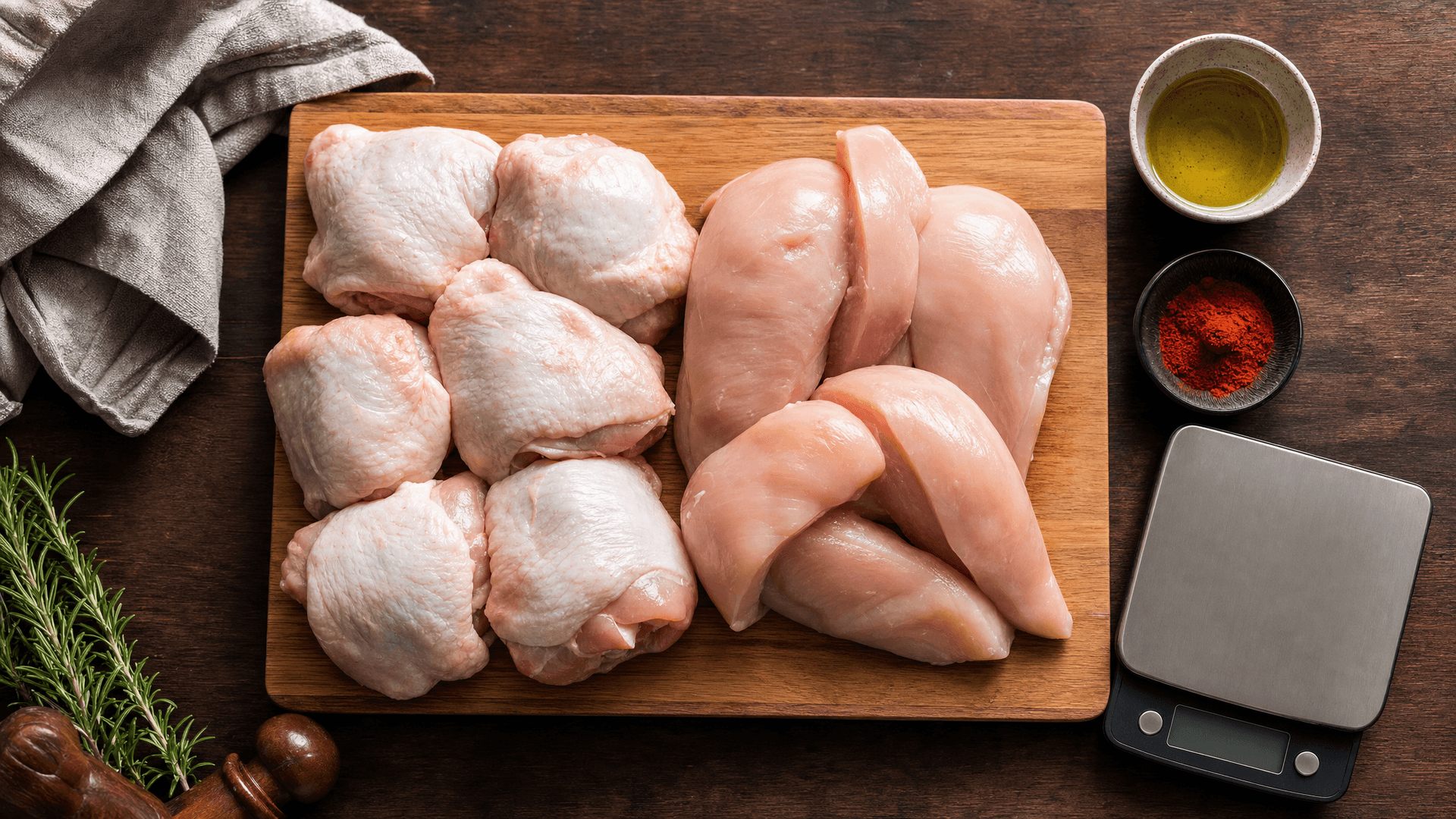
You've been buying chicken breast since the day you started lifting. Nobody told you to — you just absorbed it. Every physique guy on your feed had a container of dry white meat and broccoli, so that became the default.
Then you tried to bulk. And now you're standing in your kitchen at 9pm, staring at your fourth meal of the day, calculating that you're still 600 calories short and physically not hungry enough to care.
Here's the thing nobody says out loud: chicken breast is a cutting food. It's the leanest common protein on the planet. That's exactly what makes it great when you're trying to eat less, and exactly what makes it a pain in the ass when you're trying to eat more.
Chicken thighs solve most of that problem. They're cheaper, they're denser, they don't turn to sawdust when you reheat them, and the protein difference is way smaller than you think. Let's actually run the numbers instead of arguing about it.
- Thighs deliver roughly 25-30% more calories per gram than breast, which matters a lot when appetite is your limit
- Bone-in, skin-on thighs are often half the price per kilo of breast — the best calorie-per-dollar chicken you can buy
- The protein gap is real but small: about 26g vs 31g per 100g cooked
- Thighs are nearly impossible to overcook and they reheat without going rubbery
- Swap chart below lets you convert existing meals without recalculating your macros from scratch
- Breast still wins in two specific cases: very high protein targets on low calories, and shredded-meat recipes
The Numbers, Straight Up
Let's start with cooked weight, because that's what actually lands on your plate. Raw numbers are useful for shopping, cooked numbers are useful for eating.
| Cut (100g cooked) | Calories | Protein | Fat |
|---|---|---|---|
| Breast, skinless | 165 | 31g | 3.6g |
| Thigh, boneless skinless | 209 | 26g | 11g |
| Thigh, skin-on | 245 | 25g | 16g |
So per 3.5 oz of cooked meat, a skinless thigh gives you 44 more calories and 5 less grams of protein than breast. Skin-on thighs give you 80 more calories for the same 5g protein hit.
Five grams. That's it. That's the entire protein "penalty" that made you eat dry breast for three years.
Now scale that up to a real meal. Say you're eating 7 oz of cooked chicken at dinner:
- Breast: 330 cal, 62g protein
- Skinless thigh: 418 cal, 52g protein
- Skin-on thigh: 490 cal, 50g protein
You lost 10-12g of protein and gained 90-160 calories. If you're a hardgainer chasing 3,200 calories a day and hitting 2,700 because you're full, that trade is a no-brainer. You can replace 12g of protein with a scoop of whey in your shake in four seconds. You cannot manufacture appetite.
Chicken thigh fat is roughly 50% monounsaturated — the same category as olive oil and avocado. It's not the villain your 2015 fitness magazine said it was. The saturated fat in a 7 oz thigh serving is about 4g, which is nothing in the context of a full day.
Calories Per Dollar: It's Not Close
If you're bulking on a student budget, this is probably the section that decides it for you.
Typical grocery prices vary by country and store, but the ratio between cuts is remarkably consistent. Breast is the premium cut. Thighs are the discount cut. Bone-in, skin-on thighs are the clearance cut.
Here's a realistic snapshot:
| Cut | Price per kg | Price per lb | Cooked yield | Calories per $ |
|---|---|---|---|---|
| Breast, boneless skinless | $8.80 | $4.00 | ~72% | ~135 |
| Thigh, boneless skinless | $6.60 | $3.00 | ~75% | ~235 |
| Thigh, bone-in skin-on | $4.40 | $2.00 | ~60% edible | ~335 |
Read that last column again. Bone-in thighs give you roughly 2.5x the calories per dollar of breast. Even boneless thighs beat breast by around 75%.
For someone eating 2.2 lbs of raw chicken a week — which is normal for a guy at 165 lbs pushing a surplus — switching from breast to bone-in thighs saves you real money every single month. Money you can put into rice, oats, peanut butter, or milk. All of which are also absurdly cheap calories.
If cost-per-calorie is your main constraint right now, our breakdown of the cheapest calories per dollar for bulking covers the other 24 foods that belong in your cart alongside dark meat chicken.
Buy bone-in thighs, debone them yourself with a paring knife, and freeze the bones. Ten minutes of work, and you get free stock that turns rice into something worth eating. That's calories and flavor for zero extra cost.
Calories Per Gram of Stomach Space
This is the metric almost nobody tracks, and it's the one that actually determines whether your bulk succeeds.
You have a finite amount of stomach volume per day. Not calories — volume. If you're a naturally skinny guy, your appetite ceiling hits way before your calorie target does. So the real question for every food you eat is: how many calories am I getting per gram of physical bulk?
Chicken breast is about 1.65 calories per gram cooked. Skin-on thigh is about 2.45 calories per gram. That's a 48% improvement in calorie density for the exact same feeling of fullness.
Let's make it concrete. Say your daily chicken intake is 10.5 oz cooked:
- Breast: 495 calories, 93g protein
- Skin-on thigh: 735 calories, 75g protein
That's a 240-calorie swing from a single ingredient swap that costs you nothing in effort and takes up identical space in your stomach. Do that across two meals a day and you've closed most of a typical hardgainer's deficit.
And protein is rarely the binding constraint anyway. If you're at 165 lbs and targeting 0.8g per lb, you need about 135g of protein a day. Between eggs, dairy, a shake, and one chicken meal, you'll clear that without trying. The thing you'll miss is calories. Every time.
This doesn't mean fat is free. If you're already hitting your calories comfortably and just want more protein per bite, breast is the better tool. Calorie density is only an advantage when appetite — not appetite plus a scale reading — is your bottleneck.
Cooking: One of These Is Genuinely Easier
Here's where thighs stop being a nutrition argument and start being a quality-of-life argument.
Breast has a 10-degree window
Chicken breast is lean, which means there's almost no intramuscular fat to buffer heat. Pull it at the right internal temperature and it's juicy. Leave it 90 seconds longer and it's chalk. Every skinny guy who "hates chicken" hates overcooked breast, and almost everyone overcooks breast because the safe window is tiny.
To do breast properly you need to brine it, pound it to even thickness, sear it hot, and pull it early to rest. That's four steps of care for a piece of meat you're going to eat out of a container at your desk.
Thighs are basically foolproof
Thighs have more fat and more connective tissue. As they cook past the "done" point, that collagen breaks down into gelatin, which keeps the meat moist. There's a genuinely wide window — probably five to ten minutes — where a thigh goes from cooked to better. You can forget about them in the oven and they're still good.
Practical method that never fails: toss 2.2 lbs of thighs with 2 tbsp oil, salt, paprika, garlic powder, and whatever else is in the cupboard. Spread on a sheet pan. 425°F for 30-35 minutes. Done. No flipping, no thermometer, no anxiety.
Reheating is where breast dies
Meal prep means reheating. Reheating means a second cook. Breast that was perfect on Sunday is dry by Tuesday and unbearable by Thursday, because the microwave drives out what little moisture was left.
Thighs reheat fine. The rendered fat re-melts and coats the meat again. Day-four thigh tastes roughly like day-one thigh. If you've ever abandoned a meal prep because you couldn't face another rubbery breast, this alone is worth the switch.
For actual recipes built around this — most of which work with either cut — see our roundup of the best chicken recipes for bulking.
The Swap Chart
This is the part you can screenshot. If you already have meals built around chicken breast, here's how to convert them without redoing your macros from scratch.
Match the protein (keep protein identical, gain calories)
| Breast (cooked) | Swap to thigh, skinless | Protein | Calorie change |
|---|---|---|---|
| 100 g / 3.5 oz | 120 g / 4.2 oz | ~31g | +85 cal |
| 150 g / 5.3 oz | 180 g / 6.3 oz | ~47g | +130 cal |
| 200 g / 7 oz | 240 g / 8.5 oz | ~62g | +170 cal |
| 250 g / 8.8 oz | 300 g / 10.6 oz | ~78g | +215 cal |
Match the weight (easiest, minor protein drop)
| Same cooked weight | Protein change | Calorie change |
|---|---|---|
| 150 g / 5.3 oz | −7g | +65 cal |
| 200 g / 7 oz | −10g | +90 cal |
| 250 g / 8.8 oz | −12g | +110 cal |
The lazy version: keep your portion size exactly the same, swap the cut, and add nothing. You lose about 10g of protein per meal and gain about 90 calories. If you eat chicken twice a day, that's −20g protein and +180 calories.
Cover the protein with one extra egg, 5 oz of Greek yogurt, or half a scoop of whey. Any of those takes under a minute and costs less than the meat you saved on.
Chicken loses roughly 25% of its weight during cooking. So 2.2 lbs raw becomes about 1.65 lbs cooked. If you're prepping for the week and want 7 oz cooked chicken per meal across 5 meals, buy about 3 lbs raw boneless.
When Breast Actually Wins
I'm not going to pretend thighs are better at everything. There are two situations where breast is genuinely the right call.
1. High protein target, capped calories
If you're doing a very controlled lean bulk — say you're prone to gaining fat fast and you're holding a tight surplus of 250 calories — every calorie has a job. In that case, breast's protein-per-calorie ratio is the best of any whole food that isn't a fish fillet or a protein powder. Roughly 19g of protein per 100 calories, versus 12g for thigh.
Guys who put on fat easily, or anyone in the back half of a bulk who's watching the mirror get soft, should probably keep breast as the base and use thighs as the variety option.
2. Shredded and mixed dishes
Shredded chicken for tacos, wraps, salads, or a big batch of chicken salad works better with breast. The fibers pull apart cleanly and the neutral flavor takes on whatever sauce you throw at it. Shredded thigh works, but it's greasier in a cold application and the texture is stringier.
Everything else — roasting, grilling, pan-searing, curries, stir-fries, rice bowls, tray bakes — thighs win or tie.
The honest verdict
For a hardgainer trying to get from 150 lbs to 176 lbs, buy thighs most of the time. Maybe a 70/30 split in favor of dark meat. The calorie density, the price, and the fact that you'll actually finish the food are worth far more than 5g of protein per 3.5 oz.
Building Meals Around Thighs
A few combinations that work, roughly costed in calories so you can plug them straight in.
The tray bake (about 950 cal)
8.8 oz raw thighs, 10.5 oz potatoes cut into chunks, 2 tbsp olive oil, spices. One tray, 40 minutes at 425°F. About 950 calories and 50g of protein for maybe two minutes of actual work.
The rice bowl (about 1,100 cal)
7 oz cooked thighs over 1.5 cups cooked rice, a handful of frozen veg, 1 tbsp sesame oil, soy sauce, and a fried egg on top. This is the single best "I need calories and I need them now" meal in the rotation.
The curry (about 800 cal per portion)
Thighs are made for curry. The fat carries the spice, and the long simmer that would destroy breast just makes thighs better. 2.2 lbs of thighs, a can of coconut milk, curry paste, and you have four portions that get better in the fridge over three days.
What to pair it with
Chicken is a protein source, not a meal. The calories in a bulk come from what's next to it — rice, potatoes, oil, bread, dairy. If you're still building your protein rotation, our ranked list of the best protein sources for bulking shows where chicken sits against beef, eggs, dairy and the cheap stuff you might be ignoring.
When you roast thighs, there's a layer of rendered fat and juice in the bottom of the tray. That's 100-200 free calories with actual flavor. Spoon it over your rice. Throwing it away is the exact opposite of what a bulking guy should be doing.
Common Mistakes
1. Switching to thighs and not adjusting protein at all. The 5g per 3.5 oz difference is small per meal but adds up across a week. Add a shake or an extra couple of eggs and you're fine. Ignore it for a month and you're 20g a day short.
2. Buying "thigh fillets" at breast prices. Some stores charge nearly the same for trimmed boneless skinless thighs as for breast, which erases the entire cost advantage. Check the price per kilo, not the sticker. Bone-in is where the savings live.
3. Removing the skin because it "feels healthier." If you're bulking, the skin is 60-80 calories of pure convenience per thigh. Leave it on. Get it crispy. It's the reason the meal is enjoyable.
4. Assuming thighs mean you can skip tracking. Calorie-dense foods make it easier to hit a surplus, which also makes it easier to blow past it. Track for the first month so you know what your portions actually look like.
5. Cooking a week of thighs and eating them plain. Dark meat has more flavor than breast, but it's not a sauce. Batch three different seasoning blends across the same tray so you don't get bored by Wednesday.
Where FuelTheGains Fits
Knowing that thighs beat breast is the easy part. The annoying part is turning that into a week of meals that actually adds up to your target — figuring out how many grams of chicken, how much rice, how much oil, and what to eat on the days you train versus the days you don't.
That's the whole reason we built . You give it your weight, your training, and your budget, and it builds the meal plan around foods that are actually calorie-dense and cheap — dark meat chicken included — instead of handing you a generic list of grilled breast and steamed vegetables that no hardgainer has ever finished.
It also handles the swap math automatically. Change an ingredient, and the rest of the plan adjusts so you still land on your numbers. No spreadsheet, no re-doing your macros every time the store's out of something.
The Bottom Line
Chicken breast isn't bad. It's just optimized for a goal you don't have. It's a cutting food that bodybuilding culture accidentally turned into the default protein for everyone, including the guys who need the exact opposite.
If you're skinny, hungry-adjacent at best, and struggling to close a 500-calorie gap every day, dark meat is the easier path. More calories per gram of stomach space, roughly double the calories per dollar, and food you'll actually want to eat on day four of meal prep.
Buy a pack of bone-in thighs this week. Roast them at 425°F for 35 minutes with a lot of salt. See if your bulk doesn't get noticeably less miserable.