
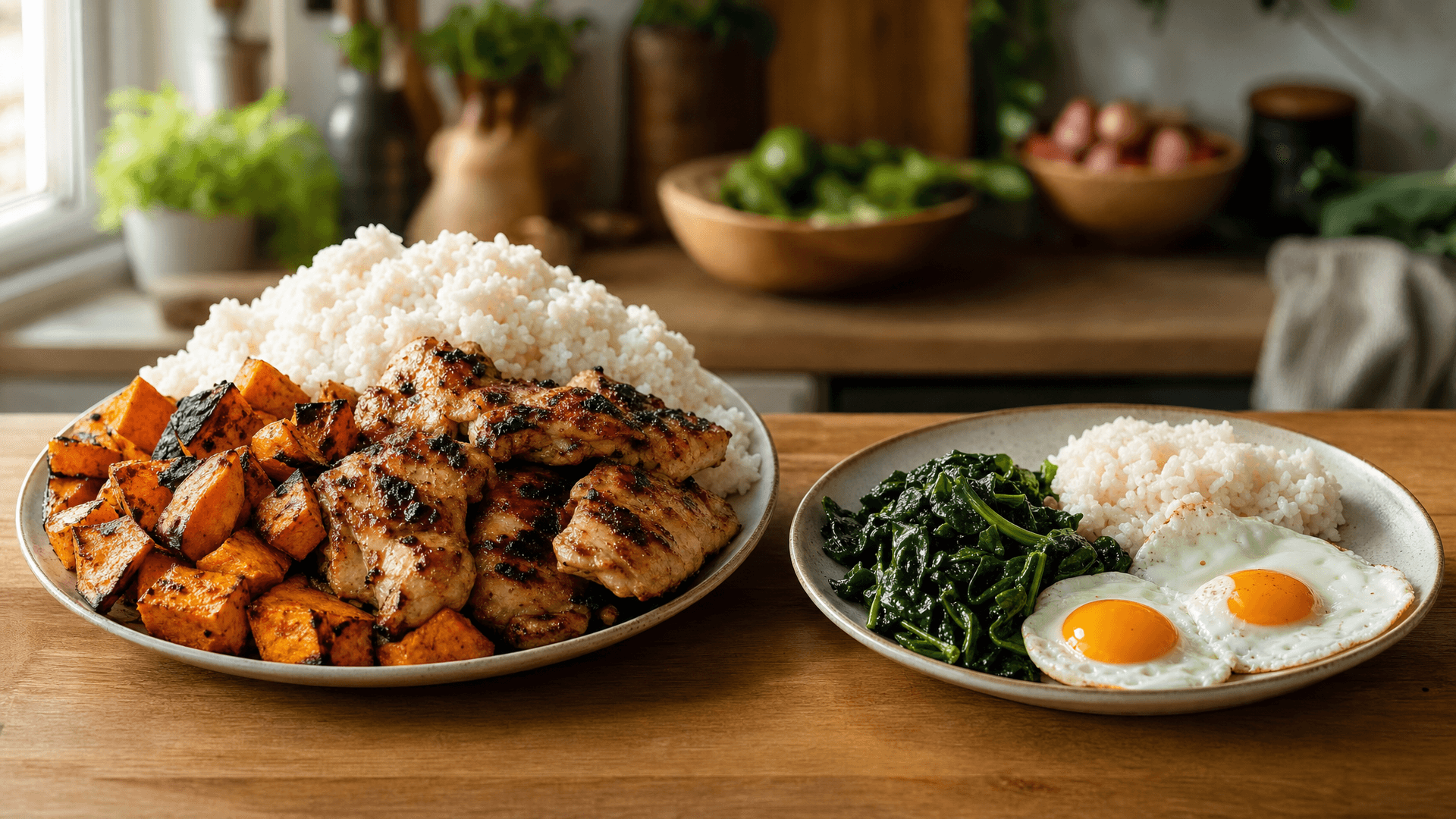
Here's the thing almost nobody tells skinny guys who are trying to bulk: your body doesn't need the same amount of food every single day.
Yet that's exactly how most people bulk. They calculate one number — some flat daily calorie target — and eat it seven days a week. Same on leg day. Same on the rest day where they moved from the couch to the fridge and back.
Then they panic when the scale creeps up and the waistband gets tight. "I'm getting fat." So they cut calories across the board, kill their surplus, and stall out.
There's a smarter way to run this, and it's called calorie cycling. You eat more on the days you train — when your muscles are actually primed to grow — and pull calories back on rest days when you don't need the extra fuel. Same weekly surplus, better body composition.
This is the middle ground between a lazy flat bulk and obsessive, weigh-every-almond tracking. Let me show you exactly how to set it up.
- Calorie cycling means eating more on training days and less on rest days, while keeping your weekly surplus the same
- Training days are when muscle protein synthesis is elevated, so extra calories there build more muscle and less fat
- Set your weekly surplus first, then distribute it: high days get the bulk of it, low days sit near maintenance
- A simple split is +500 to +700 on training days and +0 to +150 on rest days
- Protein stays high and constant every day — only carbs and fats move
- It lets hardgainers run a bigger overall surplus with less fat gain than a flat bulk
Why eating the same calories every day is a mistake
Your body isn't in the same state on Monday as it is on Sunday.
When you train hard — especially heavy resistance training — you kick off a process called muscle protein synthesis (MPS). It's your body's repair-and-build response, and it stays elevated for roughly 24 to 48 hours after a tough session. During that window, your body is actively looking for raw materials: protein to rebuild muscle fibers, carbs to refill the glycogen you burned, and enough total energy to make the whole thing happen.
Give it a calorie surplus in that window, and a bigger chunk of those extra calories get partitioned toward muscle.
Now flip it. On a rest day, MPS has settled back down. You're not depleting glycogen, you're not creating training damage to repair. Your body's demand for extra fuel drops. But if you're eating that same big surplus anyway? Those extra calories don't have anywhere useful to go. They're far more likely to be stored as fat.
That's the flaw in the flat bulk. You're feeding a growth signal on days it isn't there, and paying for it in fat.
"Partitioning" just means where your calories end up — muscle or fat. Training improves partitioning for a day or two afterward. Calorie cycling stacks your biggest surplus on top of that window to take advantage of it.
The core idea: same weekly total, different daily split
Here's the part that trips people up. Calorie cycling is not about eating less overall. Your weekly surplus stays exactly the same. You're just redistributing it.
Think in weeks, not days.
Say you've decided you need a +2,800 calorie weekly surplus to gain roughly 0.5-0.75 lb per week — a solid lean-bulk pace. On a flat bulk, that's +400 calories every day, seven days a week.
With calorie cycling, you take that same +2,800 weekly total and pour most of it into your training days. If you train four days a week, you might run +600 on each of those four days (that's +2,400) and +100 on each of the three rest days (that's +300). Add it up: +2,700. Basically the same weekly surplus, but now the food is landing where it actually helps.
If you've never nailed down your numbers, start with our guide on how to calculate your bulking calories — you need a maintenance figure and a weekly surplus before any of this cycling math means anything.
Step 1: Find your maintenance and weekly surplus
You can't cycle around a number you don't know. So first, pin down maintenance.
For most guys who train hard, maintenance lands somewhere around 15-17 kcal per lb of bodyweight, but that's a starting estimate, not gospel. A 155 lb lifter might sit around 2,600 maintenance calories. A bigger 190 lb guy could be closer to 3,000.
Track your intake and weight for two weeks at a steady calorie level. If your weight holds flat, that's maintenance. If it drifts, adjust.
Once you've got maintenance, decide your weekly surplus based on your goal pace:
| Weekly weight gain | Weekly surplus | Best for |
|---|---|---|
| ~0.2 kg / 0.5 lb | +1,750 cal | Cautious lean bulk |
| ~0.35 kg / 0.75 lb | +2,800 cal | Standard lean bulk |
| ~0.5 kg / 1 lb | +3,850 cal | Aggressive / true hardgainer |
A skinny hardgainer who genuinely struggles to gain can lean toward that bottom row. If you gain fat easily, stay near the top.
Weigh yourself daily, first thing in the morning, and use the weekly average — not any single day. Day-to-day scale swings are mostly water and food weight, and they'll drive you crazy if you react to them.
Step 2: Split the surplus across high and low days
Now take that weekly surplus and distribute it. The rule of thumb:
- Training days (high days): get the majority of the surplus
- Rest days (low days): sit at maintenance or just slightly above
A clean, simple split most people can run:
- High days: maintenance +500 to +700
- Low days: maintenance +0 to +150
Let's use a real example. Take that 155 lb lifter with a 2,600 maintenance who trains 4 days a week and wants a +2,800 weekly surplus.
| Day type | Days/week | Calories each | Surplus each |
|---|---|---|---|
| Training (high) | 4 | 3,250 | +650 |
| Rest (low) | 3 | 2,700 | +100 |
Weekly surplus: (4 × 650) + (3 × 100) = 2,600 + 300 = +2,900. Dialed in.
The beauty here is the high day feels generous. You're eating 3,250 calories on a day you're hungry anyway — post-training appetite is real. And the low day at 2,700 feels almost effortless, barely above maintenance, so you're not force-feeding on days your appetite is flat.
If you train 5-6 days a week, your high days carry less surplus each because you have more of them. Just keep the weekly total fixed and divide. More training days means a smaller per-day bump — that's fine, the growth window is covered more often.
Step 3: Keep protein constant, move carbs and fat
This is the part people get wrong. When they hear "eat less on rest days," they cut protein. Don't.
Protein stays high and constant every single day. Rest days are when your body is doing most of the actual rebuilding, so it needs a steady protein supply just as much as training days do. Aim for 0.7-1.0 g per lb of bodyweight, every day, high or low.
For our 155 lb guy, that's roughly 130-150g of protein daily, no matter what.
What actually moves between high and low days is carbs and fat — mostly carbs.
Carbs are your training fuel. On high days, load them up: they refill glycogen, drive performance, and blunt muscle breakdown. On low days, pull them back since you're not depleting glycogen.
Here's how the macros might shake out for that same lifter:
| Macro | High day (3,250 cal) | Low day (2,700 cal) |
|---|---|---|
| Protein | 140g | 140g |
| Carbs | 400g | 280g |
| Fat | 90g | 85g |
Notice protein is identical. Fat barely moves. The carbs do the heavy lifting — about 120g of difference, which is right around 480 calories. That's your whole daily swing, and it maps perfectly onto when your body can use those carbs best.
Time the bulk of your extra high-day carbs around your workout — a solid meal 2-3 hours before and another within a couple hours after. That's when your muscles are most insulin-sensitive and hungriest for glycogen.
What a high day actually looks like on a plate
Numbers are abstract. Food isn't. Here's a sample training-day layout hitting roughly 3,250 calories and 140g of protein.
Breakfast: 3 whole eggs, 2 slices toast, 2 oz oats cooked with a scoop of whey and a banana. Big, carb-heavy start.
Lunch: 7 oz chicken breast, 1.5 cups cooked rice, veggies, olive oil drizzle.
Pre-workout snack: Greek yogurt with honey and a handful of granola.
Post-workout: A shake with 2 scoops whey, whole milk, and another banana — fast carbs and protein right in the window.
Dinner: 6 oz lean beef, a large baked potato, more veggies.
That's a genuinely big day of eating, and it should be. If you're a hardgainer, don't be surprised if you need a shake to close the gap — chewing 3,250 calories is a job.
Don't try to hit high-day calories entirely from clean, low-density foods like chicken and rice on day one. You'll fill up before you hit your target. Use calorie-dense helpers — whole milk, nut butters, olive oil, dried fruit — to close the gap without a bloated stomach.
What a low day looks like
Low days are easier. You're near maintenance, so it feels like a normal day of eating with plenty of protein.
Breakfast: 3 eggs, one slice of toast, a piece of fruit.
Lunch: 6 oz chicken, a moderate portion of rice, big salad.
Snack: Cottage cheese or Greek yogurt.
Dinner: 5 oz salmon, roasted potatoes, veggies.
Fewer carbs, same protein, and you're not stuffing yourself. This is also where rest days get their own strategy — protein timing, recovery foods, and appetite management all matter. We cover it in depth in rest day nutrition for bulking.
Why this works so well for hardgainers
Here's the real payoff, and it's the reason calorie cycling beats a flat bulk for skinny guys specifically.
Because your surplus is concentrated on days your body can actually use it, you can run a bigger overall surplus with less fat gain. The flat bulker who tries to push +500 every day ends up softer, because half those surpluses land on rest days and turn to fat. You're spending that same surplus more efficiently.
For a hardgainer whose whole problem is not eating enough, this matters twice over. You get to do your heaviest eating on days you're already hungry from training, which makes the surplus achievable. And you get to eat lighter on days your appetite is naturally low, so you're not choking down food you don't want.
It's the exact strategy we lean on for staying lean while growing — the full framework is in how to gain muscle without getting fat. Calorie cycling is one of the sharpest tools in that toolbox.
If you're a true hardgainer who's failed to bulk before, try pushing your high days to maintenance +700 and keeping low days right at maintenance. You'll get a strong growth stimulus on training days and give your appetite a break in between.
Common mistakes to avoid
Calorie cycling is simple, but there are a few ways to screw it up.
1. Cutting protein on low days. Said it already, saying it again because it's the biggest one. Protein is constant. Every day. Your recovery depends on it.
2. Turning low days into diet days. Low days are near maintenance, not a cut. If you drop way below maintenance, you're bleeding off the surplus you built on high days and killing your weekly total. Keep low days at or just above maintenance.
3. Making high days a free-for-all. "High day" doesn't mean "eat until you can't move." It's a specific number — maintenance plus 500-700. Blowing way past it turns your lean bulk into a dirty bulk fast.
4. Ignoring the weekly total. This is the number that actually drives weight gain. If you cycle perfectly but your weekly surplus is too small, you won't grow. Do the weekly math and check it.
5. Reacting to daily scale weight. You'll weigh more the morning after a high day — that's food and water, not fat. Only the weekly average tells the truth.
Give any calorie setup a solid 3-4 weeks before judging it. If the weekly-average scale is climbing at your target pace and your lifts are going up, it's working. If the scale is flat after a month, bump your weekly surplus by around 250-350 calories and reassess.
How to track progress without going insane
The whole point of calorie cycling is that it's the middle path — more strategic than a flat bulk, less obsessive than tracking every gram forever.
So track smart:
- Weigh daily, judge weekly. Morning weight, weekly average, that's your signal.
- Log your lifts. If the weight on the bar and your reps are climbing, you're growing.
- Check the mirror and the waistband. If your waist is ballooning faster than your shoulders, your surplus is too big — trim the high days first.
- Take monthly photos. Same lighting, same time of day. Progress is slow enough that photos catch what the mirror misses.
You don't need to weigh food for the rest of your life. Nail your portions for the first 4-6 weeks so you know what a high day and a low day actually look like on your plates. After that, most guys can eyeball it and just spot-check occasionally.
Where FuelTheGains fits in
Calorie cycling works — but only if you actually hit your high-day targets. And that's exactly where most hardgainers fall apart. Hitting 3,250 calories and 140g of protein on a training day is hard when you've got a small appetite and a busy schedule.
That's the gap is built to close. When you're staring down a big high-day number and you're already full, a genuinely calorie-dense, high-protein option makes the difference between hitting your target and coming up 400 calories short — again.
We built it for the skinny guy who does everything right in the gym and still can't eat enough to grow. No choking down a sixth chicken breast, no giving up because the food is a chore. Just an easier way to close the daily gap, especially on the days that matter most.
Because the best bulking plan in the world is worthless if you can't actually eat the food.
The bottom line
Your body isn't the same every day, so your calories shouldn't be either. Eat big on training days when muscle is primed to grow, pull back to maintenance on rest days, and keep protein high across the board.
Same weekly surplus, better results — more muscle, less fat, and a plan that actually fits your appetite instead of fighting it.
Set your numbers, run it for a month, and let the weekly average tell you the truth. This is the smart way to bulk.