
You take your meds at 7:30 a.m. You get more done before noon than most people do all day. And then you look down at 4 p.m. and realize you've eaten a granola bar and half a coffee.
That's not a discipline problem. That's pharmacology.
Stimulant ADHD medication — Adderall, Vyvanse, Ritalin, Concerta — works partly by boosting dopamine and norepinephrine, and appetite suppression is a well-documented side effect of exactly that mechanism. For most people it doesn't hit like nausea. It's quieter and way more dangerous for a bulk: hunger just never shows up. You don't feel full. You don't feel anything. Food becomes a task you keep meaning to get to.
So you eat when you remember, which is roughly twice a day, which is roughly 1,500-1,800 calories, which is why you've weighed the same 143 lbs since your junior year.
Here's the thing nobody tells you: you don't have to fight the medication. You have to schedule around it. The suppression isn't constant — it's a curve with a beginning, a flat middle and an end. Every one of those phases has a different job. Once you map your food onto that curve instead of onto a normal person's hunger cues, gaining weight gets a hell of a lot easier.
- Stimulant meds suppress appetite for roughly 8-10 hours, not all day — the curve has exploitable windows
- Front-load a huge breakfast in the 30-60 minutes before your dose kicks in
- Use liquid calories through the dead zone because chewing is the part your brain refuses
- The evening rebound window is your single biggest calorie opportunity — plan for it, don't wing it
- Set alarms for food the same way you'd set them for the dose itself
- Eat the same target on off-days, and never compare a Saturday weigh-in to a Wednesday one
Why Your Appetite Actually Disappears
Stimulants raise norepinephrine and dopamine signalling in the brain, and that signalling overlaps heavily with the circuits that regulate hunger and satiety. The practical result is that the "I should eat" signal gets turned down for as long as the drug is active in your system.
Two things make this brutal for someone trying to bulk.
First, the suppression window covers the exact hours you'd normally eat. Lunch happens in the dead zone. Mid-afternoon snacks happen in the dead zone. If you're on an extended-release formula taken at 7 a.m., you're effectively appetite-blind from roughly 8 a.m. to 5 p.m. That's two of your three meals gone.
Second, you don't notice it happening. Someone who feels sick after eating knows they have a problem. You just... don't think about food. Then you eat one big dinner, feel stuffed, and conclude you "eat a ton." You don't. You ate 900 calories in one sitting and 600 across the rest of the day.
The average guy in this position is running a 600-900 calorie daily deficit compared to what he thinks he's eating. That's not a rounding error. That's the entire difference between gaining 0.7 lb a week and gaining nothing for three years.
Nothing here is medical advice, and skipping doses to eat more is a terrible trade — your focus, your work and your training consistency all live on that prescription. Talk to your prescriber about timing, formulation and dose if suppression is severe. The strategies below are about working with the medication, not around it.
Map the Curve Before You Plan the Food
Before you change anything, spend three days writing down two things: what time you dose, and what time hunger actually returns. Most people are shocked at how predictable it is.
A typical curve looks like this:
| Phase | Timing after dose | What appetite feels like |
|---|---|---|
| Pre-onset | -30 to +30 min | Normal, sometimes strong |
| Ramp | 30-90 min | Fading fast |
| Dead zone | 1.5-8 hours | Absent, food feels like a chore |
| Taper | 8-11 hours | Coming back, often suddenly |
| Rebound | 11-15 hours | Very strong, sometimes ravenous |
Instant-release formulas like standard Adderall IR or Ritalin compress this — a shorter, sharper dead zone, often with two humps if you take a second dose. Extended-release formulas like Vyvanse, Adderall XR or Concerta stretch it out into one long flat plateau.
Your plan is the same either way. Load the edges, drink through the middle.
Step 1: Front-Load Breakfast Before the Dose
This is the single highest-leverage change, and it's the one people resist hardest because mornings are chaos and the whole reason you take the pill is to make mornings functional.
Do it anyway. The 30-60 minutes before onset is the only time all day your appetite is genuinely on your side, and you're going to waste it if you dose first and eat second.
The target: 800-1,200 calories before the pill takes hold. That's not a normal breakfast. That's a breakfast built for the job.
What that actually looks like:
- 3 whole eggs scrambled in 1 tbsp butter, plus 2 slices of buttered toast — around 650 calories
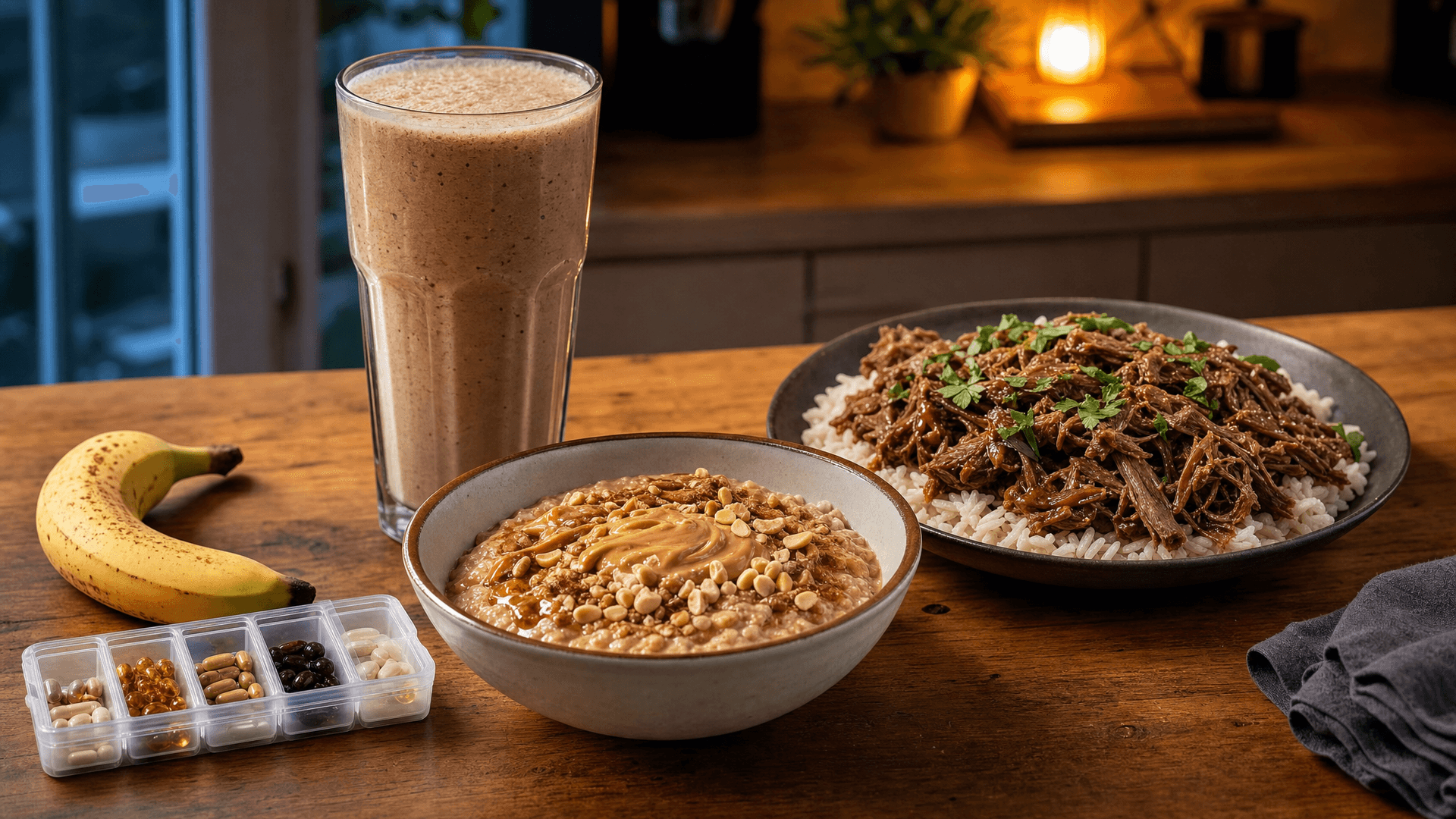
- A bowl of oats made with whole milk instead of water, 2 tbsp peanut butter stirred in, one banana — around 700 calories
- 9 oz of full-fat Greek yogurt, a handful of granola, honey, and 1 oz of walnuts — around 750 calories
- Leftover dinner. Seriously. Cold pasta at 7 a.m. is completely valid.
Two rules make this survivable.
Prep it the night before. Overnight oats, pre-portioned egg mix, a container of last night's rice and chicken. Morning-you has zero executive function before the meds hit — that's the whole problem. Don't ask morning-you to make decisions.
Take the pill mid-meal or right at the end. Check the instructions on your specific prescription, since some are meant to be taken with food and some aren't, but as a general timing principle, dosing after you've already eaten most of the meal buys you the whole window.
If you can only change one thing this week, change breakfast. Adding 600 calories to a meal you already eat is easier than inventing a whole new meal in the middle of the dead zone.
Step 2: Drink Your Way Through the Dead Zone
Here's the key insight about appetite suppression: it kills your desire to eat far more than your ability to eat. You can physically get calories down. Your brain just refuses to initiate the process, and chewing a plate of food when you have no hunger feels like homework.
Liquid calories sidestep that entirely. No plate, no fork, no thirty minutes of chewing something you don't want. You drink it in two minutes and you've banked 700 calories.
This is why shakes are non-negotiable on stimulants, not optional. Through an 8-hour dead zone, you want 1-2 shakes at 600-800 calories each. That's potentially 1,600 calories acquired during the hours you'd otherwise eat almost nothing.
A basic one that works:
- 2 cups whole milk — 300 cal
- 1 scoop whey — 120 cal, 25g protein
- 2 tbsp peanut butter — 190 cal
- 1 banana — 100 cal
- ¼ cup rolled oats — 75 cal
That's 785 calories and 40g of protein in about 90 seconds of effort. If you want more variety, we've got seven high-calorie shake recipes with full macros that all clear 700 calories.
The dead-zone rules:
Sip, don't chug. A shake sitting on your desk that you finish over 40 minutes goes down much easier than one you try to slam. Fullness isn't the enemy here, but a cold gut-bomb at 1 p.m. can put you off food for the rest of the afternoon.
Set an alarm. Label it. "SHAKE." You will not remember on your own — that's not a character flaw, it's literally the medication doing its job on your attention and your hunger at the same time.
Keep a backup that requires nothing. A carton of ready-to-drink mass shake, a jar of trail mix in your bag, 1.8 oz of nuts in your desk drawer. On the days you skipped prep, this is the difference between 2,900 calories and 2,100.
If you do want solid food in the dead zone, pick things that are calorically dense and physically small — that's the entire category of high-calorie foods that don't fill you up. Dried fruit, nut butters, olive oil on everything, full-fat dairy, cured meats. A handful of dried apricots and 1.4 oz of almonds is 400 calories that takes up almost no room.
Don't try to fix the dead zone with volume food. A big salad, a bowl of soup, a plate of chicken and vegetables — these take forever to eat, kill what little appetite you have, and net you 400 calories for 30 minutes of work. In the dead zone, calorie density is everything.
Step 3: Own the Rebound Window
Around hour 9 to 12, the drug clears enough that your hunger comes back — and it often comes back hard, because your body has been running a deficit all day and now the brakes are off.
Most guys waste this window. They're tired, the crash makes them irritable, and they either eat one normal dinner and go to bed, or they eat a pile of low-calorie garbage while scrolling and don't count it.
Treat the rebound as your second-biggest meal of the day, planned in advance. Target 900-1,200 calories across dinner and an evening snack.
What makes this work:
Have the food already made. The rebound hits at the exact moment your executive function is at its lowest for the day. If dinner requires 45 minutes of cooking, it becomes a bowl of cereal. Batch-cook on Sunday, or keep something you can heat in 6 minutes.
Add fat to what you already cook. A tablespoon of olive oil on the pasta, cheese on the rice bowl, butter on the vegetables. Fat is 9 calories a gram, which is why it's the fastest way to raise a meal's calories without raising its size. Two extra tablespoons of oil across dinner is 240 calories you won't notice eating.
Use the pre-bed slot. An hour before sleep, when hunger is fully back, is a free 400-600 calories. Cottage cheese with honey and nuts. A shake. A peanut butter sandwich and a glass of whole milk. This is also good timing for slow-digesting protein overnight.
Aim for a total daily protein target of roughly 0.7-0.9g per lb of bodyweight, and don't stress about spreading it perfectly. A skewed distribution — light at midday, heavy morning and evening — is fine. Total intake matters far more than timing.
Cook double portions every single time you cook. The extra portion is tomorrow's breakfast or tomorrow's emergency dinner. On stimulants, the meal you don't have to make is the meal you actually eat.
Dosing Days vs. Off Days
A lot of people take a "drug holiday" on weekends or during breaks — no meds, or a lower dose. Your appetite comes roaring back and you eat like a normal human for two days.
This is a gift and most guys blow it in one of two directions.
Direction one: they under-eat anyway, out of habit. Your food schedule for the last five days has been built around suppression — small lunches, shakes, one big dinner. On Saturday your appetite is functional, but the habit stays, and you eat the same 2,400 calories you eat on a Tuesday. That's a wasted opportunity.
Direction two: they treat it as a free-for-all and then feel guilty about it. Don't. Off-days are when you should be eating the most food you eat all week.
The practical approach: hold your calorie target constant, change how you hit it.
| Day type | Target | How you hit it |
|---|---|---|
| Dosing day | 3,200 cal | Huge breakfast + 2 shakes + big dinner |
| Off day | 3,200 cal (or a little more) | 3-4 normal meals, fewer shakes needed |
Same number. Different vehicle. On off-days you don't need to force liquid calories, so eat real food and enjoy it. On dosing days, the shakes do the work your appetite can't.
If your off-day naturally lands at 3,600 or 3,800 calories because you're genuinely hungry — great, take it. A weekly average of 3,300 built from five days at 3,200 and two days at 3,600 is a better bulk than seven flat days you had to force. Bodies work on weekly totals, not daily ones.
Why the Scale Lies on Weekends
Here's a pattern that wrecks more ADHD bulks than the appetite suppression itself.
You weigh in Monday morning after a weekend of real eating: 146.4 lbs. Up almost 2 lbs. You feel like it's finally working.
Then you weigh in Friday, after five days of shakes and forced meals: 144.4 lbs. Down almost a kilo. You conclude the plan isn't working and you either give up or panic-add calories.
Neither number was real. What changed was carbohydrate intake, sodium and gut content, not tissue. Weekend eating means more carbs, more salt, more total food volume sitting in your digestive tract — each gram of stored glycogen holds roughly 3 grams of water with it. A big carb-and-salt weekend can swing the scale by 2-3 lbs with zero change in actual mass.
Then Monday to Friday you're on shakes and lower food volume, the water comes off, and the scale drops.
Two rules fix this permanently:
Weigh every morning, same conditions. Out of bed, after the bathroom, before food or water, same clothing situation.
Only compare weekly averages. Take all seven numbers, average them, and compare that number to last week's average. Never compare a single Monday to a single Friday. Real gain looks like an average creeping up 0.5-0.9 lb a week while the daily numbers bounce around like a bad stock chart.
Give it three weeks before you judge anything. Two weeks of averages is barely enough signal to see through the noise.
A Full Day That Actually Hits 3,300 Calories
Here's what this looks like assembled, for someone dosing Vyvanse at 7:30 a.m.
| Time | What | Calories |
|---|---|---|
| 6:50 | Oats, whole milk, peanut butter, banana | 720 |
| 7:00 | 2 eggs on buttered toast | 380 |
| 7:30 | Dose | — |
| 11:00 | Shake (milk, whey, PB, oats) | 785 |
| 14:30 | Nuts + dried fruit + cheese | 450 |
| 19:00 | Pasta with meat sauce, olive oil, parmesan | 850 |
| 21:30 | Cottage cheese, honey, walnuts | 420 |
| Total | 3,605 |
Notice the shape: 1,100 calories before 7:30 a.m., about 1,235 sipped or grazed through the dead zone, and 1,270 in the evening. Only two of those seven entries require real cooking.
Adjust the total to your own numbers. Estimate maintenance at roughly 15-17 calories per pound of bodyweight if you're active, then add 300-500 for a lean bulk. A 154 lb guy who trains four times a week and walks a lot lands somewhere near 2,900 maintenance, so 3,300 is a solid starting target.
Five Mistakes That Kill ADHD Bulks
- Waiting to feel hungry. You won't, for eight hours. Eating on a clock instead of on hunger is the entire strategy. Alarms, not instincts.
- Coffee stacked on top of the meds. Caffeine compounds appetite suppression and it's usually the thing standing between you and breakfast. Move your coffee to after you've eaten, or cut the morning cup entirely for two weeks and see what happens to your intake.
- Skipping the shake because you "had a big lunch." In the dead zone you're a terrible judge of how much you ate. Track it for a month, honestly, and stop guessing.
- Increasing meal size instead of meal frequency. Bigger plates in the dead zone don't get finished. More small, dense hits do.
- Giving up at week two. Water weight, training volume changes and inconsistent weigh-in timing make the first fortnight look flat almost every time. If your average is up at all after three weeks, the plan is working.
If the core problem is that food just doesn't appeal to you at all — meds aside — there's a whole separate toolkit worth reading in our guide on how to increase your appetite for bulking.
Where FuelTheGains Fits
The hardest part of this isn't the science. It's that a suppressed-appetite bulk requires a genuinely different meal plan — one that puts 1,100 calories before 8 a.m., replaces lunch with something drinkable, and stacks the back half of the day. Building that yourself, around your dose timing and your food preferences and your budget, is a few hours of spreadsheet work you'll probably never do.
That's what FuelTheGains does. You put in your stats, your training, your dose schedule and what you'll actually eat, and it builds the week: exact meals, exact portions, exact timing, with a grocery list attached. If you're on stimulants, the front-loaded-breakfast-plus-liquid-midday shape is the one to build around — and having it written down means you're not making food decisions at 2 p.m. with zero hunger and zero interest.
Have a look at if you want the plan handed to you instead of engineering it yourself.
The Bottom Line
Appetite suppression isn't a wall, it's a schedule. Your meds give you a big open window in the morning, a long flat stretch where only liquids get through, and a hungry evening that most people sleep through.
Load the edges. Drink the middle. Eat the same on off-days. Judge yourself on weekly averages, not on Monday's number.
Do that for a month and you'll gain more weight than you did in the previous two years — not because you found more discipline, but because you finally stopped expecting your body to tell you when to eat.