
You've been going to the gym for a few weeks, maybe a few months. You're hitting the weights, doing the exercises you found online, and yet — nothing. The scale hasn't moved. Your arms look the same. Your shirts still fit the same way they did six months ago.
Sound familiar? You're not alone. Most skinny guys who start lifting make one critical mistake: they train hard but eat like they're on a diet. Building muscle without a caloric surplus is like trying to build a house without buying materials. You can have the best blueprint in the world — it doesn't matter if there's nothing to build with.
This guide is everything you need to know to run your first successful bulk. No fluff, no bro-science, just what actually works.
- Eat in a caloric surplus of 300-500 calories above your TDEE every single day
- Hit at least 0.7g per lb of protein daily — aim for 1g per lb
- Follow a structured program with progressive overload — not random exercises
- Weigh yourself daily and track the weekly average to monitor progress
- Aim to gain 1-2 lbs per month for a lean bulk
- Sleep 7-9 hours per night — muscle is built during recovery, not in the gym
What Is Bulking, Exactly?
Bulking is a phase where you intentionally eat more calories than your body burns to support muscle growth. That's it. It's not complicated in theory — eat more, lift heavy, sleep well, and your body builds new muscle tissue.
The reason it works is simple biology. Your body needs two things to build muscle:
- A stimulus — resistance training that tells your muscles "hey, you need to get bigger"
- Raw materials — enough calories and protein to actually construct new tissue
Without the surplus, your body doesn't have the energy or building blocks to add muscle. You might get a little stronger through neural adaptations (your brain gets better at recruiting existing muscle fibers), but actual muscle growth? That requires fuel.
There are two main approaches:
Lean bulk (recommended for beginners): A moderate surplus of 300-500 calories. You gain muscle with minimal fat. It's slower but you look good the entire time and don't need an aggressive cut afterward.
Dirty bulk: Eating everything in sight with no regard for quality or surplus size. You'll gain muscle faster, but you'll also gain a lot of fat. We've got a full breakdown of dirty bulk vs clean bulk if you want the details, but for beginners — stick with a lean bulk.
Step 1: Calculate Your Calories
Before you can eat in a surplus, you need to know your maintenance calories — the number where you neither gain nor lose weight. This is called your Total Daily Energy Expenditure (TDEE).
The Quick Method
Multiply your body weight in pounds by 15-16 to get a rough estimate of your maintenance calories.
For a 150 lb guy:
- Maintenance: roughly 2,250-2,400 calories
- Bulking target: 2,550-2,900 calories (add 300-500)
The More Accurate Method
Use the Mifflin-St Jeor equation, then multiply by an activity factor:
| Activity Level | Multiplier |
|---|---|
| Sedentary (desk job, no exercise) | 1.2 |
| Lightly active (1-3 days lifting) | 1.375 |
| Moderately active (3-5 days lifting) | 1.55 |
| Very active (6-7 days lifting + active job) | 1.725 |
For most skinny guys who lift 3-5 times per week, the multiplier is 1.55.
Calorie calculators give you a starting point, not gospel truth. Pick a number, eat that amount consistently for 2 weeks, and adjust based on what the scale does. If you're not gaining, add 200 calories. If you're gaining too fast, drop 100. For a detailed walkthrough, check out our guide on how to calculate your bulking calories.
Your Bulking Surplus
Add 300-500 calories to your maintenance number. That's your daily target.
- 300 calorie surplus: Slower, leaner gains. Best if you're worried about fat gain.
- 500 calorie surplus: Faster results, slightly more fat. Best if you're very skinny and just want to get bigger.
Most beginners should start at +400 and adjust from there.
Step 2: Set Your Macros
Calories determine whether you gain weight. Macros determine what kind of weight you gain. Get them right and you'll build mostly muscle. Get them wrong and you'll pack on unnecessary fat.
Protein: The Most Important Macro
Protein provides the amino acids your body uses to build and repair muscle tissue. This is non-negotiable.
Target: 0.7-1.0g per lb of body weight per day.
For a 150 lb guy, that's 110-150g of protein daily.
The research is clear: going above 1g per lb doesn't provide additional muscle-building benefits. But going below 0.7g per lb leaves gains on the table. Aim for the middle — 0.9g per lb — and you're golden.
Not sure where to get all that protein? We've got a full guide on the best protein sources for bulking.
Fat: Essential but Easy to Overdo
Fat is crucial for hormone production (including testosterone), brain health, and absorbing vitamins. Don't fear it, but don't drown in it either.
Target: 25-35% of total calories from fat.
On a 2,700 calorie bulk, that's roughly 75-105g of fat per day.
Carbs: Your Training Fuel
Carbs fill whatever calories are left after protein and fat. They're your primary energy source for intense training — and during a bulk, you need a lot of them.
Target: Whatever's left after protein and fat.
Here's what this looks like for a 150 lb guy eating 2,700 calories:
| Macro | Grams | Calories | % of Total |
|---|---|---|---|
| Protein | 136g | 544 | 20% |
| Fat | 90g | 810 | 30% |
| Carbs | 337g | 1,346 | 50% |
| Total | — | 2,700 | 100% |
Don't stress about hitting these numbers perfectly every day. Being within 10% consistently is better than being exact on Monday and giving up by Wednesday. For a deep dive on tracking, read our macro tracking guide for bulking.
Step 3: Build Your Meal Plan
You know your calories. You know your macros. Now you need to actually eat them — and for most skinny guys, this is the hardest part.
The biggest mistake beginners make is eating "when they're hungry." If you're naturally skinny, your appetite is lying to you. It's telling you that you're full after 1,800 calories when you need 2,700. You need to eat on a schedule, whether you feel like it or not.
The 4-Meal Framework
Split your daily calories across 4 meals, roughly 3-4 hours apart:
| Meal | Time | Calories | Example |
|---|---|---|---|
| Breakfast | 8:00 AM | 650 | Eggs, oats, banana, peanut butter |
| Lunch | 12:00 PM | 750 | Rice, chicken breast, veggies, olive oil |
| Post-workout | 4:00 PM | 700 | Shake + sandwich or pasta |
| Dinner | 8:00 PM | 600 | Ground beef, potatoes, salad |
That's 2,700 calories without any snacking. If you need more, add a small snack between meals or make your shake bigger.
Make It Easy on Yourself
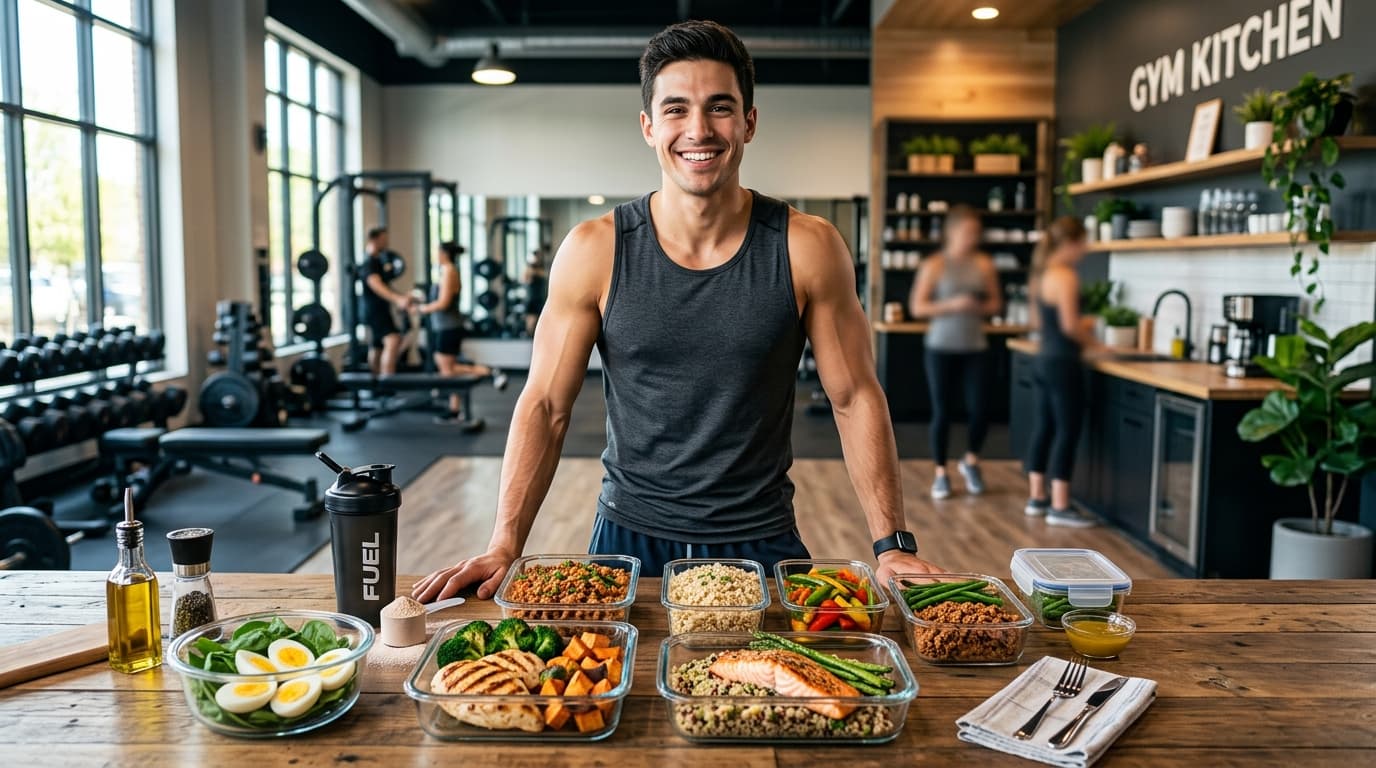
Meal prep is the number one thing that separates people who succeed at bulking from people who don't. If you have to cook every meal from scratch, you'll quit within two weeks.
Spend 2-3 hours on Sunday prepping your protein and carbs for the week. Cook a big batch of rice, grill a bunch of chicken, and portion it out. Our meal prep guide for muscle gain walks you through the entire process.
If you hate cooking, focus on foods that require zero prep: Greek yogurt, whole milk, nuts, cheese, rotisserie chicken, canned tuna, bread with peanut butter. You can absolutely bulk without being a chef. Check out our guide on how to bulk without cooking.
The Power of Liquid Calories
Here's a cheat code that every successful hardgainer discovers eventually: drink your calories.
A 20 oz shake with whole milk, protein powder, oats, peanut butter, and a banana can easily hit 800-1,000 calories. That's a third of your daily target in 60 seconds.
When your stomach says "I can't eat another bite," you can almost always drink a shake. Liquid calories bypass the fullness signals that solid food triggers. Use this to your advantage.
For shake recipes and ideas, check out our high-calorie shakes for weight gain guide.
Step 4: Train for Hypertrophy
Eating in a surplus without training properly is just getting fat. You need a structured program that forces your muscles to adapt and grow.
The Core Principles
Progressive overload is the single most important training concept. It means doing slightly more over time — more weight, more reps, or more sets. If you bench pressed 110 lbs for 8 reps last week, aim for 9 reps this week, or bump up to 115 lbs.
Compound movements should be the backbone of your program. These are exercises that work multiple muscle groups at once:
- Squat — quads, glutes, core
- Bench press — chest, shoulders, triceps
- Deadlift — back, hamstrings, glutes
- Overhead press — shoulders, triceps
- Barbell row — back, biceps
- Pull-ups — back, biceps
These movements let you move the most weight and stimulate the most muscle growth per exercise.
Isolation exercises (curls, flyes, lateral raises) are the cherry on top. They're useful for bringing up lagging body parts, but they shouldn't be the foundation of your program.
A Simple Beginner Program
Train 3-4 days per week. Here's a basic structure:
Day A — Push (Chest, Shoulders, Triceps)
| Exercise | Sets × Reps |
|---|---|
| Bench Press | 4 × 6-8 |
| Overhead Press | 3 × 8-10 |
| Incline Dumbbell Press | 3 × 10-12 |
| Lateral Raises | 3 × 12-15 |
| Tricep Pushdowns | 3 × 10-12 |
Day B — Pull (Back, Biceps)
| Exercise | Sets × Reps |
|---|---|
| Deadlift | 3 × 5 |
| Barbell Row | 4 × 6-8 |
| Pull-ups or Lat Pulldown | 3 × 8-10 |
| Face Pulls | 3 × 15 |
| Barbell Curls | 3 × 10-12 |
Day C — Legs
| Exercise | Sets × Reps |
|---|---|
| Squat | 4 × 6-8 |
| Romanian Deadlift | 3 × 8-10 |
| Leg Press | 3 × 10-12 |
| Walking Lunges | 3 × 12 each leg |
| Calf Raises | 4 × 15 |
Run this as A-B-C with a rest day between sessions. As you get more advanced, you can move to a 4-day upper/lower split.
How Hard Should You Train?
Leave 1-2 reps in the tank on most sets. You should finish each set thinking "I could have done 1-2 more." Going to absolute failure on every set increases fatigue without proportionally increasing muscle growth.
The exception: the last set of isolation exercises. Feel free to push those closer to failure.
Step 5: Track Your Progress
What gets measured gets managed. If you're not tracking, you're guessing — and guessing is why most people spin their wheels for years.
Weigh Yourself Daily
Step on the scale every morning, after using the bathroom, before eating or drinking. Write the number down.
Your weight will fluctuate day to day based on water retention, sodium intake, sleep, and a dozen other factors. Ignore the daily number. Instead, calculate your weekly average and compare it to last week's average.
Target rate of gain:
| Experience Level | Weekly Gain | Monthly Gain |
|---|---|---|
| Beginner (year 1) | 0.3-0.5 lbs | 1-2 lbs |
| Intermediate (year 2-3) | 0.2-0.3 lbs | 0.8-1.3 lbs |
| Advanced (year 4+) | 0.1-0.2 lbs | 0.4-0.8 lbs |
If you're gaining faster than this, you're probably gaining too much fat. Reduce your surplus by 100-200 calories. If you're not gaining at all, increase by 200 calories.
Track Your Lifts
Keep a training log. Write down every exercise, weight, sets, and reps. Your lifts should be going up over time. If they're not, something is off — usually sleep, calories, or recovery.
Take Progress Photos
The mirror lies. Or rather, you see yourself every day so changes are invisible. Take photos every 2-4 weeks in the same lighting, same angle, same time of day. Compare them side by side.
Front, side, and back — shirtless, relaxed. Don't flex. Relaxed photos show actual muscle growth better than flexed photos where lighting does half the work.
Step 6: Nail Your Recovery
Training breaks your muscles down. Food provides the raw materials. But the actual building happens during recovery — especially sleep.
Sleep: The Free Anabolic
During deep sleep, your body releases growth hormone, repairs damaged muscle fibers, and synthesizes new protein. Cutting your sleep from 8 hours to 6 doesn't just make you tired — it measurably reduces muscle protein synthesis.
Aim for 7-9 hours of actual sleep per night. Not 7 hours in bed scrolling your phone. Seven hours of sleep.
Tips for better sleep:
- Same bedtime every night (yes, even weekends)
- No screens 30-60 minutes before bed
- Keep your room cool and dark
- No caffeine after 2 PM
For a deeper dive, read our guide on sleep and recovery for muscle growth.
Rest Days
You don't need to lift every day. In fact, you shouldn't. Three to four days per week of hard training is plenty for beginners. Your muscles need 48-72 hours to recover between sessions targeting the same body parts.
On rest days, still eat at your surplus. Your body is building muscle on those days — it needs the calories just as much as on training days. Check our rest day nutrition guide for exactly what to eat.
Step 7: Avoid the Most Common Beginner Mistakes
These are the pitfalls that derail 90% of first-time bulkers. Avoid them and you're already ahead of the game.
1. Not Eating Enough
This is the number one reason skinny guys fail to bulk. Every time. You think you're eating a lot, but when you actually track your calories, you're at 1,800 when you need 2,700.
The fix: Track your food for at least the first 4-6 weeks. Use an app. Weigh your food. You'll be shocked at how little you were actually eating.
2. Relying on Appetite
Your appetite is calibrated to maintain your current weight. If you only eat when you're hungry, you'll eat maintenance calories and wonder why you're not growing.
The fix: Eat on a schedule. Set alarms if you need to. Treat meals like a prescription — they happen whether you feel like it or not.
3. Program Hopping
Switching programs every 3 weeks because you saw a new one on Instagram is a guaranteed way to make zero progress. Every program works — if you stick with it long enough.
The fix: Pick a program and run it for at least 12 weeks. Judge results after 3 months, not 3 weeks.
4. Ignoring Compound Movements
Doing 12 sets of bicep curls and skipping squats is like painting the walls of a house that has no foundation.
The fix: Prioritize squat, bench, deadlift, overhead press, and rows. Add isolation work after.
5. Expecting Overnight Results
Realistic expectations: you can gain 10-20 lbs of muscle in your first year if everything is dialed in. That's amazing progress — but it takes 12 months, not 12 days.
The fix: Commit to at least 6 months. Take progress photos monthly. The changes are happening even if you can't see them day to day. Our bulking results timeline shows you exactly what to expect and when.
6. Overcomplicating Supplements
Supplements are the last 5%. Beginners obsess over them when they haven't nailed the first 95% (food, training, sleep). The only supplements with strong evidence for muscle growth are creatine monohydrate and protein powder.
The fix: Get your diet right first. Then consider adding creatine and whey protein to fill gaps.
Your First Bulk: A 4-Week Quick Start
Here's exactly what to do for the next 4 weeks. No overthinking. Just execute.
Week 1: Foundation
- Calculate your TDEE and add 400 calories
- Buy a food scale and download a calorie tracking app
- Write down your current body weight and take progress photos
- Pick the Push/Pull/Legs program above and start training
Week 2: Dial In
- Track every meal — aim for your calorie and protein targets
- Start meal prepping on Sunday for the week ahead
- Focus on learning proper form on compound lifts
- Weigh yourself daily and start calculating weekly averages
Week 3: Optimize
- Review your weekly average weight — are you gaining?
- If not, add 200 calories (usually an extra snack or bigger shake)
- If gaining too fast (>1% body weight per week), cut 100 calories
- Start pushing for progressive overload on your main lifts
Week 4: Assess and Commit
- Take new progress photos and compare to Week 1
- Check your training log — are your lifts going up?
- By now, eating at a surplus should feel more natural
- Commit to 3 more months of consistent bulking
Where FuelTheGains Comes In
Look — all of this works. The science is settled, the principles are proven. But let's be honest: most guys who read guides like this still struggle to actually do it consistently. Not because they're lazy, but because tracking every meal, calculating every macro, and adjusting every week is a lot of work.
That's exactly why we built . It's a personalized bulking coach that does the math for you — your calories, your macros, your meal plans, all tailored to your body and your goals. No spreadsheets, no guesswork.
If you've tried bulking before and it didn't stick, this might be the missing piece.
The Bottom Line
Bulking isn't complicated. Eat more than you burn, hit your protein, train with progressive overload, sleep enough, and be patient. That's genuinely all there is to it.
The hard part isn't knowing what to do — it's doing it consistently for months. But if you can commit to even 80% consistency for 6 months, you'll be shocked at the transformation.
Your future self will thank you for starting today. Now go eat something.