
Your alarm goes off at 5:15. You've got twenty minutes before you need to be out the door, and the thought of eating anything solid makes your stomach turn.
So you skip it. You train fasted, you feel like garbage on set three, and by the time you're showered and at your desk at 8:30, you've been awake for three and a half hours and eaten exactly zero calories.
Now do the math. If your bulking target is 3,500 calories and you've got twelve waking hours left, you need to average nearly 300 calories an hour for the rest of the day. That's brutal. And it's why so many guys who train early stay stuck at the same bodyweight for months while their bench goes up 5 kg and their scale doesn't budge.
This isn't a discipline problem. It's a scheduling problem. And scheduling problems have solutions.
- Early training doesn't ruin a bulk — losing the first 3 hours of your eating day does
- Liquid calories are the entire answer pre-dawn: your gut handles them when it won't handle food
- Use the 10-minute rule: whatever you drink at 5:30 needs 30-40 minutes to clear, so drink it the second you're up
- Training fasted is fine for sessions under 60 minutes if you nail the post-workout window
- Restructure the day into 4 big anchors instead of 6 small meals — a compressed window needs bigger blocks
- The post-training 90 minutes is your single highest-leverage eating opportunity of the day
- If you can't eat pre-workout, front-load the night before with a slow-digesting meal
Why Early Training Wrecks a Bulk (And It's Not What You Think)
Let's kill a myth first: training fasted does not "burn your muscle." Your body isn't sitting there at 6:05am deciding to eat your biceps because you skipped a bagel. Muscle protein breakdown during a 45-minute lifting session in a fasted state is real but small, and it's easily reversed by what you eat afterward.
The actual damage from early training is arithmetic, not physiology.
Here's what a normal guy's eating day looks like when he trains at 6pm:
| Time | Meal | Calories |
|---|---|---|
| 7:00am | Breakfast | 750 |
| 10:30am | Snack | 400 |
| 1:00pm | Lunch | 900 |
| 4:00pm | Pre-workout | 450 |
| 7:30pm | Dinner | 800 |
| 9:30pm | Before bed | 300 |
| Total | 3,600 |
Six eating opportunities spread across fourteen hours. Comfortable. Nothing feels like force-feeding.
Now here's the 6am lifter:
| Time | Meal | Calories |
|---|---|---|
| 5:15am | Nothing (nauseous) | 0 |
| 6:00–7:00am | Training | 0 |
| 8:30am | Coffee, maybe a banana | 100 |
| 12:30pm | Lunch | 900 |
| 4:00pm | Snack | 400 |
| 7:30pm | Dinner | 800 |
| 9:30pm | Before bed | 300 |
| Total | 2,500 |
Same guy. Same appetite. 1,100 calories short, every single day. Over a month that's roughly 33,000 calories — about 9 lbs of bodyweight he should have gained and didn't.
You didn't fail at bulking. You just deleted the two biggest meals of your day and replaced them with a banana.
Missing 1,100 calories a day isn't a small miss. For a hardgainer aiming at 0.5-0.9 lbs of gain per week, that single gap is larger than the entire surplus you were trying to create.
The 10-Minute Rule
Here's the single most useful thing in this article, and it's stupidly simple.
Whatever you're going to consume before training, consume it within 10 minutes of your alarm going off.
Not when you feel like it. Not after you've brushed your teeth and checked your phone. The moment your feet hit the floor.
Why? Because the limiting factor at 5:30am isn't hunger — it's transit time. Liquid calories need roughly 30 to 40 minutes to clear your stomach enough that you can squat without feeling like you're going to see them again. If you drink at 5:50 and start warming up at 6:05, you're going to have a bad time. If you drink at 5:20 and start at 6:05, you're fine.
The window is real and it's tight, so protect it. Get the calories in first, do everything else after.
Most guys have this backwards. They wake up, get dressed, drive to the gym, and then think about whether they should have eaten something. By that point the decision has already been made for them.
Prep the night before. Blend your shake at 10pm and leave it in the fridge. At 5:15am, "open fridge, drink" requires zero decisions from a brain that isn't online yet.
Liquid Calories Are Not Optional
At 5:30 in the morning your appetite is at its lowest point of the entire 24-hour cycle. Ghrelin — the hormone that makes you feel hungry — follows a daily rhythm and it's bottomed out overnight. Combine that with the mild nausea most people get when they force food down before dawn, and solid meals are basically off the table.
Liquids sidestep all of it. There's no chewing, no volume in your gut, no texture to gag on, and the calorie density can be enormous.
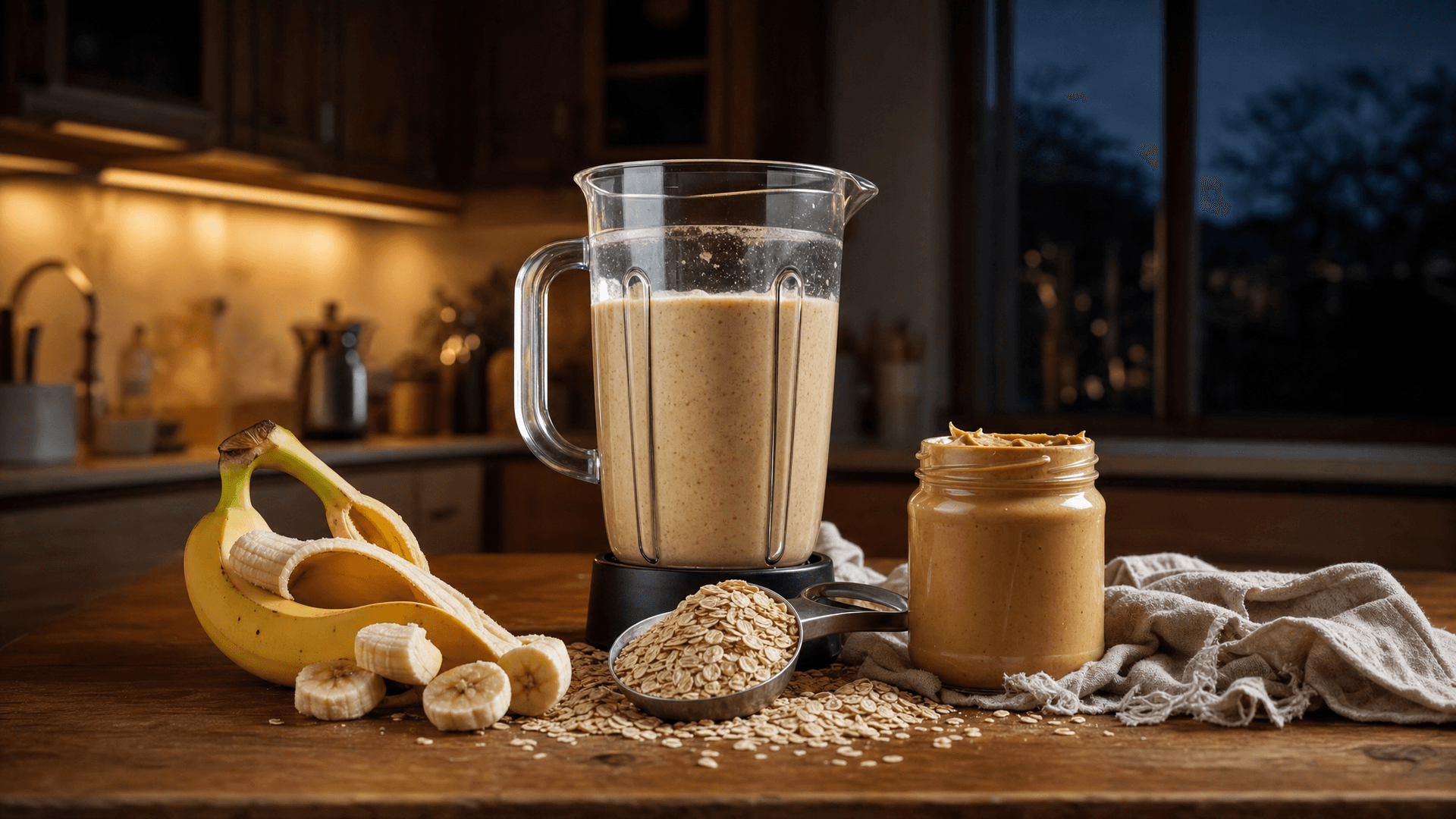
Here's what a genuinely good pre-dawn shake looks like:
| Ingredient | Calories | Protein |
|---|---|---|
| Whole milk (400 ml) | 260 | 13g |
| Instant oats (60g) | 230 | 8g |
| Whey protein (1 scoop) | 120 | 25g |
| Banana | 105 | 1g |
| Peanut butter (1 tbsp) | 95 | 4g |
| Honey (1 tbsp) | 65 | 0g |
| Total | 875 | 51g |
That's 875 calories before 5:30am. Drunk in about ninety seconds. It requires no appetite whatsoever — just the ability to swallow.
Compare that to the "banana and coffee" version at 100 calories, and you've just recovered 775 of the 1,100 you were missing. One habit. One shake.
If 875 Is Too Much at First
It might be. Your stomach isn't used to this, and training on a full gut is genuinely unpleasant if you go from zero to a full shake overnight.
Start with half. Blend the full thing, drink 7 fl oz of it before the gym and the rest in the car afterward. Add 2 fl oz a week to the pre-training portion. Within a month you'll be handling the whole thing without noticing.
The adaptation is fast. Gastric emptying speeds up with repeated exposure, and the nausea response fades. Guys who insist they "can't eat in the morning" almost always mean they haven't tried for more than three days in a row.
Don't make it too thick. A shake you have to chew is a shake that sits in your stomach through your whole session. Use more liquid than you think you need — thin enough to drink through a wide straw without effort.
When Training Fasted Is Actually Fine
Sometimes the shake isn't happening. You woke up late, you're genuinely nauseous, you've got a stomach bug. Fine. Here's when fasted training costs you basically nothing:
Your session is under 60 minutes. Muscle glycogen from yesterday's meals is still sitting in your legs. A 45-minute session of 4-5 exercises doesn't come close to depleting it. You'll feel slightly flatter, and that's about the whole cost.
You ate a substantial dinner the night before. If you put away 800+ calories at 8pm, you're not remotely fasted at 6am in any way that matters. Digestion of a mixed meal with fat and protein runs for hours.
You're not doing heavy conditioning. Fasted lifting is fine. Fasted sprints, prowler work, or a 90-minute session with long finishers is where you start to actually feel it.
Here's when fasted training does cost you:
Sessions over 75 minutes. Now you're into real glycogen depletion, and the last third of the session — usually your accessory volume, which is a lot of your hypertrophy work — gets noticeably worse.
You skipped dinner or ate light. Two consecutive low-fuel windows compound. This is where the flat, weak, dizzy feeling comes from.
You're going to skip breakfast afterward too. This is the actual killer. Fasted training isn't the problem — fasted training followed by a 400-calorie morning is.
For a hardgainer, fasted vs. fed training is a rounding error. Fed vs. fasted day is the whole ballgame. If skipping the pre-workout shake means you eat an extra 800 calories at 8am because you're actually hungry, that's a fine trade. If it means you eat a banana, it isn't.
If you do want to dial in what to eat before lifting more generally, we've got a full breakdown of what to eat before the gym on a bulk — most of it applies whether you're training at 6am or 6pm, just compressed.
The Post-Training Window Is Your Whole Day
If you take one structural change away from this article, make it this one: the 90 minutes after your early session is the highest-leverage eating opportunity you will ever have.
Three things line up at once:
- You're actually hungry. Training suppresses appetite briefly and then blows it wide open. By 7:30am you're capable of eating in a way you were not at 5:15.
- Your muscles are primed. Insulin sensitivity and glucose uptake are elevated post-training. Calories eaten here are getting used well.
- You have time. You're showering and getting ready anyway. There's a natural 30-40 minute block sitting right there.
Most early lifters waste it completely. They shower, grab coffee, and eat at 10am when they're already behind.
Your post-training meal on a bulk should be 700-1,000 calories minimum. Not a protein shake. An actual meal — and if you got the pre-workout shake in, this is on top of it, not instead of it.
What That Looks Like
| Option | What's in it | Calories |
|---|---|---|
| Egg and rice bowl | 4 eggs, 200g cooked rice, cheese, avocado | 900 |
| Oats loaded | 100g oats, whole milk, whey, peanut butter, banana | 950 |
| Breakfast burrito | 3 eggs, tortilla, cheese, beans, sausage | 850 |
| Cottage cheese bowl | 250g cottage cheese, granola, honey, nuts, berries | 780 |
Note the food weights there — 7 oz of cooked rice, 3.5 oz of dry oats, 9 oz of cottage cheese. These are real portions, not the sad half-cup most guys measure out.
If you want a much deeper list of ways to get past 700 calories at breakfast without eating a stack of pancakes every morning, our high-calorie breakfast guide is built exactly for this slot.
Cook this the night before. Post-workout at 7:20am is not the moment to be scrambling eggs. Rice, chicken, and a hard-boiled batch of eggs in the fridge turns your biggest meal of the day into a 4-minute reheat.
Restructuring the Rest of the Day
Once you've fixed the morning, the rest of the day needs to change shape too. Here's the mistake almost everyone makes: they try to keep the six-small-meals structure inside a compressed window. It doesn't work. You end up grazing all day and never getting a meal big enough to move the needle.
Fewer, bigger anchors beats more, smaller ones.
The 4-Anchor Structure
| Time | Anchor | Target |
|---|---|---|
| 5:20am | Pre-training shake | 700-900 |
| 7:45am | Post-training meal | 800-1,000 |
| 12:30pm | Lunch | 800-900 |
| 7:00pm | Dinner | 800-900 |
| Total | 3,100-3,700 |
Four eating events. Two of them happen before 8am. That's the entire trick — you've moved 1,700 calories into a window that used to hold zero.
Notice what's missing: the 10:30am snack, the 4pm snack, the pre-bed shake. You don't need them when your anchors are actually big. And if you do want a fifth, add it at 4pm — it's the longest gap in the day and the easiest place to slot 400 more calories if you're chasing a higher target.
Adjusting the Anchors for Your Number
The table above lands around 3,400. If you need more or less, don't add meals — grow the existing ones.
- Need 4,000+? Add 2 fl oz of olive oil across lunch and dinner (400 cal), and push the pre-training shake to a full 20 fl oz of whole milk.
- Need closer to 3,000? Drop the pre-training shake to 10 fl oz and keep everything else.
- Training days vs. rest days? Keep them identical. Cycling calories around training is a fine-tuning tool for people whose problem is fat gain. Your problem is total intake.
There's a lot more nuance to how meal timing interacts with training and growth — our full meal timing guide covers the research on windows, frequency, and protein distribution if you want to go deeper than the practical version here.
Front-Loading the Night Before
Here's an underrated lever: if the morning is genuinely hostile to eating, make the previous evening do more work.
A large dinner with meaningful fat and protein content digests slowly. Eat 7 oz of salmon with 9 oz of potatoes and a generous pour of olive oil at 8pm, and a meaningful chunk of those calories are still being absorbed at 5am. You're not truly fasted when you train — you're late-postprandial.
This does two things. It reduces the "I'm training on nothing" feeling even when you skip the shake, and it lets you bank calories at the time of day when your appetite is strongest.
A good pre-bed addition for early trainers:
- 9 oz Greek yogurt with honey and granola — 450 cal, 25g protein
- 3 oz mixed nuts — 480 cal
- A casein or milk-based shake with 14 fl oz whole milk — 400 cal
Don't go so heavy at 9:30pm that you sleep badly. Sleep quality matters more for muscle growth than the last 300 calories. If you're waking up at 3am with reflux, you overdid it — pull it back and move those calories to lunch.
Practical Fixes for the Common Problems
"I gag on shakes at 5am"
Three fixes, in order of how much they help:
- Make it colder. Cold liquids are dramatically easier to get down when you're nauseous. Fridge-cold, not room temperature.
- Cut the sweetness. Most morning gag reflexes are triggered by cloying sweet flavors, not volume. Use unflavored or lightly-flavored protein, skip the honey, add a pinch of salt.
- Use a straw and don't breathe through your nose. Sounds ridiculous. Works.
"I need to leave 15 minutes after waking up"
Then drink it in the car or on the walk. A shaker bottle travels fine. You've got the 30-40 minute transit window anyway, so drinking it during your commute puts it in the exact right place.
"I train at 5:30, not 6"
Same rules, tighter margin. Shift to a thinner, lower-fiber shake — milk and whey and a bit of honey, skip the oats and peanut butter — and move the oats to your post-training meal instead. Fat and fiber slow gastric emptying, and at 5:00am you don't have time for slow.
"I do cardio or conditioning in the morning"
Different problem. Sustained conditioning on an empty stomach genuinely degrades performance, and it also digs into the surplus you're trying to build. If your morning is conditioning-focused rather than lifting-focused, get at least 300 calories of fast carbs in beforehand — even just 10 fl oz of juice and a banana.
"I'm just not hungry until noon"
That's a symptom, not a fixed trait. Appetite entrains to eating patterns. If you eat at 5:20 and 7:45 for two straight weeks, you will start being hungry at 5:20 and 7:45. It's uncomfortable for about ten days and then it isn't.
How to Know It's Working
Two metrics, and only two.
Bodyweight, weekly average. Weigh yourself every morning after the bathroom, before the shake. Average the seven numbers. You want the average to move 0.5-0.9 lbs per week. Day-to-day noise is meaningless — a 3 lb swing overnight is water and gut contents, not tissue.
Training performance. If your first lift of the session is going up in weight or reps over a 3-4 week block, you're fueled. If it's flat or dropping while you sleep fine and train hard, you're under-eating.
If the weekly average hasn't moved in two weeks, don't restructure everything. Add 300 calories to one anchor — usually the post-training meal, since your appetite is highest there — and reassess in another two weeks.
Track for the first 4-6 weeks and then stop. The point of tracking isn't to do it forever. It's to learn what 900 calories actually looks like on a plate so you can eyeball it later.
Where FuelTheGains Fits
The hardest part of everything above isn't willpower. It's the planning — figuring out what a 20 fl oz shake at 5:20am plus a 900-calorie meal at 7:45am plus two more anchors actually adds up to, and then rebuilding that math every time your schedule shifts.
That's what we built for. You tell it your target, your training time, and what you're actually willing to eat, and it builds the anchors around your schedule — including the early-morning ones most meal planners pretend don't exist. Shake recipes that hit a specific calorie number instead of "some milk and a scoop." Post-workout meals sized for the window you actually have.
It's not magic. It just removes the part where you're standing in the kitchen at 5:15am doing arithmetic with a blender in your hand.
The Bottom Line
Training at 6am doesn't make bulking harder. Losing the first three hours of your eating day does — and those two things are not the same problem.
Fix the morning with liquid calories inside 10 minutes of waking. Treat the post-training window like the biggest meal of your day, because it is. Build the rest of the day around four real anchors instead of six half-hearted ones.
Do that and you're eating 1,700 calories before most people have had breakfast. The 6am alarm stops being the thing that's holding your bulk back and starts being the reason it's ahead of schedule.