
You're standing in the cereal aisle at 9pm, tired, and you grab the box with the guy on the front doing a pull-up. Feels like the healthy choice. Feels like it fits the plan.
Then you get home, pour a bowl, eat it, and you're hungry forty minutes later. You look at the label. 120 calories per serving. With skim milk. That's not breakfast — that's a snack with extra steps.
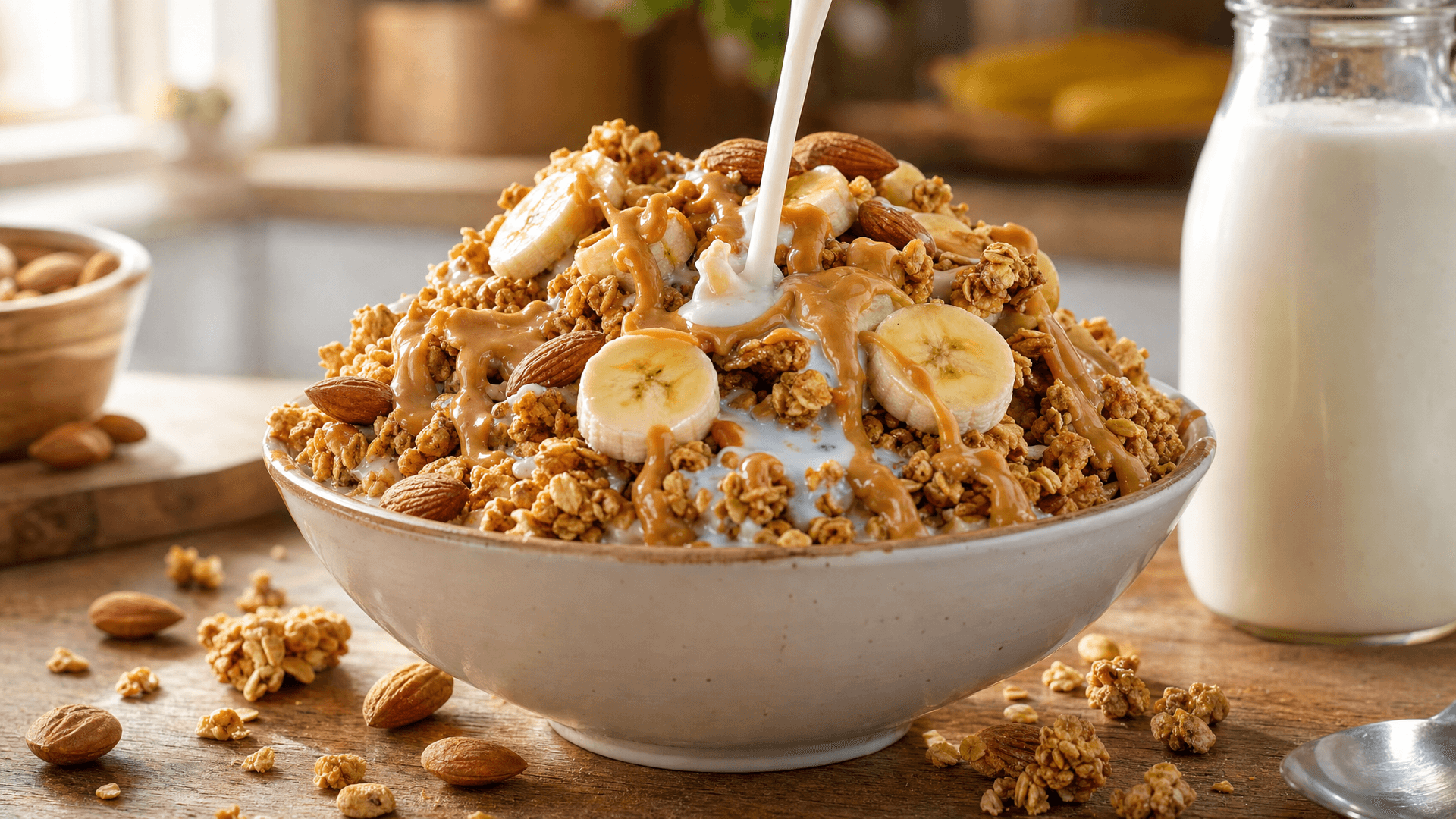
Here's the thing nobody tells skinny guys: cereal is one of the best bulking tools in the entire grocery store. No pan. No prep. No appetite required. A properly built bowl clears 900 calories in under four minutes and you're out the door.
But you have to pick the right box. Most cereal is literally air — puffed grains engineered for volume, marketed on being "light." Light is the enemy. You need dense.
Let's fix your cereal aisle.
- Puffed cereals are air by design and deliver only 350-400 calories per 100g of actual product
- Granola and muesli are the dense picks at 450-500 calories per 100g with real fat content
- The "serving size" on the box is usually 30g, which is roughly a third of what you'll actually pour
- Weigh your cereal for two weeks so you learn what a real portion looks like
- Whole milk instead of skim adds about 130 calories per 400ml with zero extra effort
- A tablespoon of nut butter stirred into the bowl adds 95 calories and slows the sugar crash
- Three loaded bowl formulas below hit 800, 950 and 1,100 calories with no cooking
The Serving Size Trap
Flip any cereal box over. Look at the serving size. It's almost always 30g, sometimes 40g if the brand is feeling honest.
Now go pour what you'd normally pour into a cereal bowl. Weigh it. I'll wait.
It's 2.8-3.9 oz. Every time. Nobody in the history of breakfast has poured 30g of cereal and called it a meal.
This matters in both directions. If you're trying to lose weight, the serving size trap makes you eat triple what you think. If you're trying to gain, it makes you believe you ate more than you did — because you saw "220 calories with milk" on the box and mentally logged that, when you actually ate 600.
So the first rule: stop reading calories per serving. Read calories per 100g. It's the only number that lets you compare boxes honestly, and it's printed on every label in Europe and most labels in the US.
Here's what that looks like across categories:
| Cereal type | Calories per 100g | Why |
|---|---|---|
| Puffed rice / puffed wheat | 380 | Air-heavy, near-zero fat |
| Corn flakes | 375 | Same problem, no fat |
| Bran flakes | 340 | Fiber-dense, fills you up fast |
| Wheat biscuits | 360 | Better, still low fat |
| Muesli (unsweetened) | 370 | Nuts help, but oats dominate |
| Granola (standard) | 450 | Oil + sugar in the bake |
| Granola (nut-heavy) | 490 | Fat from nuts does the work |
| Protein granola | 420 | Protein swapped in for some fat |
The gap between corn flakes and nut-heavy granola is 115 calories per 100g. Over a 3.5 oz bowl every morning, that's 115 calories a day, 800 a week, and roughly 1 lb a month of difference from a single swap that costs you nothing in effort.
Fat carries 9 calories per gram. Carbs and protein carry 4. A cereal with 20g of fat per 100g is automatically ahead of one with 2g by 160 calories, before you've even looked at anything else. That's why granola beats flakes and always will.
How I Ranked These
Three criteria, weighted in this order:
- Calories per 100g — the whole point. Density wins.
- Protein per 100g — cereal is usually the weak link in your protein day. Anything that helps counts.
- Cost per 100g — you're probably a student or you just started earning. Premium protein granola at €12 a bag is a great cereal and a terrible plan.
I'm also weighting eatability. A cereal you can eat 4.2 oz of without gagging beats a technically-denser one that goes down like gravel. If you have a small appetite, this matters more than the numbers.
The 10 Best Cereals for Bulking
1. Nut-Heavy Granola (Almond, Pecan, Walnut Clusters)
~490 cal / 100g · 10g protein · mid-to-high cost
The undisputed king. The whole nuts and seeds are doing the heavy lifting — you're basically eating trail mix with a spoon. A 3.5 oz serving with 10 fl oz of whole milk lands at 680 calories before you add anything.
Downside: it's the most expensive category and clusters make it easy to under-pour. Weigh it.
2. Classic Oat Granola (Honey, Maple, Cinnamon)
~450 cal / 100g · 8g protein · mid cost
The workhorse. Cheaper than nut-heavy, nearly as dense, and available in every store on earth. Buy the biggest bag you can find — granola in 2.2 lb bags is often half the price per 100g of the fancy 12 oz pouches.
If you only take one thing from this article: replace whatever's currently in your cupboard with a big bag of this.
3. Protein Granola
~420 cal / 100g · 20-25g protein · high cost
Less dense than regular granola because they've swapped fat for protein isolate, but 22g of protein in a bowl is real value if you're chronically under on protein. Best used as a blend — half protein granola, half classic — so you get density and protein without paying premium prices for the whole bowl.
4. Traditional Swiss Muesli (Oats, Raisins, Nuts, Seeds)
~370 cal / 100g · 10g protein · low-to-mid cost
Not as dense as granola because it isn't baked in oil, but it's cheap, high in fiber, and easy to eat a lot of. It also soaks up milk beautifully, which means you can add more liquid calories to the same bowl.
Muesli's superpower is overnight soaking. Pour 3.5 oz into a jar with 12 fl oz of whole milk before bed. In the morning it's soft, dense and goes down in ninety seconds even with zero appetite. Same trick as high-calorie oatmeal recipes, just cold.
5. Instant Oats (Yes, They Count)
~370 cal / 100g · 12g protein · very low cost
The cheapest calories in the aisle by a wide margin. You can eat instant oats cold with milk exactly like cereal — no cooking required, no microwave, nothing. Texture is worse than granola but the price is brutal in the best way: often under $1 per lb.
Use this as your base and mix granola in for flavor. That's the budget move.
6. Wheat Biscuit Cereals
~360 cal / 100g · 11g protein · low cost
Decent protein for a plain cereal and they're compact — two biscuits weigh about 1.4 oz, so four biscuits gets you to a real portion fast. They also absorb an absurd amount of milk, which is a feature when you're chasing liquid calories.
Not exciting. Very functional.
7. Frosted / Sweetened Flakes
~380 cal / 100g · 6g protein · low cost
I'm not going to pretend these are health food. But if the alternative is you skip breakfast entirely, a bowl of frosted flakes with whole milk and a banana is 550 calories you wouldn't have eaten otherwise. Sugar isn't the enemy when you're trying to gain — under-eating is.
Just don't make it your only cereal. Protein is weak and you'll be hungry again in ninety minutes.
8. Chocolate Cereals / Cocoa Puffs
~390 cal / 100g · 7g protein · low cost
Same logic as above with one bonus: the milk at the bottom of the bowl turns into chocolate milk, which most guys will actually finish. Sounds stupid. Works. If you're the type who leaves half the milk in the bowl, this fixes it — and that leftover milk is 100+ calories you were throwing in the sink.
9. Bran Flakes / High-Fiber Cereals
~340 cal / 100g · 10g protein · low cost
Lowest density on the list and the most filling per calorie — normally a disqualifier. It's here for one reason: if you're bulking hard, your digestion is going to struggle, and a couple of bowls a week of something high-fiber keeps things moving.
Use it as maintenance, not as your main.
10. Puffed Rice / Puffed Wheat
~380 cal / 100g · 6g protein · low cost
Technically fine calories per 100g. Practically terrible, because you physically cannot pour 100g of puffed rice into a normal bowl — it doesn't fit. You'd need three bowls. This is the cereal that tricks more skinny guys than any other: the number looks OK, the reality is a 45g portion and 170 calories.
Avoid unless you're using it as a topping.
Volume is the hidden variable. Two cereals with identical calories per 100g can deliver wildly different real-world meals if one is dense and one is air. Before you buy, pick up the box and feel the weight. A 1.1 lb box that feels heavy for its size is dense. A giant box that feels empty is air you're paying for.
The Milk Decision
Your cereal is maybe 60% of the bowl's calories. The milk is the rest, and most guys sabotage it without thinking.
| Milk (400ml / ~13.5 oz) | Calories | Protein |
|---|---|---|
| Skim | 140 | 14g |
| Semi-skimmed / 2% | 190 | 13g |
| Whole milk | 260 | 13g |
| Whole milk + 1 scoop whey | 380 | 38g |
| Almond milk (unsweetened) | 55 | 2g |
Whole milk over skim is +120 calories for the same act of pouring. Do it every day for a month and you've added 3,600 calories — about 1 lb of gain — from a decision you make once at the store.
And unsweetened almond milk? If you're bulking and using almond milk, you're actively fighting yourself. It's 55 calories per 13.5 fl oz. You may as well pour water on your cereal.
If milk sits well with you, it's the single best liquid calorie source available. We went deep on exactly how far you can push it in our breakdown of whole milk and GOMAD — worth reading before you start drinking a gallon a day.
Pour more milk than you need, then drink what's left in the bowl. That last 3.4 fl oz is 65 calories most people rinse down the drain. Over a year of daily breakfasts, that's roughly 24,000 calories thrown away.
The Three Loaded Bowl Formulas
This is where cereal stops being a snack and becomes a real bulking meal. The pattern is always the same:
Cereal + whole milk + fat source + sweet carb + optional protein.
Each addition takes under ten seconds and none of them require heat.
Formula 1: The Baseline Bowl — 800 Calories
For guys who want something simple that they'll actually make every morning.
- 3.5 oz classic oat granola — 450 cal
- 12 fl oz whole milk — 230 cal
- 1 sliced banana — 105 cal
- 1 tbsp honey — 65 cal
Total: 850 calories, 20g protein. Takes about three minutes including slicing the banana. If you're skipping breakfast right now, this alone might close your entire calorie gap.
Formula 2: The Protein Bowl — 950 Calories
For when cereal is doing double duty as your protein hit.
- 2.5 oz classic granola + 1.8 oz protein granola — 525 cal
- 10 fl oz whole milk — 195 cal
- 5.3 oz full-fat Greek yogurt — 145 cal
- 1 tbsp peanut butter, stirred in — 95 cal
- Handful of raisins — 90 cal
Total: 1,050 calories, 48g protein. The Greek yogurt makes it thicker, which some guys love and some hate — try it before you commit.
Formula 3: The Maximum Bowl — 1,100 Calories
For genuine hardgainers who need to force the issue. This is not a bowl you eat casually.
- 4.2 oz nut-heavy granola — 590 cal
- 13.5 fl oz whole milk — 260 cal
- 2 tbsp almond butter — 190 cal
- 1 oz dried mango or dates — 95 cal
- 1 tbsp chia seeds — 60 cal
Total: 1,195 calories, 32g protein. Eat this and you've done a third of your day's calories before 8am. That's the whole strategy — front-load hard so the evening doesn't have to carry everything.
Appetite is highest in the morning for most people and lowest at night. If you eat 1,200 calories at breakfast, dinner only has to be normal-sized. Guys who skip breakfast are trying to eat 3,500 calories in two evening meals — and that's why they fail.
If a giant bowl of cereal isn't your thing, there are other ways to hit these numbers before 9am — we covered seven of them here.
Cost Per 100g: What This Actually Costs You
Density is useless if you can't afford it every week. Here's the rough landscape:
| Cereal | Typical cost per 100g | Calories per unit of cost |
|---|---|---|
| Instant oats (bulk bag) | Very low | Excellent |
| Bran flakes | Low | Poor |
| Wheat biscuits | Low | Good |
| Store-brand granola | Low-mid | Very good |
| Sweetened flakes | Low | Good |
| Traditional muesli | Mid | Good |
| Branded granola | Mid-high | Fair |
| Nut-heavy granola | High | Fair |
| Protein granola | Highest | Poor |
The best value play in the entire aisle: buy bulk instant oats as your base and store-brand granola as your flavor layer. Mix them 50/50. You get roughly 410 calories per 100g at a fraction of what pure branded granola costs, and honestly it tastes fine.
The worst value play: buying small bags of premium protein granola and eating 40g of it because it's expensive and you're rationing. You've now paid the most money for the fewest calories. Don't.
Make your own granola in one batch. 1.1 lb oats, 5.3 oz mixed nuts, 100ml oil, 100ml honey, bake at 160°C for 25 minutes, stir halfway. You get roughly 2 lb of ~480-calorie granola for about a third of retail price, and it lasts three weeks in a sealed jar.
Five Mistakes That Kill Your Cereal Bowl
1. Eyeballing the portion. You think you're pouring 3.5 oz. You're pouring 2.3 oz. Weigh it for two weeks until your eye is calibrated, then stop. This is the single highest-impact fix on this list.
2. Using a small bowl. Physical constraint beats willpower. A small bowl caps you at 2.5 oz of cereal and 7 fl oz of milk no matter what you intend. Buy a big damn bowl.
3. Leaving the milk behind. Covered above, but it bears repeating — that's a free 60-90 calories every single morning.
4. Treating cereal as your only breakfast component. A bowl of cereal is a base, not a meal. The fat source (nut butter, seeds, whole nuts) is what turns 500 calories into 800. It takes ten seconds and costs almost nothing.
5. Buying based on the front of the box. "Multigrain," "protein," "fitness," and "wholesome" mean nothing. Turn the box over. Calories per 100g and fat per 100g. Those two numbers tell you everything.
How to Know It's Working
Weigh yourself every morning, same time, after the bathroom, before you eat. Ignore any single day — bodyweight swings 2-4 lbs on water alone.
What you want is a weekly average trending up by 0.5-1 lb. For a 155 lb guy that's a sustainable lean bulk. Faster than that and you're adding more fat than you need to.
If four weeks pass and the weekly average hasn't moved, you're not eating as much as you think. Nine times out of ten the culprit is portion drift — you started weighing your cereal, then stopped, and slid back to 2.5 oz bowls without noticing.
Re-weigh for a week. The scale will tell you the truth.
Where FuelTheGains Fits
Here's the honest problem with everything above: knowing that a 3.5 oz granola bowl with whole milk and peanut butter hits 850 calories is useless if you don't know whether 850 at breakfast is the right number for you.
A 137 lb guy who is 5'11" and trains four days a week needs a very different daily target than someone 22 lbs heavier who lifts twice. Generic advice like "eat more" is why most hardgainers spin their wheels for a year.
That's where comes in. You put in your stats, your training, and how much time you actually have — and you get a real daily calorie and protein target plus meal plans built around food you'll eat. Cereal included, because we're not going to pretend you're meal-prepping salmon at 7am on a Tuesday.
It takes the guesswork out so you can stop wondering and start eating to a number.
The Bottom Line
Cereal isn't a compromise. Built right, it's one of the most efficient bulking meals available — no cooking, no appetite required, four minutes from cupboard to done.
Buy dense, not light. Weigh your portion until your eye learns it. Use whole milk, drink what's left in the bowl, and always add a fat source.
Do that tomorrow morning and you've added 300-400 calories to your day without changing anything else about your life. Do it for three months and you'll see it in the mirror.