
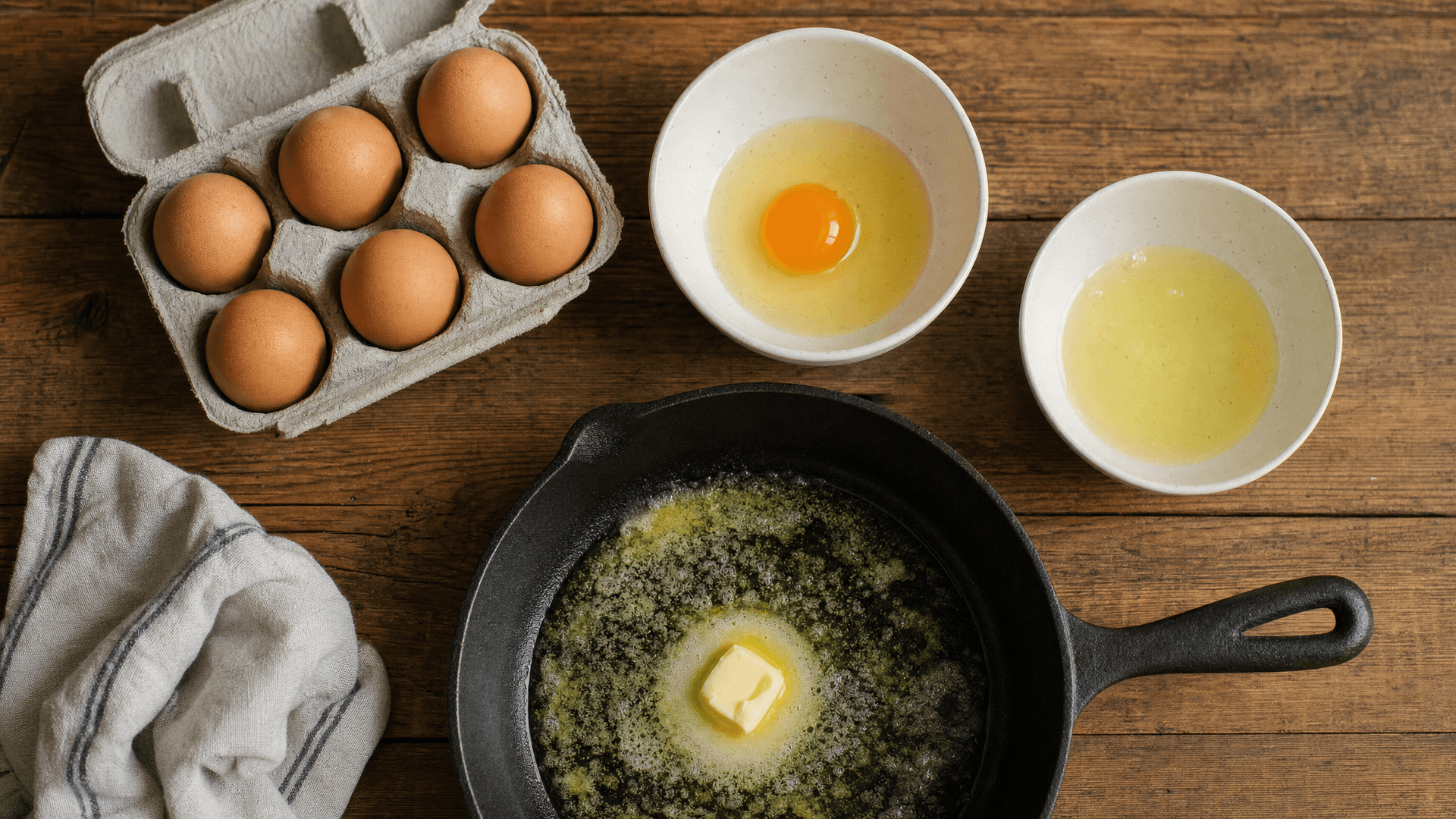
You crack six eggs into a bowl. You fish out every yolk with a spoon, flick them into the bin, and scramble a pile of pale, rubbery whites that taste like wet paper.
You do this because some shredded guy on your feed said yolks are "empty fat." Meanwhile you're 155 lb soaking wet, you've been stuck at the same weight for eight months, and you just threw 330 calories in the garbage before 8am.
That's not discipline. That's self-sabotage with extra dishes.
Here's the thing nobody tells skinny guys: almost all the egg-white advice floating around was written for people trying to lose weight. A guy cutting to 8% body fat has a real reason to strip calories out of his protein sources. You have the exact opposite problem. You need calories to be dense, cheap, and easy — and the yolk is the single densest, cheapest, easiest thing in your kitchen.
And it gets worse than just the calories. The research suggests the yolk isn't dead weight riding along with the protein — it actively makes that protein work harder.
Let's go through it properly.
- One large yolk carries 55 calories, 2.7g of protein, and nearly every micronutrient in the egg
- Protein-matched whole eggs drove roughly 40% more muscle protein synthesis than egg whites in a controlled trial
- Dietary cholesterol barely moves blood LDL in most people — the 300mg daily cap was dropped a decade ago
- Yolks are the cheapest calories in the carton, roughly 3x more calorie-dense per gram than the white
- Egg whites earn a spot only when you need protein without calories — which, on a bulk, is almost never
What You're Actually Throwing Away
Let's break a 1.8 oz large egg into its two halves, because most guys have genuinely no idea what the split looks like.
| Part | Calories | Protein | Fat | Micronutrients |
|---|---|---|---|---|
| White | 17 | 3.6g | 0g | Almost none |
| Yolk | 55 | 2.7g | 5g | Nearly all of them |
| Whole egg | 72 | 6.3g | 5g | Complete |
Read that protein column again. The yolk isn't a fat blob you tolerate for flavor — it's carrying 43% of the egg's protein. When you bin six yolks you're not just dumping 330 calories, you're dumping 16g of protein along with them.
Now the micronutrients. The yolk holds essentially all of the egg's vitamin A, vitamin D, vitamin E, vitamin K, B12, folate, selenium, zinc, iron, choline, lutein and zeaxanthin. The white holds water, protein, a little riboflavin, and that's basically the list.
So when you separate eggs, the mental math you're doing is "I'm keeping the good part." The actual math is "I'm keeping the water and throwing away the nutrition."
USDA values for a large egg. Sizes vary — a jumbo egg pushes closer to 90 calories, a medium sits around 63. If you're tracking tightly, weigh a few and average them rather than trusting the box.
The Study That Should Have Ended This Debate
In 2017, researchers at the University of Illinois ran the experiment everyone had been arguing about for twenty years.
They took resistance-trained young men, had them do a leg workout, and then fed them 18g of protein — either as whole eggs, or as egg whites. Same protein. Same leucine. Same amino acid profile. The only real difference was that the whole-egg group also got the fat and micronutrients that come with the yolk.
Then they measured myofibrillar protein synthesis — the specific kind of protein synthesis that builds contractile muscle tissue, not just any protein in the body.
The whole-egg group showed roughly 40% greater myofibrillar protein synthesis over the following hours.
Same protein dose. Same leucine. Forty percent more muscle-building signal.
Why would that even happen?
Honest answer: we don't fully know. But there are a few mechanisms that likely stack together.
The fat may improve amino acid handling. Dietary fat slows gastric emptying and changes how the meal is absorbed. That's often framed as a downside ("slower protein absorption!") but for muscle protein synthesis, a sustained amino acid delivery isn't a bad thing.
The yolk has its own bioactive cargo. Phosphatidic acid, phospholipids, cholesterol itself, and a pile of micronutrients that participate in cell signalling. Cholesterol is the raw material your body uses to make testosterone. That's not a supplement-ad claim, it's just biochemistry.
Vitamin D plays a role in muscle function. Each yolk carries roughly 40-50 IU. Not huge on its own, but if you're eating four eggs a day, that's a meaningful contribution to a nutrient a large share of the population is low in.
Micronutrient status affects everything. You can't build tissue efficiently while running low on zinc, selenium, B12 or choline. The yolk hands you all four.
One study is one study — don't treat 40% as a law of physics. But the direction is clear and it's been replicated in the broader literature on whole-food versus isolated-protein sources. The point isn't that yolks are magic. It's that there is zero evidence whole eggs are worse, and real evidence they're better.
If the idea that not all protein sources are interchangeable is new to you, it's worth reading our breakdown of why protein quality and leucine content matter more than raw grams. It's the same principle: the number on the label doesn't tell you what the food actually does.
The Cholesterol Thing (Let's Just Kill It)
This is the real reason most people separate eggs. Not calories — fear.
Here's the honest state of the science.
Dietary cholesterol is not the same as blood cholesterol. Your liver produces somewhere around 80% of the cholesterol in your body. When you eat more, the liver makes less. It's a regulated system, not a bucket you fill.
Most people are "hypo-responders." Roughly two-thirds to three-quarters of the population show negligible change in blood LDL when dietary cholesterol goes up. The remaining "hyper-responders" do see a rise — but in many of them it's a rise in the large, buoyant LDL particles rather than the small dense ones most associated with risk.
The official guidance already changed. The US Dietary Guidelines dropped the hard 300mg/day cholesterol limit back in 2015, explicitly noting that cholesterol is "not a nutrient of concern for overconsumption." That was over a decade ago, and the gym-bro internet still hasn't caught up.
Trials with 3 eggs a day exist. Multiple controlled studies have fed young, healthy, active people two to three whole eggs daily for weeks and found neutral or favorable changes to the lipid panel — often HDL up, LDL:HDL ratio unchanged or improved.
What that doesn't mean
It doesn't mean eggs are a free pass, and it doesn't mean your blood work is irrelevant. Bulking itself — the surplus, the weight gain, the saturated fat that usually rides along with a high-calorie diet — can move your markers. That's a real thing worth watching, and we covered it in detail in what actually happens to your blood work during a bulk.
The practical version: get a lipid panel before you start a serious bulk, get another one three to six months in, and compare. That's a better decision-making tool than any blog post, including this one.
If you have familial hypercholesterolemia, an existing cardiovascular diagnosis, or a doctor who has specifically told you to limit dietary cholesterol — follow your doctor, not a bulking article. This section is about healthy young lifters, not everyone.
The Cost Math: Yolks Are the Cheapest Calories You Own
This is the part that should genuinely change your grocery habits.
A carton of 12 large eggs weighs about 21 oz of edible egg and gives you 864 calories and 76g of protein. Say it costs you $4.
Separate them all and you're left with 204 calories and 43g of protein — from the same $4. You just tripled your effective cost per calorie by doing extra work.
Now compare to buying liquid egg whites, which is what most separator-guys eventually do. A 16 oz carton runs around $4 and delivers roughly 250 calories and 52g of protein.
| Source | Cost | Calories | Calories per dollar |
|---|---|---|---|
| Whole eggs (dozen) | $4.00 | 864 | 216 |
| Liquid egg whites | $4.00 | 250 | 63 |
| Chicken breast (1 lb) | $5.00 | 750 | 150 |
| Whey protein (2 scoops) | $2.00 | 240 | 120 |
Whole eggs beat liquid egg whites by roughly 3.5x on calories per dollar, and they beat chicken breast too. For a hardgainer on a student budget, that's the whole ballgame. Calories are the constraint. Money is the constraint. Eggs solve both at once — but only if you eat the entire egg.
Put another way: at $3.05 per lb of whole egg, you're paying less per calorie than almost anything in the protein aisle. Separate the yolks and you're suddenly paying $9 per lb for the privilege of eating less.
If eggs are your main protein staple, buy the biggest tray your fridge will hold. Eggs keep for weeks, they don't need prep, and a tray of 30 costs meaningfully less per egg than three separate cartons.
How Many Whole Eggs Can You Actually Eat?
The usual question. The usual bad answer is "one or two."
For a healthy lifter with no diagnosed lipid issue, three to six whole eggs a day is an entirely reasonable staple and lands you at 216-432 calories and 19-38g of protein before you've added anything else.
Here's roughly how that scales:
| Bodyweight | Daily calorie target | Whole eggs that make sense |
|---|---|---|
| Lighter lifter | 2,600-2,900 | 3-4 |
| Mid-range | 3,000-3,400 | 4-5 |
| Heavier / hard gainer | 3,500-4,000 | 5-6 |
A 140 lb guy at 5'10" trying to get to 165 lb is usually looking at 3,000-3,300 calories a day. Four whole eggs gets him almost 300 of those with about two minutes of effort. That's a real dent in the hardest part of bulking: the sheer logistics of eating.
And eggs aren't your whole protein plan — they're the floor. You still want to hit 0.7-1.0 g per lb of bodyweight in total protein across the day, spread over three to five feedings. Eggs handle breakfast, they handle a second breakfast, they handle the 11pm "I'm 400 calories short" panic.
Make them actually calorie-dense
Scrambled eggs in a dry pan is a wasted opportunity. Every one of these adds meaningful calories for almost no extra volume in your stomach:
- 0.5 oz of butter in the pan: +110 calories
- 1 oz of grated cheese: +115 calories
- A splash of whole milk or cream in the mix: +40-80 calories
- 7 oz of pan-fried potatoes on the side: +180 calories
- Half an avocado: +160 calories
That's a 290-calorie four-egg scramble turned into a 750-calorie meal that takes the same six minutes.
If you want the full playbook here, we put together 12 high-calorie egg recipes built for bulking — all cheap, all fast, all using the whole damn egg.
When Egg Whites Actually Earn a Spot
I'm not going to pretend egg whites are useless. They're a genuinely excellent protein source: nearly zero fat, nearly zero carbs, complete amino acid profile, dirt cheap protein-per-calorie.
The question is just whether that profile helps you.
Here's the rule, and it's simple:
Use egg whites when you need more protein but cannot fit more calories. That's it.
On a bulk, that situation is rare — but it does happen:
You're adding volume to an already-big meal. You've got a four-egg scramble going and you want it to be a six-egg scramble's worth of protein without the extra 110 calories. Crack in two extra whites. Fine.
You're at the end of a heavy bulk and appetite is gone. You're 180 lb now, eating 4,000 calories, and genuinely struggling. Some of your protein needs to come without dragging fat along. Whites help.
You're building a high-protein dessert. Egg whites whip. Yolks don't. If you're making protein pancakes or a meringue-topped anything, whites have a functional job.
You're in a short cutting block. Obvious, but worth stating. When calories are the enemy, whites are the tool.
You have a diagnosed reason to limit cholesterol. Already covered above. Follow the doctor.
The most practical answer for most lifters isn't "all yolks" or "no yolks" — it's a ratio. Four whole eggs plus two extra whites gives you 322 calories and 32g of protein. You get every yolk nutrient, high protein, and control over where the calories land. On a bulk, keep the ratio yolk-heavy. That's the whole adjustment.
Five Mistakes Skinny Guys Make With Eggs
1. Separating out of habit, not reason. If you can't explain, in one sentence, why the yolk is bad for your current goal — put it back in the bowl.
2. Treating eggs as the only protein. Eggs are a staple, not a plan. You still need meat, dairy, fish or whey across the rest of the day to hit your total. 9 oz of Greek yogurt or 5 oz of chicken does work eggs can't.
3. Cooking them in nothing. Dry pan, no fat, no cheese, no toast. You've turned a calorie-dense food into a snack. Add fat — you're bulking.
4. Worrying about cholesterol while eating fast food four times a week. If your diet is 40% takeaway, the yolks aren't the problem. Fix the big rocks first.
5. Buying liquid whites on a bulk. You're paying triple for fewer calories. Unless you've got a specific reason from the list above, that carton is money set on fire.
Eating This Much Is the Hard Part
Everything above assumes you're actually hitting your numbers. That's where most hardgainers fall over — not on egg strategy, but on the daily grind of eating 3,200 calories when your appetite taps out at 2,100.
That's where FuelTheGains comes in. It builds you a full bulking plan around foods you'll genuinely eat — your budget, your cooking ability, your schedule — and tells you exactly what to eat and when, so you're not doing calorie arithmetic in your head at 10pm. Eggs will almost certainly be in it, yolks included, because they're one of the few foods that's cheap, dense, fast and high-quality all at once.
If the planning side is what keeps stalling you out, go build your plan at .
The Bottom Line
The yolk is not the problem. It never was.
For a lifter trying to gain weight, separating eggs means paying more money for fewer calories, less protein, and almost none of the micronutrients — chasing a cholesterol fear that the actual dietary guidelines abandoned a decade ago.
Eat the whole egg. Cook it in butter. Add cheese. Save your discipline for the things that actually need it — showing up to train, hitting your calorie target on days you don't feel like it, and sleeping enough to grow.
Then go crack four of them.