
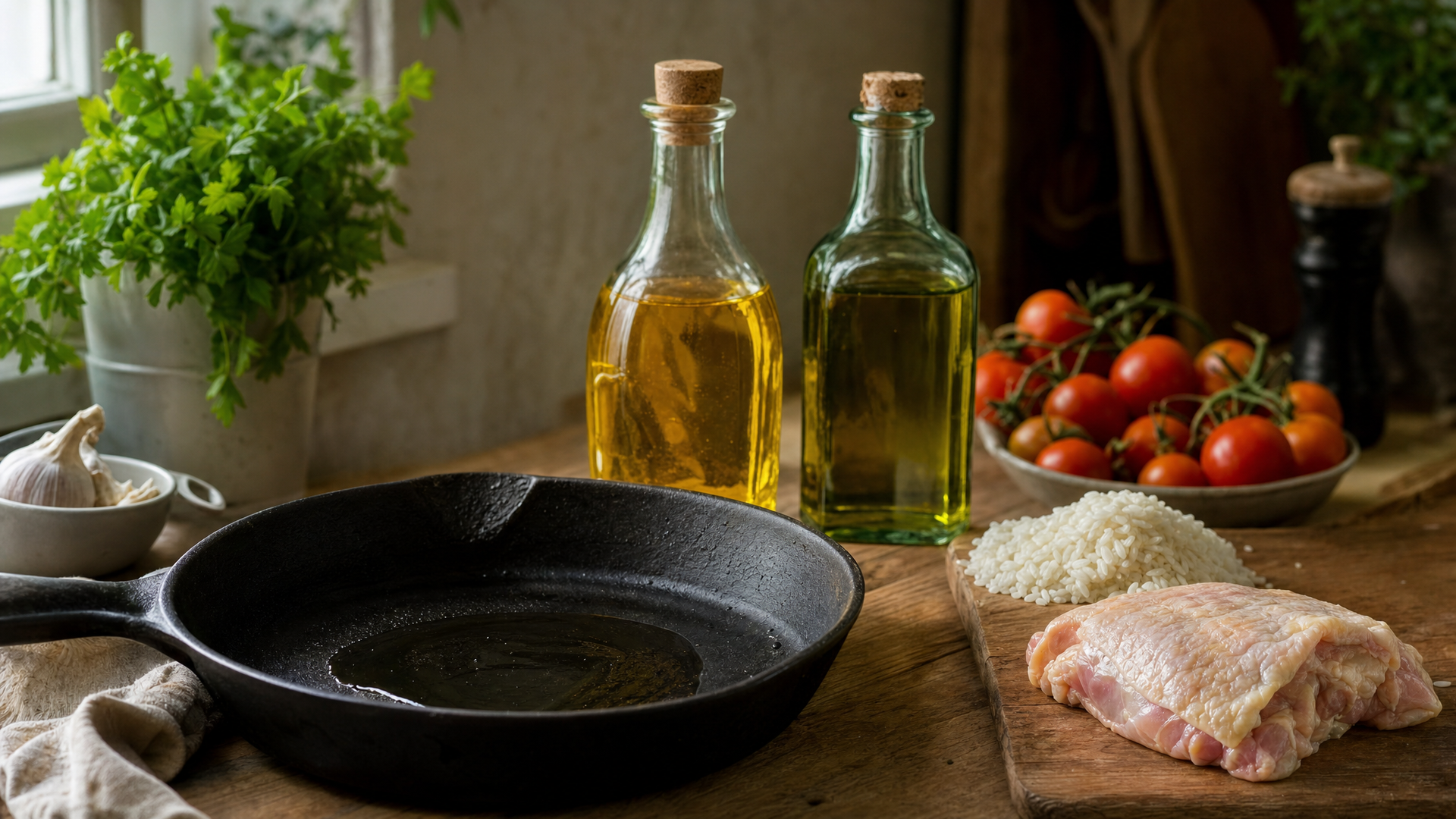
You're 140 lb, you've been trying to eat 3,500 calories a day for two months, and you've finally figured out that a glug of oil in the pan is the cheapest, fastest way to close the gap.
Then you open your phone. A podcast host with a cold plunge tells you canola oil is "industrial sludge." A gym bro on Reels says soybean oil "castrates you." Someone in the comments links to a study on rats. And now you're standing in the supermarket aisle holding a $16 jar of grass-fed tallow, doing math on whether you can afford to cook this way for the next six months.
You can't. And you probably don't need to.
Here's the honest version: the seed oil panic contains one real insight wrapped in about eight layers of nonsense. The nonsense is what gets shared. The real insight is boring and cheap to fix. Let's separate them, because if you're a hardgainer, fat is your single best lever for getting calories in — and being scared of it is a much bigger threat to your physique than linoleic acid ever was.
- No human trial has shown seed oils lowering testosterone at normal dietary intakes
- The "inflammation" claim comes mostly from cell cultures and rodents, not from people who lift
- Linoleic acid does not block muscle protein synthesis — protein and total calories drive that
- The real issue is that at 3,500+ calories your omega-6 intake scales up, so omega-3 intake has to scale too
- Repeatedly reheated oil is genuinely worth avoiding — fresh oil is fine
- Cook with olive oil when you can afford it, canola when you can't, and stop buying $16 tallow
- Being underfed will cost you far more muscle than any cooking oil ever will
What a "seed oil" actually is
The term is marketing, not chemistry. "Seed oils" usually means the eight or so industrially refined oils: soybean, canola (rapeseed), corn, cottonseed, sunflower, safflower, grapeseed, and rice bran.
What they share is a high proportion of polyunsaturated fat, and specifically linoleic acid — an omega-6 fatty acid. Sunflower oil is roughly 60% linoleic acid. Soybean oil sits around 50%. Canola is much lower at about 20%, with a big chunk of monounsaturated fat that makes it look, chemically, a lot more like olive oil than like sunflower.
That last point matters and almost nobody mentions it. Canola and sunflower get lumped together constantly, and they're not remotely the same thing. Canola is roughly 63% monounsaturated fat — olive oil is about 73%. If your problem with seed oils is the omega-6 load, canola is a strange hill to die on.
Linoleic acid is also, by the way, an essential fatty acid. Your body can't make it. You need some. The debate is entirely about how much, and whether the modern amount is a problem.
All cooking fats are mixtures. Butter has polyunsaturated fat in it. Olive oil has saturated fat in it. There is no such thing as a "pure" saturated or unsaturated cooking fat — you're always choosing a ratio, not a category.
Claim #1: Seed oils tank your testosterone
This is the one that actually scares young guys, and it's the weakest of the three.
The claim traces back to a handful of sources. There are rodent studies where animals fed very high proportions of polyunsaturated fat showed reduced testicular testosterone production. There's a small, frequently-cited observational study in men where higher PUFA intake correlated with lower testosterone. And there's a much older body of work showing that very low-fat diets reduce testosterone compared to moderate-fat diets.
That last finding is real and it's important — but notice which direction it points. Eating too little fat lowers testosterone. Guys avoiding seed oils often end up eating less total fat, because they've eliminated the cheapest fat source and haven't replaced the calories.
What we don't have is a controlled human trial where swapping olive oil or butter for sunflower oil, at normal intakes, measurably dropped testosterone in men. Not one. The intervention data on dietary fat composition and androgens in humans is thin, inconsistent, and mostly shows total fat intake mattering more than fat type.
There's also a scale problem. The rodent studies that show clear effects use diets where polyunsaturated fat makes up an enormous share of energy — far beyond what you'd hit cooking dinner in canola. Rats also metabolise fatty acids differently from us. "It happened in a mouse at 5x the human dose" is the single most abused phrase in fitness content.
If your testosterone actually feels low — low libido, flat mood, no morning erections, brutal recovery — the culprit is almost never your cooking oil. Look at sleep, chronic underfeeding, excessive cardio, body fat extremes, and alcohol first. Those have real, replicated effects.
We cover this pattern in more detail in our 12 bulking myths that keep skinny guys small — a lot of bulking advice is built on exactly this kind of extrapolation from an animal model to your dinner plate.
Claim #2: Seed oils cause chronic inflammation
This one is more interesting, because the mechanism is plausible.
Linoleic acid converts to arachidonic acid, and arachidonic acid is a precursor to some pro-inflammatory signalling molecules. On paper: more omega-6, more inflammation. It's a clean story. It's the story that launched a thousand podcast segments.
The problem is that when researchers actually feed people more linoleic acid and measure inflammatory markers, the effect mostly doesn't show up.
A well-known systematic review pooled controlled trials where linoleic acid intake was manipulated in adults, and looked at markers like C-reactive protein, interleukin-6, and TNF-alpha. The overall finding was essentially no effect. Increasing dietary linoleic acid didn't meaningfully raise inflammatory markers in humans.
There's a second wrinkle: the conversion of linoleic acid to arachidonic acid in humans is heavily rate-limited. You can nearly double someone's linoleic acid intake and barely move their tissue arachidonic acid levels. The pathway that the whole theory depends on turns out to be a bottleneck, not an open pipe.
So why does the theory persist?
Because inflammation is a scary word that explains everything and therefore nothing. And because the observational data is genuinely messy — the populations eating the most industrial seed oil are also the populations eating the most ultra-processed food, the most calories, moving the least, and sleeping the worst. Seed oil is a passenger in that car, and it keeps getting blamed for the driving.
That's not a defence of ultra-processed food. It's a request that we blame the right variable. A guy eating 7 oz of chicken thighs pan-fried in canola with rice and broccoli is not in the same metabolic situation as a guy eating a family-size bag of chips, even though both involve seed oil.
Claim #3: Linoleic acid blocks muscle protein synthesis
This is the version that's aimed specifically at lifters, and it's the easiest to dismiss.
Muscle protein synthesis is driven overwhelmingly by two things: adequate protein with enough leucine, and mechanical tension from training. Total energy availability sets the ceiling. Fat type doesn't show up as a meaningful variable in any of the human MPS literature.
There is research on omega-3 supplementation and muscle — some of it suggesting EPA and DHA may improve the anabolic sensitivity of muscle to protein, especially in older adults. But "omega-3s might help a bit" is a very different claim from "omega-6s actively hurt." The first has some support. The second has essentially none.
If you're hitting 0.7-1.0g per lb of protein, training hard, and eating in a surplus, the fatty acid profile of your cooking oil is not the variable holding you back. It's not even in the top ten.
Rank your bulking problems honestly: total calories, protein, training consistency, sleep, then everything else. Seed oils live somewhere around number 15. Fix the top four before you spend a single euro on tallow.
The one thing that genuinely does matter
Alright. Here's the part the debunkers usually skip, and it's specifically relevant to you, because you're eating a lot.
Your omega-3 intake has to scale with your calories
Most of the seed oil discourse fixates on the ratio of omega-6 to omega-3. That framing is a bit sloppy — ratios can look great while both numbers are terrible. But there's a real underlying point, and bulking makes it sharper.
When a sedentary person eats 2,200 calories, their absolute linoleic acid intake is moderate. When you're eating 3,500-4,000 calories to gain 0.5-1 lb a week, everything scales. If a meaningful chunk of those extra calories is coming from sunflower or soybean oil, your absolute omega-6 intake can climb a lot — while your omega-3 intake stays exactly where it was, because nobody accidentally eats more salmon during a bulk.
That's the imbalance worth caring about. And the fix isn't to remove omega-6. It's to add omega-3.
Practically:
- Eat fatty fish twice a week. 5 oz of salmon, mackerel, or sardines per serving.
- If you hate fish, an algae or fish oil supplement providing 1-2g of combined EPA and DHA daily does the job.
- Add 1 oz of walnuts or 0.7 oz of ground flax or chia to breakfast. The conversion from plant omega-3 to EPA/DHA is poor, but it's not zero and the calories are welcome anyway.
That's it. It costs less than one bottle of tallow per month and it addresses the actual mechanistic concern rather than the marketing version of it.
Reheated, degraded oil is a real problem
The second legitimate concern: polyunsaturated fats oxidise more easily than saturated or monounsaturated fats. More double bonds means more places for things to go wrong under heat and oxygen.
Oil that's been held at frying temperature for hours, or reused across multiple sessions, accumulates oxidation products — aldehydes, polymers, and other compounds you'd rather not eat in quantity. This is a documented issue in commercial deep-frying, and it's a reasonable argument for not making takeaway fried food a daily bulking staple.
But notice what this concern is actually about. It's about repeatedly reheated oil at high temperature for a long time. It is not about a tablespoon of fresh canola in a pan for four minutes. Those are not the same exposure, and conflating them is how a sensible point becomes a panic.
Don't reuse frying oil more than once at home, and never keep oil on high heat "ready to go" while you prep other things. If your pan is smoking, the oil has already degraded — dump it, wipe the pan, start again. This matters far more than which bottle you poured from.
Also: store your oil in a dark cupboard, sealed, away from the hob. Light and heat degrade it slowly on the shelf too. Buy sizes you'll finish in a couple of months rather than the 6.6 lb catering tub that'll sit half-empty until spring.
The practical verdict: what to cook with
Here's how I'd actually rank fats for a lifter trying to eat a lot of food without going broke.
| Fat | Use it for | Rough cost | Verdict |
|---|---|---|---|
| Extra virgin olive oil | Dressings, finishing, medium-heat cooking | High | Best all-round choice |
| Canola / rapeseed | Everyday cooking, high heat, baking | Very low | Fine. Genuinely fine. |
| Avocado oil | High-heat searing | Very high | Good, rarely worth the price |
| Butter / ghee | Flavour, eggs, moderate heat | Medium | Fine in moderation |
| Sunflower / safflower | Neutral cooking | Low | Fine, but canola is a better default |
| Soybean / corn | Whatever's already in packaged food | Low | Not worth seeking out or fearing |
| Tallow / lard | Roasting, flavour | Medium-high | Fine. Not magic. |
| Repeatedly reused frying oil | Nothing | — | Actually avoid this one |
The headline: olive oil is the best choice, canola is the best value, and nothing on this list except degraded oil is worth losing sleep over.
Olive oil earns its spot on evidence rather than vibes — the Mediterranean diet literature is about as strong as nutrition evidence gets, and it's also ridiculously calorie-dense for how easy it is to add to food. We broke that down fully in olive oil for bulking, including how to get 500 extra calories a day out of it without noticing.
How much oil is fine?
For a 155 lb lifter eating 3,500 calories, a reasonable target is 25-35% of calories from fat — call it 100-135g of fat a day. Of that, getting 2-4 tablespoons from cooking oils is completely normal and completely fine.
If you want a crude guideline for the omega-6-heavy oils specifically: keep sunflower, soybean, corn, and grapeseed to a couple of tablespoons a day, use olive or canola as your default, and make sure you're actually eating omega-3s. That's the whole protocol. It fits in a sentence.
The rest of your fat should be coming from real food anyway — whole eggs, fatty cuts of meat, nuts, nut butters, full-fat dairy, avocado. If you want the full breakdown of which food sources give you the most calories for the least effort, our guide to the best fats for bulking covers it in depth.
The mistakes I see skinny guys make chasing this
1. Removing oil and not replacing the calories. This is the big one. A guy cuts his cooking oil to avoid seed oils, drops 300 calories a day without realising it, and then wonders why he's stalled at 145 lb for a month. Oil is dense — one tablespoon is about 120 calories. You can't quietly delete three of them a day and expect nothing to happen.
2. Buying premium fat and cutting protein to afford it. If your grocery budget is fixed and you spend $7 per lb on tallow, something else comes out of the basket. Usually meat. Trading protein for cooking fat is an objectively bad deal for a lifter, every single time.
3. Treating "seed oil free" as a health signal. Food companies noticed the trend immediately. "No seed oils" now appears on cookies, chips, and protein bars — products where the seed oil was never the problem. A cookie fried in beef tallow is still a cookie.
4. Avoiding restaurants and social meals. If you're a 5'10" hardgainer struggling to hit calories, turning down a meal out because the kitchen uses canola is self-sabotage with extra steps. Eat the food. Enjoy your life. Get the calories.
5. Ignoring the thing that actually works. Adding fatty fish twice a week takes ten minutes of planning. Switching to tallow takes a credit card. Guess which one people do.
Here's a useful test for any nutrition rule you're about to adopt: does following it make it easier or harder to hit your calorie target? If harder, the evidence behind it needs to be overwhelming. For seed oils, it isn't.
When it's actually worth paying up
I'm not going to pretend all fats are identical. There are three situations where spending more makes sense:
You cook at high heat often. If you're searing steak or stir-frying several times a week, a high-smoke-point, oxidation-resistant fat is a genuine upgrade. Refined olive oil, avocado oil, or ghee all work. Not because seed oils are toxic, but because they degrade faster at 7 oz steak searing temperatures.
You eat a lot of one thing. If a single fat source is providing 40% of your daily calories — and at 4,000 calories that's easy to do accidentally — it's worth that source being olive oil rather than the cheapest bottle on the shelf. Diversity of fat sources is a reasonable, low-cost hedge.
Flavour. Butter on eggs. Olive oil on salad. Good fat makes food you'll actually eat again tomorrow, and adherence beats optimisation every time when you're trying to eat 3.3 lb of food a day.
Outside those three, the marginal benefit of upgrading your cooking oil is small enough that it's within the noise of everything else you're doing.
Where FuelTheGains fits
The reason this debate eats so much mental energy is that it's answerable in a way the hard stuff isn't. Picking a cooking oil feels like progress. Actually planning 3,500 calories a day, every day, for five months — that's the part nobody wants to do.
That's what we built for. You tell it your weight, your height, your training, and how fast you want to gain, and it builds the meal plan around real food you'll actually eat, with the macros already balanced and the fat sources sensible by default. No 47-tab spreadsheet, no guessing whether today's total landed.
It won't argue with you about linoleic acid. It'll just make sure that whatever oil you choose, you're hitting the surplus that actually builds the muscle — which is the only part of this that was ever going to move your scale from 140 lb to 160 lb.
The bottom line
Seed oils are not killing your gains. The evidence for lowered testosterone in humans doesn't exist, the inflammation story falls apart in controlled trials, and there's no mechanism by which linoleic acid blocks muscle growth.
What's real: repeatedly reheated oil is worth avoiding, and if you're eating 3,500+ calories a day you should deliberately add omega-3s rather than just subtracting omega-6s.
So cook with olive oil when the budget allows, canola when it doesn't, eat fatty fish twice a week, don't reuse frying oil, and spend the money you saved on tallow on another 2.2 lb of chicken.
The guy who eats 3,600 calories a day in sunflower-fried chicken and rice will out-gain the guy eating 2,800 calories of artisanal tallow every time. Not close. Get the food in first — everything else is a rounding error.