
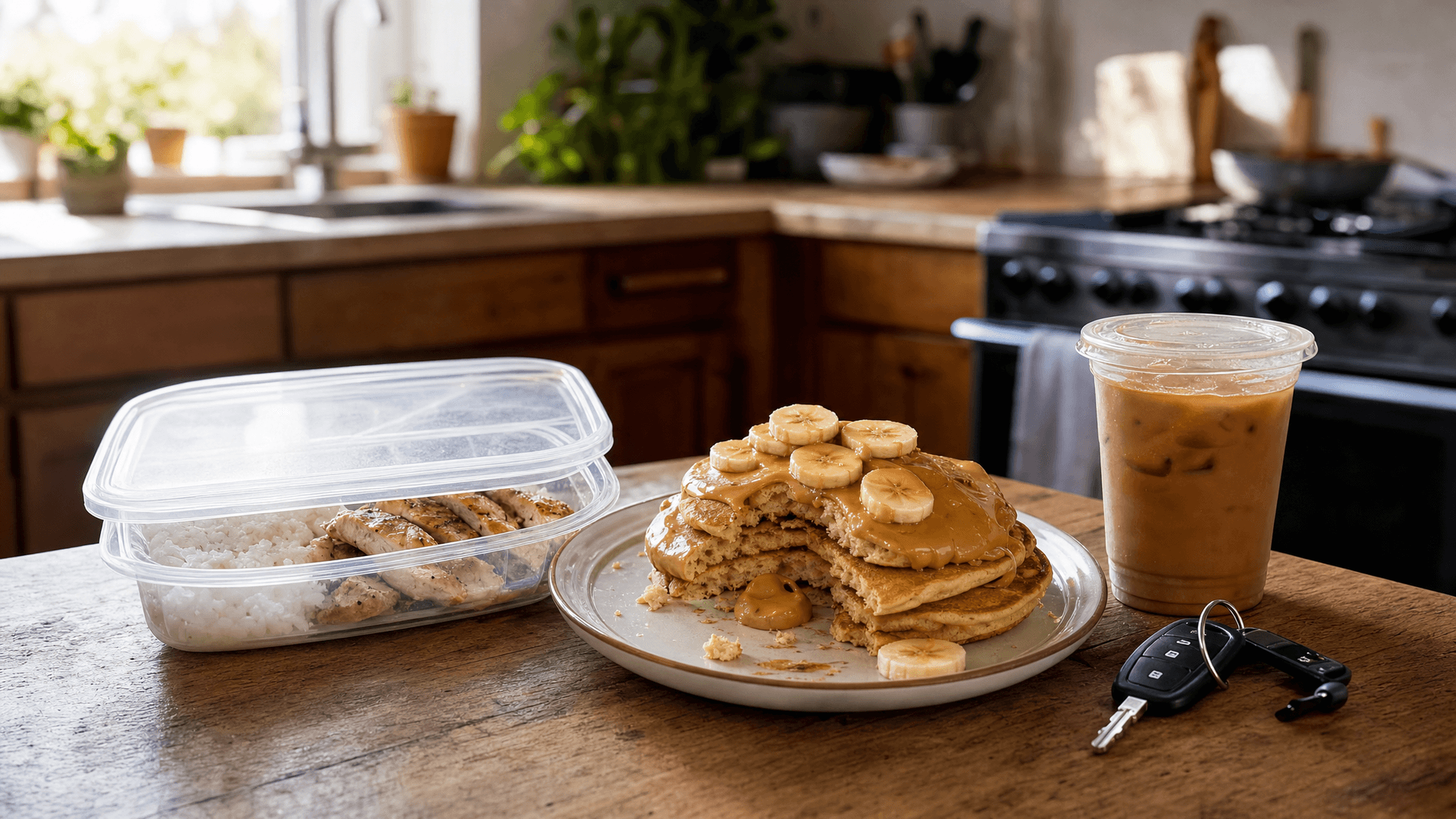
Monday through Friday, you're a machine.
You've got the containers stacked in the fridge. You eat at 7, 10, 1, 4, and 8. You hit your number every single day without thinking about it, because the structure does the thinking for you.
Then Saturday shows up and the whole thing quietly falls apart.
You sleep until 10:30. Breakfast becomes coffee. You're not hungry, so you push lunch to 2pm and it ends up being whatever's left in the fridge. Dinner is big — genuinely big, maybe 1,200 calories with drinks — and you go to bed thinking you crushed it. Sunday is a rerun with slightly more guilt.
And then you weigh in Monday and the scale hasn't moved in three weeks.
Here's the thing nobody tells skinny guys who are trying to bulk: you're not failing on the days you're tracking. You're failing on the two days you stopped counting. And because they're only two days out of seven, they feel too small to matter. They're not. They're 29% of your week, and they're where your entire surplus goes to die.
- Two unstructured weekend days can erase a full week's calorie surplus
- Your weekly average is the only number that matters, not your daily hits
- Weekend losses come from three places: the missed morning, fewer eating windows, and one big meal replacing four
- Front-load Saturday and Sunday with a fixed anchor meal before noon
- Liquid calories are the highest-leverage weekend tool because they don't need hunger
- Bank extra calories on Friday and Saturday instead of trying to save them on Monday
- Track for two weekends only, then run the template on autopilot
The Math That Explains Your Stalled Scale
Let's put actual numbers on this, because "eat more on weekends" is useless advice without seeing the size of the hole.
Say you're a 155 lb guy at 5'11" who trains four times a week. Your maintenance is around 2,700 calories. You're running a lean bulk at 3,100 — a 400-calorie daily surplus, which should put on roughly 0.7 lb a month of mostly lean weight. Reasonable. Sustainable. The right call.
Monday through Friday you nail 3,100. Five days at a +400 surplus gives you +2,000 calories banked for the week.
Now the weekend. You wake up late and skip a 700-calorie breakfast. Your afternoon meal is a sandwich instead of a prepped 900-calorie plate — call it 500. Dinner is big, 1,300 with drinks. You forget your shake entirely.
Saturday total: 1,800 calories. That's not a small miss. That's 1,300 below maintenance.
Sunday's a little better because you're home — 2,400. Still 300 below maintenance.
| Day | Calories | vs. Maintenance (2,700) |
|---|---|---|
| Mon-Fri (each) | 3,100 | +400 |
| Weekday total | 15,500 | +2,000 |
| Saturday | 1,800 | -900 |
| Sunday | 2,400 | -300 |
| Week total | 19,700 | +800 |
You planned a +2,800 week. You got +800. Your weekly average drops from 3,100 to 2,814 — barely a hundred calories over maintenance.
That's not a bulk. That's maintenance with extra steps and a lot of Tupperware.
A +100 daily average will technically add weight — around 0.9 lb over three months. But that's slower than normal water and glycogen fluctuation, which swings 2-4 lbs week to week. So the signal is completely buried in the noise. You genuinely cannot tell it's working, which is exactly why guys quit at week six.
Where the Calories Actually Go
It's not one big thing. It's three small ones that compound, and they're all structural, not motivational.
1. The Missing Morning
This is the biggest one by a mile.
On a weekday you're up at 7 and eating by 7:30. On Saturday you're up at 10:30 and "not really hungry." So the first thing you eat is at noon. You just deleted an entire eating window — and on a bulk, every window is worth 600-900 calories.
Worse: those hours don't come back. You can't eat five meals in the eight waking hours you've got left, especially when three of them are spent out of the house. The day is now mathematically capped.
2. Fewer Eating Windows, Not Smaller Meals
Guys assume weekend meals are smaller. Usually they're not — weekend meals are often bigger. The problem is there are two or three of them instead of five.
Your stomach has a ceiling. If you're a hardgainer, that ceiling is low. You physically cannot fit 3,100 calories into two sittings without feeling like you're going to die. So you eat until you're full, stop at 2,200, and assume you did fine because you felt full.
Fullness is not a calorie counter. It never has been.
3. The One Big Social Meal Illusion
Restaurant food feels enormous. And a burger and fries genuinely is 1,100-1,400 calories. But you ate it instead of two prepped meals and a shake, which together were 2,000.
The meal that felt like a splurge was actually a 900-calorie deficit compared to your normal Tuesday. This is the single most common misread in bulking. If you eat out often, our restaurant guide for bulking breaks down how to order so the big meal is actually big.
The "I ate huge yesterday" feeling is the least reliable data you have. Feeling stuffed comes from volume and fat content, not calorie totals. A 14 oz plate of pasta with cream sauce and a 14 oz plate of salad and grilled chicken can feel identical and differ by 900 calories.
Stop Grading Yourself Daily
Here's the mental shift that fixes most of this before you change a single meal.
Your body doesn't know what a Tuesday is. Muscle protein synthesis, glycogen storage, and fat gain all run on rolling multi-day energy balance, not calendar days. Nothing resets at midnight.
So the daily number is a tool, not a target. The number that determines whether you grow is your 7-day average.
This is liberating once it clicks. It means:
- A 2,400-calorie Saturday isn't a failure. It's a gap you offset elsewhere.
- Eating 3,600 on Friday isn't "overeating." It's pre-loading.
- Missing one meal doesn't matter. Missing the same meal every weekend does.
How to Actually Audit It
Take your tracker and do this once. It takes ten minutes and it's the highest-value ten minutes in your entire bulk.
- Pull the last 14 days of calories.
- Add all 14 together, divide by 14. That's your true intake.
- Now add just the 10 weekdays and divide by 10. That's your imagined intake.
- Subtract. The difference is your weekend gap.
Most guys who think they're bulking at 3,100 find a true average between 2,650 and 2,850. That's the whole mystery, solved with arithmetic.
If you don't have 14 days logged, don't guess retroactively — you'll flatter yourself. Track the next two weekends honestly, including drinks, and use those. Two weekends is enough to see the pattern.
If your audit shows you're genuinely averaging a surplus and the scale still won't move, the problem is somewhere else. Our breakdown of why you're not gaining weight while bulking covers the other nine usual suspects.
The Weekend Template
Now the fix. The rules here are deliberately minimal, because anything complicated will not survive a hangover, a late night, or a Sunday where you leave the house at 9am.
Three rules. That's it.
Rule 1: The Anchor Meal Before Noon
Non-negotiable. You eat something substantial before 12pm on both weekend days, regardless of when you woke up or how hungry you are.
You're not waiting for hunger. Hunger on a weekend morning is a broken signal — you slept 10 hours, your body's in low-energy mode, and it will not ask for food until 2pm. By then the day is lost.
Target 700-1,000 calories for the anchor. Options that take under five minutes:
| Anchor option | Calories | Protein | Prep |
|---|---|---|---|
| 4 eggs, 2 toast, butter, avocado | 780 | 34g | 8 min |
| Overnight oats + whey + peanut butter | 850 | 45g | 0 min (made Friday) |
| Whole-milk shake + 2 bananas | 900 | 42g | 3 min |
| Bagel, cream cheese, smoked salmon | 720 | 33g | 4 min |
| Leftover weekday prep container | 800 | 50g | 2 min |
That last one is underrated. Make one extra weekday container on Thursday and eat it Saturday morning. It feels weird for about a week and then it's just normal.
Rule 2: One Liquid Meal, Always
Your weekend appetite is unreliable. Liquid calories don't care about your appetite.
One shake per weekend day, hit whenever there's a gap — before you go out, after you get back, at 11pm, in the car. It's the flex slot that patches whatever the day broke.
A solid weekend shake:
- 2 cups whole milk — 300 cal
- 1 scoop whey — 120 cal
- 2 tbsp peanut butter — 190 cal
- 1 banana — 100 cal
- 2 oz oats (blended) — 230 cal
940 calories, 48g protein, 90 seconds. That single shake covers most of the gap we calculated earlier.
Pre-portion two shakes' worth of dry ingredients into ziplock bags on Friday night. Saturday you dump the bag in the blender with milk. Zero decisions on a day where decision-making is not your strength.
Rule 3: The Social Meal Is a Bonus, Not a Replacement
When you've got a dinner out, brunch, or a party, treat it as an addition to your day, not a substitute for it.
Concretely: eat your anchor meal, have a normal afternoon meal, then go to dinner. Yes, you'll be less hungry at the restaurant. Order anyway — get the higher-calorie option, eat 70% of it, and you're still way ahead of the guy who "saved room" and ate one 1,200-calorie meal all day.
Never save calories for a big meal. It's the most reliable way to end the day 800 short. Your appetite ceiling is lower than your ambition, and you will not eat 2,500 calories in one sitting no matter how hungry you arrive.
A Real Weekend, Written Out
Here's what a Saturday hitting 3,100 actually looks like when you woke up at 10:30 and have dinner plans at 8pm.
11:00 — Anchor. Overnight oats made Friday: 2.8 oz oats, whole milk, whey, 2 tbsp peanut butter, honey. 850 cal, 45g protein.
14:00 — Real meal. Leftover prep container: rice, 6 oz chicken thigh, olive oil, veg. 780 cal, 52g protein.
17:00 — Shake. The 90-second one above. 940 cal, 48g protein.
20:30 — Dinner out. Burger, side of fries, two beers. Eat most of it. 1,300 cal, 40g protein.
Running total: 3,870. That's above your 3,100 target — and that's fine. That's good, actually. It's banking against the Sunday that's about to go sideways, and it's how the weekly average stays where you want it.
Notice what happened: you didn't skip the social dinner, you didn't cook anything, and you didn't count a single macro during the day. You did three things in the right order.
Sunday's usually easier — you're home more. But it's also the day people unconsciously start "eating clean for the week ahead," which means light. Don't. Sunday is a normal bulking day. Run the same three rules and add your weekly meal prep at the end of it.
Bank Forward, Never Backward
One more strategic layer, and it's the difference between a template that works and one that works effortlessly.
Front-load the week. Never try to make it up on Monday.
Compensating backwards fails for a simple reason: on Monday you're back in your structured routine, and your structured routine is already at your ceiling. There's no room to add 800 calories to a day that's already scheduled to the minute. So the deficit just stays a deficit.
Front-loading works because Friday is a good eating day for almost everyone — you're still in weekday rhythm, still have prep in the fridge, and often training. Adding 400-600 calories to Friday costs you nothing.
Practically:
- Friday: target 3,500-3,700 instead of 3,100
- Saturday: aim high, accept whatever lands above 2,800
- Sunday: normal 3,100, full three rules
This is really just calorie cycling applied to your social calendar instead of your training split. If you want the full framework — including how to line high days up with your heavy sessions — read our guide to calorie cycling for bulking.
If you train on Saturday, train in the morning before the anchor meal is due, then eat immediately after. A morning session solves the "not hungry" problem better than any trick — training reliably makes you eat.
The Mistakes That Keep This Broken
1. Tracking only weekdays. If your app has gaps on Sat-Sun, you don't have data — you have a highlight reel. Log the messy days especially.
2. Counting a beer as nothing. Four beers is 600 calories, and they're real. Count them. They're not clean calories, but on a bulk they're not your enemy either. The problem is that alcohol suppresses appetite for hours afterward — that's the actual cost, not the calories.
3. Waiting to feel hungry. Covered above, but it's the #1 killer. Weekend hunger arrives about four hours too late to be useful.
4. Making the weekend a project. If your plan involves cooking on Saturday, it will fail by week three. Everything in the template above is either pre-made, poured, or ordered.
5. Weighing yourself Monday morning only. After a low-food weekend with less sodium and less food volume in your gut, Monday is your lightest weigh-in of the week. You're literally sampling at the worst possible moment. Weigh daily, use the 7-day average.
6. Going all-or-nothing. A weekend where you hit 2,900 instead of 3,100 is a win. Two hundred calories off is noise. Eighteen hundred off is the problem. Don't let a small miss turn into a "screw it, I'll restart Monday."
Two Weeks of Tracking Is All You Need
You don't have to log food forever. You have to log it long enough to learn the shape of your own weekend.
Track two full weekends — every drink, every restaurant meal, honestly. At the end you'll know two things: your actual weekend average, and which of the three leaks is yours. Almost everyone has one dominant leak, not all three.
Then stop tracking and just run the rules. The anchor meal and the shake are worth 1,800 calories between them; get those two automatic and the weekend basically can't go below maintenance, even if the rest of the day is chaos.
Check your progress by weight trend, not by logs: weigh daily, average the week, and look for 0.5-0.9 lb of gain per week on a lean bulk. If four weeks of weekly averages are flat, your intake is too low — add 250 to Friday and Saturday and reassess.
When Cooking Isn't the Answer
Here's the honest bottom of all this: the weekend problem isn't knowledge. You already knew you ate less on Saturday. The problem is that eating 155 lb-guy-becomes-176 lb-guy quantities requires either a lot of cooking or a lot of money, and weekends have neither.
That's the gap was built for. It generates a full bulking meal plan around your actual calorie target, your budget, and how much effort you're willing to put in — including low-effort days where nothing needs cooking. You get the grocery list, the portions, and the shake recipes that fill gaps like the one this article is about, so a Saturday morning is a decision you already made on Thursday.
It won't make you eat. But it removes the "what do I even have for this" question, which is what actually kills most weekends.
The Bottom Line
Your bulk isn't failing because your weekday plan is wrong. It's failing because your weekday plan only covers five days and you've been grading yourself on those five.
Add up 14 days. Find your real average. Then fix the weekend with the three rules: eat before noon, drink one shake, treat social meals as a bonus.
That's it. Two hundred words of plan and probably 9-13 lbs a year you were leaving on the table.