
Let's skip the part where a fitness site pretends none of its readers smoke.
If you're a guy in your 20s who lifts, there's a decent chance weed is somewhere in your week. Maybe it's a joint on Friday, maybe it's a gummy before bed most nights, maybe it's a lot more than that. And when you go looking for actual information about how it affects a bulk, you get two useless options: total silence, or someone in a tank top telling you that you'll never grow because you're "poisoning your temple."
Neither of those helps you eat 3,600 calories tomorrow.
So here's the real version. Cannabis does something genuinely useful for a hardgainer — it makes eating easier, which is the single hardest part of bulking. It also does something genuinely costly — it messes with the deep, dream-heavy part of your sleep, which is where a chunk of your recovery lives. Whether it helps or hurts your gains comes down almost entirely to timing, dose, and what's in your fridge when the munchies hit.
- The munchies are a real hardgainer advantage — but only if you steer them into prepped high-calorie food instead of chips
- THC suppresses REM sleep, and REM debt shows up as flat training and poor motivation, not obvious tiredness
- Next-morning appetite is usually blunted, which can cancel out every calorie the munchies gave you
- Edibles hit 30-120 minutes later and last 4-8 hours — plan around that window, not around smoking timelines
- Keep a "munchie shelf" stocked so the easiest food in the house is also the most calorie-dense
- Daily use is where the recovery cost stacks up; 1-3 nights a week is a very different situation
What Cannabis Actually Does to Appetite
The munchies aren't a meme. They're a well-documented effect, and the mechanism is pretty direct.
THC binds to CB1 receptors, which sit in the parts of your brain that regulate hunger and reward. Two things happen. First, your body's own hunger signalling gets amplified — ghrelin, the "you're hungry" hormone, goes up. Second, and this is the bigger one for a bulker, food becomes more rewarding. Smell hits harder. Taste hits harder. The part of your brain that normally says "eh, I'm full" gets quieter.
For most people that's a party trick. For a hardgainer, that's the exact problem you've been fighting for months.
Because here's the thing about being naturally skinny: you're not failing to grow because your program is wrong. You're failing to grow because you sit down to your fourth meal of the day, look at another 7 oz of chicken and rice, and physically don't want it. Appetite is the bottleneck. Everything else is negotiable.
Studies on appetite in clinical populations have found THC can push daily intake up meaningfully — we're talking a few hundred calories a day, sometimes more. If you're a 150 lb guy trying to eat 3,400 calories and consistently landing at 3,000, that gap is exactly the gap that's keeping you at the same weight.
Guys who gain weight easily don't have an appetite problem — they have a stopping problem. If that's you, everything in this article flips, and the munchies are a liability, not a tool. Read this with that filter on.
The catch — and it's a big one — is that the munchies don't send you toward food that builds muscle. They send you toward food that's sweet, salty, crunchy, and immediate. Nobody has ever gotten high and thought "you know what sounds incredible right now? Poached cod."
So the entire game is redirection.
The Munchie Window Is a Meal, Not a Snack
Here's the mental reframe that changes everything: stop treating the munchies as a snack episode and start treating them as a scheduled meal.
If you get high at 9pm and you're hungry at 9:40pm, that's not a lapse in discipline. That's meal five. It's a meal you'd normally have to force down, and now your body is actively asking for it. That's a gift. Don't hand it to a bag of tortilla chips.
The difference between a good munchie window and a bad one is roughly 900 calories of quality, and it's decided entirely by what's within arm's reach.
Bad munchie window
- Half a bag of chips (600 cal, 8g protein)
- Some cereal, dry, out of the box (300 cal, 6g protein)
- Whatever candy's in the drawer (200 cal, 0g protein)
That's 1,100 calories and 14g of protein. It counts toward your total, sure, but it's almost pure filler, it'll bloat you, and you'll wake up feeling like garbage.
Good munchie window
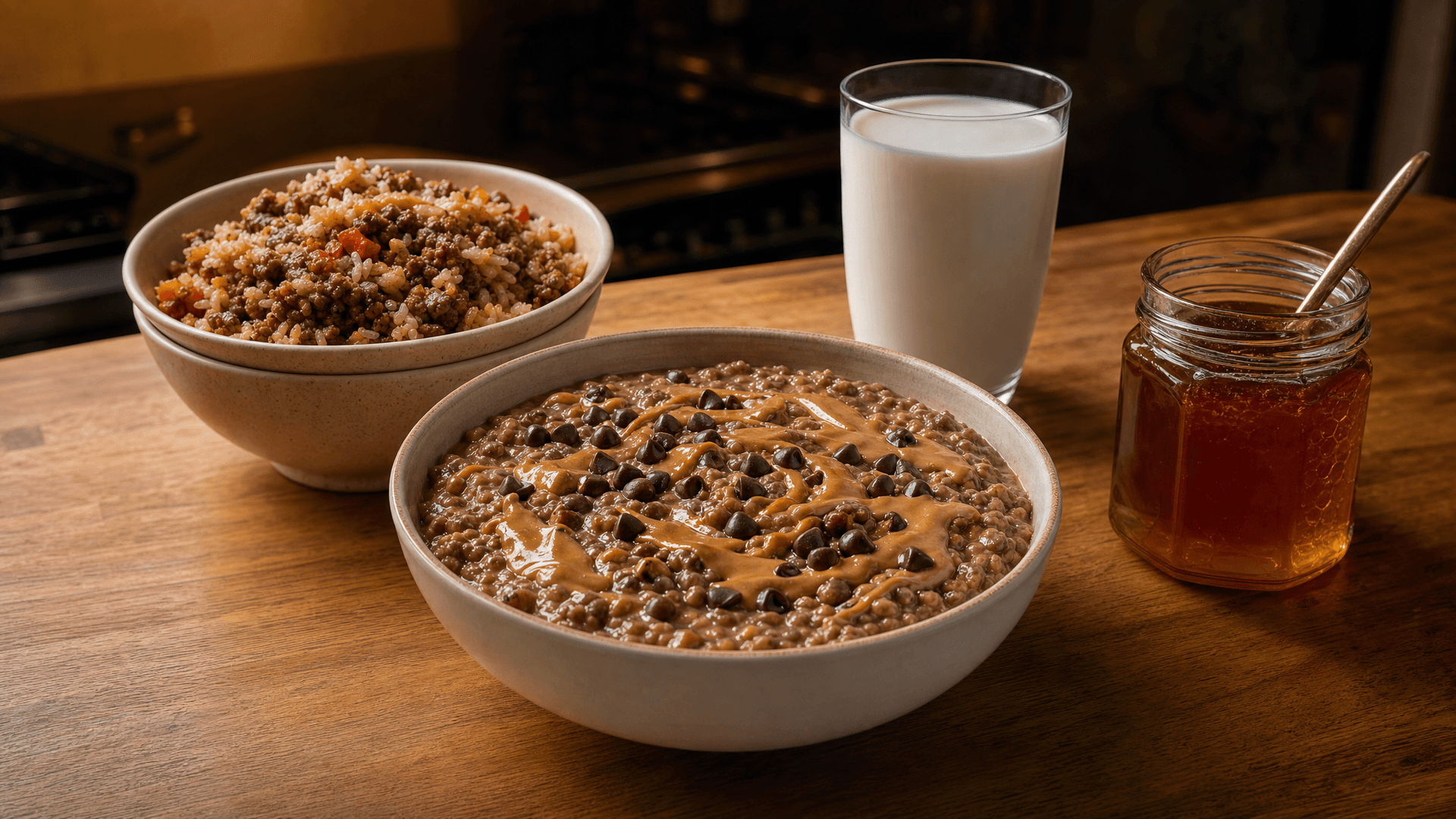
- A rice bowl: 5 oz cooked rice, 5 oz shredded chicken thigh, olive oil, hot sauce (750 cal, 45g protein)
- A shake with whole milk, oats and peanut butter (550 cal, 35g protein)
That's 1,300 calories and 80g of protein — and it's easier to eat than the chips, because the munchies are doing the work for you.
Same feeling. Same effort. Completely different outcome six weeks later.
Cook your munchie meal before you smoke. Present-you makes bad food decisions when hungry and high; past-you makes great ones. A covered bowl in the fridge with a fork already in it beats any amount of willpower.
Build a Munchie Shelf
This is the single highest-leverage thing in this whole article, and it takes twenty minutes on a Sunday.
The rule: the easiest food in your house should also be the most calorie-dense. If reaching for chips takes three seconds and reaching for real food takes fifteen minutes, you'll eat chips every single time. Fix the friction, not your character.
Here's what to keep stocked and prepped:
| Item | Prep needed | Calories | Protein |
|---|---|---|---|
| Pre-cooked rice + shredded chicken bowls | Reheat 90s | 700-800 | 45g |
| Overnight oats with whey and peanut butter | None — grab it | 650 | 40g |
| Full-fat Greek yogurt + granola + honey | Assemble, 60s | 550 | 35g |
| Cheese and salami on crackers | None | 500 | 25g |
| Peanut butter and honey on white bread | 60s | 600 | 20g |
| Whole milk (kept cold, always) | Pour | 300 per pint | 16g |
| Trail mix in a pre-portioned jar | None | 450 | 12g |
Three things to notice.
One: every item is either zero-prep or under two minutes. That's non-negotiable. High-you does not cook.
Two: most of the calories come from fat. Fat is 9 calories per gram versus 4 for carbs and protein, so 1 oz of nuts does more work than a whole bowl of rice cakes. When you're chasing calories, fat is the cheat code.
Three: every option has real protein in it. This is the part people skip. If your munchie meal is 900 calories of pure carbs, you've spent your appetite window on the least useful macro.
If you want the full playbook on getting more food down when you don't feel like eating, we went deep on it in our guide to increasing your appetite for bulking — most of those strategies stack perfectly with what's described here.
The Sleep Problem Nobody Wants to Hear
Okay. Now the bad news, and it's real bad news, so don't skim this part.
THC changes your sleep architecture. Specifically, it suppresses REM sleep — the stage where you dream, and the stage most tied to memory consolidation, motor learning, and emotional regulation.
Here's what makes this sneaky: weed makes you fall asleep faster and it often increases slow-wave (deep) sleep early in the night. So subjectively, you feel like you slept great. You went out fast, you didn't wake up at 3am, you don't remember any dreams. Feels like a win.
But REM normally makes up around 20-25% of a night's sleep, and it's concentrated in the back half. Regular THC use compresses it. You're getting eight hours in bed and something closer to seven hours of usable sleep.
The symptoms of REM debt don't look like tiredness. They look like:
- Your motivation to train quietly disappearing
- Technical lifts feeling clumsy — your squat groove is just off
- Being weirdly irritable and short-fused
- Progressive overload stalling even though your food and program haven't changed
The dream rebound is the tell. If you take a few nights off and get vivid, exhausting, cinematic dreams, that's your brain repaying REM debt. The stronger the rebound, the bigger the debt you'd built up.
Sleep isn't a nice-to-have during a bulk — it's where the actual adaptation happens. Growth hormone pulses, protein synthesis, nervous system recovery from heavy work: all of it is downstream of sleep quality. We broke down exactly how much this costs you in sleep and recovery for muscle growth, and the short version is that chronically under-recovered lifters gain slower and hold more fat per pound of muscle.
So the honest math: cannabis can hand you 400 extra calories a night and quietly take back a chunk of your recovery. Whether that trade is worth it depends entirely on frequency.
The frequency reality
| Pattern | Appetite benefit | Recovery cost | Verdict |
|---|---|---|---|
| Once or twice a week, evening | Solid on those nights | Minimal — REM recovers between | Fine, use it deliberately |
| 3-4 nights a week | Good | Noticeable REM suppression | Works, but watch your training logs |
| Every night | Diminishes — tolerance builds | Sustained REM suppression | This is where gains stall |
| Daily, multiple times | Appetite often drops long-term | Significant | Actively working against you |
That last row surprises people. Heavy chronic users often report less appetite, not more, because CB1 receptors downregulate. The munchies are a tolerance-sensitive effect. If you're smoking every day, you've probably already lost most of the appetite benefit and kept the entire sleep cost.
The Morning-After Appetite Crash
This is the effect that quietly kills more bulks than the sleep thing does, and almost nobody talks about it.
You eat huge at 10pm. Feels amazing. Then you wake up and you're not hungry until 1pm.
There's a few things going on. A genuinely large late meal is still digesting when you wake up. Cannabinoids linger and can leave a foggy, low-drive morning. And the sleep you got was less restorative than the clock suggests, which itself blunts appetite hormones.
So your day looks like this: you skipped breakfast entirely, you had a small lunch, and by the time your appetite comes back at dinner you're 900 calories behind where you needed to be. Then you get high again at night to catch up, and you've built a loop where all your food is jammed into a six-hour window at the end of the day.
That's a bad pattern for two reasons. Protein distribution matters — spreading 30-40g of protein across four or five feedings beats dumping 120g into two. And front-loading zero calories before training means you're lifting on fumes.
Non-negotiable rule: a liquid breakfast on mornings after. A shake with whole milk, a scoop of whey, oats and a banana is 700 calories and takes 60 seconds. You don't need appetite to drink something. This one habit rescues most of the deficit.
Weigh yourself daily and use the weekly average. If your morning-after crashes are eating the surplus, the scale will tell you long before your mirror does — you'll see a flat trendline despite feeling like you're eating constantly.
Edibles vs. Smoking: The Timing Difference
These are functionally two different drugs when it comes to training, and treating them the same is how people end up stoned in the squat rack at a bad time.
| Smoking / vaping | Edibles | |
|---|---|---|
| Onset | 2-10 minutes | 30-120 minutes |
| Peak | 20-30 minutes | 2-4 hours |
| Duration | 2-3 hours | 4-8 hours, sometimes more |
| Predictability | High — you feel it, you stop | Low — easy to overshoot |
| Munchie timing | Fast, sharp, short | Slow, broad, long |
| Sleep impact | Ends earlier in the night | Often still active through REM windows |
For smoking, the useful window is narrow and controllable. You know within five minutes where you are. If you smoke at 8:30pm, you're eating by 9pm and mostly clear by 11pm — meaning the second half of your night's sleep is relatively less affected.
For edibles, everything stretches. Take one at 9pm and you might peak at midnight, right when your body should be moving into its REM-heavy stretch. That's the worst-case scenario for recovery. An edible taken at 6pm, with a real meal at 8pm and lights out at 11pm, is a substantially better structure for the same dose.
Never take an edible "to see" before training. A dose that felt like nothing at rest can land hard 90 minutes in, and being heavily impaired under a loaded barbell is a genuine injury risk — not a vibe. Impaired reaction time and heavy compound lifts are a bad combination.
What about training high?
Some people love it, and there's a legitimate case for it on low-skill, high-effort work — steady-state cardio, machine-based hypertrophy, an arms day. Focus narrows, boredom disappears, and time under tension feels less miserable.
But be honest about the costs:
- Heart rate goes up at rest, so your conditioning work feels harder for the same output
- Proprioception and reaction time drop — bad news for heavy squats, deadlifts, and anything overhead
- Your perception of effort gets unreliable; you'll either sandbag or push past a technical breakdown without noticing
- Rest periods stretch out with no sense of time and your session runs to 100 minutes
My take: if you're going to train high, do it on accessory days and keep the barbell work sober. Save the heavy compound sessions for a clear head, when you can actually judge whether that fifth rep was clean.
The Substance Comparison Nobody Makes
Worth putting this in context, because lifters who'd never touch a joint will happily do six beers on a Saturday.
Alcohol suppresses muscle protein synthesis directly, dehydrates you, wrecks sleep architecture in its own way, and delivers about 7 calories per gram that your body prioritizes burning over everything else. The research on drinking and hypertrophy is genuinely unflattering — we covered the details in our breakdown of how alcohol affects your gains.
Cannabis doesn't have that same direct anti-anabolic mechanism in the research we have. Its costs are mostly indirect — through sleep, through motivation, through appetite timing. That doesn't make it free. It makes it a different trade, and one that's more manageable if you're deliberate about it.
The point isn't "weed is fine, drink less." It's that if you're auditing what's slowing your progress, an honest audit puts your Saturday night ahead of your Tuesday gummy.
Practical Rules That Actually Work
Here's the whole thing distilled into rules you can start using tonight.
1. Prep the meal before you're high. Cook it, plate it, cover it, put it front-and-center in the fridge. Removing every decision is the entire strategy.
2. Set a hard stop 3 hours before bed. For smoking that means 8pm for an 11pm bedtime. For edibles push it earlier — 5 or 6pm. This protects the back half of the night where REM lives.
3. Protein first, always. Whatever the munchie meal is, the protein goes in your mouth before the carbs do. You'll hit 40g before your appetite gets hijacked by the crunchy stuff.
4. Liquid breakfast the morning after. No exceptions. A 700-calorie shake takes zero appetite to consume.
5. Cap it at 3-4 nights a week during a hard training block. If you're running a program with heavy squats and deadlifts twice a week, your nervous system needs full nights. Save it for deload weeks and lighter days.
6. Track two things: bodyweight trend and your top set. If your weekly average bodyweight is climbing 0.25-0.5 kg and your main lifts are moving, the trade is working. If bodyweight is flat or your lifts have stalled for three weeks, something's off — take two weeks off and see what changes.
7. Never mix it with an alcohol-heavy night before a training day. Both hit sleep, and the combination compounds in ways neither does alone.
8. Watch the tolerance creep. If you need more to feel the same, the appetite benefit is already fading while the sleep cost stays. A one-to-two week reset restores both.
This is about training outcomes, not a recommendation to use anything. Cannabis legality varies enormously by where you live, smoking anything has respiratory costs, and if you're subject to drug testing for sport or work, none of the above is worth the risk. If you have any history of anxiety or psychosis, talk to an actual doctor.
What This Looks Like Over 12 Weeks
Two lifters, same program, same starting point: 159 lb, 5'11", both targeting 3,400 calories a day.
Lifter A smokes most nights, doesn't prep, eats whatever's in the cupboard, sleeps eight hours that feel like six, and skips breakfast four days a week. He averages maybe 3,000 calories with poor protein distribution. Twelve weeks later he's up 3 lb, mostly around his waist, and his bench hasn't moved.
Lifter B smokes Friday and Sunday, has a rice bowl waiting in the fridge both nights, stops by 8pm, drinks a shake every morning without fail. He averages 3,400 calories with protein spread across five feedings and full nights of sleep the other five days. Twelve weeks later he's up 9 lb, his lifts are all climbing, and he looks noticeably fuller.
Same substance. Same frequency of fun. Wildly different outcome — and the difference is entirely structure.
Where FuelTheGains Fits
Everything above rests on one assumption: that you actually know what your surplus should be and what a munchie meal needs to contain to fit it.
Most guys don't. They're eyeballing it, which is why they can eat a huge late-night meal and still end the week under their target without realizing.
That's what we built for. It works out your real calorie and protein targets from your bodyweight, height and training load, then builds a weekly meal plan around them — including the meals you can prep ahead and reheat in ninety seconds. Which, if you've read this far, you'll recognize as exactly the thing that turns a munchie window from a liability into your best eating opportunity of the day.
You don't need to change your lifestyle to bulk properly. You need to know your number, and you need food ready when your appetite shows up.
The Bottom Line
Cannabis isn't going to build your physique and it isn't going to destroy it. It's a variable, and like every other variable in a bulk, it rewards being deliberate and punishes being sloppy.
Use the munchies — steer them into 7 oz of chicken and a bowl of rice instead of a bag of chips. Protect your sleep by setting a hard cutoff a few hours before bed. Rescue the next morning with a shake before your appetite comes back online. And be honest with yourself about frequency, because daily use quietly takes the benefit away and keeps the cost.
Do that, and it's a non-issue. Ignore it, and you'll spend six months wondering why the scale won't move.