
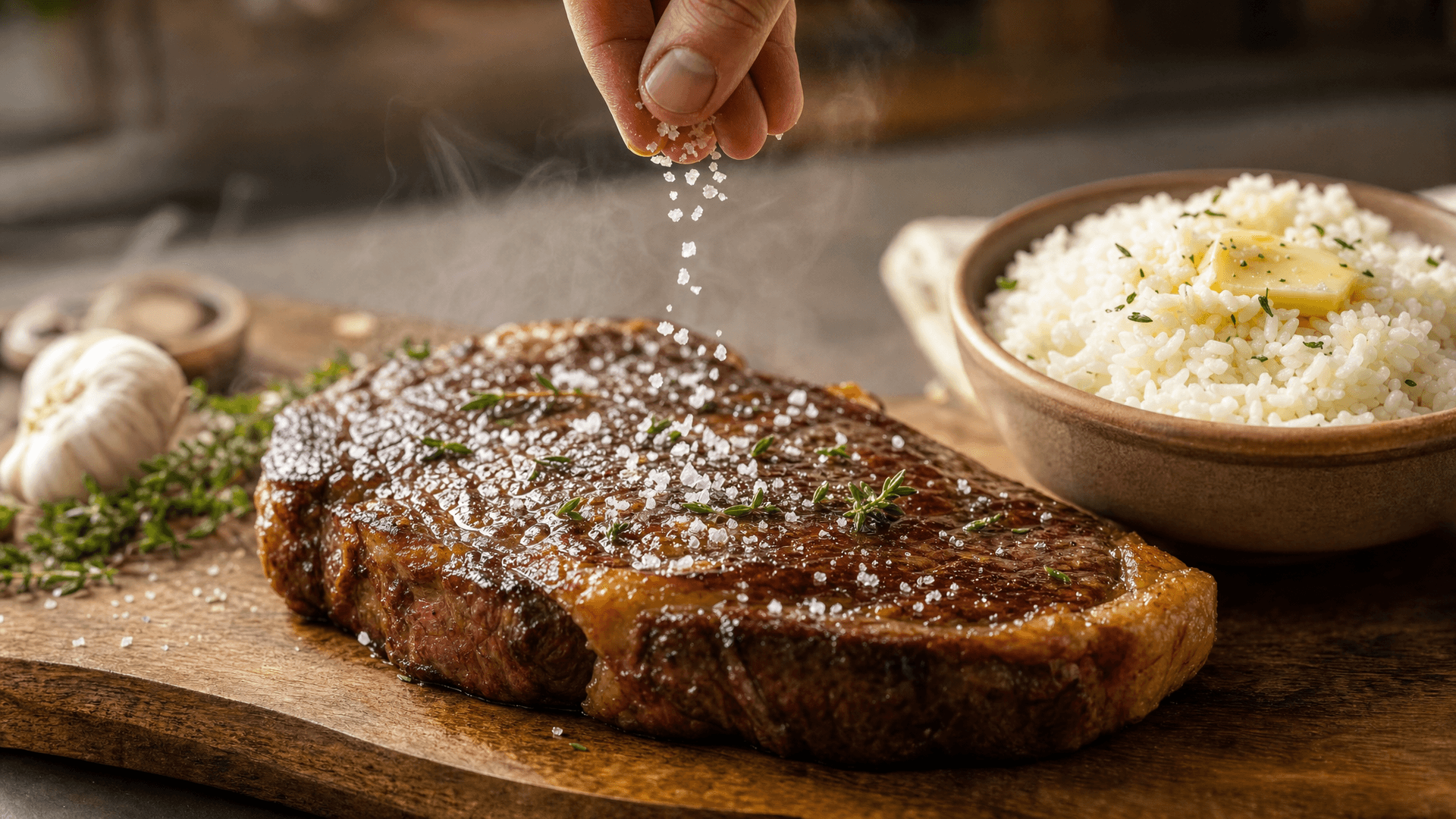
You've read it a hundred times: cut back on salt. Watch your sodium. Season with herbs and lemon instead.
That advice was written for a specific person — a sedentary adult in their fifties with rising blood pressure who eats most meals from a drive-through or a freezer box. It's decent advice for that person.
It is not advice for you: a 145 lb guy who cooks chicken, rice and broccoli in a plain pan five nights a week, trains hard four to six times, sweats through a shirt every session, and is desperately trying to eat more food than his appetite wants.
For that guy, "cut the salt" is one of the quietest ways to sabotage a bulk. It flattens your pumps, drains your training energy, makes already-boring food harder to swallow, and leaves you feeling lightheaded on your heaviest sets — all while you blame your program, your genetics, or your creatine.
Here's what sodium actually does, how much you're losing, how much you need, and how to hit it without turning your diet into a sodium bomb.
- Sodium recommendations are built for sedentary people, not lifters who sweat 5+ times a week
- Sweat can cost you 500-1,500mg of sodium per hour of hard training
- Most lifters cooking whole foods at home land well under their actual needs
- A hard-training bulker generally does fine in the 3,000-5,000mg per day range
- Salt makes bland bulking food edible, which directly helps you eat more calories
- Sodium is what lets creatine and water actually get into the muscle
- Salting more is a genuinely bad idea if you have diagnosed hypertension or kidney disease
Why "Cut Salt" Doesn't Apply to You
Public health messaging is a blunt instrument. It has to be. When a country's average sodium intake comes mostly from processed food, packaged bread, restaurant meals and sauces, the simplest useful message is "eat less of it."
But averages hide people. The average adult in that dataset walks maybe 4,000 steps a day, doesn't lift, and doesn't sweat on purpose. You're in a different category entirely.
Three things separate you from the person that advice targets:
You lose sodium on purpose. Every training session, you're pushing salt out through your skin. Sedentary people don't. That loss has to be replaced or you're running a deficit that compounds week over week.
You cook your own food. This is the big one. The moment you switch from takeout and packaged meals to chicken breast, rice, oats, eggs, potatoes and frozen vegetables, your sodium intake can drop by half or more overnight — and nobody warns you about it. You made a "healthy" change and accidentally started under-eating a nutrient you need more of, not less.
Your blood pressure probably isn't the issue. Sodium sensitivity varies enormously between people, and lean, young, physically active men are typically at the low end of it. That doesn't mean sodium is free — it means the risk calculus that produced "cut salt" doesn't describe your situation.
Salt and sodium aren't the same number. Table salt is about 40% sodium by weight. One teaspoon of table salt contains roughly 2,300mg of sodium. When an article says "6g of salt," that's about 2,400mg sodium. Nutrition labels list sodium; salt shakers deliver salt. Mixing them up is how people end up off by more than double.
What Sodium Actually Does in a Training Body
Sodium isn't a flavor. It's the primary electrolyte in the fluid outside your cells, and it runs several systems you care about directly.
Blood volume and blood pressure during training
Sodium holds water in your bloodstream. More sodium means more plasma volume, which means more blood getting pushed to working muscle every beat.
Run low and your plasma volume drops. Your heart has to work harder for the same output, your heart rate creeps up on identical loads, and standing up fast between sets makes the room go gray at the edges. That dizzy, hollow feeling after a heavy set of squats is not always "I went hard." Sometimes it's just low blood volume.
Muscle contraction and nerve signaling
Every muscle contraction you produce starts as an electrical signal, and that signal depends on the sodium-potassium gradient across cell membranes. Sodium goes in, the signal fires, the pump resets it.
You don't need to memorize the mechanism. You need to know the consequence: when sodium is low, signal quality degrades. Force output drops, coordination gets sloppy on your last hard sets, and cramping risk goes up — especially in calves, hamstrings and abs, and especially in hot weather.
Nutrient transport into the muscle
This is the one most lifters have never heard. Sodium-dependent transporters move glucose, amino acids and creatine across cell membranes. Creatine uptake specifically relies on a sodium-and-chloride-dependent transporter.
Translation: sodium is part of how the good stuff gets into the muscle cell. If you're loading creatine and wondering why the pumps and weight gain feel underwhelming, running low on sodium is a plausible reason. You've got the passenger and no vehicle.
Cell volume and the pump
The visible one. Muscle "fullness" is largely intracellular water. Sodium, potassium and glycogen all pull water into the cell. Cut sodium hard and your muscles go flat — you look smaller in the mirror at the same bodyweight, and the pump you used to chase disappears.
That's not vanity, either. Cell swelling appears to be one of the signals that tells a muscle cell to build. Chronically flat cells aren't an anabolic environment.
How Much Sodium You're Actually Sweating Out
Sweat rates vary wildly, but a hard hour of resistance training in a warm gym typically costs somewhere between 1 and 3 pints of fluid. Conditioning work, a hot summer, or a guy who just sweats a lot can push that past 2 quarts per hour.
Sweat sodium concentration varies even more — roughly 400 to 1,500mg per liter depending on genetics, heat acclimation and how much sodium you habitually eat.
Multiply those out and a single hard session can plausibly cost you anywhere from 300mg to over 2,000mg of sodium. Do that five or six times a week and it's not a rounding error.
| Training scenario | Fluid lost | Sodium lost |
|---|---|---|
| 60 min lifting, cool gym, light sweater | 0.4 L | ~250 mg |
| 75 min lifting, average gym, average sweater | 1.0 L | ~700 mg |
| 90 min lifting + 15 min conditioning, warm gym | 1.8 L | ~1,300 mg |
| Summer session, no A/C, heavy sweater | 2.5 L | ~2,500 mg |
The salty-sweater test
You can self-diagnose roughly. If any of these apply, you're on the high-loss end:
- White crusty rings on the brim of your hat or your black t-shirt after training
- Sweat that stings your eyes badly
- A gritty, salty taste when sweat runs to your lip
- Cramps that show up late in sessions or the evening after
None of that is diagnostic in a lab sense, but it's a real signal. Guys with visible salt crust on their clothes are losing meaningfully more sodium than guys whose shirts dry clean.
Signs You're Under-Eating Sodium
Low sodium rarely announces itself. It shows up as a set of vague complaints you'll blame on everything else:
- Flat, deflated muscles despite eating plenty and gaining weight
- Dizziness on standing, especially after leg day or first thing in the morning
- Terrible pumps even on high-rep, high-carb days
- Cramping in calves, hamstrings or feet
- Fading in the second half of sessions — good first three exercises, garbage last three
- A headache that shows up mid-workout and clears with a salty meal
- Craving salty food hard — pickles, olives, broth, chips. Your body is not being dramatic
- Weak appetite and food that tastes like cardboard
- Constantly needing to pee despite drinking a normal amount of water
That last two-item combo is the classic hardgainer trap. You're drinking a lot of water because you read that hydration matters, you're eating bland whole foods with almost no added salt, and the water runs straight through you because there's not enough sodium to hold it. You feel bloated with liquid, full to the throat, unable to finish your third meal — and still under-hydrated at the cellular level. If that sounds familiar, read the full breakdown of how much water to actually drink while bulking, because water and sodium are the same problem viewed from two sides.
None of these symptoms are exclusive to low sodium. Dizziness, headaches and fatigue have plenty of other causes, some of which matter. If salting your food properly for two weeks doesn't fix it, stop guessing and go see a doctor.
How Much Sodium Does a Bulking Lifter Actually Need?
Let's put real numbers on this.
The commonly cited public-health ceiling is around 2,300mg per day. Baseline physiological need — the amount to not be deficient sitting on a couch — is closer to 1,500mg.
For a hard-training lifter, a reasonable working target is roughly 20-32 mg per lb of bodyweight per day, adjusted up for sweat.
Run that on real people:
| Bodyweight | Sedentary baseline | Training-day target |
|---|---|---|
| 57 kg / 125 lb | ~1,500 mg | 2,800 - 3,500 mg |
| 66 kg / 145 lb | ~1,500 mg | 3,200 - 4,000 mg |
| 75 kg / 165 lb | ~1,500 mg | 3,500 - 4,500 mg |
| 84 kg / 185 lb | ~1,500 mg | 4,000 - 5,000 mg |
So a 145 lb guy training five days a week in a warm gym is looking at 3,200-4,000mg on training days — comfortably above the number every health article told him was the maximum, and that's the point.
If you're a heavy sweater, training twice a day, or lifting through summer without air conditioning, the top of that range goes higher still. Endurance athletes in hot climates routinely run past 6,000mg without issue.
On complete rest days, drop back toward the lower end. You're not losing much, and there's no benefit to forcing it.
Don't jump from 1,800mg to 4,500mg in a day. Add roughly 500mg (about a quarter teaspoon of salt) per day for a week, see how you feel and look, then add another 500mg. You'll find your number, and you won't spend three days puffy and confused about why.
How to Hit It With Normal Food
You don't need packets, tablets or a bag of "electrolyte formula" that's mostly sugar. You need a salt shaker and a few strategic foods.
Just salt your food
The simplest lever. A quarter teaspoon of salt is about 575mg of sodium. Salting three meals properly gets you well over 1,500mg on its own — and it's the version that also makes your food taste good, which matters more than you think.
Salt during cooking, not just at the table. Salt in the pasta water, salt on the chicken before it hits the pan, salt in the rice. Food seasoned throughout tastes better with less total salt than food dusted on top at the end.
Lean on genuinely useful salty foods
These deliver sodium alongside protein, carbs or micronutrients — not empty calories:
| Food | Serving | Sodium |
|---|---|---|
| Cottage cheese | 200 g / 7 oz | ~750 mg |
| Deli turkey | 100 g / 3.5 oz | ~1,000 mg |
| Dill pickles | 2 spears | ~600 mg |
| Beef or chicken broth | 1 cup | ~800 mg |
| Feta cheese | 30 g / 1 oz | ~320 mg |
| Canned tuna in brine | 1 can | ~350 mg |
| Soy sauce | 1 tbsp | ~900 mg |
| Whole wheat bread | 2 slices | ~300 mg |
| Salted pretzels | 30 g / 1 oz | ~350 mg |
| Olives | 10 olives | ~500 mg |
Salting 7 oz of chicken breast, adding 7 oz of cottage cheese as a snack, and putting soy sauce on your rice bowl covers most of a training day's requirement without a single supplement.
The pre-workout and intra-workout play
This is where you'll feel the difference fastest.
Pre-workout: roughly 500-1,000mg of sodium 30-60 minutes before training, with water. That can be a quarter teaspoon of salt in 16 oz of water, a cup of broth, or a salty pre-training meal.
Intra-workout: if the session runs past 75 minutes or you're sweating hard, add another 300-600mg to your training bottle. Salt plus a bit of carbohydrate in 24 oz of water works fine and costs almost nothing.
Post-workout: salt your post-training meal deliberately. This is when you're replacing losses and driving nutrients into muscle — and the meal will taste better, which means you'll finish it.
If salt water makes you gag, dissolve it into something with flavor — squash, a low-calorie drink mix, or a small amount of juice. The concentration you're aiming for is barely detectable when there's anything else going on in the glass.
The Appetite Angle Nobody Talks About
Here's the argument that matters most for a skinny guy, and it has nothing to do with electrolyte physiology.
Bland food is hard to eat in volume.
If you're a hardgainer, your problem isn't knowing what to eat. It's getting the food down day after day when your appetite gave up around meal three. And the single biggest reason "clean" bulking diets fail is that unseasoned chicken, plain rice and steamed broccoli are genuinely miserable to eat 21 times a week.
Salt fixes that for essentially zero calories. It doesn't just add its own taste — it suppresses bitterness, amplifies savory notes and makes everything taste more like itself. Properly seasoned chicken and rice is a real meal. Unseasoned chicken and rice is a chore you eventually stop doing.
There's a second effect too. Salt stimulates saliva and appears to mildly stimulate appetite. That's exactly backwards from what someone cutting wants, which is why the mainstream advice runs the other direction — and exactly what you want when you're trying to force down another 600 calories.
A lot of guys plateau not because their calorie target was wrong, but because the food they picked was unpalatable enough that they quietly stopped hitting it. Season aggressively. Use sauces. The bulk you actually eat beats the bulk you designed.
Sodium, the Scale, and the Water Weight Panic
Add sodium and your weight will jump. Expect 1-3 lb within a few days.
Don't panic and don't celebrate. That's water — extracellular and intracellular — moving into your body because there's now enough sodium to hold it. It's a one-time step change, not a trend, and it settles within about a week as your kidneys adapt.
Most of that water is going where you want it: into muscle cells, alongside glycogen and creatine. That's why guys who fix their sodium often report looking fuller at a higher scale weight, not softer.
The mistake is reading that jump as fat gain and slashing calories in response. You'd be cutting food because you drank a glass of salt water. If the scale confuses you regularly, the full guide to reading weight fluctuations while bulking covers how to separate real tissue gain from daily noise — the short version is to weigh daily and only trust the weekly average.
Give any sodium change 7-10 days before you judge it. Compare weekly averages, not individual mornings.
When Salting More Is Genuinely a Bad Idea
This isn't a free-for-all, and pretending otherwise would be dishonest.
- You have diagnosed hypertension or your doctor has told you to restrict sodium
- You have kidney disease or reduced kidney function
- You have heart failure or take medication where fluid balance matters
- You're on blood pressure medication of any kind
- You have a strong family history of hypertension and have never had your own pressure checked
In any of these cases, talk to your doctor before increasing sodium. This article does not override medical advice given to you specifically.
Beyond those, a few honest caveats.
Some people are sodium-sensitive. Roughly a quarter of people see a meaningful blood pressure response to higher sodium. If you're one of them, you should know it. Get a cheap home blood pressure cuff, take a baseline before you change anything, then check again after two weeks at your new intake. If it climbs meaningfully, back off. That's a $30 experiment that removes all the guesswork.
More is not better past a point. There's no bonus for 8,000mg. Once you're replacing losses and your food tastes good, extra sodium just means more thirst, more bathroom trips, and puffiness in your face and hands.
Sodium is not a substitute for the rest of the picture. Potassium and magnesium matter too, and most lifters are short on both. Fruit, potatoes, beans and leafy greens handle potassium. Nuts, seeds and dark chocolate handle magnesium. Fixing sodium while eating zero vegetables is solving one problem and ignoring three.
Processed-food sodium isn't equivalent. Getting 4,000mg from salted whole foods is not the same dietary pattern as getting it from frozen pizza and fast food, even if the sodium number matches. The number isn't the only thing on the label.
Common Mistakes
- Confusing salt and sodium. A teaspoon of salt is 2,300mg of sodium, not 5,000. Off-by-2.5x errors are common in both directions.
- Going from zero to maximum overnight. You'll feel bloated and thirsty and conclude sodium is bad. Ramp it.
- Only salting at the table. Season during cooking. Better flavor, less total salt.
- Drinking huge volumes of water with no sodium. You'll dilute yourself, pee constantly, kill your appetite and feel worse. Water and salt work as a pair.
- Judging the change on the scale after 48 hours. Give it a full week and compare averages.
- Never checking your blood pressure. You're changing a variable that affects blood pressure. Measure it. Once.
- Taking sodium seriously and ignoring potassium. They're a system. Eat your fruit and potatoes.
- Using sodium as an excuse for bad programming. Salt won't fix a plan with no progressive overload. It removes a limiter; it doesn't build the muscle.
When You're Fighting the Calories, Not the Micros
Here's the thing about sodium: it's a limiter, not the main event. Fixing it makes training feel better and food taste better. It doesn't create a surplus.
If you're a naturally skinny guy, the actual war is calories — hitting a real surplus, consistently, for months, with food you'll still eat in week twelve. That's where most bulks die, and no amount of salt saves a plan you can't stomach.
That's the problem we built around. You put in your stats, your training load and the food you actually like eating, and it builds a bulking plan with the calories and macros mapped to real meals — including how to season and structure them so they're still edible after a month. No 400-page PDF, no generic 3,000-calorie template that assumes you love plain oats.
Get the calories handled first. Then fix the sodium, and both start working properly.
The Bottom Line
The advice to cut salt was written for someone who isn't you. You sweat five times a week, cook your own food, and are trying to eat more than your appetite wants — three things that all push your sodium needs up, not down.
Salt your food. Aim for somewhere around 3,000-5,000mg on training days, ramp into it over a couple of weeks, check your blood pressure once, and skip all of it if a doctor has told you otherwise.
Then go see what your sets feel like when there's actually enough blood in the tank.