
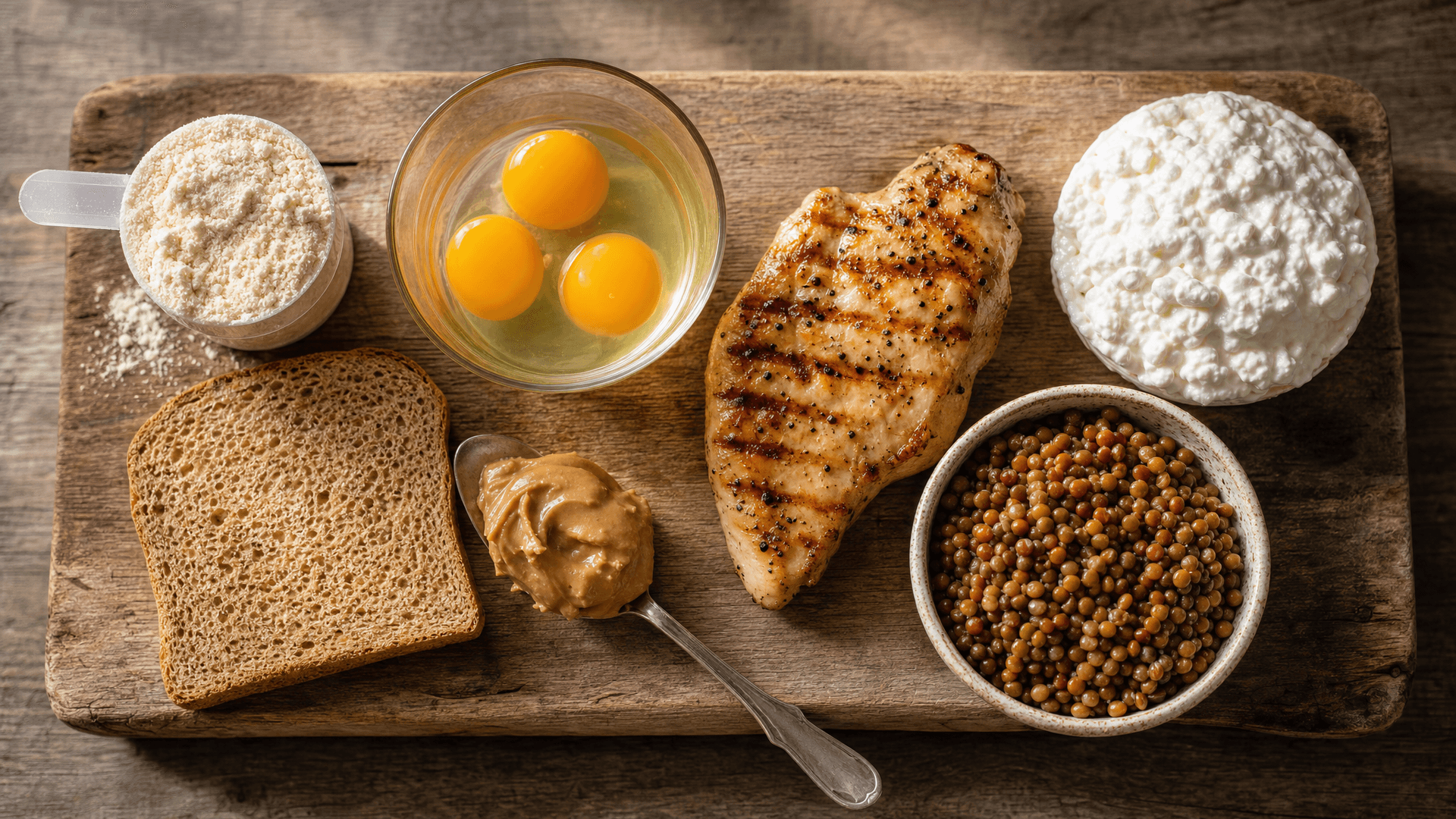
Two guys, same gym, same program, same three years of training. Both weigh around 160 lbs. Both log 180g of protein every single day and both hit it, religiously, because they're the kind of people who weigh their oats.
One of them added 13 lbs of mostly lean mass over eight months. The other added maybe 2 lbs and a bit of a belly.
The tracker said they were doing the same thing. They weren't. Not even close.
Here's the part nobody tells you when you first start bulking: your app treats every gram of protein as interchangeable, and your muscles absolutely do not. A gram of collagen and a gram of whey are the same number on a screen and two completely different signals inside a muscle cell. If you're eating a lot and growing slowly, there's a very good chance you don't have a quantity problem. You have a quality problem — and unlike a quantity problem, fixing it usually costs you nothing extra.
- Muscle protein synthesis is triggered by leucine, not by total protein grams
- You need roughly 2.5-3g of leucine in a single sitting to flip the switch
- DIAAS scores tell you how much of a protein your body can actually use — animal sources score above 1.00, most plants and grains land far below
- Collagen, bread, oats, rice and protein cookies inflate your tracker without moving the needle
- Most stalled hardgainers are eating enough protein but only getting 2 real MPS triggers a day
- Redistributing what you already eat into 4 leucine-complete meals costs zero extra money
The 180g illusion
Open your tracking app and look at yesterday. Not the total — the sources.
A typical "high protein" day for a guy who thinks he's dialed in looks something like this: oats with peanut butter in the morning, a sandwich at lunch, a protein cookie in the afternoon, rice and chicken for dinner, casein or collagen before bed. That day can easily hit 180g on paper.
But watch what happens when you break it down by meal:
| Meal | Total protein | Leucine | MPS triggered? |
|---|---|---|---|
| Oats + peanut butter | 22g | ~1.4g | No |
| Turkey sandwich | 28g | ~2.1g | Borderline |
| Protein cookie | 20g | ~1.2g | No |
| Chicken + rice + veg | 55g | ~4.3g | Yes |
| Collagen before bed | 20g | ~0.5g | No |
That's 145g of "protein" and exactly one clean muscle-building signal in a 16-hour day. The other 125g got burned for energy, used for tissue repair, or converted to glucose. It wasn't wasted, exactly — protein is never truly wasted — but it didn't do the one job you were buying it for.
Meanwhile the guy who grew ate 180g too, spread as roughly 45g of animal-based protein at four meals. Same total. Four signals instead of one.
That gap, repeated over 240 days, is the difference between the two guys in the intro.
Leucine is the switch, not protein
Muscle protein synthesis isn't a dimmer. It's closer to a light switch with a stiff spring.
Your body is constantly building and breaking down muscle tissue. To tip the balance toward building, a sensor in your muscle cells called mTOR has to get activated. And mTOR responds primarily to one amino acid: leucine.
Not protein in general. Leucine specifically. It's one of the three branched-chain amino acids, and it functions less like a building block and more like a key. The other 19 amino acids are the bricks; leucine is the guy who tells the crew to start laying them.
This has two enormous consequences that most bulking advice completely skips.
Consequence 1: there's a threshold
Below a certain dose of leucine in a single sitting, the switch doesn't flip at all. You get a partial, sluggish response — or nothing.
The research puts that threshold at roughly 2.5g of leucine for a young trained lifter, and closer to 3g or more if you're older or eating a mixed meal with a lot of fat and fiber slowing absorption. Practically, that means:
- 20-25g of high-quality animal protein clears it comfortably
- 30-40g of most plant protein is needed to clear the same bar
- 60g of collagen never clears it, no matter how much you eat
Three meals of 25g of whey beats one meal of 75g of whey for total daily MPS. Same grams. Different outcome.
Your body evolved to only start an expensive construction project when it's confident the materials are actually there. A big spike of leucine in the blood is the signal that says "a real meal just landed." A slow trickle reads as background noise, and nothing gets built.
Consequence 2: bricks without a key does nothing
This is where the sneaky foods get you. A protein cookie genuinely contains 20g of amino acids. But if those amino acids come from rice protein, wheat gluten, and gelatin, the leucine content is a fraction of what 20g of whey would give you. You get bricks. No key. No build.
And here's the cruel bit for hardgainers: you often eat those foods instead of a real meal, not in addition to one. The cookie replaced the eggs.
DIAAS: the score that tells you what's real
For decades protein quality was measured with PDCAAS, a scoring system that capped every score at 1.00 and used a fecal digestibility method that was, frankly, too generous to plants and processed proteins.
The current standard is DIAAS — Digestible Indispensable Amino Acid Score. It measures how much of each essential amino acid actually gets absorbed in the small intestine, then scores the protein by its weakest link. It doesn't cap at 1.00, which means you can finally see how far apart the top and bottom actually are.
Rough scores, and treat these as directional rather than gospel since values shift with processing and cooking:
| Source | DIAAS (approx.) | What it means |
|---|---|---|
| Whey protein isolate | 1.09 | Every gram counts, plus a leucine bomb |
| Whole milk | 1.14 | Best cheap all-rounder |
| Whole eggs | 1.13 | Near-perfect amino profile |
| Chicken breast | 1.08 | Gold standard solid food |
| Beef | 1.10 | Same tier as chicken |
| Greek yogurt | 1.06 | Slow-digesting, great before bed |
| Soy protein isolate | 0.90 | Best plant option by a mile |
| Pea protein | 0.82 | Solid, low in methionine |
| Oats | 0.54 | Half the grams are usable |
| Rice | 0.59 | Better than oats, still not a protein food |
| Wheat / bread | 0.45 | Under half |
| Peanuts | 0.43 | It's a fat source that contains protein |
| Collagen / gelatin | 0.00 | Zero. Not a typo |
Look at that spread. Wheat scores 0.45. That means when your sandwich bread contributes "8g of protein," your body can realistically use something closer to 4g of it toward muscle, and almost none of it comes with meaningful leucine.
Now go back and mentally re-run your tracker's total using those multipliers. For most people eating a grain-heavy bulk, the honest number is 20-30% lower than what the app says.
The five foods quietly inflating your number
These aren't bad foods. Several of them are staples I'd never tell you to drop. The problem is when you count them as protein and build your day around them.
1. Collagen powder (DIAAS: 0.00)
Collagen is 33% glycine and contains essentially no tryptophan, which is why it scores a literal zero on DIAAS. It's genuinely useful for skin, tendons, and connective tissue. It is completely useless for muscle protein synthesis.
If you're taking 0.7 oz of collagen a day and counting it toward your 180g, you're actually at 160g of usable protein. That single swap — collagen to whey — has fixed more stalled bulks than any supplement I know of.
Watch for "protein" waters, gummies, and coffee creamers. A huge share of them use hydrolyzed collagen because it's cheap and dissolves clear. Read the ingredient panel, not the front of the bottle.
2. Oats, bread, pasta and rice
A big bowl of oats gives you 13g of protein. Sounds decent. But at a DIAAS of 0.54 that's about 7g usable, with maybe 0.9g of leucine — nowhere near the threshold.
Grains are your carbs. They're supposed to be your carbs. Eat them freely, load your plate, use them to hit your calories. Just stop letting them pad the protein column in your head. If 14 oz of cooked rice and two slices of bread are contributing 20g to your daily "total," the real contribution is closer to 10g of low-leucine filler.
3. Peanut butter and nuts
Peanut butter is a fantastic bulking food. 2 tbsp gives you around 190 calories for almost no stomach volume, which is exactly what a hardgainer needs.
It is not a protein source. DIAAS 0.43, low leucine, and the 8g on the label is mostly there to make the macro split look balanced. Count it as fat. Enjoy it. Move on.
4. Protein cookies, bars and "protein" cereal
Some are excellent — whey-based bars with 20g of protein are a legitimate meal replacement. Many are not. The tell is the ingredient list: if you see rice protein, wheat gluten, soy flour, gelatin, or "protein blend" without a breakdown, assume the leucine content is roughly half what an equivalent whey serving would deliver.
There's also the fiber trick. A lot of bars use so much chicory root and soluble corn fiber that eating two ruins your appetite for the next real meal. For a hardgainer, killing your appetite is a bigger crime than the weak amino profile.
5. Plant milks
Almond milk has about 1g of protein per 8 oz. Oat milk has 2-3g and is mostly sugar. If you switched from dairy to almond milk and kept the rest of your diet identical, you quietly deleted 20-30g of some of the highest-quality protein in your day. Soy milk is the one exception — it's the only plant milk in the same conversation as dairy.
For a full breakdown of what to buy instead, our ranked list of the best protein sources for bulking sorts everything by cost and convenience, which is usually the real constraint.
Audit your own day in five minutes
Do this once. It's uncomfortable and it works.
Step 1. Pull up yesterday in your app and write down every meal with its protein number.
Step 2. Next to each meal, write where that protein actually came from. Not "lunch: 30g" — "lunch: 18g chicken, 8g bread, 4g cheese."
Step 3. Cross out everything from grains, nuts, seeds, vegetables, and collagen. Those are your incidental grams.
Step 4. Count how many meals have at least 25g left standing from animal sources, soy, or a whey/casein shake.
That number — not your daily total — is your real score. If it's 2 or fewer, you've found your problem.
Most guys who run this audit discover they have one genuinely complete meal (dinner) and three meals of carbs wearing a protein costume.
Don't fix this by eating more. Fix it by moving what you already eat. Take the two eggs from your afternoon snack and put them in breakfast. Take half the chicken off your dinner plate and put it in your lunch. Same food, same cost, twice the MPS triggers.
The fix: four leucine-complete anchors
Here's the whole strategy, and it fits on a napkin.
Every eating occasion gets an anchor of at least 25-30g from a high-DIAAS source. Everything else — the rice, the oil, the bread, the peanut butter — is calories built around that anchor.
For a lifter at 165 lbs aiming at 0.8 g per lb, that's about 135g of quality protein, which splits neatly into four anchors of 30-35g plus incidental grams from everything else. You'll land near 170g on the tracker and, more importantly, near 135g of stuff that counts.
What an anchor actually looks like
- Whole eggs: 4 large eggs, ~2.2g leucine
- Chicken breast: 4.5 oz raw, ~2.6g leucine
- Greek yogurt: 9 oz, ~2.5g leucine
- Whey: one 1 oz scoop, ~2.7g leucine
- Whole milk: 20 oz, ~2.0g leucine
- Lean beef mince: 5 oz raw, ~2.7g leucine
- Cottage cheese: 8 oz, ~2.8g leucine
- Tofu: 9 oz, ~2.0g leucine
- Canned tuna: two 5 oz tins, ~3.0g leucine
Notice how small some of those portions are. You do not need a 10 oz steak. You need 4.5 oz of something decent, four times a day.
Rebuilding the failed day
Take the 145g day from the top of this article. Same shopping list, same money, redistributed:
| Meal | Change | Result |
|---|---|---|
| Breakfast | Add 3 eggs to the oats | 32g, threshold cleared |
| Lunch | Double the turkey, drop one slice of bread | 40g, threshold cleared |
| Snack | Swap protein cookie for a whey shake in milk | 38g, threshold cleared |
| Dinner | Unchanged | 55g, threshold cleared |
| Pre-bed | Swap collagen for Greek yogurt | 25g, threshold cleared |
Now you've got five triggers instead of one, the daily total actually went up slightly, and you spent maybe two extra euros. That's the whole article in one table.
The plant-based version of this problem
If you don't eat meat, none of this means you're stuck — it means your margin for error is smaller.
Plant proteins are lower in leucine per gram and usually limited in one essential amino acid (lysine in grains, methionine in legumes). The fix is mechanical, not mystical:
- Eat more grams per meal. Where a meat eater needs 25g to clear the leucine threshold, aim for 35-40g from plants. That's a real, unavoidable tax of roughly 20-30%.
- Lead with soy. Tofu, tempeh, edamame, soy milk, and soy protein isolate are the only plant sources with a genuinely complete profile and a DIAAS near 0.90.
- Combine within the day. Grains plus legumes covers each other's gaps. You don't need to do it in the same bite, but do it in the same day.
- Consider targeted supplementation. A pea-rice blend fixes the limiting amino acid problem, and adding 1g of leucine to a plant shake is cheap insurance.
Our full guide on gaining muscle without meat walks through a week of eating built on those rules.
Studies comparing matched doses of soy and whey consistently show whey producing a larger MPS response — and when researchers raise the soy dose, the gap closes. Plants work. They just need volume.
Five mistakes that survive even after people learn this
1. Chasing total protein instead of distribution. Going from 180g to 220g when your day only has two anchors is spending money to fix the wrong variable. Distribution first, then total.
2. Front-loading everything into dinner. A 9 oz chicken breast at 8pm doesn't retroactively fix a 12-hour gap. There is an upper limit to how much a single meal can drive MPS, and past roughly 40-50g of protein you're mostly paying for a very expensive glucose source.
3. Counting BCAA drinks as protein. BCAAs contain leucine, so they'll nudge the switch — but with no other amino acids present, you've flipped the switch on an empty construction site. Whole protein beats BCAAs every time.
4. Assuming more protein powder is the answer. Whey is a tool, not a strategy. If you're already at three shakes a day and stuck, your problem is food, not powder.
5. Ignoring how much you actually need in the first place. Quality only matters once the quantity is roughly right. If you're not sure where your target should sit, start with how much protein you actually need to build muscle and come back to this.
How to know it's working
Give it six weeks. Change nothing else — same program, same calories, same sleep. Then look at:
- Scale weight trend. You want 0.5-1 lb per week on a lean bulk. Use the weekly average, never a single morning.
- Strength on your main lifts. More MPS triggers per day usually shows up as recovery first. If your third set stops falling apart, that's the signal.
- Waist measurement. If weight is climbing but your waist is climbing faster, you fixed protein quality and overshot calories. Different problem.
- Fullness. This one's subjective, but people who go from one anchor a day to four consistently report looking fuller within a month.
A guy at 155 lbs and 5'9" should expect roughly 7-9 lbs over those six weeks only if calories are aggressive. If you're running a slower surplus, expect half that — and judge on strength instead.
Where FuelTheGains comes in
The reason this problem is so common isn't that lifters are lazy. It's that no tracking app on the market distinguishes between 30g of whey and 30g of bread. They all just add numbers. You'd have to run the DIAAS math and the per-meal leucine audit yourself, by hand, every single day.
That's what we built to handle. You put in your bodyweight, your training days, and what you actually like eating, and it builds a plan where every meal already clears the leucine threshold — anchored on real food you can afford, with the surplus calories layered on top instead of pretending peanut butter is a protein source.
No macro spreadsheet, no manually looking up amino profiles. Just a week of meals where the protein column means what you think it means.
The bottom line
Total protein is the headline number. Leucine per meal is the number that actually builds muscle.
Most stalled hardgainers are already eating enough. They're just eating it in a shape their body can't use — one real meal and three carb-heavy imposters, with a collagen scoop at the end that does literally nothing for their quads.
Run the five-minute audit. Count your anchors. If the number is under four, move some food around and give it six weeks.
You've probably been eating enough this whole time. You just weren't eating it in a way that counted.