
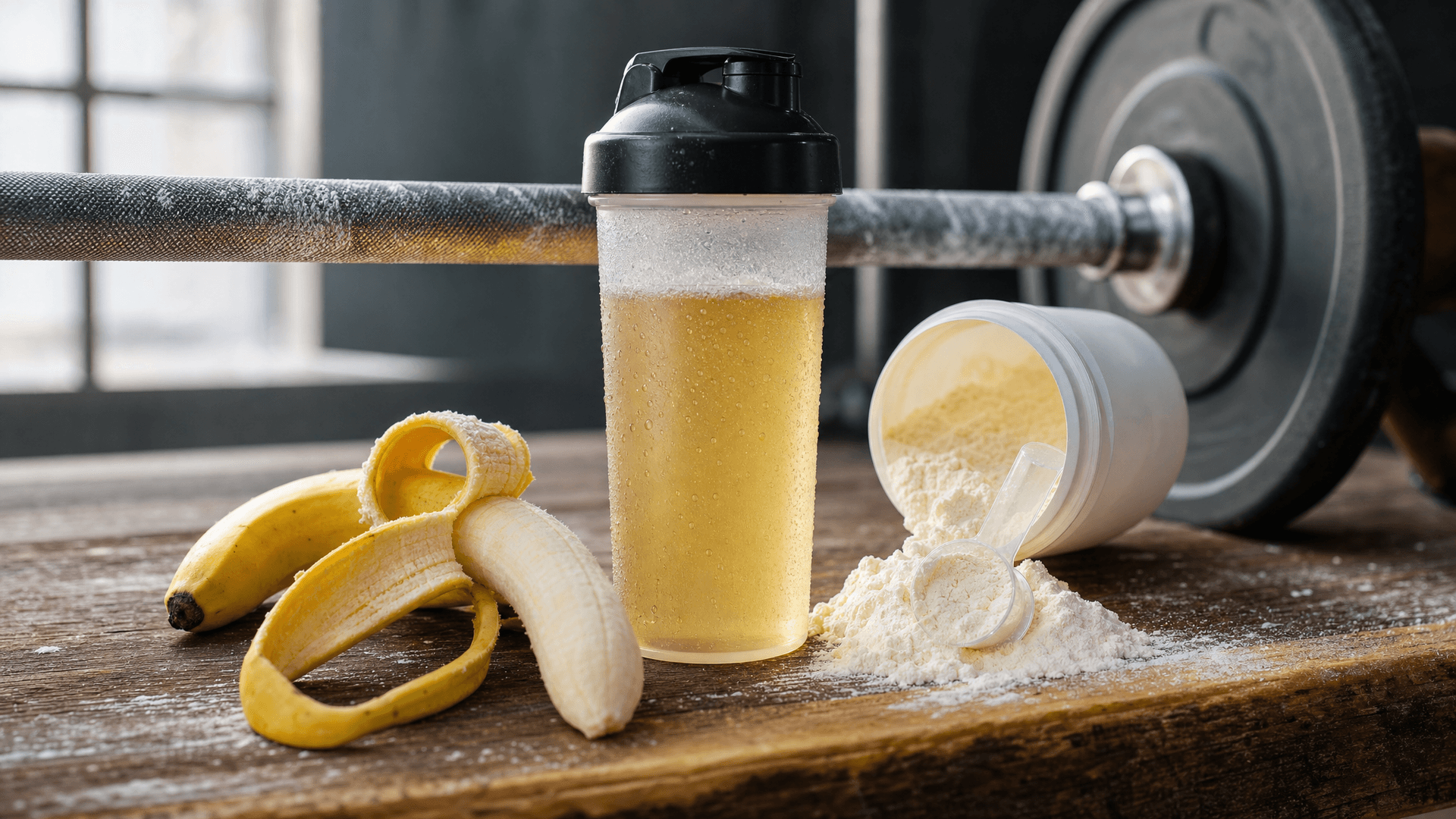
You've got the pre-workout meal sorted. Rice, chicken, a banana, timed about 90 minutes out. You've got the post-workout shake waiting in your bag for the walk home.
And then there's the hour in the middle.
For most lifters, the time actually spent under the bar is a nutritional black hole. Nothing goes in but water and maybe a scoop of something with too much caffeine in it. Sixty, seventy-five, sometimes ninety minutes of nothing.
If you're a normal-appetite guy trying to lean out, that's completely fine. Skip it. Go lift.
But if you're a hardgainer — the kind of guy who has to force down his fourth meal and still finishes the day 300 calories short — that hour is a genuinely stupid thing to waste. You're already standing there. You're already holding a bottle. And liquid calories sipped slowly over an hour are about the least appetite-suppressing calories that exist.
This is the article nobody writes for skinny guys. Here's when intra-workout nutrition actually does something, when it's a marketing scam with a citrus flavour, and how to make a sipper for pocket change.
- Intra-workout carbs barely change performance in sessions under 60 minutes for most lifters
- The real win for hardgainers is 200-400 easy liquid calories that don't kill your next meal
- It matters most if you train fasted, train past 75 minutes, do two-a-days, or sweat buckets
- Plain dextrose or maltodextrin plus a pinch of salt costs a fraction of branded intra-workout powders
- Skip it entirely if you already hit your surplus and your sessions are short
- Sip slowly across the whole session — chugging it mid-workout is how you end up nauseous
What "Intra-Workout Nutrition" Actually Means
Intra-workout nutrition is anything you consume between your first warm-up set and your last working set. In practice that means a drink, because chewing food mid-session is miserable and slow.
The standard version is some combination of:
- Fast carbs — dextrose, maltodextrin, cyclic dextrin, juice, sugar
- Protein or amino acids — whey isolate, clear whey, EAAs
- Electrolytes — mostly sodium, sometimes potassium and magnesium
- Water — obviously, but the amount matters more than people think
Supplement companies sell this as a performance category. Pump. Endurance. Anabolic window. Whatever.
For a hardgainer, that framing is backwards. The performance benefit is real but small and situational. The calorie benefit is real, immediate, and applies to almost every skinny guy reading this.
The Real Argument for Hardgainers Isn't Performance — It's Calories
Let's do the maths that actually matters.
Say you're 155 lb and 5'10", training four times a week, and your target is 3,200 calories a day. You keep landing around 2,900. Not because you're lazy — because by 8pm you're genuinely full and the thought of another plate makes you want to lie down.
That 300-calorie gap is the entire difference between gaining 0.7 lb a month and gaining 1 lb a month.
Now add a bottle with 60g of carbs and a scoop of whey. That's roughly 340 calories, drunk across 70 minutes while you rest between sets. You didn't sit down. You didn't cook. You didn't lose an hour of your evening.
And here's the part people miss: it barely touches your appetite for the next meal. Liquid calories consumed slowly, during physical activity, with the stomach emptying faster than usual, are about as close to "free" as calories get for someone with a small appetite.
Solid food triggers more stretch receptors and slower gastric emptying, which is what makes you feel stuffed. A dilute carb drink sipped over an hour leaves your stomach quickly and never creates that fullness signal. It's the same principle behind high-calorie shakes for weight gain — just spread over a longer window.
Four training days a week at 340 calories is 1,360 extra calories weekly. Over a 12-week bulk that's around 16,000 calories, which is somewhere in the region of 3-4 lb of extra tissue you wouldn't otherwise have built.
That's not nothing. That's a visible difference in the mirror, from a bottle you were already carrying.
Does It Actually Improve Your Session? The Honest Answer
Let's not oversell this. Here's what the evidence roughly supports.
Sessions under 60 minutes: probably not
If you're in and out in under an hour, and you ate a proper meal beforehand, your muscle glycogen is nowhere near depleted. A typical hypertrophy session burns through maybe 25-40% of stored glycogen in the trained muscles. You've got plenty left.
Studies on carbs during short resistance sessions mostly show nothing meaningful for total volume or strength. If someone tells you their bench went up because of intra-workout carbs on a 45-minute push day, they're describing a placebo — a genuinely useful placebo, but a placebo.
For short sessions, the only real argument is the calories. Which, if you're skinny, is still a good argument. Just be honest about which benefit you're buying.
Sessions over 75-90 minutes: yes, meaningfully
Once you're past the 75-minute mark, things change. Glycogen starts to actually matter, blood glucose drifts down, and central fatigue creeps in. This is where lifters report — and studies tend to show — better performance on the back half: more reps on the last few sets, less of that "I'm just going through the motions" feeling on your final exercise.
If your leg day involves squats, RDLs, leg press, hack squats, and calves, and it takes you 100 minutes because you rest properly, carbs during the session are doing real work.
Long sessions aren't automatically better sessions. If your workout runs 110 minutes because you're scrolling between sets, the fix isn't a carb drink — it's a timer. Intra-workout nutrition should support a session that's long because it's dense, not one that's long because it's slow.
When Intra-Workout Nutrition Actually Matters
Here are the five situations where I'd tell a skinny guy to genuinely bother.
1. You train fasted in the morning
This is the big one. If you're up at 6am, at the gym by 6:30, and your first meal is at 9am after your commute, you've got a problem that isn't solved by a bigger dinner.
You're training on an overnight fast, then extending that fast through the whole session. That's often a 13-14 hour stretch with nothing coming in, four days a week. For a guy already struggling to eat enough, that's a huge chunk of the day surrendered.
An intra-workout drink here is doing double duty: it's your missing pre-workout meal and your fuel. Front-load it — start sipping during your warm-up rather than waiting until set three.
If you can move your training later, a proper pre-workout meal for bulking beats any drink. But most people can't move their training. Work with reality.
2. Your sessions run past 75 minutes
Covered above. Long, high-volume sessions — especially lower body, or anything where you're doing 20+ hard sets — genuinely benefit. This is the one scenario where the performance claim holds up.
3. You're doing two-a-days, or lifting plus a sport
Football training Tuesday evening, lifting Tuesday morning. Or a lifting session followed by five-a-side. Or you're a climber, a boxer, a rower who also lifts.
When you've got two glycogen-depleting sessions in a day, the window to refuel between them is tight and your appetite is usually wrecked from the first one. Carbs during session two aren't optional at that point — they're what stops session two being garbage.
4. You sweat like a maniac
If your gym is hot, or you're one of those guys whose shirt is soaked by the third set, you're losing more sodium than you think. Losing 2.2 lb of body weight in a session is almost entirely water, and it comes with real sodium loss.
Sodium in your intra-workout drink helps you hold onto fluid, keeps blood volume up, and — genuinely — reduces that flat, weak feeling on the last exercise. This is the cheapest upgrade on this list. It costs literally nothing. It's salt.
5. Your appetite collapses after training
Very common in hardgainers. You train hard, you get home, and the last thing on earth you want is a plate of rice. Then you eat something small, and you're 600 calories down for the day.
Getting calories in during the session partially solves this. You arrive home already 300 calories up, and — annoyingly, in a good way — training with some carbs on board tends to leave you more willing to eat afterwards, not less. The post-session appetite crash is partly a blood sugar and stress-hormone thing, and a carb drink blunts it.
That still doesn't excuse skipping the meal. Pair it with a proper post-workout meal for bulking — the drink is a supplement to it, not a replacement.
When It's a Complete Waste of Money
I'd rather you spent your money on food. Skip intra-workout nutrition entirely if:
- You're already hitting your surplus comfortably. If you're gaining 0.7-1 lb a week, don't add anything. Change nothing. Congratulations.
- Your sessions are 45 minutes and you ate an hour before. You are not depleted. You are not catabolic. You're fine.
- You're buying a branded "intra-workout matrix" at 40 quid a tub. Look at the label. It's usually 25g of carbs, some EAAs you don't need, and eight ingredients at doses too small to matter. You can build the same thing from a 2.2 lb bag of dextrose for a fraction of the price.
- It's replacing a meal. If you're drinking 400 calories during training and then eating 400 fewer calories at dinner, you've achieved nothing except spending money.
- It gives you gut problems. Some people cannot handle carbs sloshing around while they squat. If that's you, force it and you'll just train worse. Move those calories elsewhere.
Before you buy anything, spend two weeks just adding a pinch of salt to your gym water. It's free, and for a lot of people in hot gyms it's most of the felt benefit right there.
What Actually Goes in the Bottle
Four ingredients. That's the whole category.
Carbs — the main event
Target: 30-70g of carbs per session, which lands somewhere around 0.2-0.4g per lb of bodyweight for most lifters.
Options, cheapest to fanciest:
- Table sugar — works. Sucrose is half glucose, half fructose, and the fructose actually helps absorption via a separate transporter. Costs nothing. Slightly sweeter than ideal.
- Dextrose — pure glucose. Fast, cheap, mildly sweet. A 2.2 lb bag lasts about a month.
- Maltodextrin — glucose chains. Barely sweet, lower osmolality than dextrose, so it tends to sit better in the stomach at higher doses. My default recommendation.
- Fruit juice — grape and apple juice are basically pre-mixed carb drinks. Zero prep.
- Cyclic dextrin (HBCD) — genuinely the best-tolerated at high doses, genuinely overpriced. Only worth it if you've tried the cheap stuff and your gut said no.
Don't overthink the source. At the doses we're talking about, the differences between these are small. Tolerance and cost matter more than absorption curves.
Protein — optional, and smaller than you think
Target: 15-25g if you use it at all.
Protein during training is not doing anything magical. If you ate protein within a couple of hours before lifting, the amino acids are still circulating — there's no gap to fill.
Include it for one reason: calories and convenience. 0.9 oz of whey isolate is another 100 calories with almost no volume.
Use isolate or clear whey, not concentrate. Concentrate mixed thin and warm, sloshing around during squats, is a bad time. Skip casein entirely.
EAAs? If you eat enough total protein — 0.7-1.0g per lb a day — EAAs during training are redundant. They also add zero calories, which for a hardgainer makes them the wrong tool. BCAAs specifically are the most oversold supplement in the gym. Ignore them.
Sodium — the free upgrade
Target: 300-800mg per bottle. That's roughly an eighth to a third of a teaspoon of table salt.
It improves fluid retention, helps carb absorption, and stops the drink tasting like flat syrup. If you sweat heavily or train in a hot gym, go towards the top of that range.
You barely taste it once there's flavour and carbs in there. If you can taste it, you used too much.
What to leave out
- Caffeine — belongs in your pre-workout, not your intra. Sipping stimulants across 90 minutes wrecks sleep.
- Fat — slows gastric emptying. Nothing worse mid-session.
- Fibre — same reason, but with added consequences.
- Creatine — fine to add, but timing is irrelevant. Take it whenever.
5 DIY Intra-Workout Sippers
All of these go in a standard shaker or a 25 oz bottle, topped up with cold water. Numbers are approximate.
| Recipe | What's in it | Calories | Carbs | Protein |
|---|---|---|---|---|
| The Basic | 60g maltodextrin, pinch of salt, squeeze of lemon | 240 | 60g | 0g |
| The Full Bottle | 50g dextrose, 25g whey isolate, pinch of salt | 300 | 50g | 23g |
| The Lazy One | 400ml grape juice, 100ml water, pinch of salt | 260 | 64g | 0g |
| The Gas Station | 2 scoops Gatorade powder + 30g sugar | 280 | 70g | 0g |
| The Two-a-Day | 70g maltodextrin, 25g clear whey, ½ tsp salt | 380 | 70g | 23g |
1. The Basic Sipper
2 oz of maltodextrin, a pinch of salt, a squeeze of lemon or a splash of squash for flavour. Shake with cold water and drink across the session.
This is the default. 240 calories, costs about the price of a coffee per week, and it goes down like slightly sweet water. If you only try one thing from this article, try this.
2. The Full Bottle
1.8 oz dextrose plus 0.9 oz whey isolate, salt, water. 300 calories, 23g of protein.
Mix it thin — more water than you'd use for a normal shake. Thick protein drinks during heavy sets are how you learn what your last meal tasted like.
3. The Lazy One
Grape juice cut with water and salted. No powders, no shopping, nothing to measure. 260 calories and it's arguably the best-tasting option here.
The only downside is the sugar-to-volume ratio — you're drinking a fair bit of liquid. If you're already carrying 50 oz of water to the gym, that's a full bottle's worth.
4. The Gas Station Special
You forgot your powder. Buy a sports drink, add sugar or a sachet of honey, done. Not elegant, but it beats nothing, and it beats the 400-calorie protein bar that'll kill your dinner.
5. The Two-a-Day Refueller
2.5 oz maltodextrin plus clear whey plus a proper half-teaspoon of salt. 380 calories.
For your second session of the day, or a genuinely brutal leg day. This is the highest dose I'd suggest without testing tolerance first.
Do not test a new intra-workout drink on a day you care about. Try it on an easy upper body session first. Going from zero to 70g of carbs mid-squat is a mistake you only make once.
How to Actually Drink It
The mechanics matter more than the recipe.
Sip, don't chug. Two or three mouthfuls between sets. Spread across the entire session. Slamming 300 calories in five minutes is the fastest route to feeling sick under the bar.
Start during your warm-up. Especially if you're training fasted. You want carbs arriving before you need them, not after you've already gone flat.
Dilute more than feels necessary. A concentrated drink sits in your stomach. Aim for at least 20-25 oz of water per 2 oz of carb powder. If it tastes syrupy, add water.
Finish it before your last set. Don't be the guy still drinking during his cool-down. That's just delaying your post-workout meal.
Build up gradually. Start at 30g of carbs. If your gut's happy after a week, go to 45g. Then 60g. Most people tolerate more than they expect, but only if they ramp.
Common Mistakes
- Using it to justify a smaller dinner. These are additional calories. The whole point. If your daily total doesn't go up, you've wasted your money.
- Buying the branded tub. Same ingredients, four times the price, plus proprietary blends at useless doses.
- Adding fat "for extra calories." Peanut butter in your intra-workout drink is a genuinely terrible idea. Save it for the shake afterwards.
- Using it on rest days. It's intra-workout. On rest days, eat food.
- Loading caffeine into it. Your 8pm session becomes a 1am staring contest with the ceiling.
- Not adding salt. Free, effective, universally skipped.
- Thinking it replaces the pre- and post-workout meals. It's the smallest of the three. The meals around your session still carry most of the load.
- Drinking it during a 40-minute session and expecting a performance jump. You'll get the calories. You won't get the pump story. That's fine.
How to Tell If It's Working
Two things to track, and only two.
Bodyweight trend. Weigh yourself daily, first thing, and use the weekly average. If you add roughly 1,200-1,400 calories a week to your intake, you should see the trend line tick up within three to four weeks. A reasonable target is 0.5-1 lb per week — faster than that and you're mostly adding fat.
Back-half session quality. Log your last exercise of the session, not the first. If your final set of leg press was 12 reps and it's now 14, and nothing else changed, the carbs are doing something. If it's identical after a month, you're getting calories only — which, again, is still the main reason you're doing this.
Don't judge it in one session. Give it a month. And don't change three things at once, or you'll never know what worked.
Where FuelTheGains Comes In
Here's the thing nobody says out loud: the reason intra-workout calories are appealing is that hitting a surplus through food alone is genuinely hard when you're a naturally skinny guy. If eating were easy, you wouldn't be reading an article about drinking your calories at the gym.
That's the problem exists to solve. It builds your bulking plan around what you'll actually eat — your budget, your kitchen skills, how many meals a day you can realistically manage, and how much you can stomach in one sitting. It tells you your real calorie and protein numbers instead of a generic "eat big," and it structures the day so the surplus is spread across meals you'll finish rather than piled into a dinner you'll abandon halfway.
Intra-workout nutrition is a tool for closing the last 200-400 calorie gap. It doesn't build the plan. Get the plan right first, then use the bottle to top it off.
The Bottom Line
For most lifters, intra-workout nutrition is optional. For a hardgainer, it's one of the easiest wins available: 200-400 calories that cost you no appetite, no cooking time, and about the price of a coffee a week.
Start with the Basic Sipper — 2 oz of maltodextrin, a pinch of salt, cold water. Sip it across the session. Add whey later if you want the protein and the extra hundred calories.
Don't expect it to transform your bench. Expect it to quietly add to your weekly total, four times a week, forever. That's how bulks actually get won — not by one heroic meal, but by refusing to leave an hour of the day empty.